2026 Southwestern U.S. Insect Collecting Trip iReport

In a break from recent years, I did only one out-of-state collecting trip this summer, and it didn’t take place until late in the season—August 22nd though September 4th. This wasn’t by design—I had originally planned a trip to California early in the season but had to scrap it for medical reasons, and an already full summer calendar left late August and early September as the only other time I could make such a trip. Where else to go at that time, however, than southeastern Arizona and adjacent New Mexico, the memories and successes (and also frustrations) of which are captured in this, the 19th installment in my series of “Collecting Trip iReports.”

For this trip, I was fortunate to be joined by fellow buprestophile Jason Hansen, who traveled with me for the entirety of the trip. Additionally, Norm Woodley and Steve Lingafelter graciously hosted us at their home in Hereford, Arizona and accompanied us to several of their favorite collecting localities. With their help, I collected several species that I’d not seen before.

Like previous trip reports, this one assembles field notes largely as they were generated during and shortly after the trip. Some sections may have been lightly “polished,” but the notes have not been substantially rewritten or changed based on subsequent examination of collected specimens (unless expressly indicated by “[Edit…]” in square brackets). Again (as suggested by the word “iReport”), this post is illustrated exclusively with iPhone photographs. Previous collecting trip iReports are:
– 2013 Oklahoma
– 2013 Great Basin
– 2014 Great Plains
– 2015 Texas
– 2018 New Mexico/Texas
– 2018 Arizona
– 2019 Arkansas/Oklahoma
– 2019 Arizona/California
– 2021 West Texas
– 2021 Southwestern U.S.
– 2022 Oklahoma
– 2022 Southwestern U.S.
– 2023 Southwestern U.S.
– 2024 New Mexico: Act 1
– 2024 New Mexico: Act 2
– 2024 New Mexico: Finale
– 2025 Southwestern U.S.: Act 1
– 2025 Southwestern U.S.: Act 2 (Finale)


Day 1—Aug 22nd

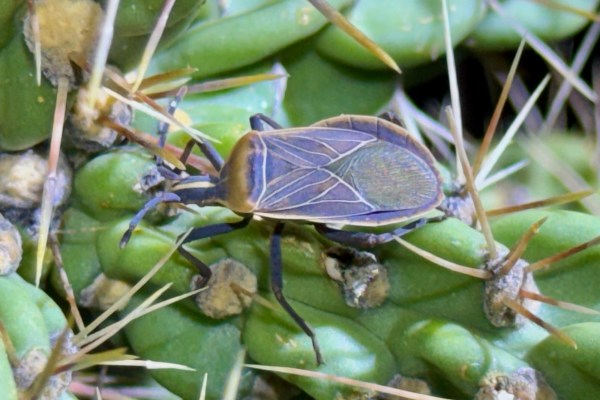
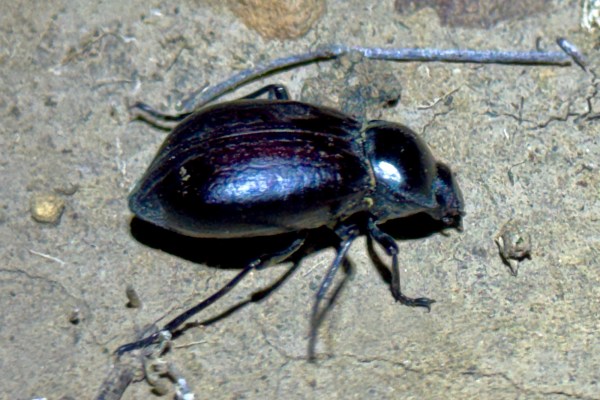
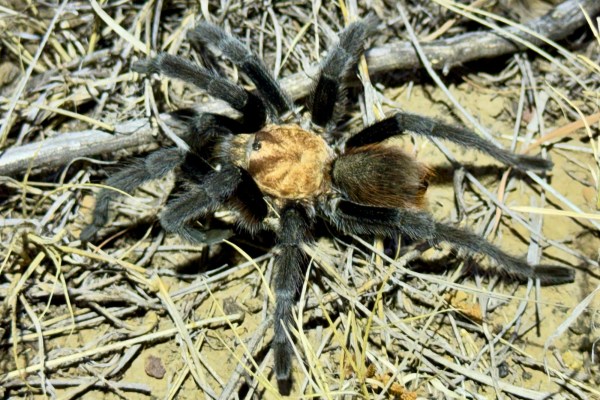
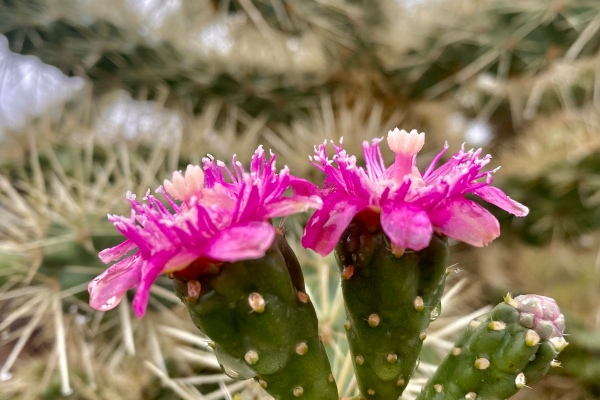
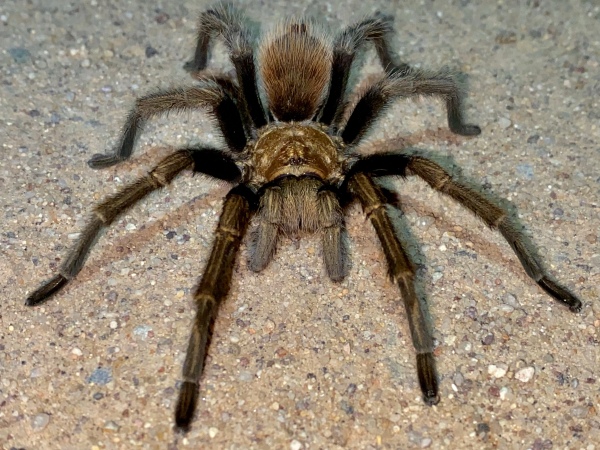
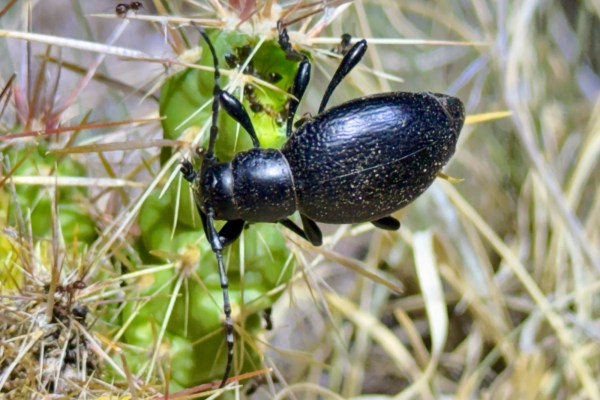
Our goal for Day 1 was to make it to Black Mesa State Park in the far northwestern corner of Oklahoma’s northwestern-most county (Cimarron Co.) before dark. We didn’t quite make it (it’s a +12-hour drive from St. Louis), but our car headlights allowed us to set up camp before making dinner and hanging a couple of Entoquip Entrap™ lantern kits. Expectations were low given the lateness of the season for this area, but the lantern traps are quick and easy to set up. I did collect a few miscellaneous beetles at the lights—the most colorful being Pyrota concinna (family Meloidae), but of greater interest were insects seen while scanning the juniper chaparral landscape around the campsite. These included Moneilema armatum (family Cerambycidae) and Chelinidea vittiger (cactus coreid bug—family Coreidae) on Cylindropuntia imbricata (cane cholla), Stenomorpha convexa (darkling beetle—family Tenebrionidae), and Aphonopelma hentzi (Texas brown tarantula—family Aphonopelmidae).
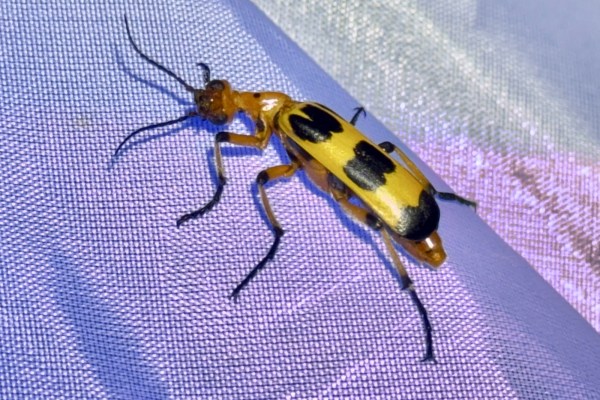
Pyrota concinna at ultraviolet light.
Moneilema armatum on Cylindropuntia imbricata (cane cholla).
Chelinidea vittiger (cactus coreid bug) on Cylindropuntia imbricata (cane cholla).
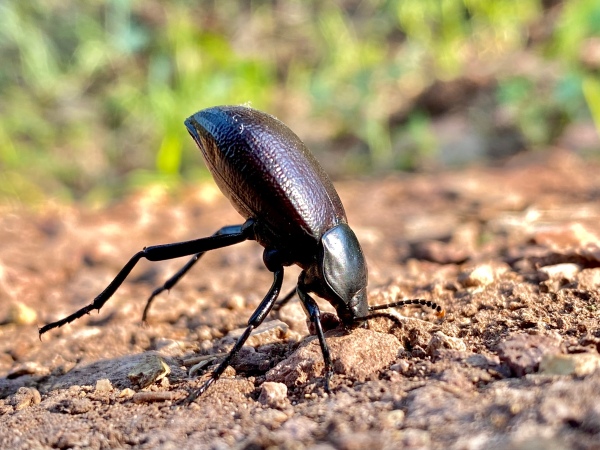
Stenomorpha convexa in juniper chaparral at night.
Aphonopelma hentzi (Texas brown tarantula) in juniper chaparral at night.

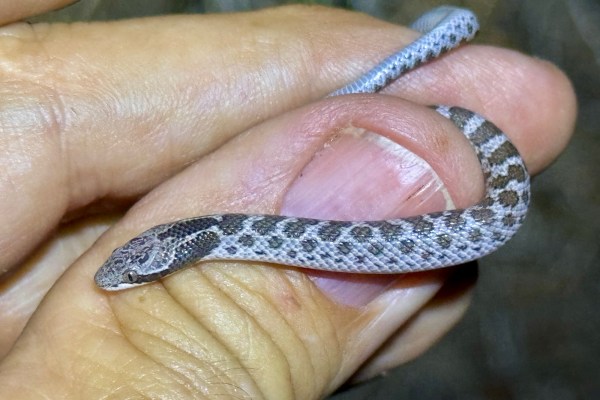
I even took the time to document a couple of vertebrates that posed (willingly or unwillingly) for photos—a non-native Eurasian collared dove (Streptopelia decaocto—family Columbidae) and a native Texas nightsnake (Hypsiglena jani ssp. texana—family Colubridae)—before retiring for the night.
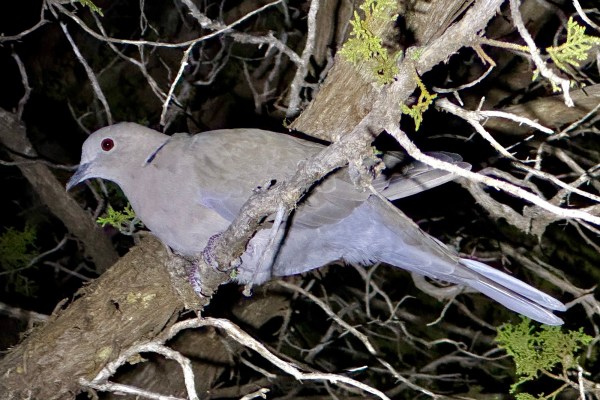
Eurasian collared dove (Streptopelia decaocto).
Texas nightsnake (Hypsiglena jani ssp. texana).

Day 2—Aug 23rd

Despite facing another solid day of travel to reach our first target collection locality (Organ Mountains-Desert Peaks National Monument in south-central New Mexico), I could not leave the area without showing Jason the sandstone escarpment just east of nearby Kenton (Oklahoma’s westernmost town). The pinyon/juniper/oak woodland on the escarpment has, over the last 15 years, been a bonanza of interesting beetles, including numerous new state records of species more typically found in the Rocky Mountain foothills biotic zone further west. Again, the lateness of the season tempered our expectations, but late-season Acmaeodera spp. (family Buprestidae) on fall-blooming asters remained a possibility. We started out by beating the two oak species found in the area—Quercus × undulata (wavyleaf oak) and Quercus mohriana (Mohr’s oak), and it wasn’t long before Jason noticed larval mines of Brachys sp. (family Buprestidae) on leaves of the former. I have collected adults of Brachys barberi on these very same oaks in previous years during the spring, so surely that is the species responsible for the mines. To this point, the species has only been associated with Quercus havardii (shinnery oak), so our efforts immediately turned to collecting infested leaves. It took a couple of hours, but ultimately we ended up with nearly two dozen leaves, which I placed in containers kept in a cooler. Back home, they will be set up in rearing containers so that voucher specimens can be obtained to document the new larval host.
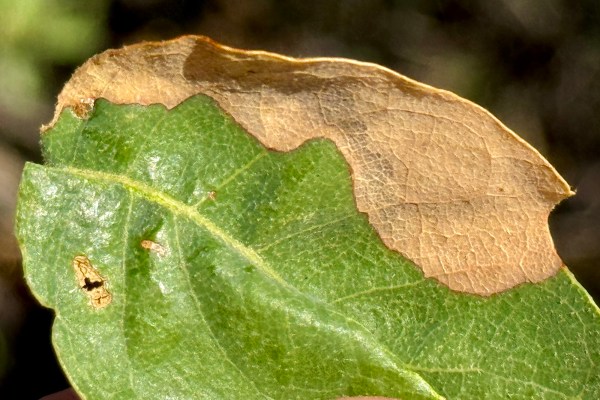
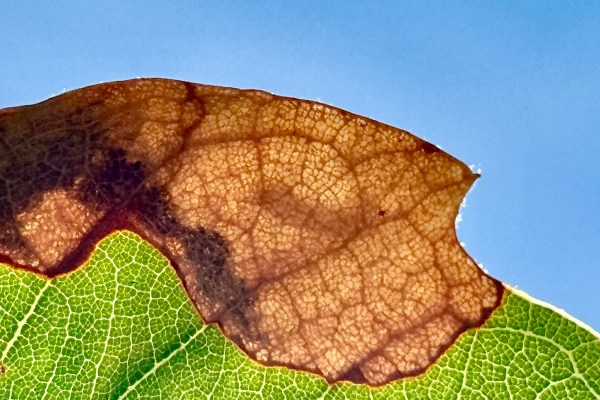
Larval leaf mine of Brachys barberi on Quercus × undulata (wavyleaf oak).
Brachys barberi larva inside leaf mine on Quercus × undulata (wavyleaf oak).

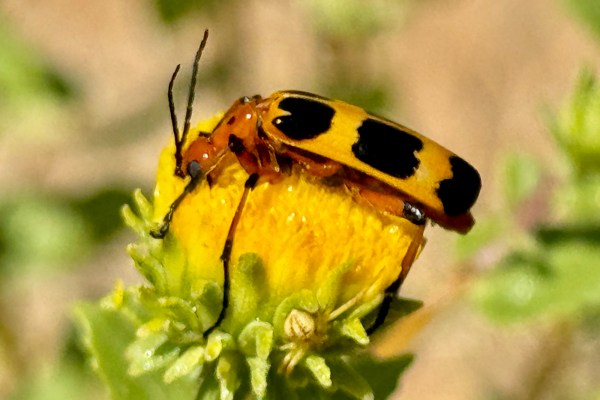
Not too many other insects of interest were seen, but beating Neltuma glandulosa (honey mesquite) yielded Stictipelta marmorata (family Membracidae), another Pyrota concinna was found on the flower of Grindelia nuda (curlytop gumweed), and another lone Cicindelidia punctulata chiricahuae (Chihuahua tiger beetle—family Cicindelidae) was found flitting along the 2-track.
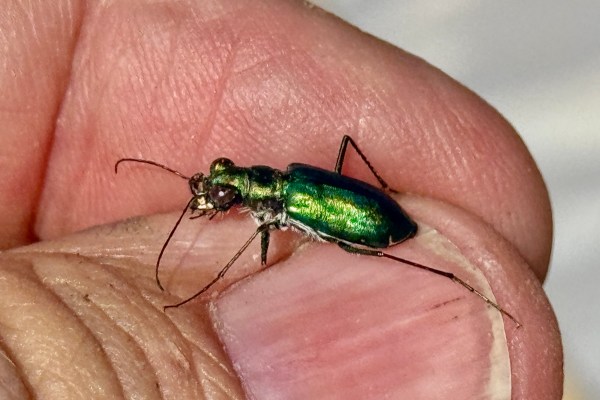
Cicindelidia punctulata ssp. chihuahuae (Chihuahua tiger beetle).
Pyrota concinna (blister beetle) on flower of Grindelia nuda (curlytop gumweed).

The rest of the day was spent driving to Organ Mountains-Desert Peaks National Monument (Doña Ana Co., New Mexico), where I have looked a couple of times for the recently-described Brachys rileyi, associated with Quercus gambelii (Gambel oak) at higher elevations here and a handful of other locations in New Mexico and western Texas. Aguierre Springs Campground was our destination for the evening, where we would camp and use as a base for searching for the beetle the next day. We arrived well after dark, only to find the gate to the campground shut with a sign saying “Closed”. What?! We had just begun debating whether this would be one of those nights that we would instead need to look for a hotel when we saw somebody from the nearby office walking up behind us with a flashlight. It was the campground host, who explained that they were having problems with “troublemakers” taking over the campground. Presumably able to see that we weren’t such people, she told us where we could go to be away from them and their noise, and unlocked the gate for us. She told us to drive slow with the brights on as we drove up the mountainside so the troublemakers would think we were rangers coming up to kick them out and would then hop in their vehicles and come down before we got there. That’s exactly what happened, as a caravan of several cars started down the mountainside just as we got about halfway up. When we got there the place was deserted except for only one other camper, so we were able to have our pick of the campground, set up camp, cook dinner, and run our lights in complete solitude. Only a few miscellaneous beetles were seen, but it was a beautiful evening at one of my favorite campgrounds.
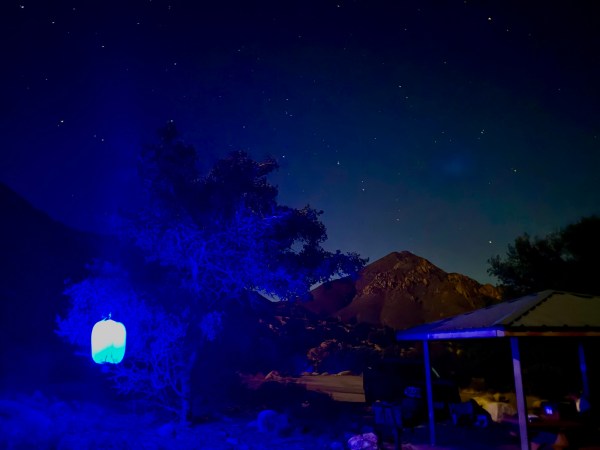
Ultraviolet light in the campground.
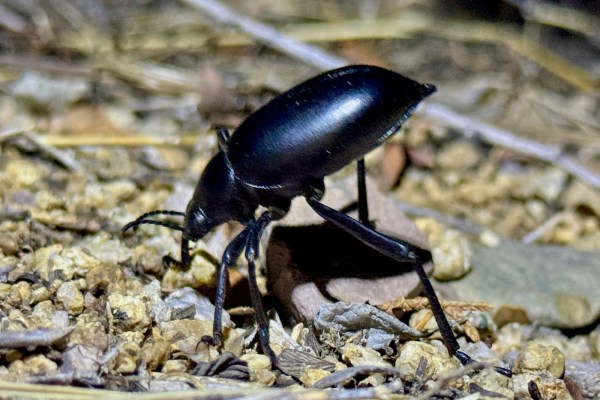
Eleodes spinipes ssp. macrura (family Tenebrionidae) in juniper/oak woodland at night.

Day 3—Aug 24th

Our plan for the day was to hike the Pine Tree Loop Trail, a 5-mile loop that ascends 1000 feet up the northern flank of the Organ Mountains into the Gambel oak/Ponderosa pine zone before dropping back down into the oak/juniper woodland below. I knew it would be a tough hike—in 2022, I hiked a portion of the loop during my first, quick (and unsuccessful) attempt to find Brachys rileyi (I failed to reach the Gambel oak zone before dwindling daylight forced a turn back). Two years later, I hiked the trail in its entirety on another, also unsuccessful attempt to find the species (it rained shortly after I reached the Gambel oak zone). Warm, dry conditions and a full day available made either of those precious scenarios unlikely, so we ascended the mountain full of optimism. Along the way, we saw Acmaeodera rubronotata (family Buprestidae) on the flower of Gutierrezia sarothrae (broom snakeweed) and beat a series of Curculio sp. (family Curculionidae) from Quercus grisea (gray oak). Further up the trail, I found the right elytron of Lampetis sp. (family Buprestidae) on the trail. At first I assumed it was Lampetis drummondii, a species known from Texas north to Kansas, but later I would learn that Lampetis webbii, normally found in Arizona and western New Mexico, also occurs in the same area.
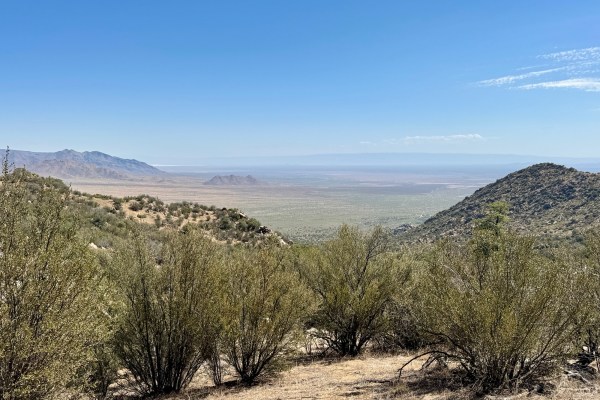
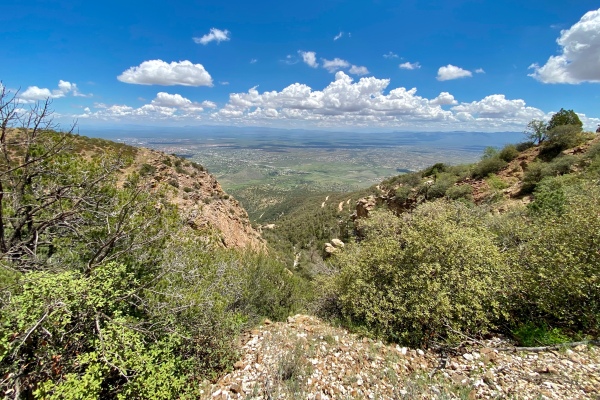
View from Pine Tree Loop Trail.

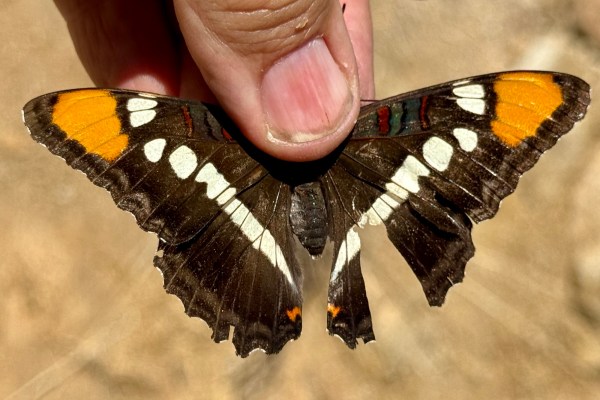
For the most part, few insects were seen until we reached a ravine about halfway up where two Acmaeodera spp. (rubronotata and amplicollis) were found on flowers of Heterotheca fulcrata (rockyscree false goldenaster). Butterflies were seen as well—Callophrys gryneus (olive hairstreak—family Lycaenidae) on H. fulcrata flowers and Adelpha eulalia (Arizona sister—family Nymphalidae) flying rapidly up and down the ravine.
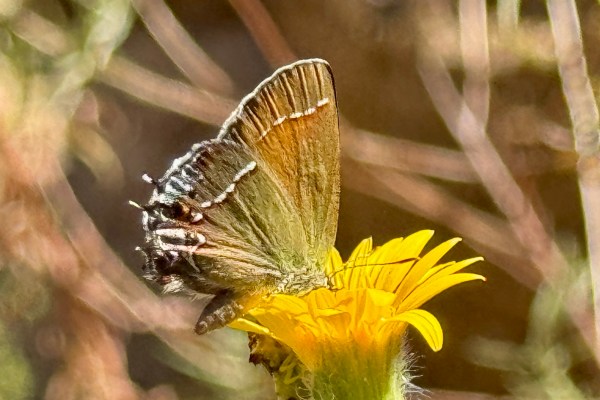
Callophrys gryneus (olive hairstreak) on flower of Heterotheca fulcrata (rockyscree false goldenaster).
Adelpha eulalia (Arizona sister).

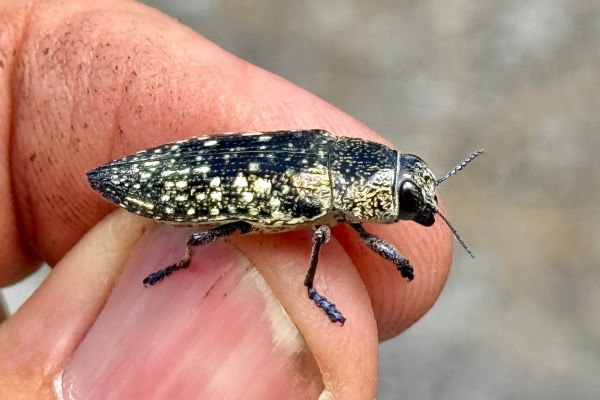
Finally reaching the Gambel oak zone, we began beating trees systematically, hopefully inspecting the dislodged insects each time hoping to see B. rileyi. While we waited for it to finally land on our sheets, I picked up a smattering of other interesting insects beaten from the oaks—two species of treehopper (Telemonthe sp. and Platycotis vittata), a couple of leaf beetles (Pachybrachis sp. and a hispine tortoise beetle—family Chrysomelidae), and a different species of weevil (family Curculionidae). By far the most exciting insect beaten from the oaks, however, was a Lampetis webbii. Again, as I had done earlier when I found the right elytron, I first assumed it was Lampetis drummondii, but the appearance wasn’t quite right and I eventually confirmed its identity as L. webbii—a species I have collected only a couple of times before, both as singletons.
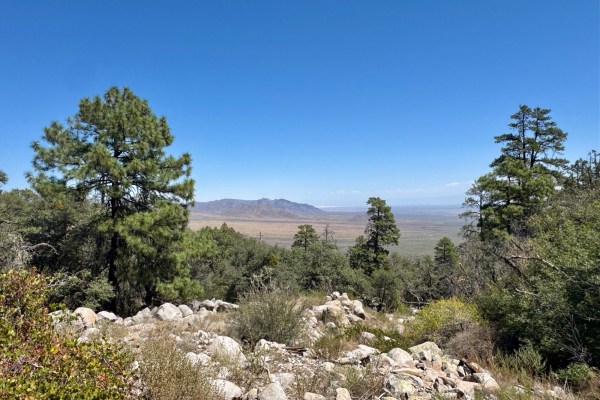
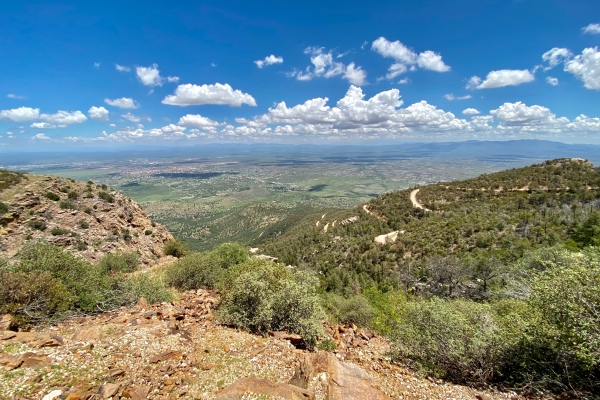
View from higher up along the Pine Tree Loop Trail.
Lampetis webbii (family Buprestidae) beaten from Quercus gambelii (Gambel oak).

Sadly, we reached the end of the Gambel oak zone without having encountered B. rileyi—a disappointing result considering the time and effort we’d given to this, our first objective for the trip. The heat of the day and low supplies of water added insult to injury for the descent back down the mountain, which seemed to take forever!
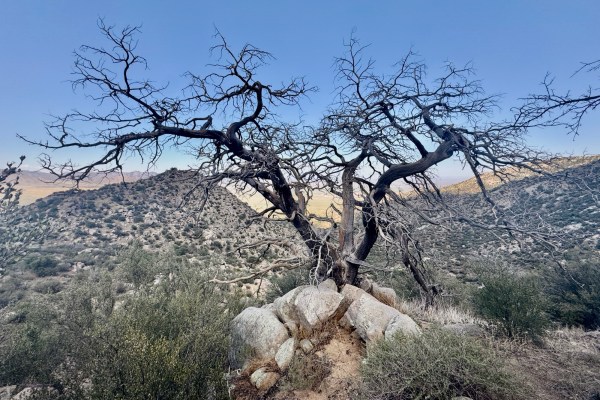
Juniperus deppeana (alligator juniper—family Cupressaceae) cadaver.
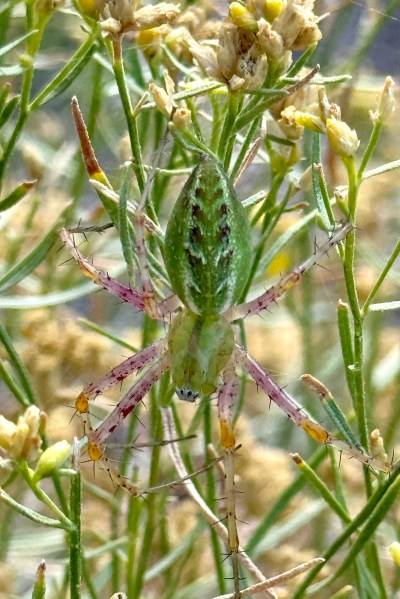
Peucetia viridans (green lynx spider—family Oxyopidae).

By the time we got back to camp, all we could think about was going into town to restock on ice and get some very cold drinks!


Day 4—Aug 25th

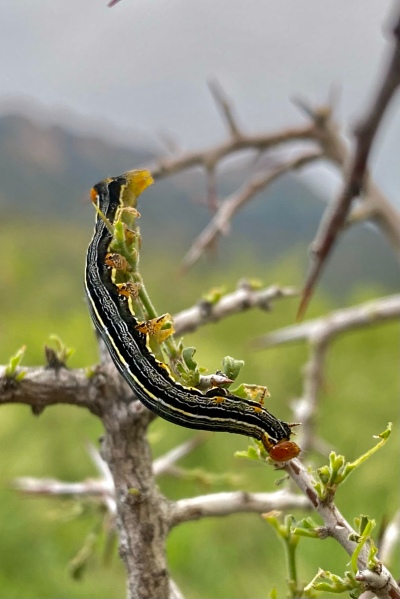
Our original plan was to travel from the Organ Mountains to the Peloncillo Mountains in southwestern New Mexico and Chiricahua Mountains in southeastern Arizona to look for several buprestid beetle species before continuing further west to hook up with Steve and Norm. First, however, we decided to devote another day to our search for Brachys rileyi, this time at Hop Canyon in the Magdalena Mountains of west-central New Mexico. One of the paratypes was collected there, and also at this time of season, giving us reason to believe that we still had a shot at finding the species. We reached the spot in the early afternoon and immediately began sampling in the Gambel oak zone at ~6000ft elevation (I opted for my long-handled tropical net in order to reach high into the canopy) in hopes of finding the tiny little red and blue beetle of our desires. Predictably, this would not happen, and in fact few insects at all were seen—my take being limited to a few Grandolobus grandis (family Membracidae) and some miscellaneous curculionids and other tiny beetles, though I did encounter the very interesting, forked-tail caterpillar of Macrurocampa dorothea (family Notodontidae).
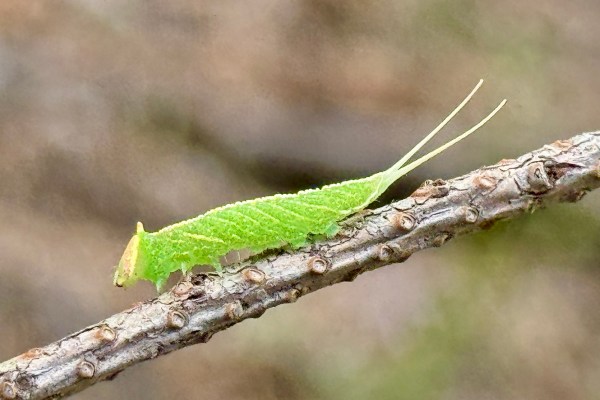
Macrurocampa dorothea caterpillar on Quercus gambelii (Gambel oak).

Despite the general scarcity of insects encountered on the oaks, several species of Acmaeodera were encountered on the variety of blooming plants that were present. Acmaeodera decipiens was the most common, with adults found on flowers of Machaeranthera tanacetifolia (Tahoka daisy), Solidago wrightii (Wright’s goldenrod), and Sphaeralcea fendleri (Fendler’s globemallow).
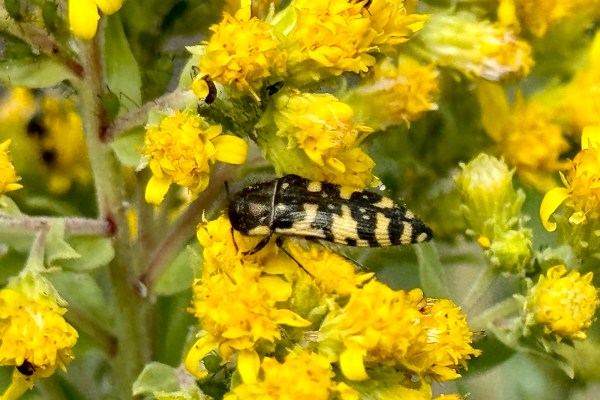
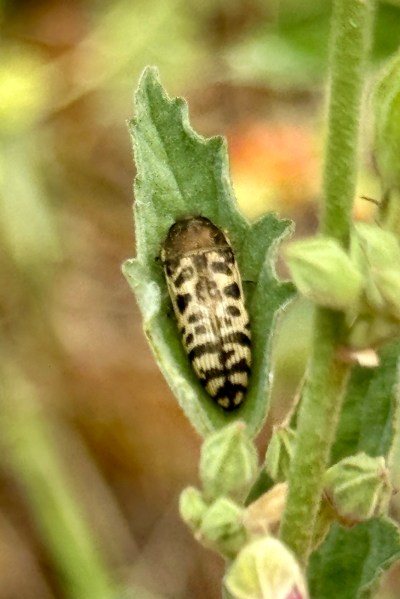
Acmaeodera decipiens on flowers of Solidago wrightii (Wright’s goldenrod).
Acmaeodera decipiens perched on foliage of Sphaeralcea fendleri (Fendler’s globemallow).

Two other species also were seen, though in lower numbers—A. rubronotata on flowers of S. wrightii and Gutierrezia sarothrae (broom snakeweed), and A. amabilis on flowers of the latter.
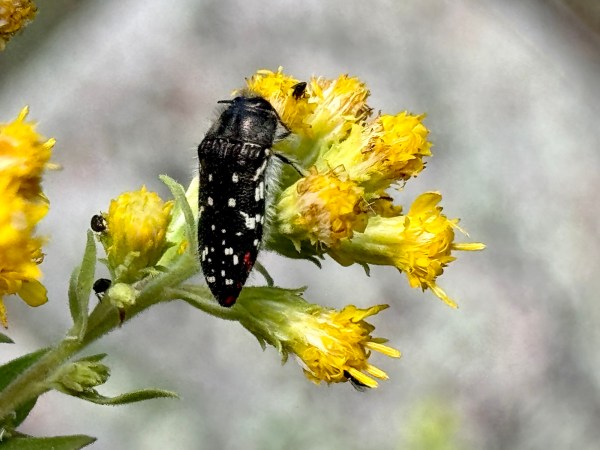
Acmaeodera rubronotata on flowers of Solidago wrightii (Wright’s goldenrod).

After devoting a second day to looking for (and not finding) Brachys rileyi, we resigned ourselves to admitting defeat and moving on to other targets. There wasn’t much time left in the day, however, to move further west, so we decided to camp at Water Canyon Campground a bit further south in the Magdalena Mountains. We still had a fair bit of daylight after arrived and before we needed to think about dinner, so after getting the camp set up I took a short walk around the campground to see what I could find. At the campground entrance I noticed a fine Tylosis maculata (family Cerambycidae) bedded down for the evening on the leaf of Sphaeralcea sp. He cooperated for some photos, and later I found another smaller individual in a nearby patch of plants. Nearby an Acmaeodera amplicollis was perched on grasses, as were two Crossidius pulchellus (family Cerambycidae) on the flowers of Gutierrezia sarothrae.
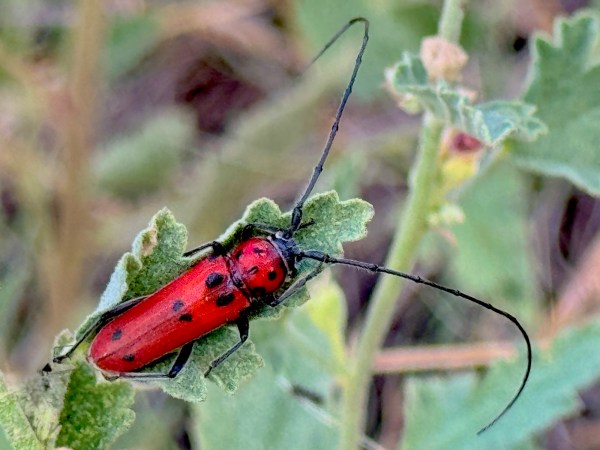
Tylosis maculatus perched on Sphaeralcea sp. (globemallow).
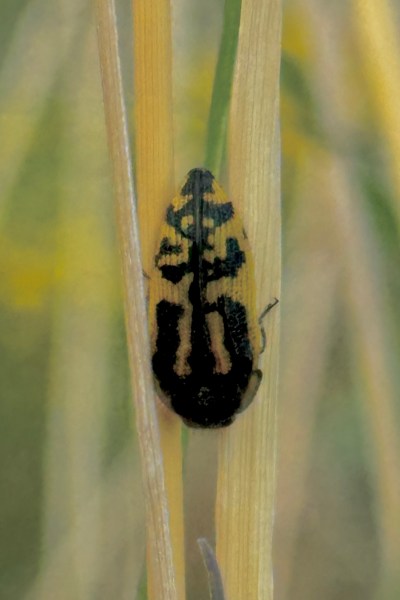
Acmaeodera scalaris perched on grass.

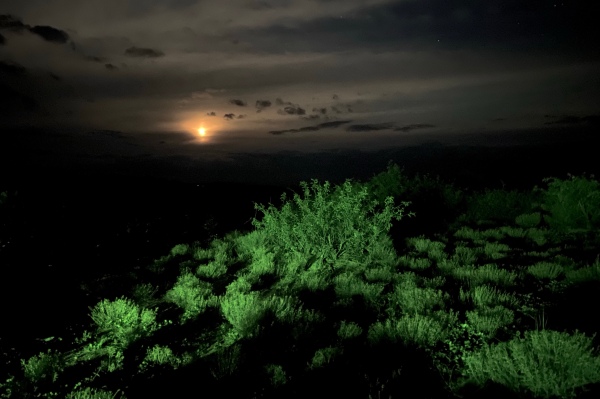
After dinner I hung two ultraviolet lights—one in the campsite and one across the road. From the former I got a few tiny tenebrionoid beetles, one bostrichid, and an anthribid weevil, while from the latter I got one ochodaeid and a few other small miscellaneous beetles. Checking tree trunks was more fruitful, with my good friend Zopherus concolor (family Zopheridae) on the trunk of a dead Pinus edulis and brought him back to the campsite for photos in the morning (he remained in a thanatotic state the entire time I carried him!). I shut the lights down shortly after 11 pm as the nearly full moon rose high, brightly illuminating the nighttime forest.
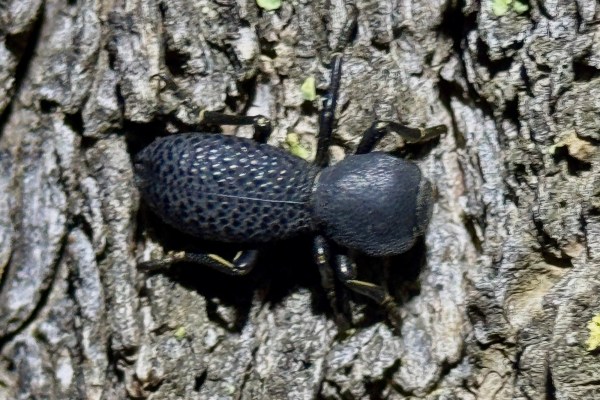
Zopherus unicolor on trunk of Pinus edulis (Colorado pinyon pine) at night.

Day 5—Aug 26th

Our destination for the day was a spot along Geronimo Trail near the Arizona/New Mexico state line in the Peloncillo Mountains, where last year in late August Joel Dubois collected a single specimen of the super rare Acmaeodera discalis in a bottle trap (along with ~100 A. cazieri!). I’ve never seen that species, nor have I ever explored the Peloncillo Mountains, so my plan was to set a couple of bottle traps in the area to leave in place for the rest of our trip and pick them up on the way back. Geronimo Trail is extraordinarily remote—nearly an hour beyond the tiny, near-ghost town of Animas—along increasingly rough, rocky roads. After what seemed like all day (in fact, it was about six hours of travel), we arrived at the spot—an unpresuming stretch of grassland at ~5000ft elevation with a ribbon of oak/juniper woodland running along the hillside to the south and a dry creekbed running alongside the north. I set one bottle trap near the creekbed, then hiked up the hillside well into the woodland to set another. I also hung a “jug trap” baited with 50:50 sweet red wine/pure ethanol near each bottle trap in hopes of catching some interesting cerambycids. Sadly, the area was extremely dry, and there was virtually no insect activity that we could discern, so rather than finding a place to camp in the area went continued on to our next destination—the Chiricahua Mountains just across the state line in Arizona.
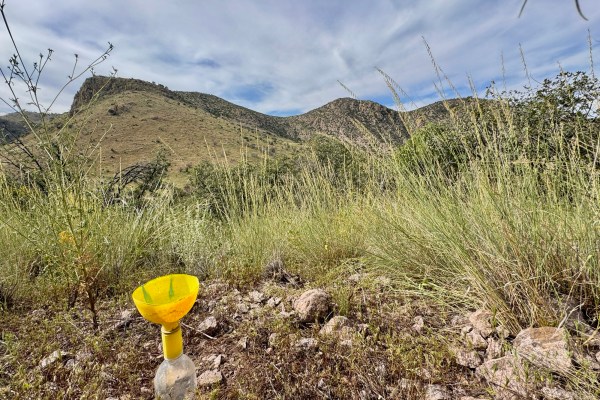
Yellow bottle trap placed in the Peloncillo Mountains.

I’ve visited the Chiricahua Mountains many times over the years going back to my first visit in 1987. There were three species I wanted to look for here—Sphaerobothris ulkei (family Buprestidae) in the desert flats below Portal, an undescribed longhorned beetle in Cave Creek Canyon, and Acmaeodera reflexa at higher elevations in the mountains. I’ve collected the first and second on previous visits (though sparingly), but I’ve never collected the latter (nor have many others), which was reportedly collected along Rd 42 at ~6000ft by the late Delbert LaRue back in 2015 (Westcott & LaRue 2017). Both of these species, however, would have to wait until tomorrow, as it was well into the evening hours by the time we arrived at Sunny Flat Campground in Cave Creek Canyon. This would be the first evening that we would set up not only the quick-and-easy Entoquip Entrap Lantern Kits but also the full-sized Entoquip Entoceptor™ stand with both ultraviolet lights and a 175-watt mercury vapor light.
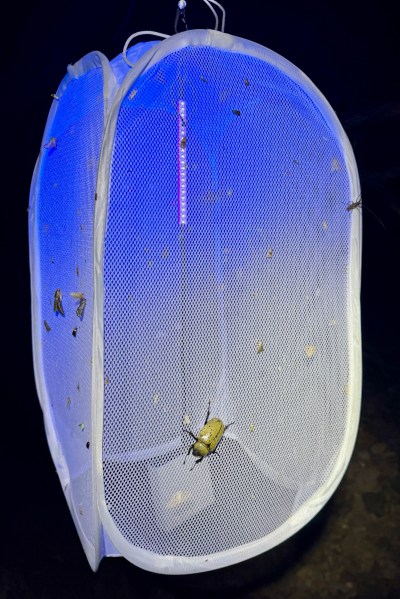
Charismatic beetle species at an Entoquip Entrap Lantern Kit.

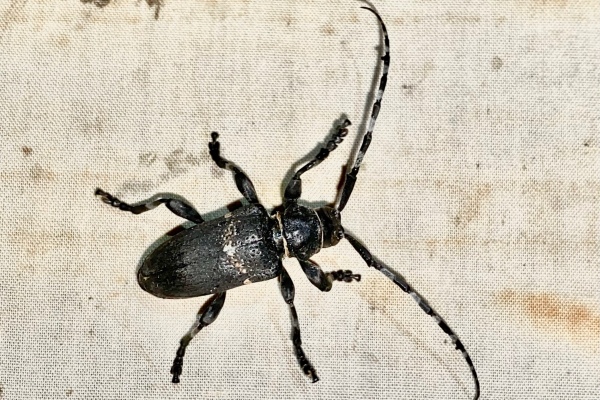
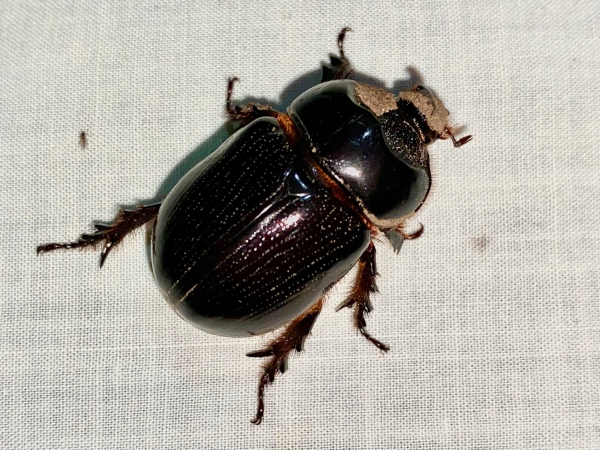
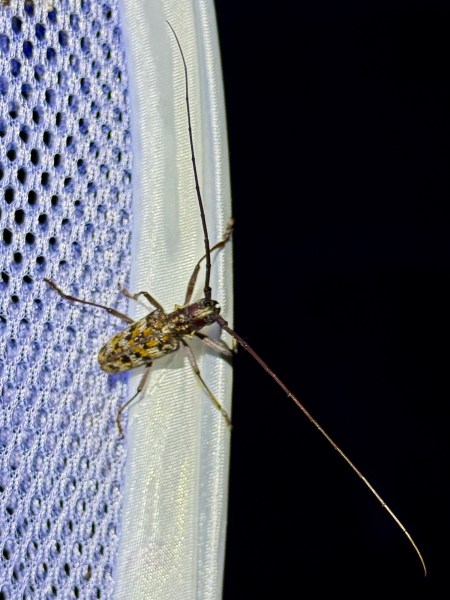
Almost immediately, some rather charismatic beetle species showed up at the lantern kits. These included a large female Dynastes grantii (western Hercules beetle—family Scarbaeidae) and a large male Monochamus clamator ssp. rubigineus (spotted pine sawyer—family Cerambycidae).
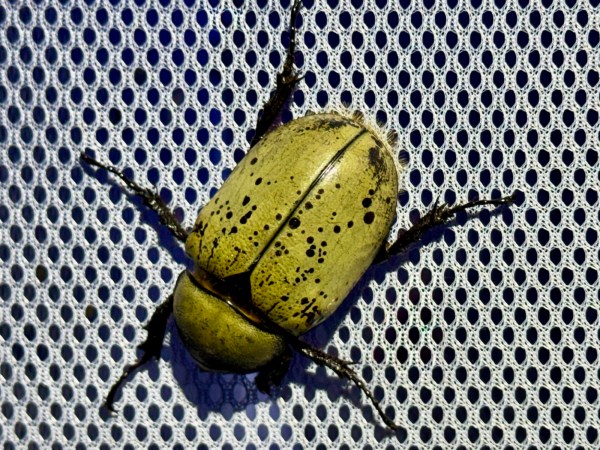
Dynastes grantii (western Hercules beetle).
Monochamus clamator ssp. rubigineus (spotted pine sawyer).

A little bit later another large longhorned beetle (Enaphalodes niveitectus—family Cerambycidae) showed up at the other lantern kit. Both lantern kits also attracted a variety of other miscellaneous smaller beetles.
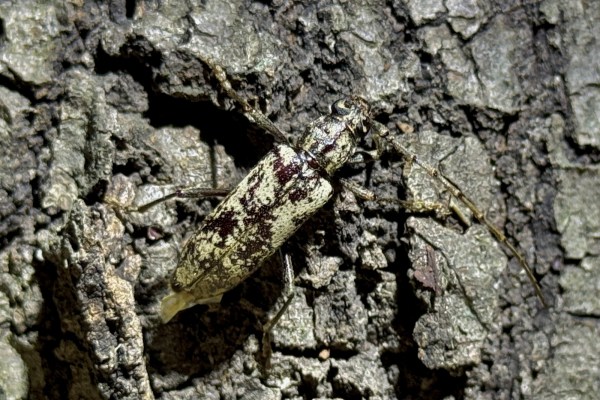
Enaphalodes niceitectus on tree trunk near ultraviolet light.

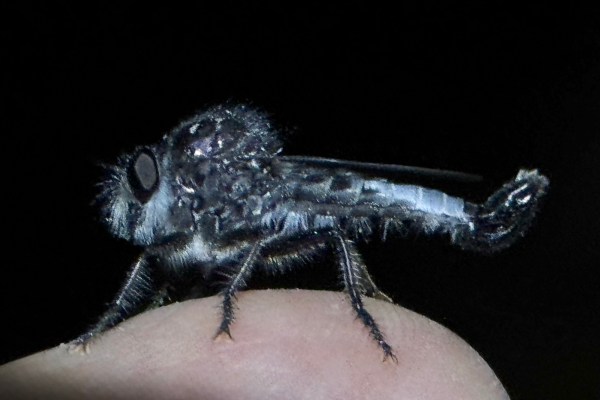
The appearance of such charismatic beetles as Dynastes and Monochamus at the lantern kits gave us hope that the full-sized stand with ultraviolet and mercury vapor lights would pull in even more such species, but other beetles were limited to a single Sternidius sp. (family Cerambycidae) and a few other miscellaneous species. Robber flies (family Asilidae), however, were nicely represented by Promachus atrox and Efferia sp.
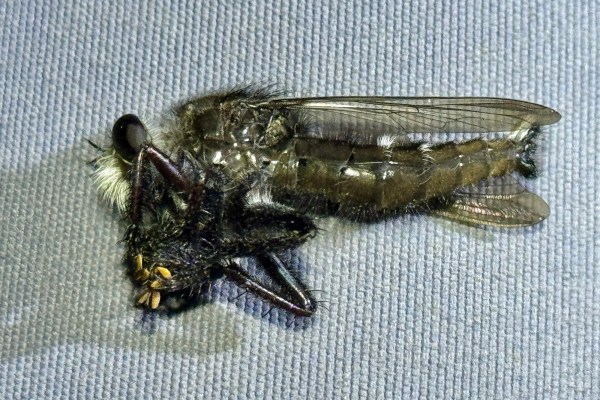
Promachus atrox (chocolate lion fly) at ultraviolet/mercury vapor lights.
Efferia sp. at ultraviolet/mercury vapor lights.

Day 6—Aug 25th

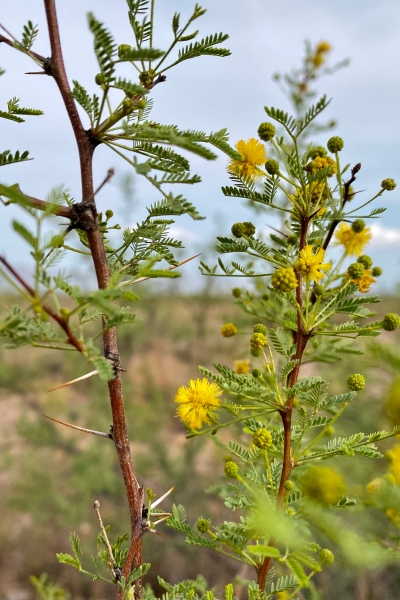
Since we had two targets for the day—Sphaerobothris ulkei in the desert flats below Portal and Acmaeodera reflexa in the higher elevations, we decided to hunt for the former before the heat of the day set in, then retire to the cool mountain air to look for the latter. I’ve collected in the flats below Portal three times before and have only three specimens of S. ulkei to show for it. I’ve never seen the species anywhere else (although I did once find a detached elytron near White Sands, New Mexico), so this seems as good a place as any to look for it. On most of my previous visits here, Gyascutus caelatus and Hippomelas sphenicus (both family Buprestidae) have been quite abundant on Vachellia constricta (whitethorn acacia), and it was the same this time as well. These large, conspicuous, charismatic buprestids are fun to chase and catch, but they can fill a bottle quickly and distract one from spending time looking for more secretive and uncommon species like S. ulkei.
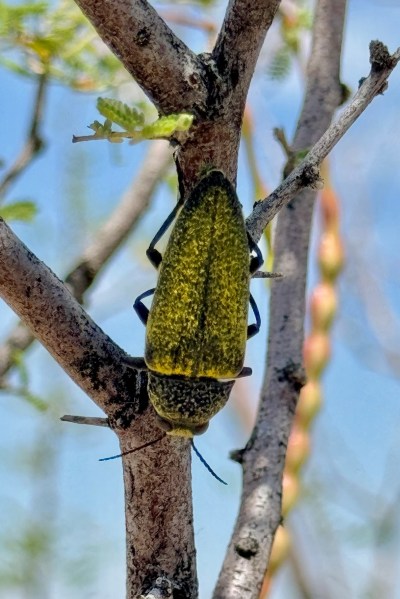
Gyascutus caelatus on Vachiella constricta (whitethorn acacia).

Still, it was hard to resist the siren call of adding at least a few more individuals of these charismatic species to my collection—better to eliminate temptation than to constantly fight it, so I went ahead and collected a small series of each. I’m glad I did, as while I was doing this I also encountered not only a few Acmaeodera gibbula on the flowers and dead branch tips, but also Chrysobothris knulli (family Buprestidae), a fairly uncommon species that I have seen only once before. I then set about systematically checking the Ephedra trifurca (longleaf jointfir) plants in the area. As I checked the plants, I noticed several H. sphenicus that seemed to be ovipositing at the joints of some of the plants (or at least probing with their ovipositor). Whether this indicates a larval host association remains to be seen.
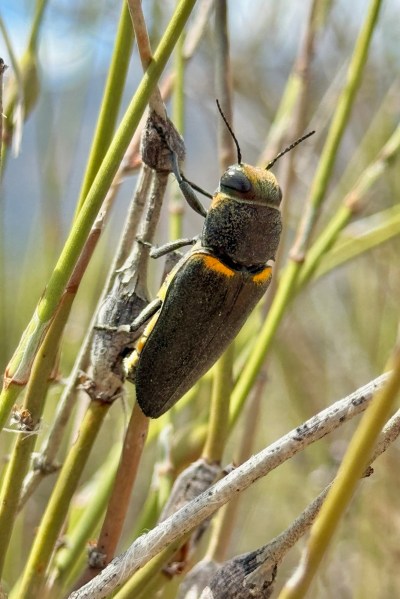
Hippomelas sphenicus ovipositing?/probing? on Ephedra trifurca (longleaf jointfir).

I continued to check the E. trifurca plants… and check… and check… and after nearly two hours and nearing the vehicle I was about ready to throw in the towel when I saw one! Despite its brilliant blue-green coloration, I don’t think I would have seen it had I not been able to recognize the tiny glimpse of its unique color perched deep within the plant.
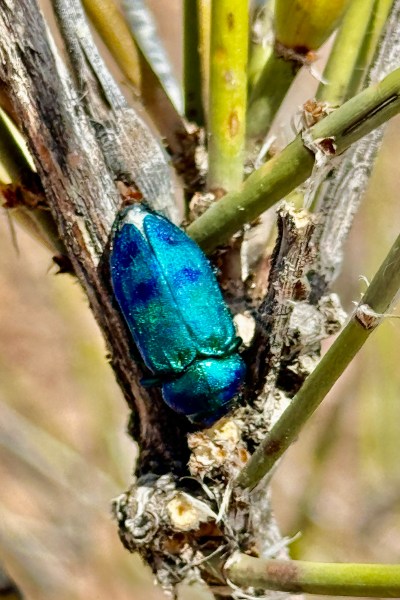
Sphaerobothris ulkei on Ephedra furcata (longleaf jointfir).

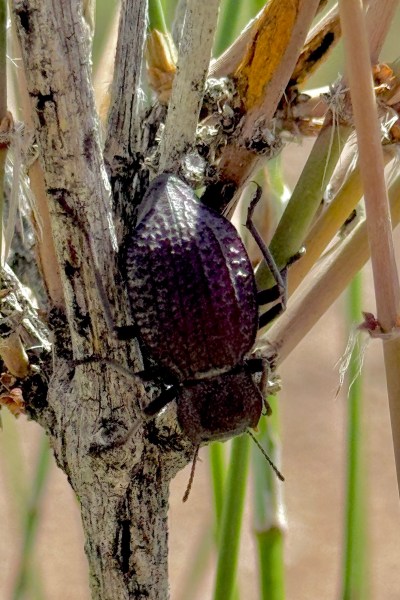
Finding one gave me renewed motivation to look for others. As I looked, I encountered a few other interesting insects, including Acmaeodera parkeri at the tip of a dead branch, the absurdly chunky and aposematically colored blister beetle (family Meloidae) Megatra punctata, and two species of darkling beetle (family Tenebrionidae)—the robust, tank-like Philolithus morbillosus, and numerous individuals of a relatively diminutive Cteisa sp.
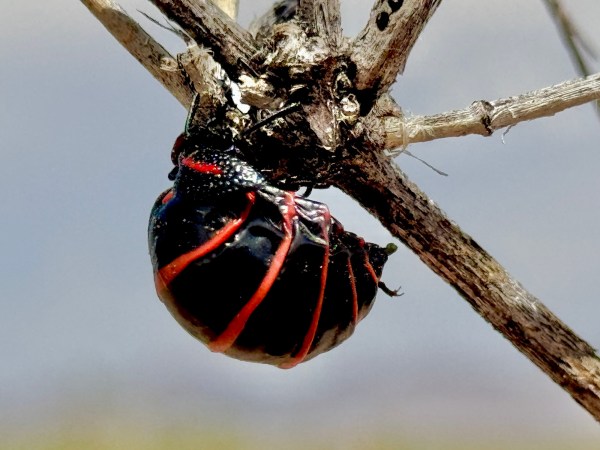
Megetra punctata on Ephedra furcata (longleaf jointfir).
Philolithus morbillosus on Ephedra furcata (longleaf jointfir).
Cteisa sp. on Ephedra trifurca (longleaf jointfir).

Certainly the most conspicuous insect seen during the day was the dazzlingly—and, like M. punctata, aposematically—colored Dactylotum bicolor (rainbow grasshopper—family Acrididae).
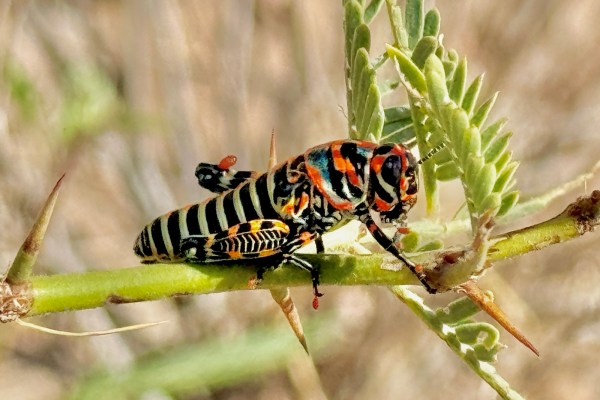
Dactylotum bicolor (rainbow grasshopper) on Neltuma glandulosa (honey mesquite).

It would take another hour, but I finally saw a second S. ulkei, but I failed to anticipate just how skittish this individual was and failed in my efforts to secure the specimen—damn! Spending three hours and catching only one of two individuals seemed like a costly effort for such a meager payout, but—of course—one is better than none. It wasn’t lack of desire to continue searching, however, that caused us to give up the hunt, but rather the developing rain storm that we had been watching bloom over the nearby Chiricahuas. For a short time, it manifested only as a pickup of gusty winds, but eventually we started getting pelted with large raindrops and headed for the truck.
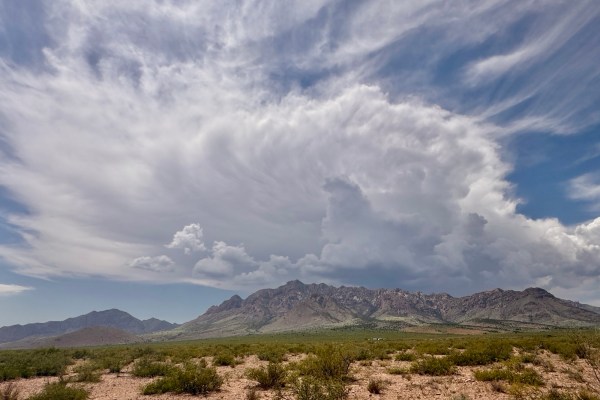
Rain clouds brewing over the Chiricahua Mountains.

Steam rose from the newly wet pavement as we drove towards the mountains. Jason and I saw it almost simultaneously and recognized it almost instantly—the unmistakable form of a Gila monster crossing the road. Neither of us had ever seen a Gila monster in the wild, but with its sausage-shape body, heavy head, and four stubby legs covered with a mottled pink and black skin what else could it be?! We quick pulled over, got out, and ran back to the spot where it had left the road (not easy with my gimpy knees!). At first we had trouble locating it in the heavy brush, but I knew for sure it had entered at that spot and that it could not have moved far from it. Shortly we found it and used a net to “coax” it back out into the road so we could get some photos of it. I’ve long wanted to see a Gila monster for myself, so this was a highlight of the trip.
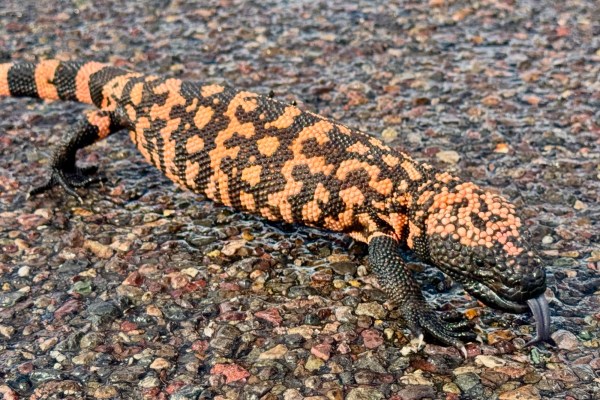
Gila monster (Heloderma suspectum—family Helidermatidae) crossing road after afternoon thunderstorm.

We were fortunate that the rains that moved through the lower elevations in the Chiricahua Mountains had missed the higher elevations, as that could have put an early end to our efforts to find our other target for the day—Acmaeodera reflexa. To the contrary, when we arrived at the spot things were dry and flowers were present in abundance, many of which are perfectly acceptable to species of Acmaeodera. Almost immediately we began finding A. amplicollis and A. decipiens, the former on flowers of Heliomeris multiflora (showy goldeneye), and the latter on the same as well as flowers of Ipomopsis macombii (Macomb’s skyrocket), Cirsium sp. (thistle), and Erigeron divergens (spreading fleabane). I paid special attention to that latter plant, as the A. reflexa collection record listed “Erigeron sp.” as the host. A large patch of this plant in full bloom was found about ¼-mile from where we parked, and since I did not see the plant anywhere else I imagine this must be the exact spot where the beetle had been collected. Unfortunately, we did not find it here or in any of the several other flowering plants at that location. This is often the case when looking for rare species based on a prior record—even finding the exact spot at the same time of season does not guarantee that the species will be encountered.
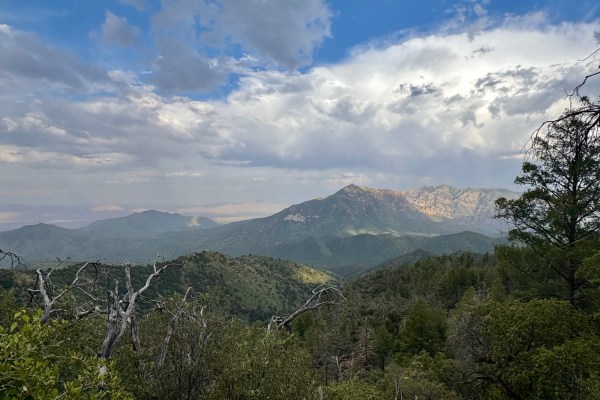
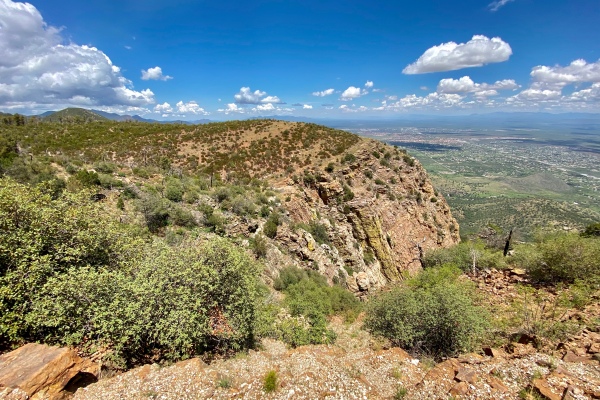
View across the Chiricahua Mountains from Rd 42 at ~6000ft.

Although we lucked out avoiding the rain at our last stop, our campsite was not so lucky. We had neglected to put the rain fly on the tent as a precautionary measure and returned to wet bedding (at least it wasn’t soaked). Worse, we suffered a flat tire on the way down the mountain, meaning that Jason would have to get up early in the morning, drive to Lordsburg over an hour away, and get the tire fixed before we could pack up the truck and head to Steve and Norm’s.


Day 7—Aug 28th

Jason had already left by the time that I got up, so after breakfast (and coffee!) I hiked the riparian woodland along the Cave Creek Canyon Nature Trail with the goal of finding additional specimens of an undescribed longhorned beetle that I discovered along this very trail in 2018. The beetle represents not only a new species but also a new genus in the tribe Acanthocinini and most closely related to Astylopsis. I am working with Patrick Gorring, who subsequently collected a female specimen, but despite the best efforts of several other collectors no additional specimens have been found. The first specimen was collected during late July, so I didn’t have a lot of confidence that a full month later in the season it would still be around, but every opportunity must be taken advantage of. Worse, I collected the specimen during a stint of general sweeping of low woody vegetation, so I had no specific host plant information on which to focus my efforts. In this area, oaks or mimosas are the most likely candidates, so it was those plants on which I focused my efforts. A patch of Mimosa aculeaticarpa (catclaw mimosa) in open conditions at the back of the campground was especially productive for weevils (at least four species) and a clytrine leaf beetle, but I distinctly remember sweeping the longhorned beetle from understory vegetation near Stewart Campground, so I beat oaks and mimosas all the way to that point. Again, no longhorned beetles were seen—in fact, almost no insects at all were seen, save for two lone weevils on Quercus arizonicus (Arizona white oak) and Desmodium batocaulon (San Pedro ticktrefoil). A disappointing result, made even more so after realizing that a day and a half spent looming for three species had resulted in the capture of just a single specimen of one of them.
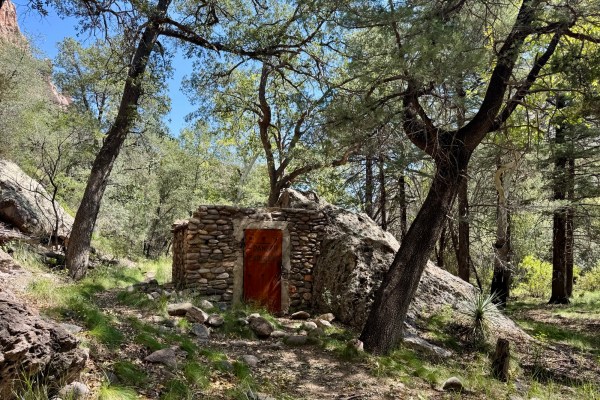
Historic storage bunker on the Cave Creek Canyon Nature Trail (built in the 1930s by the Civilian Conservation Corps).

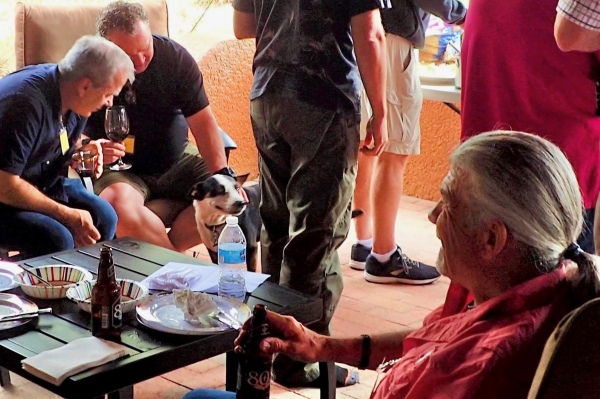
Jason had returned to the campground by the time I got back, so we loaded up the truck and made our way west to the home of Steve and Norm. Nestled in the oak woodlands below the eastern flank of the Huachuca Mountains, they are well located to reach several of the “Sky Islands” mountain ranges of southeastern Arizona. It was great to see them again, and we appreciated not only the wagyu beef dogs they served for dinner (accompanied by a fine 127.4 proof spirit), but also the good conversation and comfortable beds they provided for the night. Bonus: Steve leaves a blacklight permanently running in his yard during the summer, so we each inspected it for beetles of interest before retiring. I chose singletons of Atylostagma politum (family Cerambycidae), Digitonthophagus gazella (family Scarabaeidae), Coenonycha sp. (family Scarabaeidae), and Efferia sp.

Day 8—Aug 29th

For our first day in the area, Norm accompanied us to several spots on Middelmarch Rd leading east of Tombstone toward the Dragoon Mountains. We stopped at a stand of Sapindus drummondii (western soapberry) from which Norm collected the type series of the recently described Agrilus botzi (family Buprestidae). We thoroughly swept the stand but did not find any. Jason collected Gyascutus caelatus and Acmaeodera gibbula on Vachellia constricta, and Norm saw Acmaeodera parkeri. but the spot looked very dry despite good rains in the area in general. It was much the same further down the road in the Dragoon Mountain foothills, where we stopped at a riparian wash through desert scrub. Sweeping/beating the vegetation was fruitless, but I did find an aggregation of Poblicia thanatophana (orange-tailed speckled lanternfly—family Fulgoridae) on Baccharis salicifolia (mule fat).
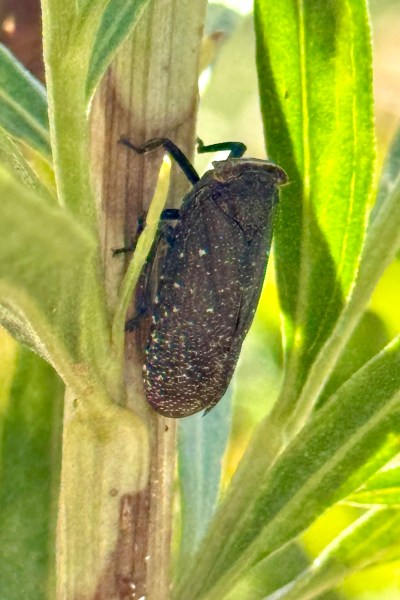
Poblicia thanatophana (orange-tailed speckled lanternfly) on Baccharis salicifolia (mule fat).

We continued down the road until we reach Middlemarch Pass (past the spot where two years ago Norm, Steve, and I collected a nice series of Acmaeodera horni) where the elevation was sufficient to support junipers and oaks in the grassland. Again, conditions remained dry and beating was largely fruitless—with the notable and welcome exception of Lampetis webbii, which I beat from Quercus arizonica. With two specimens now having been collected on the trip, my holdings of this species had doubled! Ironically, despite the very dry conditions, rain moving into the area forced us back to the car for an early exit.
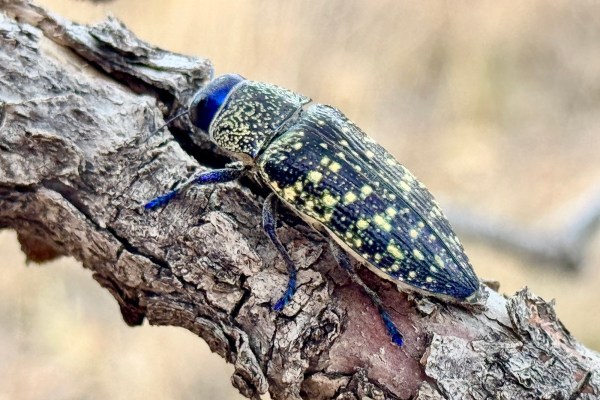
Lampetis webbii (family Buprestidae) on Quercus arizonica (Arizona white oak).

Heading back toward Tombstone, Norm mentioned that he had collected Acmaeodera flavopicta at a spot just east of town and asked us if we’d ever collected it. This is not a rare species, but neither is it very common, and in fact I had not ever encountered it myself, so we stopped at the spot and managed to collect a decent series on flowers of Picradeniopsis absinthifolia (hairyseed bahia). A few specimens of A. opacula and A. scalaris were also found in the same, and the latter was also found on flowers of Baileya multiradiata (desert marigold).

After returning, I decided to do some beating in the riparian oak woodland around their house. Two species of oak occur in this woodland—Quercus arizonica and Quercus oblongifolia (Mexican blue oak), and wanted to see what I might’ve able to find on them. Only a single Zygogramma sp. (family Chrysomelidae) was beaten from the former, but beating branches of the latter proved to be slightly more productive with yet another Lampetis webbii as well as one of the spotted Agrilus sp. and a few other miscellaneous beetles. I also encountered a small patch of Lasianthaea podocephala (San Pedro daisy), the flowers of which yielded a small series of Acmaeodera amplicollis. Finally, I noticed a lot of Calliandra eriophylla (pink fairy-duster) in the sunnier areas of the woodland. This is the host plant for Hippomelas parkeri, and species which I had not collected before but hoped to on this trip, and while I did not expect to find that species at this location, I did manage to sweep a few miscellaneous beetles from it.
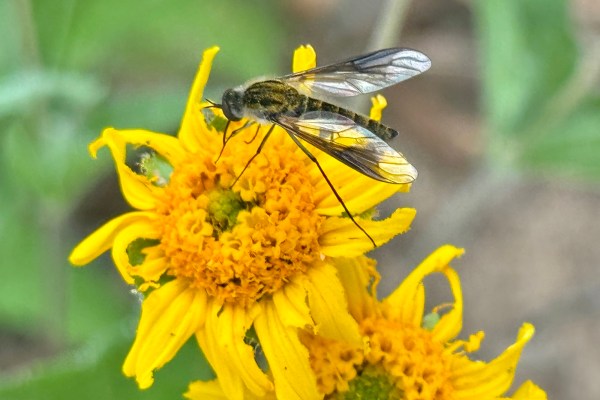
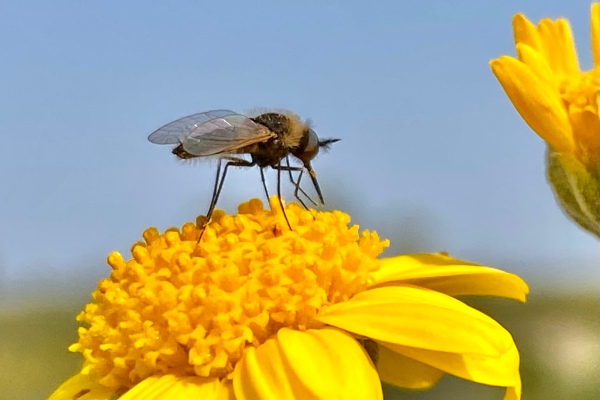
Thevenetimyia sp. (family Bombyliidae) on flower of Lasianthaea podocephala (San Pedro daisy).

The rest of the evening was spent once again enjoying good food, drink, and conversation, and I managed to snag a Strategus sp. (family Scarabaeidae) at the lights before retiring.
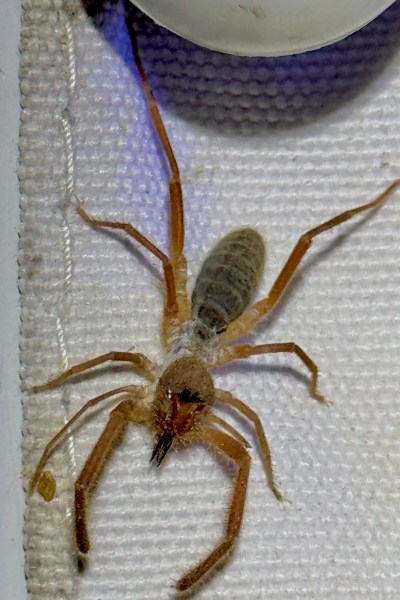
Eremobates sp. (family Eremobatidae) at ultraviolet lights.

Day 9—Aug 30th

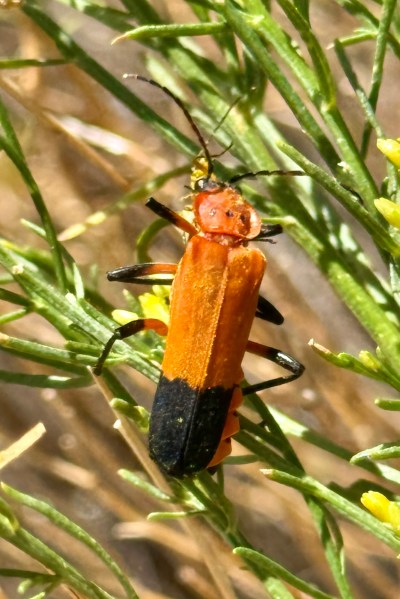
Two of my targets for the trip were Mannophorus forreri (family Cerambycidae) and Hippomelas parkeri. I collected a few individuals of the former below Kitt Peak Observatory in the Quinlan Mountains west of Tucson during mid-September back in 2019, but an effort to collect H. parkeri at the type locality during early August the year before was not successful. Fortunately, Norm has collected this species as well below Kitt Peak in the same general area where M. forreri has been collected, making the Quinlan Mountains an obvious destination for a day-long outing by all four of us. Hippomelas parkeri was my priority, so as soon as we arrived I began checking Calliandra eriophylla plants growing on the rocky slopes along the roadside, but almost immediately I saw a M. forreri on flower of Gutierrezia sarothrae. This shifted my focus to checking other nearby flowers, and I quickly started encountering M. forreri individuals on the flowers of a variety of variety of plants but especially Bebbia juncea (sweetbush), which was blooming profusely along the roadside in the area where we had parked. It didn’t take long for me to collect an adequate series, and along the way I also encountered several species of Acmaeodera (A. decipiens, A. gibbula, A. rubronotata, A. scalaris, A. solitaria)—most on Bebbia juncea but also G. sarothrae, Heterotheca fulciens (rockyscree false goldenaster), and Xanthisma gracile (slender goldenweed). I also encountered the presumed model for M. forreri (Chauliognathus profundus—family Cantharidae).
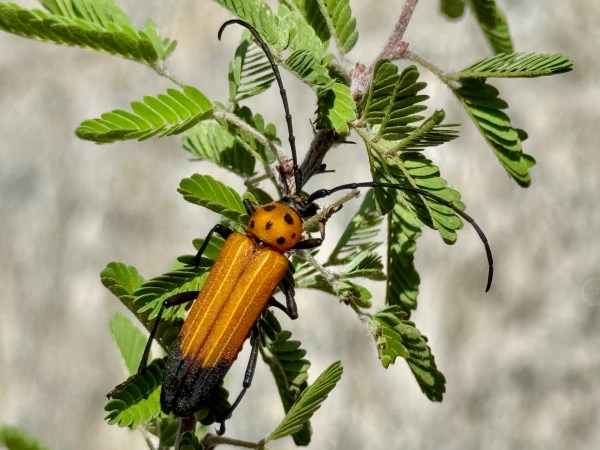
Mannophorus forreri perched on Calliandra eriophylla (pink fairy-duster).
Chauliognathus profundus on flowers of Gutierrezia sarothrae (broom snakeweed).

As pleased as I was with these encounters, I still had not yet encountered H. parkeri—my main objective for the day. I found Norm further up the road, who had already found and collected a small series, so I tagged along with him to learn his “tricks.” It took a while of checking the plants even further up the road, but I finally saw one and carefully maneuvered it into a vial.
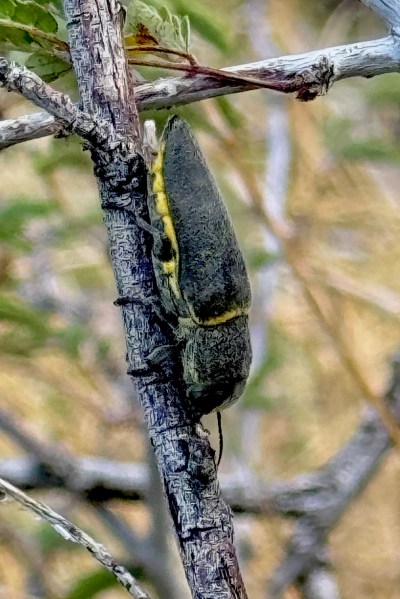
Hippomelas parkeri on Calliandra eriophylla (pink fairy-duster).

It was hard to see as it perched on the stem of the plant down inside the crown (despite its relatively large size compared to most buprestids, though smaller than other species of Hippomelas), so I began looking even more carefully. This didn’t seem to help—I checked many more plants but didn’t encounter additional individuals. I then encountered Jason as he returned from a small area up the road with access to many more plants and where he said he’d had good luck finding them by sweeping, so I borrowed his heavy-duty sweep net (I had only my aerial net) and started sweeping the plants myself. This also didn’t seem to work, and I started worrying that sweeping could actually be missing individuals buried deep with the crown of the plant. I went back to visually checking plants (even though it is a slower process), and it wasn’t long before I found a second individual. Buoyed by this success, I continued and started encountering individuals with regularity—also finding Hippomelas planicauda on Senegalia greggii (catclaw acacia), another species for the trip, and right as I’d collected what I thought was an adequate series the others pulled up in the car with big news…
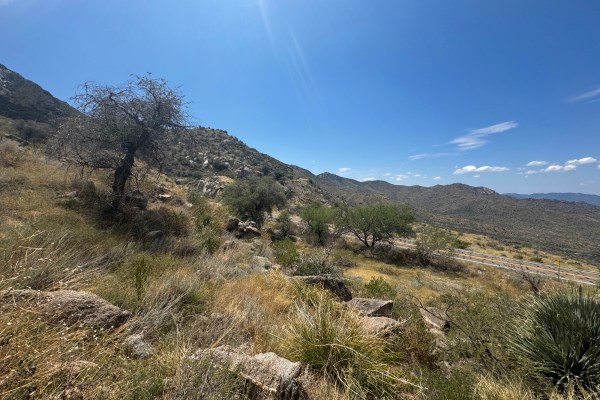
Habitat for Hippomelas parkeri (family Buprestidae).

While Norm, Jason and I were focused on H. parkeri, Steve had walked a considerable distance up the road and encountered a species of longhorned beetle that he’d not previously seen from this area—Muscidora tumacacorii (family Cerambycidae)! Finding this species has been one of my goals for years, but repeated attempts to find it have failed. Steve had noticed several of its known host plant—Guardiola platyphylla (Apache plant), and ended up collected a decent series on plants in the area. He asked me if I’d like to collect it, and my answer was an emphatic “Yes!” We drove the short distance to the spot where he’d first seen them, and within minutes we saw one sitting on one of the plants. Of course, where there is one, there must be more (right?), so we kept checking plants. As often happens, however, further searching did not yield further specimens until we had not only walked far up the road, but then doubled back and walked at down the road. Only then did we see another individual (the one shown below), which I felt safe photographing before maneuvering into a vial.
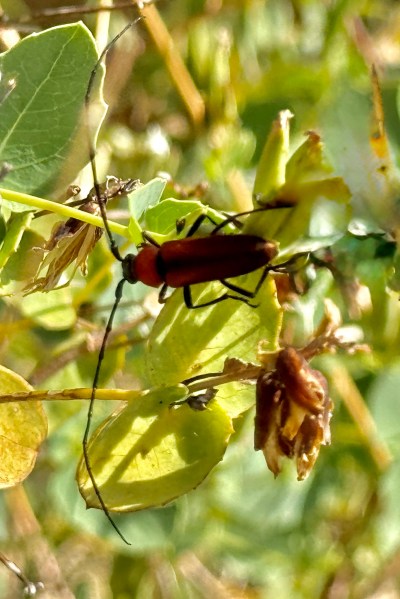
Muscidora tumacacorii on Guardiola platyphylla (Apache plant).

With three target species acquired (one by surprise) and the afternoon waning, we decided to start heading back, but only after checking a spot along the way (southwest of Three Points, Arizona) where Norm has collected Acmaeodera convicta—another species (like A. flavopicta) that is not rare but also is not common and that I have not collected. We found them fairly quickly after arriving at the spot perched on the tips of Boerhavia coulteri (Coulter’s spiderling) along with A. alicia and A. solitaria. Four target species in one day seemed too god to be true, and we all enjoyed a celebratory dinner and margaritas at a Mexican restaurant before returning home and enjoying continued coleopterological conversations for the remainder of the evening.


Day 10—Aug 31st

We awoke to rain—always a possibility during monsoon season in southeastern Arizona. Rain in one place, however, does not mean rain elsewhere, and we had planned to go to Box Canyon in the Santa Rita Mountains to look for Spectralia cuprascens (family Buprestidae). Jason had never collected this species, and I had but a single specimen in my collection to show for several attempts to find it (that specimen also taken in Box Canyon). We hoped for the best as we drove through alternately areas of rain and no rain, but as we approached the spot we were welcomed by a persistent drizzle. Having collected series of the species already, that was enough to cause Norm to opt out and remain in the car. Jason and I, however, were more motivated and moved to adjacent areas on the hillside where patches of the beetle’s host plant, Anisacanthus thurberi (desert honeysuckle) were growing.
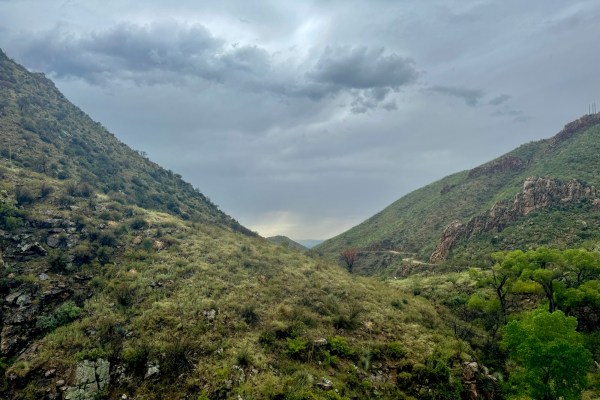
A rainy day over Box Canyon.

Jason opted for his sweeping strategy, while I again chose to more slowly but also more carefully check the plants visually before beating them. I didn’t know it at the time, but in this case Jason’s method would prove to be the better—collecting three specimens in this manner, while I did not collect any. However, I did encounter something else that, unbeknownst to me at the time, would prove to be much more desirable! Its bright green coloration made me think of Chrysobothris prasina, but it was larger with darker markings on the elytra. Normally wasn’t fooled at all—when I returned to the car and showed it to him, he immediately identified it as Chrysobothris socialis—a very uncommonly encountered species that I had not only never collected but never even seen in a collection. There were a few other captures—Sphaenothecus bivittatus (family Cerambycidae) and a few epitragine tenebrionids were beaten from A. thurberi, epitragines also on flowers of Ferocactus wislizenii (fishhook barrel cactus), and Hippomelas planicauda on stems of Mimosa dysocarpa (velvetpod mimosa). Enormous lubber grasshoppers (family Romaleidae)—both Romalea eques (horse lubber grasshopper) and Brachystola magna (plains lubber grasshopper)—didn’t seem to mind the rain!
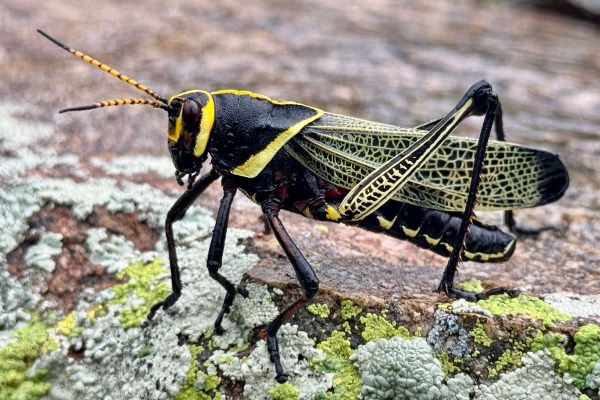
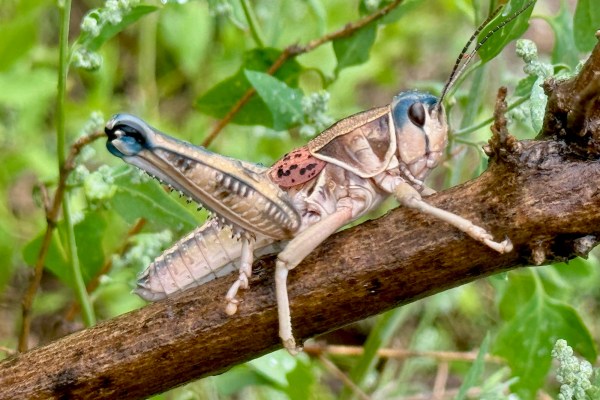
Romalea eques (horse lubber grasshopper.
Brachystola magna (plains lubber grasshopper).

As happy as I was with having found C. socialis, I was still a bit disappointed to not find S. cuprescens (when Jason had). But there was still hope as we elected to continue on to lower Florida Canyon, where additional stands of A. thurberi could be found. Norm had never collected S. cuprascens at this spot specifically, but it was reasonable to assume that it should be there and was worth giving a try while we were in the area. This would be a good decision, as beating the plants around the parking lot at the trailhead finally yielded for me a single specimen. Two target species (again, like yesterday, one by accident) despite the rainy conditions felt like a bigger win that any I could have hoped for, making the early return back home especially satisfying.

For our final night in the area, Steve took us to a low desert spot in Pima Co. west of Pantano Townsite on E Marsh Station Rd to try our hand at blacklighting. Our expectations were tempered by the rainy conditions and resulting cooler temperatures experienced earlier in the day, but we all decided it was worth a try and went for it. Unfortunately, the only good lighting came from the setting sun as it illuminated low-hanging clouds behind ocotillo silhouettes!
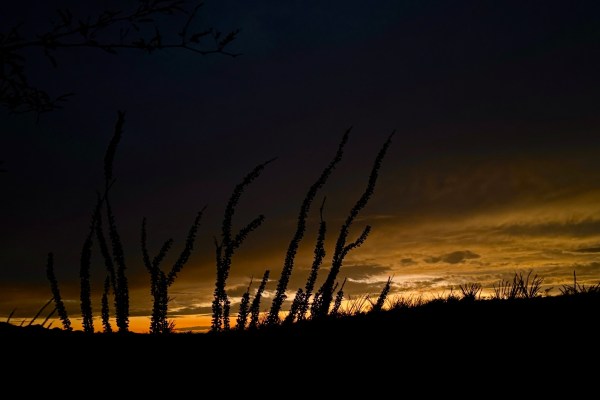
Ocotillo at nightfall.

I tried to salvage the night by beating Neltuma glandulosa. Beating at night can be quite fruitful, as beetles that normally zip off the sheet as soon as they land during the day will remain in thanatotic torpor at night. This time, it yielded only one Chrysobothris octocola, one clerid, a couple of fulgoroid planthoppers, and a large chalcidid wasp. More interesting was the large female Aphonopelma chalcodes (Arizona blonde tarantula—family Theraphosidae) that I found outside its burrow feeding on a large darkling beetle…
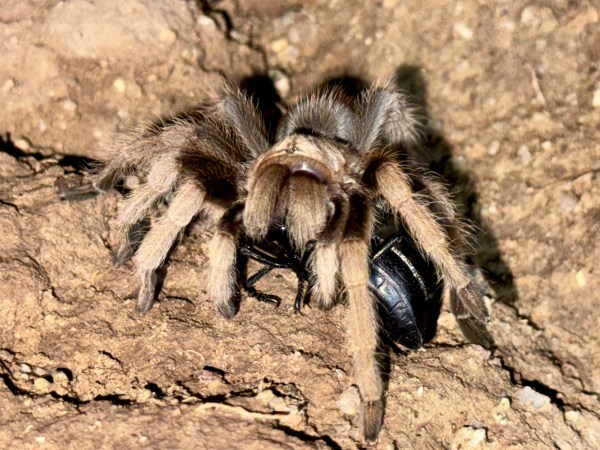
Aphonopelma chalcodes (Arizona blonde tarantula).

…and the striking caterpillar of Syssphinx hubbardi (Hubbard’s silk moth—family Saturniidae) that I found on the branch of Vachellia constricta.
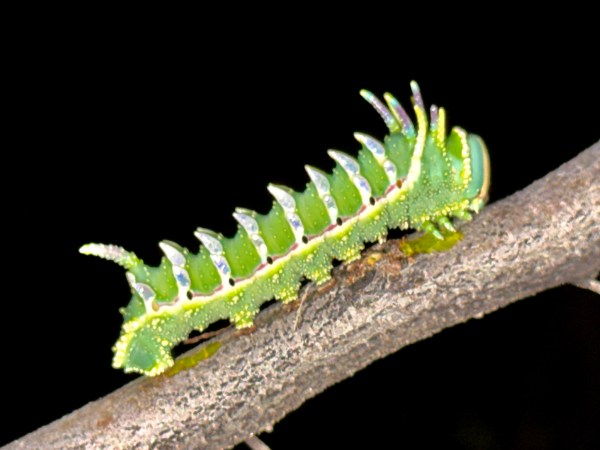
Syssphinx hubbardi (Hubbard’s silk moth) on Vachellia constricta (whitethorn acacia).

Day 11—Sep 1st

For our last full day in Arizona, we traveled to Nogales for two primary targets—The aforementioned Muscidora tumacacorii which has been reliably collected in the Atascosa/Pajarito Mountains just west of Nogales, and Megasoma punctulatum (Arizona elephant beetle—family Scarabaeidae), which is known from several areas just north and east of Nogales. Even though I had just collected two specimens of the former below Kitt Peak Observatory, I still wanted a better series. Moreover, while scarab beetles are not my normal interest, a chance to collect a species as handsomely large as M. punctulatum is hard to pass up. Steve and Norm have a M. tumacacorii “honey spot” in the riparian oak woodland near Peña Blanca Spring, and Norm graciously volunteered to show it to us.

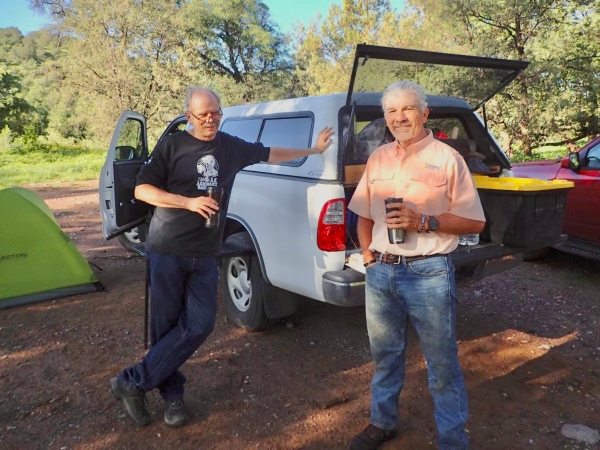
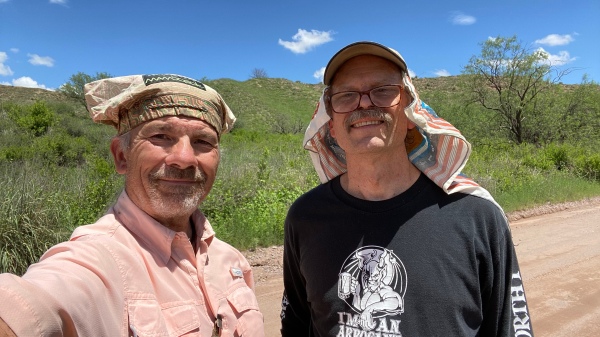
Ted MacRae, Jason Hansen, Steve Lingafelter (w/ Noxy), and Norm Woodley.

I have looked for M. tumacacorii previously in that same area, but (as we would see later in the day) the beetles can be extremely localized, and being close isn’t always good enough. As we walked through the riparian oak woodland to approach the spot, I collected Euphoria verticalis (family Scarabaeidae) in flight, Acmaeodera solitaria on flowers of Ipomoaea hederacea, (ivy-leaved morning glory) and Pseudognaphalium leucocephalum (white rabbit-tobacco), and Acmaeodera parkeri on flowers of Evolvulus arizonicus (Arizona blue-eyes).
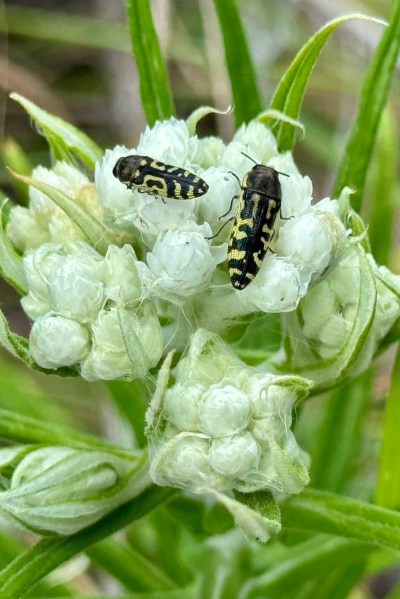
Acmaeodera solitaria on flowers of Pseudognaphalium leucocephalum (white rabbit-tobacco).

After reaching the “honey spot,” we began checking the host plant (Guardiola platyphyllum), and it wasn’t long before Norm saw a male M. tumacacorii in flight near one of the plants. It didn’t take long before I found a couple more individuals, these on flowers of Mimosa dysocarpa and Ipomoaea hederacea. However, I hit the “honey spot within the honey spot” when I encountered numerous individuals on the stems and flowers in a patch of Pseudognaphalium canescens (Wright’s cudweed). More A. solitaria were found on these plants as well, and both M. tumacacorii and A. solitaria were found nearby on the flowers of Desmodium batocaulon (San Pedro ticktrefoil). My vials full, I collected a few more A. parkeri that I found on flowers of I. hederacea, then went back to the parking lot to bid Norm adieu and thank him for all the help he and Steve had given us and for so graciously hosting us during the past several days. Jason and I then went to nearby White Rock Campground to lunch and await the arrival of Paul Kaufman, who was driving down from the Phoenix area to meet up with us.
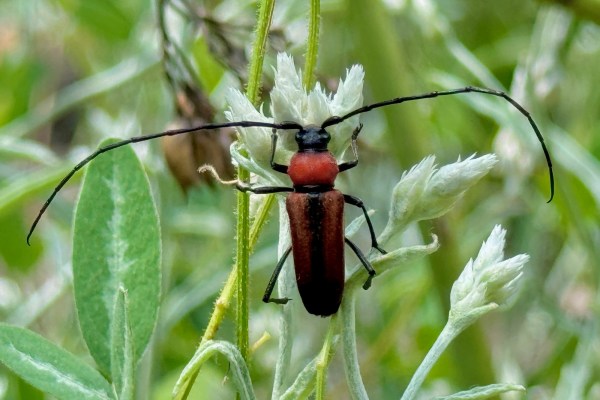
Muscidora tumacacorii perched on Pseudognaphalium canescens (Wright’s cudweed).

Paul arrived shortly enough, and we went back to the “honey spot” so that Paul could have a chance to collect M. tumacacorii himself for the first time. On the way, we passed several large clumps of Baccharis sarothroides (desert broom). As I approached the plants, I mentioned to Paul and Jason the importance of checking these any plants encountered, as it is possible to find Tragidion (family Cerambycidae) on their stems. They each gave the plants nearest them a cursory glance, but I carefully circled around the plants behind them and—sure enough—found a Tragidion sp. adult that they had missed! Lesson learned. At the money spot, both of them collected a satisfactory series of M. tumacacorii, while I focused on finding individuals that were in good position for field photographs. The photo below is about as good as I could have hoped for.
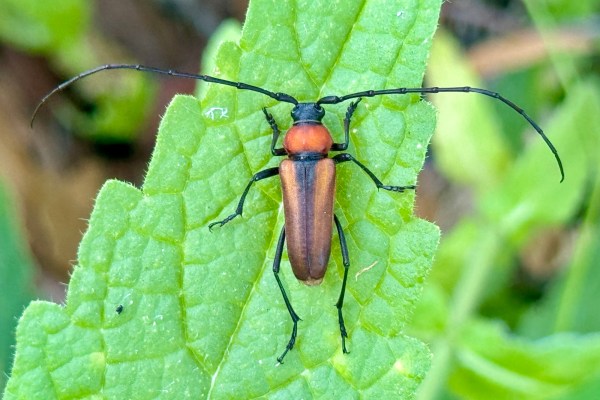
Muscidora tumacacorii (family Cerambycidae) perched near Guardiola platyphylla (Apache plant).

An unexpected photographic opportunity arose when I found a green lynx spider (Peucetia viridans—family Oxyopidae) feeding an an adult M. tumacacorii that it had captured—perhaps the first natural enemy association ever reported for the species.
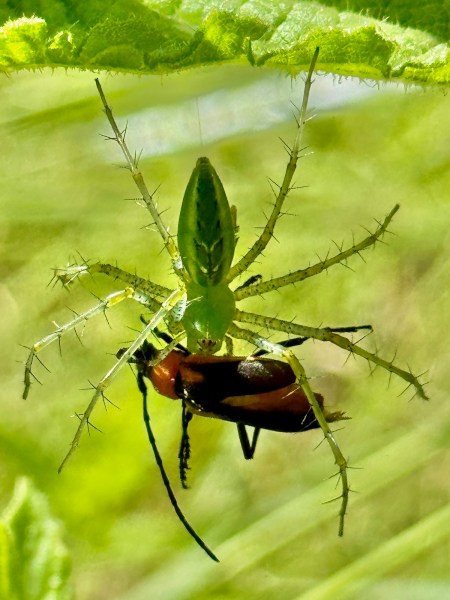
Muscidora tumacacorii (family Cerambycidae) captured by Peucetia viridans (green lynx spider).

A few other insects were collected: a large oestrid fly that landed on my hand, and a couple specimens of a Chrysobothris sp. (that I take to possibly be C. wintu) on the standing dead trunk of a wind-thrown Quercus emoryi (Emory oak).
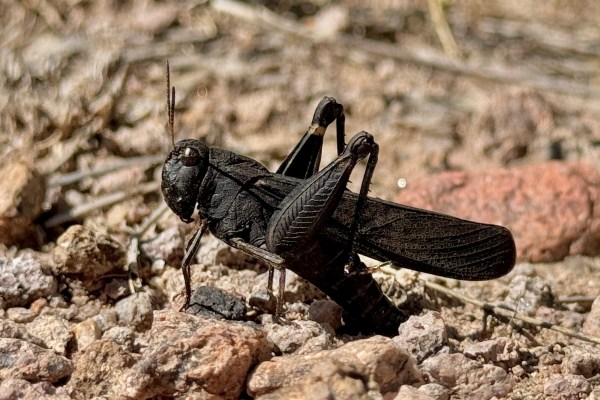
Arphia pseudonietana (red-winged grasshopper—family Acrididae).

After collecting our fill of M. tumacacorii, we debated where to go next. The type locality of Acmaeodera chuckbellamyi—still known only from the unique holotype collected by my good friend Mike Arduser more than 20 years ago—was just a bit further down the road, but numerous people (Paul and me included) have repeatedly searched for it there without success (the type locality suffered a severe burn shortly after the holotype was collected). More promising to us seemed to be an even closer spot along Ruby Road where Hippomelas parkeri has been collected. The recent success that a Jason and I had with this species notwithstanding, we nevertheless welcomed the opportunity to add specimens from a different locality to our series, and Paul hadn’t yet collected the species at all. We arrived at the spot shortly, and it wasn’t long before each of us began encountering the adults, again all on Calliandra eriophylla—its only known host. Apparently proper timing, knowledge of its habits, and familiarity with the host plant are the keys to success in finding this species, since it doesn’t seem to be encountered much during more general collecting. We all collected a series of specimens to our liking, and I also took advantage of the opportunity to add a couple of specimens of H. planicauda collected on Mimosa dysocarpa.
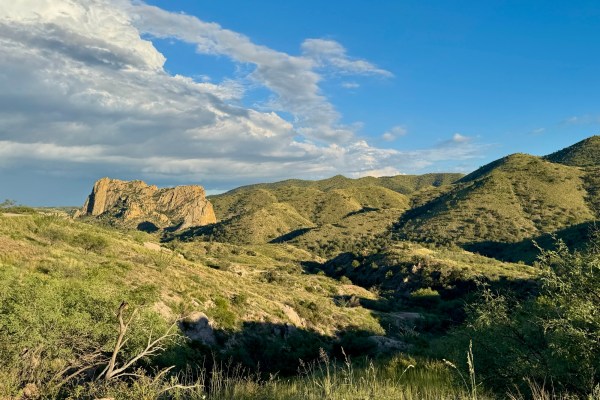
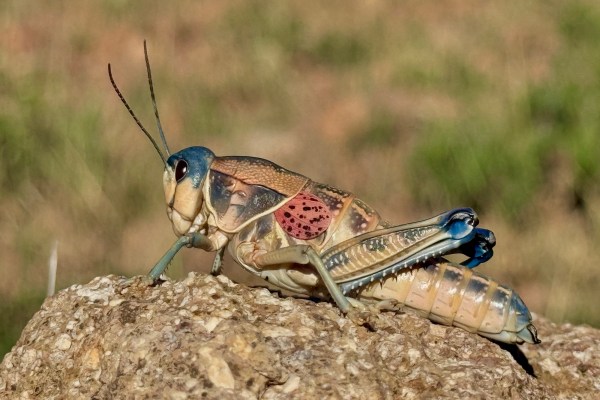
View along Ruby Rd.
Brachystola magna (plains lubber grasshopper—family Romaleidae).

My other main target for the area (Megasoma punctulatum) has been collected in mesquite savanna along nearby Duquesne Rd, so as evening approached we grabbed a quick dinner in town and set up our lights at the nearest of several spots along the road where the species has been collected. We got the lights set up just as dusk was settling, and we waited in hopes of seeing the first Megasoma.
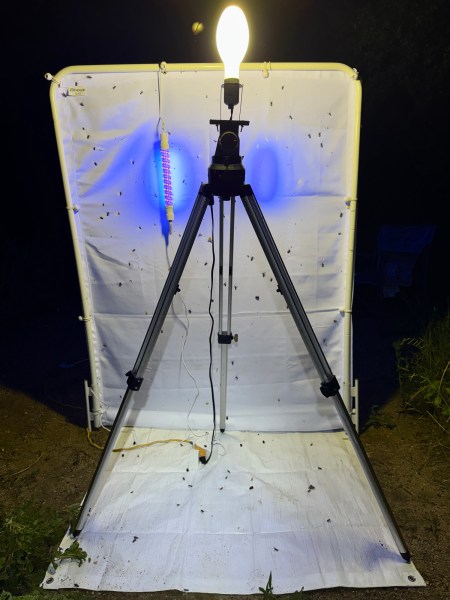
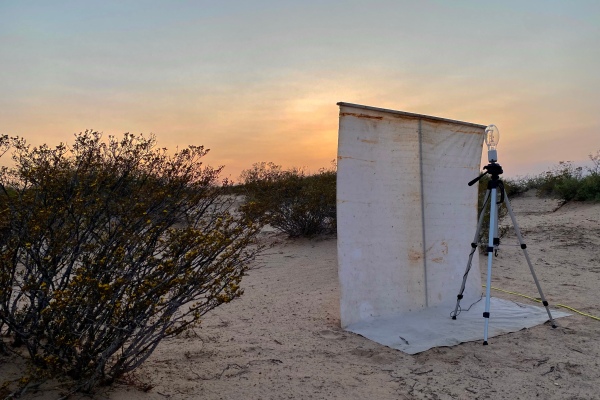
Entoquip Entoceptor™ with Entoquip ultraviolet and mercury vapor lights.

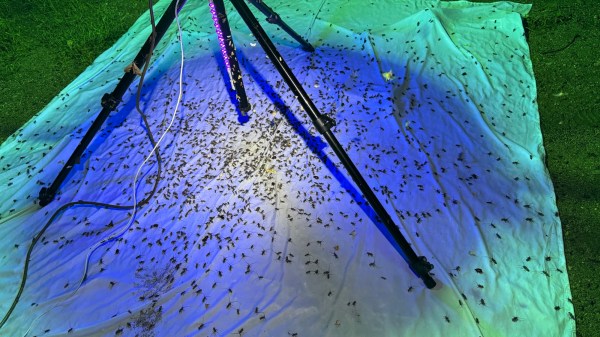
Instead of Megasoma, however, hundreds (if not thousands) of Oncideres rhodosticta (mesquite girdler) immediately started coming to the lights. The beetles were so numerous that they not only swarmed the light sheets but also the trees around the lights, the truck, and ourselves! In fact, it was nearly impossible to check the sheets for other insects without twig girdlers flying in your face and landing all over you, although Paul did give me a Cotalpa consobrina (gold bug—family Scarabaeidae) that came to his ultraviolet/mercury vapor lights setup (thanks!).
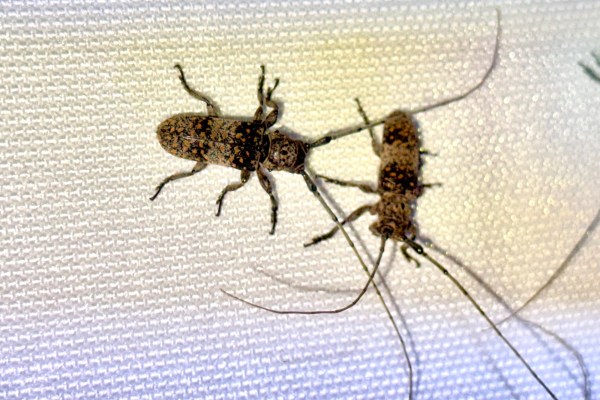
Oncideres rhodosticta (mesquite girdler—family Cerambycidae) at ultraviolet/mercury vapor lights.
Oncideres rhodosticta (mesquite girdler—family Cerambycidae) swarming at ultraviolet/mercury vapor lights.
Oncideres rhodosticta (mesquite girdler—family Cerambycidae) at ultraviolet/mercury vapor lights.

We wondered if rain earlier in the day at this spot had triggered a mass emergence and if moving to another spot where there were more big mesquite trees that we could check might give us a better chance at success, so pulled the lights and moved to further down Duquesne Rd to a spot where Jason had previously seen the beetle. We searched mesquite trunks in the area thoroughly (getting our boots soaking wet in the process because of the day’s earlier rain) but found no live beetles. Paul did find an intact female carcass on the ground, and I found a mostly intact male carcass in a black widow web on the trunk of a tree (relaxed, cleaned, and assembled on a card as my, for now, only specimen of this species). Records of this species on iNat extend from late July to late August, so we concluded that likely their season was over.
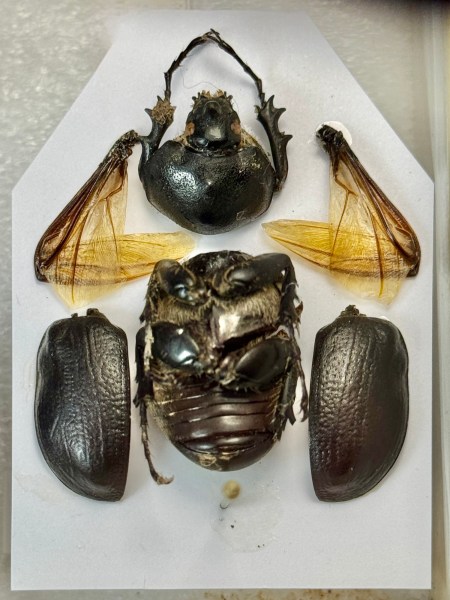
Megasoma punctulatum carcass recovered from black widow spider web.

In a final effort, we decided to try just one more spot a little further down the road where several recent observations had been posted on iNat. Again, nothing was found on the trunks other than the occasional Olios giganteus (giant crab spider—family Sparassidae). Megasoma season was over, and we had to accept it.
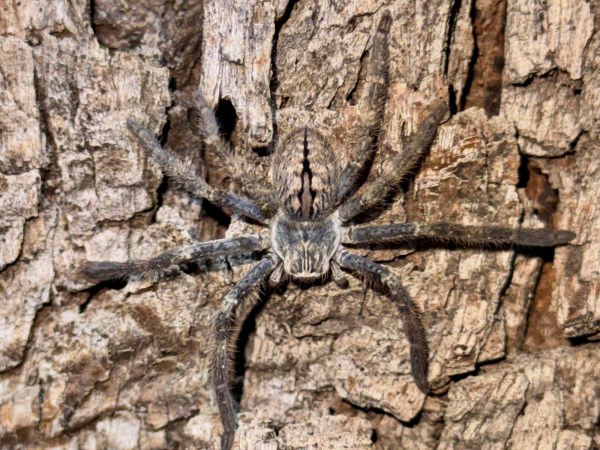
Olios giganteus (giant crab spider) on trunk of Neltuma glandulosa (honey mesquite).

Day 12—Sep 2nd

For our last day in the field, our plan was to return to the Peloncillo Mountains to retrieve the traps I had set, and the fact that they had gotten rain over the past week after we set them also gave us optimism that not only had they captured some good species (like A. discalis!), but that we would encounter better insect activity than we did back on Day 5. It would be a 5-hour drive—more than an hour longer than normal due to a washed out bridge on the Arizona side of Geronimo Trail, and the closer we got the more concerned we became by the persistence of the rain showers that were moving through the area—especially as we traversed the muddy/rocky roads in the final stretch. When we arrived at the trap site, rain was still falling—lightly but persistently, and I wasn’t anxious to hike the slippery rocky terrain in the rain, so we decided to continue on to the Arizona side to see if we could get into drier conditions. Remarkably, as soon as we crossed the pass just shy of the AZ/NM state line the rain stopped, and we headed a short distance further down to a spot where Norm told us he had collected some good species. The area certainly looked better than it did back on Day 5, but I didn’t encounter much of interest until I went a bit further up the hillside and encountered flowers of Heliomeris longifolia (longleaf false goldeneye) dotting the slopes. Three species of Acmaeodera (A. amplicollis, A. gibbula, and A. rubronotata) were encountered on the flowers—nothing unusual, but it was nice to see activity in an area where one week ago there was none.
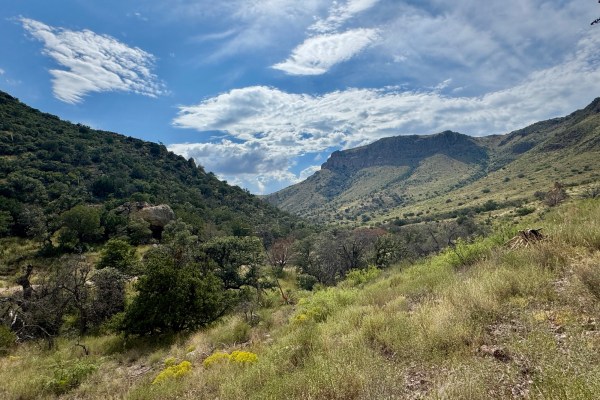
Peloncillo Mountains on the west side of the Arizona/New Mexico border.

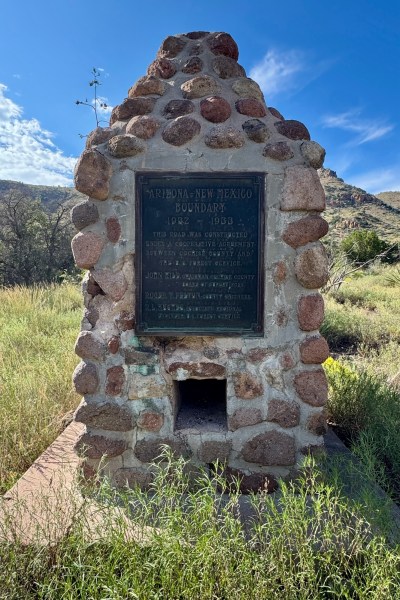
While we were there, the skies sunned up, and we decided to go back to the trap site to check the traps and see what else we might find. On the way, we took a few minutes to stop at the AZ/NM state line marker commemorating construction of Geronimo Trail nearly 100 years ago (1932–1933) under a cooperative agreement between Cochise Co. and the U.S. Forest Service.
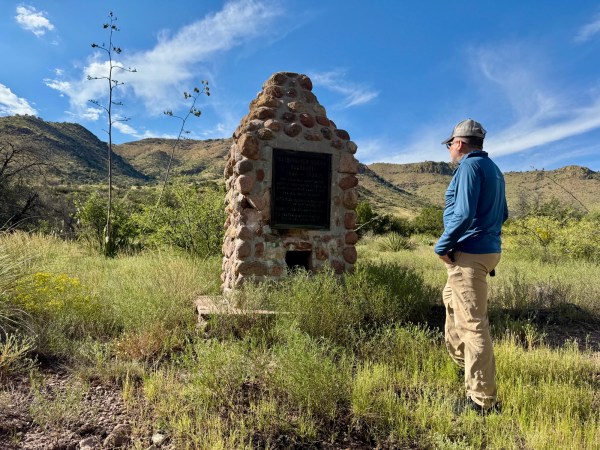
Jason at the Arizona/New Mexico state line marker.
Arizona/New Mexico state line marker.

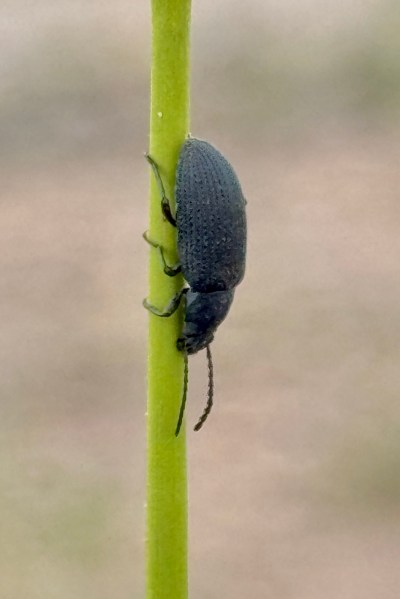
Back on the New Mexico side at the trap site, I was super anxious to see the catch but disappointed to see only a single buprestid (A. rubronotata) in the first bottle trap and a single cerambycid (Enaphalodes hispicornis) in the corresponding jug trap. Fortunately, there was much more to be excited about in the bottle trap that I’d placed further up the hillside—in fact, it is arguably the catch of the trip: two specimens of Acmaeodera reflexa! This super rare species has before now been reported only from the Animas Mountains just to the north (from where it was described), and more recently (in 2015) from the Chiricahua Mountains (see Day 6)—now it is also known from the Peloncillo Mountains. There were also a few A. amplicollis and A. rubronotata in the trap, and its corresponding jug trap contained both E. hispicornis and E. niveitectus along with a few other miscellaneous beetles. I couldn’t have been more pleased as I slowly made my way back down the mountainside, stopping only to pick up a darkling beetle (family Tenebrionidae) in the Stenomorpha marginata species complex.
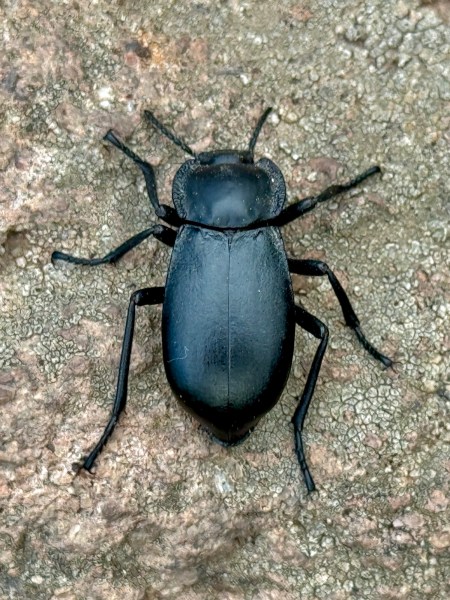
Stenomorpha marginata species complex.

As a bonus, we saw a male Aphonopelma peloncillo (Peloncillo Mountains tarantula—family Aphonopelmidae) crossing the road as we were finishing up. This recently described species is restricted to the middle and lower elevations in and around this mountain range, but within the area it is reported to be fairly common. This makes the fifth North American tarantula species that I’ve seen in the wild (A. armada, A. chalcodes, A. gabeli, A. hentzi, and A. peloncillo). For more information on this species and a revision of North American tarantulas in the genus Aphonopelma, see Hamilton et al. (2016).
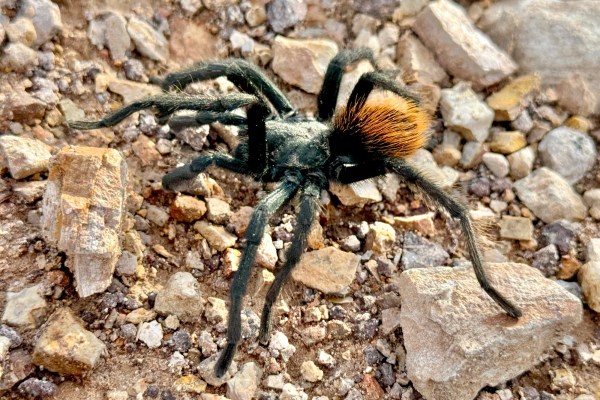
Aphonopelma peloncillo (Peloncillo tarantula).

For our final stop, we went back over the AZ/NM state line and a bit further past our previous stop to another spot where Norm had collected Acmaeodera discalis on “white flowers.” Norm and Steve also told us it would be a good place to camp and run our lights, and, in fact, it was a perfect spot for this with nice, large Arizona white oaks nestled against a riparian woodland. We searched for white flowers in the area Norm had pointed to and found a patch of Eriogonum abertianum (Abert’s buckwheat) that must have been what he’d collected. I swept the plants thoroughly and collected several Acmaeodera, but they all proved to be A. decipiens—officially putting an end to our quest for A. discalis, at least on the present trip.

The insect collecting, however, was not yet over, as we had one last opportunity to run lights. In this regard, we were richly rewarded with by far the best night of lighting that we had on the entire trip. Several species of longhorned beetles were taken (Aneflus sp., Atylostagma politum, Enaphalodes niveitectus, Oncideres rhodosticta, and Orwellion gibbulum arizonense), as were several Strategus sp., some smaller scarabs, and species of Leptoglossus, Curculio, Fulgoroidea, and Oestridae.
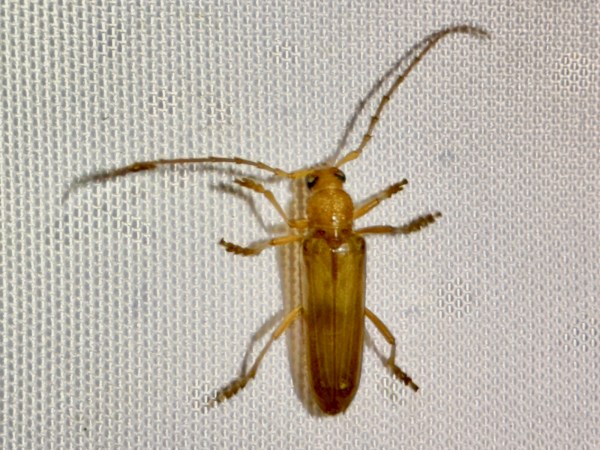
Atylostagma politum at ultraviolet/mercury vapor lights.

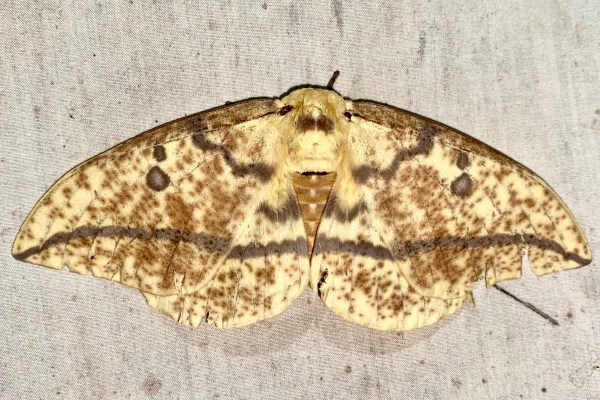
Also showing up, but not collected, was the adult of Syssphinx hubbardi (recall we saw the striking caterpillar of this species two nights ago).
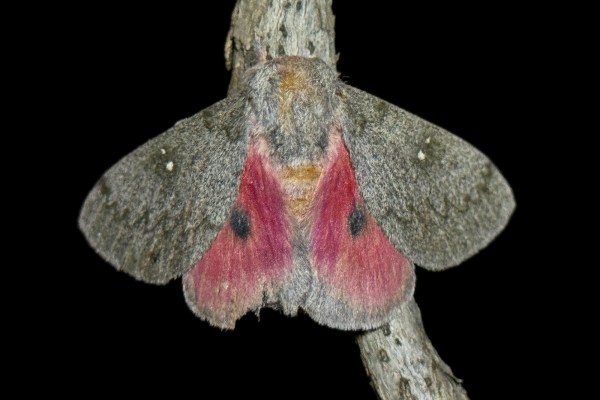
Syssphinx hubbardi (Hubbard’s silk moth) at ultraviolet/mercury vapor lights.

The collecting also wasn’t restricted to the lights. I routinely check tree trunks at night, especially those close to the lights, and for doing so this time my reward was yet another Lampetis webbii (making four for the trip—Jason got one also) and two cerambycids (A. politum and O. gibbulum arizonense), which were found on trunk of the largest Arizona white oak closest to the lights.


Day 13—Sep 3rd

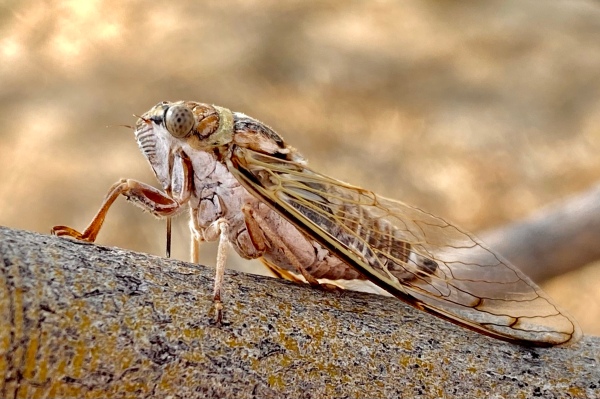
Our plan was to make it to Amarillo, Texas, which was a little over half the distance to St. Louis, so we broke camp without too much dilly dalying. I did take a moment to photograph (and catch) a Hadoa parallela (corrupted sun-singer—family Cicadidae) that had eluded me at the lights the night before.
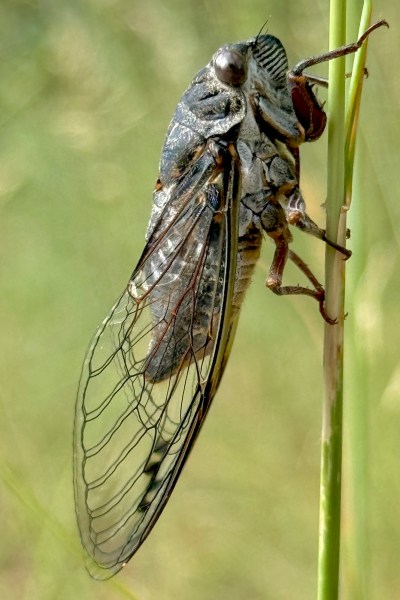
Hadoa parallela (corrupted sun-singer).

Jason also had an ask—that we stop at the trap site where we’d gotten Acmaeodera reflexa in the bottle traps. We’d seen flowers in bloom when we were here yesterday, and he wanted to give one more shot at finding the adults by sweeping and checking flowers. I was fine with this but elected not to climb the mountain again and instead checked flowers along the roadside. This resulted in a small series of Acmaeodera amplicollis on the flowers of Heliomeris longifolia. I heard Jason let out a yell at one point as he was climbing the slopes and figured he must have found one, but I later learned that he’d had a close encounter with a rattlesnake—I was hoping it might have been the rare New Mexico ridge-nosed rattlesnake, which is restricted to the Peloncillo Mountains, but it seems to have been the more common and widespread blacktailed rattlesnake based on the pattern that can be made out in the quick photos he snapped.
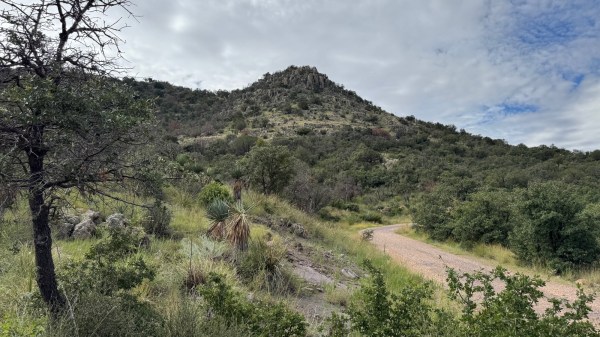
Habitat for Acmaeodera reflexa (family Buprestidae).
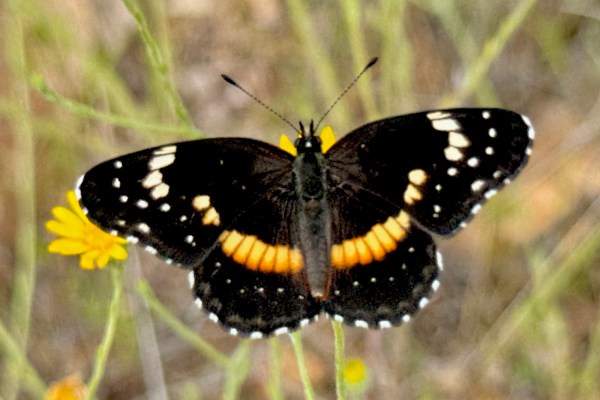
Chlosyne lacinia (bordered patch—family Nymphalidae).
Jason returns from the mountaintop.

On our way out of Peloncillo Mountains, we encountered a young woman a few miles north of Geronimo Trail whose truck (w/ U.S. government plates) was sitting axle-deep in mud on the side of the road next to a large puddle. She exuded desperation as she described how she’d gotten stuck and asked if we had any advice, so we got out to assess the situation and see what we might be able to do. We had no cell service either and were surrounded by grassland with no rocks or sticks that we could put under the wheels, but we had seen a large truck sitting off the side of the road a few miles back and Jason suggested going back to ask them if they could help. As Jason was about to leave, that very truck appeared coming up the road, stopped and talked to Jason for a minute, and then drove toward us. Astonishingly, it continued driving through the puddle right past the woman and me—our mouths agape and nearly splashing us as it went by—before stopping a short way up in the middle of the road. When the man got out and started approaching us we could see he was Border Patrol agent, and he seemed suspicious as the woman explained her predicament. He looked at me, and I said I was just a passerby who stopped the help. He didn’t really respond to the woman’s request for help but got in his phone as he walked back toward his truck, leaving the woman and I to only look at each other and wonder what in the heck was going on. Shortly afterward another BP agent—this time in a clearly marked BP vehicle—pulled up. He was much friendlier and asked the woman if she had any chains. She did not, but she did have straps—which he attached to his and her vehicles… and promptly snapped as he began pulling!
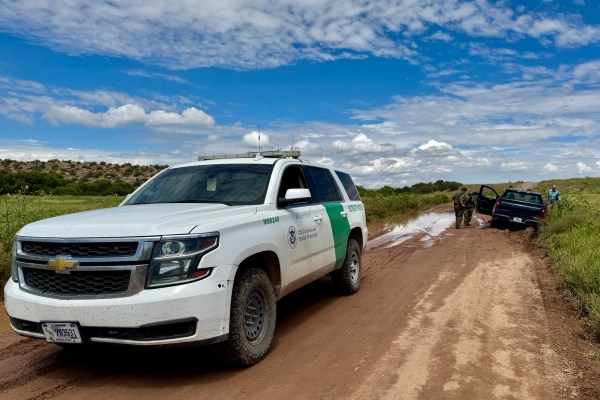
Border Patrol to the rescue.

As the friendlier agent contacted other agents to see if any had proper chains, a third BP vehicle pulled up, this one driven by a very young but very formal “Yes, sir” and “No, ma’am!” type of agent who seemed to assume only an observatory role in the happenings. Eventually the friendlier agent said he’d been able to contact a “horse unit” who had chains and that they would be there shortly (the number of BP agents who were able to converge upon the scene in relatively short time was astounding, given the extreme remoteness of the spot—nearly an hour south of the barely visible town of Animas!). As the woman and I chit-chatted, I learned that she worked for the USDA and was in the area to survey grasshoppers. Of course, I found this very interesting and told her I was an entomologist as well, all of which resulted in an unexpectedly fascinating conversation.

The crowd grows.

Shortly before the horse unit arrived, I noticed tiger beetles (Cicindelidia sp.) running along the wet margin of the roadside puddle. Despite the puzzled looks I was sure it would draw, I quickly pulled out my long-handled net and managed to catch a couple by the time the horse unit pulled up.
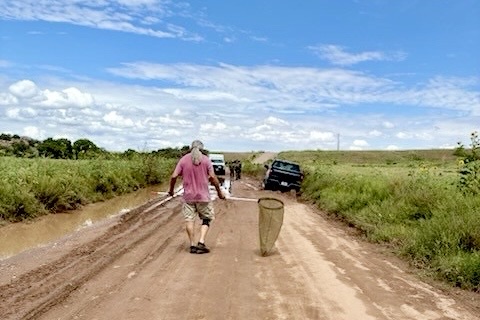
Stalking tiger beetles while Border Patrol looks on.

The large white pickup truck pulling a horse trailer passed us, turned around up the road, and pulled up to the stuck truck. Two badass cowboy types got out, and without saying a word got to work, hooked up the chains, and with the horse trailer still attached back up and pulled the truck free. The look of relief on the woman’s face was palpable as she realized show was no longer stranded in the middle of nowhere, and I’m sure she breathed a sigh of relief when she finally reached pavement—the trailing caravan of BP vehicles blasting past her at that point. We stayed behind her, and when she pulled over in Animas we pulled up beside her to make sure she was okay before resuming our journey back toward home.
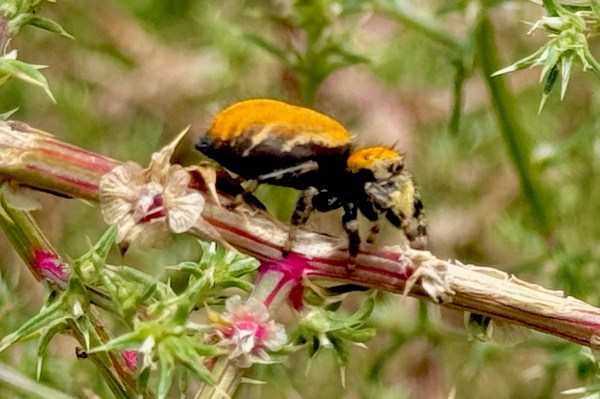
Phidippus apacheanus (Apache jumping spider—family Salticidae).

Day 14—Sep 4th

3,970 miles!

Literature Cited

Hamilton, C. A., B. E. Hendrixson & J. E. Bond. 2016. Taxonomic revision of the tarantula genus Aphonopelma Pocock, 1901 (Araneae, Mygalomorphae, Theraphosidae) within the United States. ZooKeys 560: 1–340. https://doi.org/10.3897/zookeys.560.6264

Westcott, R. L. & D. A. La Rue. 2017. New anthophilous host associations for adult Acmaeodera Eschscholtz, 1829 (Coleoptera: Buprestidae) species from the western United States and Texas. Insecta Mundi 0564: 1–8. https://journals.flvc.org/mundi/article/view/0564

©️ Ted C. MacRae 2026
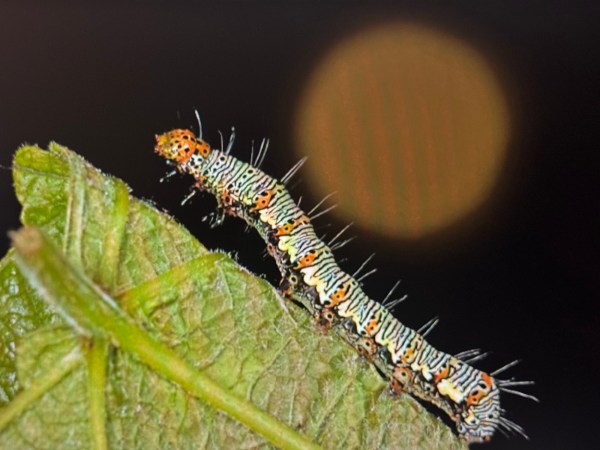
Eight-spotted forester caterpillar under moonlight

Alypia octomaculata on foliage of Vitis sp.

In the scarlet oak/shortleaf pine forests of Carter Co. in the Ozark Highlands of southeastern Missouri, an eight-spotted forester moth caterpillar (Alypia octomaculata) feeds on the foliage of wild grape (Vitis sp.), showcasing its beauty under the soft glow of moonlight.Both grape and Virginia creeper (Parthenocissus quinquefolia), the only plants upon which the caterpillars of this species feed, belong to the family Vitaceae and are loaded with bitter compounds that accumulate in the caterpillar’s body, imparting a measure of toxicity to the caterpillars that makes not only them but the adult moths that they become bitterly distasteful to potential predators. So distasteful, in fact, that the caterpillars and adults, both brightly and conspicuously colored, brazenly feed and fly in broad daylight without fear of avian predators who have learned to avoid anything sporting a black and red motif.

©️ Ted C. MacRae 2026

🐛 Digrammia continuata

Caterpillars of Digrammia continuata (curve-lined angle—family Geometridae) feed on plants in the family Cupressaceae (e.g., Chamaecyparis, Hesperocyparis, Juniperus, etc.) across North America and are colored to blend in perfectly with the foliage of their hosts. Adult moths also display a cryptic pattern of brown and gray transverse lines to blend seamlessly into bark and dead leaves when resting during the day. The caterpillar shown here was beaten from Juniperus virginiana (eastern red-cedar) during a Webster Groves Nature Study Society (WGNSS) Nature Photography Group outing at Victoria Glades Conservation Area in Jefferson Co., Missouri on 20 June 2026.

Digrammia continuata (curve-lined angle) on Juniperus virginiana (eastern red-cedar).

©️ Ted C. MacRae

🪲 Entomologizing w/ the WGNSS Entomology Group at Hughes Mountain Natural Area — 11 Oct 2025

L-R: Ted “BugMan” MacRae, Pete Kozich, David Seidensticker, “Ozark Bill” Duncan, Lisa Meihls, Chris Brown.

The Webster Groves Nature Study Society (WGNSS) Entomology Group began its final outing of the 2025 field season when eight participants (Chris Brown, Nathalie de Rocquigny, “Ozark Bill” Duncan, Jack Hambene, Pete Kozich, Ted “BugMan” MacRae, Lisa Meihls, and David Seidensticker) met up in the parking lot at Hughes Mountain Natural Area. Tucked into the southeastern corner of Washington Co., this gem of a natural area features 1.5 billion year old Precambrian outcrops that are among the oldest continuously exposed rocks in North America. Once molten as a result of volcanic activity associated with the St. Francois Mountains, the now hardened and weather-resistant rhyolite that formed after it cooled lies still exposed at the summit and surrounding areas. To the geologist, the polygonal columnar pattern of cracking at the summit—resulting in a unique formation called the “Devil’s Honeycomb”—might be the area’s most interesting feature. To the botanist, the xeric grasslands that formed on the surrounding exposures—i .e., “igneous glades”—might instead take this honor. To the entomologist, however, the unique fauna of insects associated with this interesting natural community earns top billing.

Rhyolite glade at Hughes Mountain Natural Area.

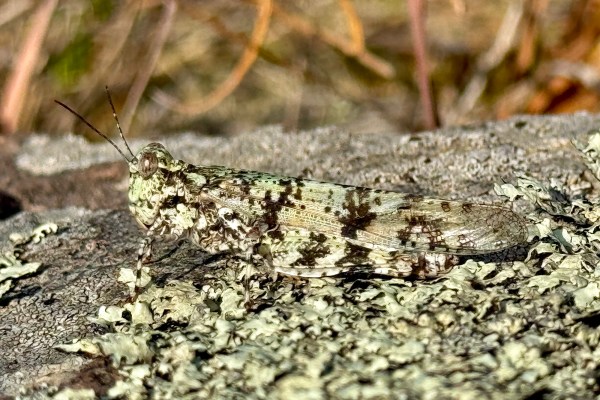
On two previous visits, the group has been fortunate to see one of Missouri’s rarest and most beautiful longhorned beetles—Tragidion coquus. Velvety black with vivid orange elytra, this charismatic species is usually seen during fall, and we hoped to be fortunate enough to see it again. Two species of fall tiger beetles—Cicindela limbalis (claybank tiger beetle) and Cicindela splendida (splendid tiger beetle), both colored iridescent green and brick red—were additional possibilities. A clear consensus quickly became apparent, however, when most participants voiced a desire to see Trimerotropis saxatilis—the famously and colorfully cryptic lichen grasshopper! It didn’t take long to see the first ones as soon as we began reaching the swathes of exposed rhyolite with their coverings of green and black lichens. Sitting motionless on the lichen-encrusted rocks, the grasshoppers were almost impossible to see, so perfectly colored and patterned was their camouflage.

Trimerotropis saxatilis (lichen grasshopper—family Acrididae).

The abundance of lichen grasshoppers on the glades was somewhat expected, but what was not was the diversity of other grasshoppers also present at the margins of the glades and in the surrounding dry woodlands. Four such species were documented, including Hippiscus ocelete (wrinkled grasshopper), Melanoplus ponderosus (ponderous spur-throat grasshopper), Melanoplus rusticus (obovate-winged grasshopper), and Spharagemon bolli (Boll’s grasshopper)—all possessing their own forms of cryptic coloration that made relocating them after they jumped difficult.

Hippiscus ocelote (wrinkled grasshopper—family Acrididae).
Melanoplus ponderosus (ponderous spur-throat grasshopper—family Acrididae).
Melanoplus rusticus (obovate-winged grasshopper—family Acrididae).
Spharagemon bolli (Boll’s grasshopper—family Acrididae).

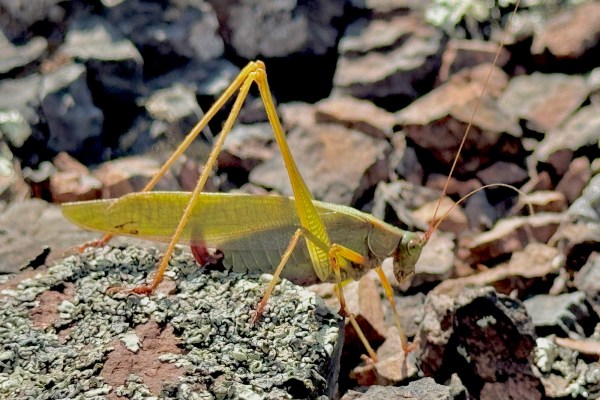
Two non-grasshopper orthopterans as well were found—several Scudderia furcata (fork-tailed bush katydid), ranging from green to tan to almost pinkish(!), were seen in the glades and woodlands, and an unusually cooperative Ceuthophilus sp. cave cricket (family Rhaphidophoridae) was also seen.

Scudderia furcata (fork-tailed bush katydid—family Tettigoniidae).
Ceuthophilus sp. (cave cricket—family Rhaphidophoridae).

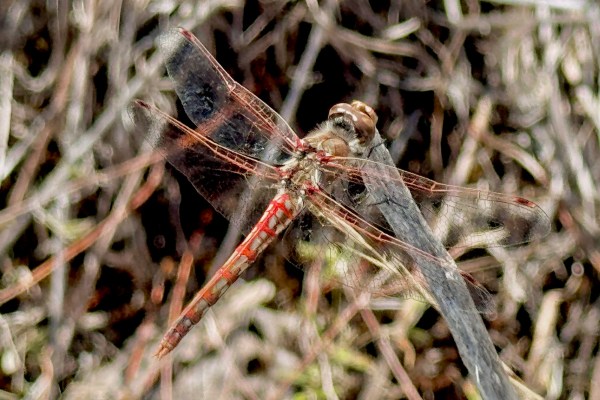
The group fanned out across the glades as they worked their way up towards the summit. Of special interest were flowers that might host pollinating insects (and possibly even T. coquus). Few flowers would be found, however—a consequence of abnormally dry conditions since late July, and we found ourselves looking for other targets. Ted managed to photograph a beautiful red-marked variegated meadowhawk dragonfly (Sympetrum corruptum), while David “captured” (through the viewfinder) a male black swallowtail butterfly (Papilio polyxenes).

Sympetrum corruptum (variegated meadowhawk—family Libellulidae).

Eventually the group reached the summit, where the “Devil’s Honeycomb” and a spectacular vista awaited us. An unexpected feature at the summit was white splotches on the tops of many of the projecting columns of rock, which the group surmised to indicate use of the summit as a roosting site by turkey vultures.

“Devil’s Honeycomb” at summit of Hughes Mountain.

The group lingered to take in the crisp air, blue skies, and spectacular view created by 1200’ of elevation before turning back to begin the descent back down the mountain.

Buford Mountain (2nd highest point in Missouri) in the distance.

Descending the mountain, however, did not mean an end of things to see. Even before getting off the summit, Lisa noticed Chelinidea vittiger (cactus leaffooted bug) on pads of Opuntia cespitosa (eastern prickly pear). This species feeds and develops almost exclusively on the pads, fruits, and young growth of prickly pear cacti (Opuntia spp.), thus, its range coincides with the distribution of these cacti.

Chelinidea vittiger (cactus leaffooted bug—family Coreidae) on Opuntia cespitosa (eastern prickly pear).

Further down the mountain, another “variegated” species was seen—this time a variegated fritillary (Euptoieta claudia) butterfly. This well-worn individual was only the third butterfly species seen on the day, the aforementioned black swallowtail and a particularly fresh common buckeye (Junonia coenia) being the other two. This one was probably making its way south to overwinter in the southern U.S., where the species is a year-round resident.

Euptoieta claudia (variegated fritillary—family Nymphalidae).
Junonia coenia (common buckeye—family Nymphalidae).

Along the way, the lichen grasshoppers continued to attract our attention due to their abundance and striking diversity of coloration. We were treated to a particularly obvious example of this when we encountered a mating pair with the much smaller male exhibiting shades of brown instead of the greens exhibited by the much larger female.

It had been a leisurely descent off the main glade, and once clearing the woodland to emerge into the last glade fragments before the final descent, Chris and Ted were further delayed by a trio of observations in rapid succession. A large, impressively marked Neoscona crucifera (spotted orbweaver) spider hunkered down on a twig first caught Chris’ attention. Photographing it turned into an adventure when an effort to manipulate the twig on which it was resting ended up alarming the spider and causing it to drop down to the ground. They returned the spider to the twig using other twigs and leaves, but invariably it dropped again. Eventually, they learned they could “reel” the spider back up to the twig by its silk line if they acted quickly enough, and with repeated efforts both succeeded in getting photographs of the spider back up on the twig.

Neoscona crucifera (spotted orbweaver—family Aranaeidae).

While this was going on, the unmistakable droning buzz of Milesia virginiensis (yellowjacket hover fly or Virginia flower fly) caught their attention. The resemblance of the adults of this species to wasps is remarkable, and they are often seen hovering in midair, making erratic shifting movements, and then suddenly flying away. This particular fly, however, cooperated by landing on a rock (briefly) and allowing a few photographs before it abruptly departed.

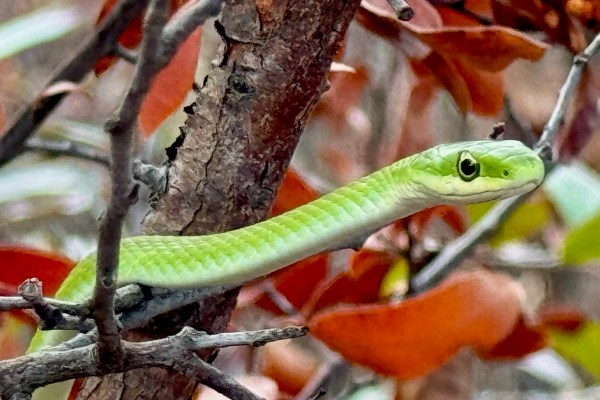
Spider and fly photographs in hand, Ted and Chris resumed their descent but took only a few steps before another sighting demanded photographs—a rough green tree snake (Opheodrys aestivus) peering quizzically from amongst the rust-red leaves of a stunted blackjack oak. The snake cooperated at first, allowing a few closeup photographs before making a run for it. Fortunately, this is a very docile species that rarely (if ever) bites when handled, so Chris and Ted were able to corral it for additional photos before returning it back to the tree from whence it came.

Opheodrys aestivus (rough green snake—family Colubridae).

At last, they were able to complete the descent and join the rest of the group in the parking lot, but not before making one last interesting find—the bizarrely beautiful caterpillar of Isa textula (crown slug moth). Like many members of the family Limacodidae (slug moths), the pale green, flattened caterpillars bear stinging spines/-in this case on lobes that radiate out from around the edge of the body. The caterpillar was found on the ground (it is probably mature and was looking for a protected place to spin a cocoon in which to spend the winter) and coaxed onto a leaf to bring it to the parking lot so everyone could have a chance to photograph it (it looked particularly stunning when set on a bright red sumac leaf).

Isa textula (crown slug moth—family Limacodidae).

©️ Ted C. MacRae 2025

🌿 Botanizing w/ the WGNSS Botany Group at Victoria Glades Preserve

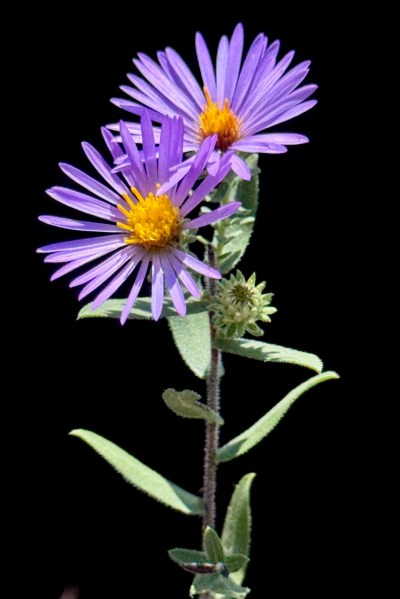
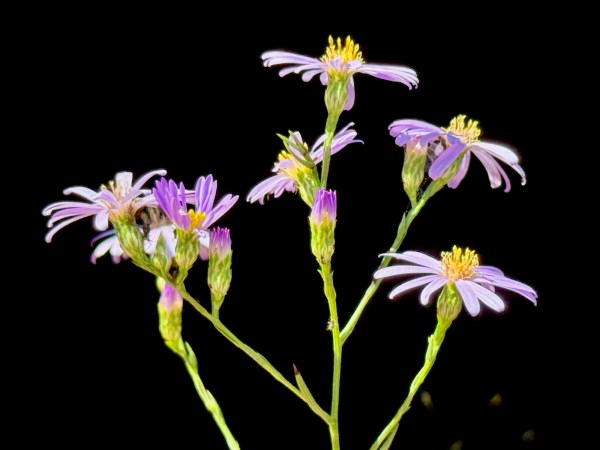
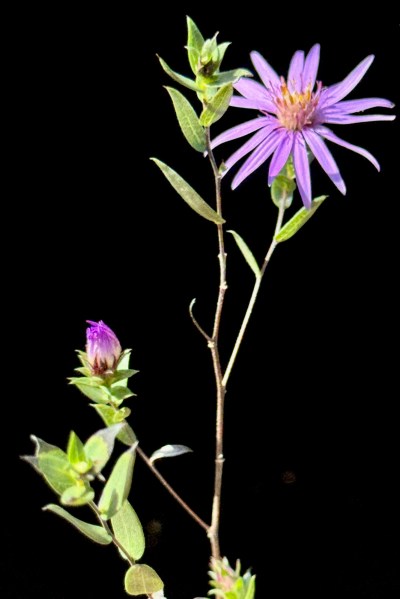
6 Oct 2025—Fall continues to advance in the St. Louis area, and despite very dry conditions during the past two months the fall bloomers continue to make their appearance. One of the area’s most reliable and interesting places to see fall blooms is Victoria Glades south of Hillsboro, where orchids, gentians, and asters anchor a unique suite of fall-blooming plants that are rarely seen elsewhere in our mostly forested environs.
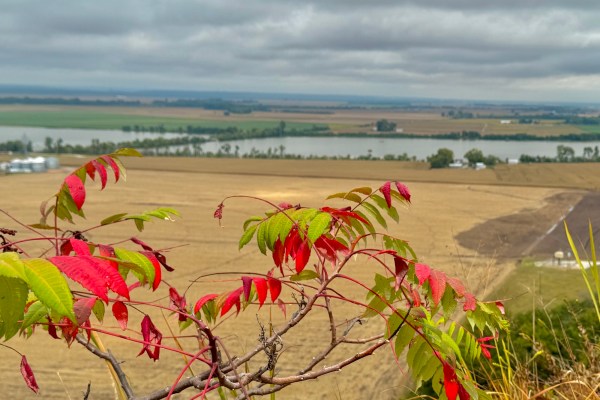
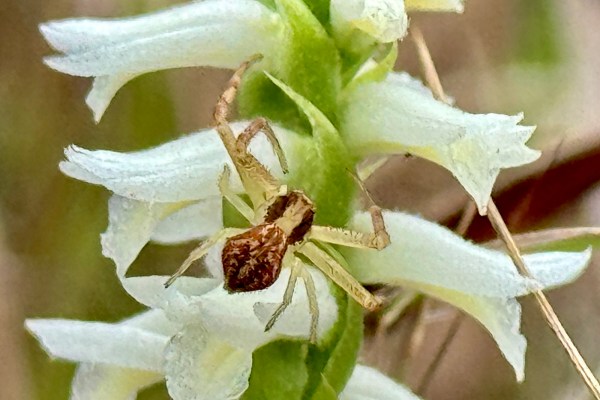
The group chose the Nature Conservancy portion of the complex to explore, as it was in the mesic forest along the riparian corridor below the glade on this side that the first of two orchids—the charmingly diminutive and seldom-seen Spiranthes ovalis (lesser ladies’ tresses)—was expected to be seen in bloom. Despite having recently taken GPS coordinates for the plants, it took several minutes of the group scouring the area around the coordinates before the tiny plants were finally found. Its delicate blooms, fall flowering season, small size, presence of basal and cauline leaves at anthesis, and preference for mesic habitats all serve to identify this species. Missouri’s populations are considered var. erostella, which lack certain essential flowering organs and are, thus, self-pollinated (cleistogamous).

Spiranthes ovalis var. erostellata (lesser ladies’ tresses—family Orchidaceae).

Clambering up and out of the creek bed and onto the open glade, the group found, again with some difficulty, the second orchid we were looking for—Spiranthes magnicamporum (Great Plains ladies’ tresses). Unlike S. ovalis, however, this species is much more commonly seen on dolomitic glades throughout the state, and there have been fall seasons at Victoria Glades featuring spectacular displays of it. Sadly, it does not appear that this will be one of those falls, almost surely because of the near absence of rain in recent months. The first two plants were found under and next to a cut eastern red-cedar, whose cadaver perhaps provided just enough protection to prevent a complete drying of the soil underneath and allowed the two plants to proceed to flowering. Of the nine species of Spiranthes presently known to occur in Missouri, S. magnicamporum is among the showiest due to its robust, often doubly helical inflorescences and relatively large flowers with spreading and arching lateral sepals. It is also among the most fragrant, with a sweetish fragrance of coumarin, which some people liken to vanilla.

Spiranthes magnicamporum (Great Plains ladies’ tresses—family Orchidaceae).

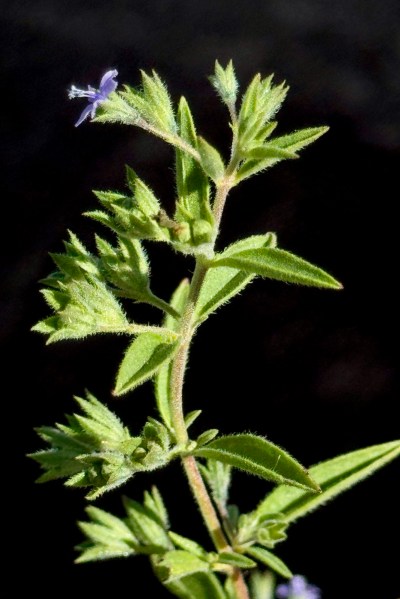
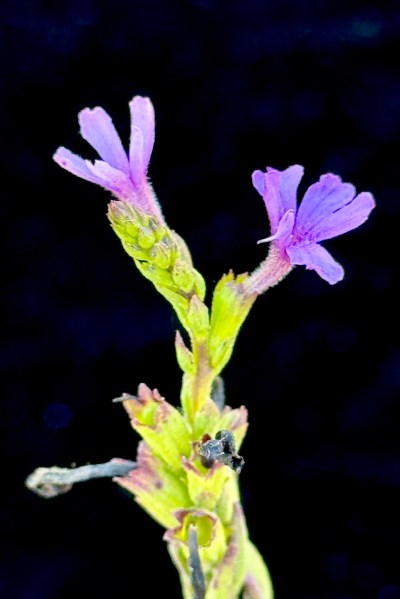
I’ve been visiting Victoria Glades for more than 40 years, yet I continue to see things I haven’t previously notified. This time it was Trichostema coeruleum (pennyroyal bluecurls), a member of the mint family (Lamiaceae). [Note: Trichostema coeruleum was known until recently as Trichostema brachiatum—now a synonym of Trichostema dichotomum.] Unlike Trichostema dichotomum (bluecurls), which prefers glades and other dry habitats with acidic substrates (e.g., sandstone), T. coeruleum prefers such habitats with calcareous substrates (e.g., dolomite). A third species of the genus, Trichostema setaceum (narrow-leaf bluecurls), also occurs in Missouri but is restricted to sand prairies in extreme southeastern Missouri.

Trichostema coeruleum (pennyroyal bluecurls—family Lamiaceae).

Dolomite glades are also the preferred habitat for many species of plants in the family Orobanchaceae, a bizarre family of mostly hemiparasitic plants that derive at least some of their nutrition not from the sun, but by tapping into the roots of nearby plants. Castilleja coccinea (scarlet paintbrush) is perhaps the best known of these, in most years joining the cacophony of wildflowers that form colorful displays across Victoria Glades during spring and early summer. There are, however, several less conspicuous but equally beautiful wildflowers in the family that are restricted in the area almost exclusively to the dolomite glades of Jefferson Co. One of these is Agalinis skinneriana (Skinner’s or pale gerardia/false foxglove), which the group found sporadically still in bloom across the open glade. There are several species of Agalinis in Missouri, some of which are quite common. However, A. skinneriana can usually be recognized by the characteristic habitat and generally upward-facing flowers with spreading to reflexed upper corolla lobes. The plants are also relatively slender and fewer-branched than the more common A. tenuifolia (common gerardia/false foxglove) and A. gattingeri (rough-stemmed gerardia/false foxglove).

Agalinis skinneriana (Skinner’s or pale gerardia/false foxglove—family Orobanchaceae).

Another plant in the family Orobanchaceae that the group saw was Buchnera americana (American bluehearts), represented by a single plant still bearing two worn blossoms. Normally blooming from June through September, plants in full bloom have no look-alikes and are not likely to be confused with anything else. Despite this, the vervain-like fruit-bearing structure of this late straggler fooled the group into at first thinking it was a species of Verbena until its true identity was realized.

Buchnera americana (American bluehearts—family Orobanchaceae).

No group of plants more iconically represents fall than goldenrods (genus Solidago) and true asters (genus Symphyotrichum), and no place allows as many uncommonly seen species to be seen together as the dolomite glades. Three species of goldenrods were seen during the day—the super common Solidago nemoralis (old field goldenrod), the less common but more showy Solidago rigida (stiff goldenrod), and the highly restricted Solidago gattingeri (Gattinger’s goldenrod) (we were not able to locate a fourth species—Solidago radula [rough goldenrod], which we have observed during previous visits on the MDC portion of Victoria Glades). It was the true asters, however, that truly tested our plant identification abilities. Relatively easier are the purple asters, of which we found three species. The first and most abundant was Symphyotrichum oblongifolium (aromatic aster), recognized by its recurved phyllaries and branched habit with narrow, linear leaves that become more numerous and smaller in the upper plant. If one is still in doubt as to its identity, however, one needs only to crush the leaves between the fingers and enjoy its distinct aroma.

Symphyotrichum oblongifolium (aromatic aster—family Asteraceae).

Along the intermittent creek and near the interface with the dry post oak woodland on the north of the glade, we encountered a second species—Symphyotrichum oolentangiense (azure aster). Identification of this species came only near the end of the outing, as a key identifying characteristic of this species—the presence of distinctly petiolate cordate basal leaves that are rough to the touch—was not seen on any of the plants examined before then. At that point, we suspected Symphyotrichum turbinellum (prairie aster) due to the vase-shaped involucres. While that species has been found at Victoria Glades, it is usually a much more highly branched plant associated with more wooded habitats (despite the common name). Finally, we found a plant with such leaves present, albeit dried up, and then another with the leaves present and still fresh to confirm the identification.

Symphyotrichum oolentangiense (sky blue aster—family Asteraceae).

In a small area at the northernmost point of the glade, we found Symphyotrichum sericeum (silky aster). This species is immediately recognizable from afar by the silvery cast to the foliage—this, combined with its highly preferred habitat of glades or dry prairies are usually enough to identify the species, although it is said that the flowers are often more purple and less bluish than other “purple asters.”

Symphyotrichum sericeum (silky aster—family Asteraceae).

As we walked the margins of the glade, the group kept their collective eyes out for Gentiana puberulenta (downy gentian), a striking and rarely seen fall flowering species that has been found on several occasions at Victoria Glades. The species has been seen at Victoria Glades on a few occasions in past years, and the locations of these sightings were scoured thoroughly but without success. Unexpectedly, near the end of the outing, a single plant in flower was located—its perfectly fresh blossom initially hidden from view underneath fallen leaves. One of three members of the genus Gentiana in Missouri, this species is easily differentiated by having the corolla spread open at maturity. Missouriplants.com notes “The rich, deep blue color of the corollas is a striking and uncommon hue among our flora.” A strikingly beautiful final find of the day indeed, and a perfect note on which to gather for lunch at historic Russell House in nearby Hillsboro.

Gentiana puberulenta (downy gentian—Gentianaceae).

For me, no botany outing is strictly about plants (just as no entomology outing is strictly about insects), so there were a few interesting insect observations on the day. On our way to look for Spiranthes ovalis (lesser ladies’ tresses), June noticed a caterpillar on the Ulmus rubra (slippery elm) that we decided must represent Halysidotus tessellaris banded tussock moth).

Halysidota tessellaris (banded tussock moth—family Erebidae) on Ulmus rubra (slippery elm).

Later, after lunch with the group, I returned with the goal of more closely inspecting Physocarpus intermedius (Midwest ninebark) along the glade toeslopes and intermittent creek to see if Dicerca pugionata was out. It has been many years since I’ve seen this species in the fall (but it has also been many years since I’ve really tried to look for it during the fall). I started first with the plants along the moist toeslopes along the west side of the glade, checking several of the now very scraggly-looking plants without success. Along the way, I encountered an especially beautiful Spiranthes magnicamporum, so I paused to take photos. While doing so, I noticed a cryptically-colored crab spider on its blossoms—Mecaphesa asperata (northern crab spider)—the first time I’ve ever seen a spider hunting on the flowers of an orchid.

Mecaphesa asperata (northern crab spider—family Thomisidae) on flowers of Spiranthes magnicamporum (Great Plains ladies’ tresses).

Towards the end of the toeslopes, finally, two D. pugionata plopped onto my sheet. The plant they were on was near the far end of the toeslopes, and if I hadn’t seen any beetles by the time I reached the far end I would have given up the search. Finding them, however, motivated me to hike over to and continue looking along the intermittent creek, where I saw three more beetles in three different spots, the last one—satisfyingly—on the very last plant I checked before the creek disappears into denser woodland.

Dicerca pugionata (ninebark borer—family Buprestidae) beaten from living Physocarpus intermedius (Midwest ninebark).

Mission accomplished, I enjoyed one more leisurely stroll across the glade before calling it another (successful) day in the field.

©️ Ted C. MacRae 2025

Botanizing w/ the WGNSS Botany Group at Salt Lick Point

After missing the last three weeks, I was happy to rejoin the WGNSS botanists on their regular weekly outing this past Monday. This week’s destination—Salt Lick Point Land & Water Reserve in western Monroe Co., Illinois—features a mosaic of loess hill prairie and limestone glades amidst dry to dry-mesic upland forest atop limestone bluffs towering up to 400 feet above the Mississippi River valley below.

View from the Newman Trail at Salt Lick Point.

It has been an exceptionally dry August and September, so much that fall blooming plants are noticeably delayed and sparse in their blooms. Nevertheless, welcome rains just in the past few days have breathed some “fall life” into the woods and brought with them the pungent, earthy aromas that one expects to accompany a landscaping morphing from the dull greens of summer to the vibrant ambers, tawnies, and golds of fall.

View from the Salt Lick Trail at Salt Lick Point.

The group first explored the upland and blufftop habitats along the challenging terrain of the Salt Lick and Newman Trails, then returned through flat lowlands along the bluff bottoms via the Johnson Trail. Although still just beginning to bloom, a diverse palette of “fall asters” gave us an opportunity to reacquaint ourselves with the characters that distinguish these often “easy-to-identify-to-genus but difficult-to-identify-to-species” plants. The bulk of these fell into one of two groups—the true asters (genus Symphyotrichum) and the goldenrods (genus Solidago).

Salt Lick Trail at Salt Lick Point.

Symphyotrichum patens (late purple aster) was the first true aster that we noticed, a rather common species distinguished by its purple (of course) flowers with loose but not recurved phyllaries and leaves broadly clasping the stem. It wasn’t long before we had a chance to test our knowledge when we encountered the similar appearing Symphyotrichum anomalum (manyray aster), also with purple flowers but distinguished from S. patens by its distinctly recurved phyllaries and petiolate rather than clasping leaves. Eventually, we would encounter a third species of the genus—Symphyotrichum lateriflorum (calico aster), distinguished by its numerous small white flowers at the tips of numerous lateral branches rather than the terminus of the stem.

View from the Newman Trail at Salt Lick Point.

Goldenrods, on the other hand, were not only more diverse but also comprised some quite conservative species. The first of these was Solidago drummondii (Drummond’s goldenrod). This near-endemic species is restricted to eastern Missouri and adjacent parts of Illinois and Arkansas and grows almost exclusively on limestone or dolomite bluffs. However, we found it growing on limestone boulders placed at the trailhead next to the parking lot. Its wide, toothed leaves on short petioles (along with habitat) make this species easy to identify. Another quite conservative goldenrod was found as we entered the dry to dry-mesic forest further up the trail—Solidago buckleyi (Buckley’s goldenrod). Restricted to the Ozarks and adjacent areas, it is a showy species with relatively large flowers and spready phyllaries. In this and other respects, it greatly resembles the much more common Soldago petiolaris (downy goldenrod); however, it differs from that species by its narrower leaves that lack distinct teeth. A third species was seen as we approached one of the larger loess hilltop prairie remnants—Solidago altissima (tall goldenrod). Unlike the previous two species, this is one of the commonest and weediest species of goldenrod in the region. Relatively tall and with pyramidal inflorescences, this species often aggressively monopolizes roadsides and fallow fields. It greatly resembles another fairly common species—Solidago gigantea (late goldenrod), which we would later see during the return hike along the edge of the river valley. Leaf texture, however, differs between these two species—S. altissima has leaves with rough surfaces (caused by stiff, unidirectionally recurved hairs that cause the leaf to move only one direction when rubbed between the thumb and forefinger), while S. gigantea has smooth leaves (that move in any direction when rubbed).

Elephantopus carolinianus (Carolina elephantsfoot, leafy elephant’s foot—family Asteraceae).

The group not only spent its time with its eyes down, but also out—across the vast Mississippi River valley spread out below the several lookout points dotting the trails. Tawny fields of near-ready-to-harvest corn provided a beautiful backdrop against the resplendent red sumacs and brilliant orange maples lining the blufftops.

Members of the WGNSS Botany Group admire the view from the Newman Trail at Salt Lick Point.
View from the Newman Trail at Salt Lick Point.

As the group’s lone entomologist/botanist (“entomotanist”?), I also kept an eye out for insects and was richly rewarded. A tiny “thorn” on the stem of S. buckleyi proved to be Enchenopa latipes (wide-footed treehopper), and unfolding the “folded” leaves of Cercis canadensis (eastern redbud) revealed the culprits—zebra-striped caterpillars of Fascista cercerisella (redbud leaffolder moth).

Enchenopa latipes (wide-footed treehopper—family Membracidae) on stem of Solidago buckleyi (Buckley’s goldenrod).
Fascista cercerisella (redbud leaffolder—family Gelechiidae) on Cercis canadensis (eastern redbud).

A spectacular earth boring beetle, Geotrupes splendidus, was seen lumbering clumsily along the trail in its endless quest for mammal dung to bury and lay an egg upon, while Bombus impatiens (common eastern bumble bee) worked the flowers of Eupatorium altissimum (tall boneset) and Eupatorium serotinum (late boneset).

Geotrupes splendidus (splendid earth-boring beetle—family Geotrupidae) on trail through dry-mesic loess woodland.
Bombus impatiens (common eastern bumblebee—family Apidae) on flower of Eupatorium altissimum (tall boneset).

A nearly mature Euchaetes egle (milkweed tussock moth) consumed the dwindling foliage of Cynanchum laeve (climbing milkweed), and Piezogaster calcarator (leaf-footed bugs) congregated on the inflorescences of Verbesina alternifolia (yellow ironweed).

Euchaetes egle (milkweed tiger moth, milkweed tussock—family Erebidae) on Cynanchum laeve (climbing milkweed).
Piezogaster calcarator (leaf-footed bug—family Coreidae) on flower of Verbesina alternifolia (yellow ironweed).

Nowhere, however, was insect activity more abundant than on the goldenrods, particularly the abundant stands of S. altissima in the uplands and S. gigantea below. Overwhelming numbers of Chauliognathus pennsylvanicus (goldenrod soldier beetles) and Lycomorpha pholus (black and yellow lichen moths) were accompanied by a cacophony of bees, wasps, and flies—a situation tailor made for Phymata sp. (jagged ambush bugs) to lay in wait while Epargyreus clarus (silver-spotted skipper) flew erratically overhead.

Phymata sp. (jagged ambush bug—family Reduviidae) mating pair on flower of Solidago altissima (tall goldenrod).
Epargyreus clarus (silver-spotted skipper—family Hesperiidae) perched on Solidago altissima (tall goldenrod).

Even in the deeply shaded mesic forest, Cyllopsis gemma (eastern gemmed satyrs) flitted deftly through the undergrowth.

Cyllopsis gemma (eastern gemmed satyr—family Nymphalidae) in mesic riparian forest.

The most unusual find, however, was a bizarre, green, jewel of a caterpillar found crawling on the forest floor—Isa textula (crowned slug moth or skiff moth), fringed with lacy projections that make it look more like a sea slug than an insect!

Isa textula (crowned slug moth, skiff moth—family Limacodidae) in leaf litter of mesic riparian forest.

Of course, a Monday WGNSS Botany Group outing isn’t truly consummated until it has enjoyed lunch at a local establishment—the choice this time being Tequila Mexican Restaurant in nearby Waterloo (best fish tacos I’ve ever had!).

©️ Ted C. MacRae 2025

Missouri Native Plant Society Spring 2022 Field Trip

For the past few years, I’ve been involved with the Missouri Native Plant Society (MONPS). To this point, however, my involvement has been limited to attending the monthly meetings of the St Louis Chapter—unfortunately, now only via Zoom since the beginning of the pandemic. I hope that soon we can return to in-person meetings (or, even better, a hybrid of the two, which allows person-to-person interaction without excluding participation by those who cannot attend in-person), but one activity that has resumed live are their periodic, multi-day field trips. The Spring 2022 Field Trip, held this past weekend in southwestern Missouri, was my first chance to participate in one of these events, and I looked forward to seeing the remnant prairies, limestone, dolomite, and sandstones glades, and chert woodland that were all on tap while rubbing elbows with some of the state’s best botanists and naturalists—some old friends and others new acquaintances!


Day 1 – Schuette Prairie
I wasn’t able to make it to the actual Day 1, so I left St. Louis early in the morning to meet the group at the first stop of the following day—Schuette Prairie in Polk Co. Named after my friend and former Cuivre River State Park naturalist, Bruce Schuette, this recently acquired limestone/dolomite prairie with a wet swale contains many plants more typical of glades such as Silphium terebinthinaceum (prairie dock), Echinacea paradoxa (yellow coneflower), and Rudbeckia missouriensis (Missouri coneflower). Of course, on this cold, overcast, early-April morning, it was far too early to see any of these highly charismatic plant species (although some of the more astute botanists were about to point them out by their barely emergent foliage, which was easy to find in the recently-burned northern half of the parcel). Abundantly in bloom, however, was the more subdued Erythronium mesochoreum (prairie fawn lily, midland fawnlily, prairie dogtooth violet). Distinguished from the similar E. albidum (white trout lily) that occurs abundantly further east by its narrower, folded, usually unmottled leaves, all but a few of which remained stubbornly closed against the stiff, cold wind.

Erythronium mesochoreum (prairie fawn lily midland fawnlily, prairie dogtooth violet).

Precious few other blooms were seen—I recall somebody mentioning they had seen Viola sororia (common violet), and I photographed this little clump of Fragaria virginica (wild strawberry) that will eventually provide food for one of the area’s many box turtles.

Fragaria virginica (wild strawberry).

Speaking of box turtles, I found this completely naked, bleached carapace and at first hoped that it might have been from an ornate box turtle (Terrapene ornata)—limited in Missouri to western prairies and a species I have not yet seen. However, the presence of a midline ridge and its relatively more domed shape suggest it is from a three-toed box turtle (Terrapene carolina triunguis).

Three-toed box turtle (Terrapene carolina triunguis) carapace.

Many other carapaces were seen (though none in such good shape), and in fact bones of many types were easy to find in the burned portion of the prairie. This disarticulated skull from what appears to be a young calf (Bos taurus) was perhaps the most impressive bone find, but we did also find a dried skeleton of a smaller individual. Being the lone entomologist of the group, I just had to turn over the carcass and search for beetles and managed to capture a skin beetle (family Trogidae) and one other small unidentified beetle (but, unfortunately, no Necrobia rufipes [red-legged ham beetle]).

Disarticulated bovid skull – probably a young calf (Bos taurus).

Rocky Barrens Conservation Area
Later in the morning, the group caravaned to Rocky Barrens Conservation Area, a 281-acre area in Greene Co. featuring Mississippian limestone glades and site for the federally-endangered Physaria filiformis (Missouri bladder-pod). This plant, in the mustard family, is found only in four counties in southwest Missouri. The plants were readily found, but we were too early to see them in bloom—or anything else, for that matter. For me, however, the glade alone was still interesting, and I couldn’t help but take note of the similarities—and differences—between this limestone example and the dolomite glades south of St. Louis with which I am so much more familiar. Almost immediately, I noted the presence of Sideroxylon lanuginosum (gum bumelia), host for Plinthocoelium suaveolens (bumelia borer)—surely one of North America’s most beautiful longhorned beetles! I didn’t see any frass piles at the base of any of the trees, the presence of which would indicate larval activity, but I’m sure the beetle is here. It would be interesting to come back during the season and look for it. While I didn’t find any signs of the beetle, I couldn’t miss the bright orange-yellow gold-eye lichens (Teloschistes chrysophthalmus) colonizing it’s branches.

Teloschistes chrysophthalmus (gold-eye lichen) on branch of living Sideroxylon lanuginosum (gum bumelia).

Another tree that caught my interest was Celtis tenuifolia (dwarf hackberry). I see these small, gnarly versions of the genus in glades and other xeric habitats, and they always catch my interest because of the diversity of interesting woodboring beetles associated with it. As I looked at the trees, I noticed one small tree in particular that was the perfect stage of dead—branches brittle but bark mostly still intact with a little bit of peeling on the trunk revealing woodboring beetle larval galleries underneath! There were only a few emergence holes present—strong evidence that the tree was still infested and worth bringing back to put in an emergence box to trap the emerging adult beetles. With luck, I’ll be pinning a series of Agrilus ferrisi next winter!

Corry Flatrocks Conservation Area
After lunch at a nearby city park, the group caravaned to Corry Flatrocks Consevation Area in Dade Co.—site of another federally-endangered plant, Mononeuria minima (formerly Geocarpon minima) (tiny-Tim, earth fruit). The sandstone glades at this site are among the largest in the area and, thus, host a large population of the plant. By this time of day, the sun had been out for awhile and the day had warmed considerably, so we hoped to see other flowering plants as well. Among the first that we encountered while walking towards the glade proper was Ranunculus fascicularis (early buttercup), distinguished from other “large-flowered buttercups” by its canescent (grayish due to hairiness) leaves with long and narrow lobes, their tips bluntly pointed or rounded. The dry, gladey habitat also distinguishes the species from the similar R. hispidus (hairy buttercup), which flowers at the same time but prefers moister habitats.

Ranunculus fascicularis (early buttercup).

On the glade proper, we quickly encountered tiny little saxifrages in bloom, which turned out to be Micranthes texana (Texas saxifrage), restricted in Missouri to this part of the state (and thus with a high CC value of 9) and distinguished from the more widespread M. virginiensis (early saxifrage) by its small, compact stature. These first individuals we encountered had especially reddish-tinged flowers.

Micranthes texana (Texas saxifrage).

As soon as we reached the more open part of the glade with large expanses Of exposed rock, the group dropped to their hands and knees to find the diminutive plants we were looking for.

MONPS Field Trip participants looking for Mononeuria minima (formerly Geocarpon minima) (tiny-Tim, earth fruit).

The plants were not uncommon, even abundant, in shallow, sand-filled depressions in the rock. Nevertheless, careful observation was still required to see and recognize them. Fortunately, the plants were already in bloom, their tiny styles barely visible to the naked eye within the green, not-much-bigger, petalless flowers. Photographing these plants, and especially those in bloom, proved to be a task almost beyond the capabilities of the smart phones that most in the group were using (me included).

Mononeuria minima (formerly Geocarpon minima) (tiny-Tim, earth fruit).

The glades stretched on for quite a distance, inviting further exploration. At the margins, white flowering trees were noticed, and moving closer they proved to be Amelanchier arborea (downy serviceberry, common serviceberry)—among the first we have seen open this spring. (I typically see the first blooms of these trees in the final days of March, at least around my home in east-central Missouri.) an even closer looked revealed tiny insects (also among the first insects I have seen active this spring) flying around and crawling about on the flowers. These proved to be parasitic hymenopterans—family ID is still pending, but I suspect they will prove to be a species in one of the many families of “microhymenopterans” that are egg parasitoids. I am not sure whether they were visiting the flowers as pollinators (which behavior I am not aware of) or in hopes of encountering other pollinators which could potentially serve as hosts—a subject with which I will need to follow up.

Amelanchier arborea (downy serviceberry, common serviceberry) with numerous tiny parasitic wasps (family undetermined).

Near the back end of the glade, we encountered a few more Micranthes texana (Texas saxifrage), these having more typical white flowers in perfect peak bloom.

Micranthes texana (Texas saxifrage) with white flowers.

Also in that part of the glade we found a few scattered individuals of Selenia aurea (golden selenia). While not quite as conservative as M. texana (CC value = 6), it has a similar range in the U.S. and in Missouri is also restricted to a handful of counties in the southwestern part of the state. The plant is known to occur in large colonies (which I have seen at nearby Corry Branch Glade)—its brilliant yellow flowers forming a spectacular display.

Selenia aurea (golden selenia).

To this point, the only insect I had seen besides the microhymenopterans was a skin beetle (family Trogidae), which I found when I kicked over some dried mammal scats. However, on the way back to the cars we finally encountered an insect large enough in size and striking enough in appearance to pique the interest of not just me but the group as a whole—a large caterpillar feeding on the foliage of Penstemon digitalis (smooth beard-tongue). It’s appearance—dark with longitudinal yellow stripes and blue spotting—immediately called to mind one of the tiger moths (formerly Arctiidae, now a subfamily in the Erebidae), specifically the genus Haploa (commonly called haploa moths). A little detective work on BugGuide comparing photos and recorded host plants narrowed the likely choice to H. confusa (confused haploa moth).

Haploa sp. prob. confusa (confused haploa moth) caterpillar feeding on foliage of Penstemon digitalis (smooth beard-tongue).

Day 2 – Lead Mines Conservation Area
The final day of the MONPS Field Trip featured a morning trip to Lead Mine Conservation Area in Dallas Co. Of particular interest to the group were several parcels within the area designated as Niangua River Hills Natural Area and featuring a diversity of habitats including dolomite glades, chert woodlands, and calcareous wet meadows (fens). Most in the group visited the northern parcel to see the dolomite glades; however, a few of us—primarily from St. Louis and well-familiar with dolomite glades—opted to visit the smaller southern unit of the natural area to see the fen and riparian woodland we needs to pass through to get there. It was a much warmer morning than yesterday, though still chilly starting out, so blooms were sparse as we hiked the woodland trail searching for any hint of color. At one point, someone noticed a shrub a bit off the trail with large, reddish pink flowers—the color seeming a bit unexpected for the situation. Bushwhacking toward it, we realized it was Chaenomeles speciosa (common flowering quince), a common, ornamental non-native plant that rarely—but obviously sometimes—escapes cultivation. While the group looked at the plant, I saw my first insect of the day—Paraulacizes irrorata (speckled sharpshooter), one of our largest and most recognizable leafhoppers, sitting head-down on the stem of a small sapling.

Paraulacizes irrorata (speckled sharpshooter).

Among the first native blooms we saw was Ranunculus hispidus (hairy buttercup). Though similarly “large-flowered” as R. fascicularis (early buttercup), it differs by its sprawling growth habit, differently shaped-leaves, and preference for moist habitats. Buttercups are a favorite flower host for jewel beetles (family Buprestidae) in the genus Acmaeodera, and one species —A. tubulus—is among our earliest-emerging beetles in the spring, so I checked each buttercup flower that I saw hoping to see these little beetles signaling the beginning of insect activity for the season. Sadly, none were seen.

Ranunculus hispidus (hairy buttercup).

At last we reached the fen—a large open area on the toe-slopes of the adjacent hillside where water draining through the underlying strata emerged to the surface to maintain a continually wet environment. The fen here is special, as two species of Cyprepedium (lady’s slipper orchids) are know to occur in the fen (and in fact, all four of the state’s Cyprepedium spp. can be found with Lead Mine Conservation Area). At this early date, the orchids would not be anywhere close to blooming; however, the group looked for evidence of their presence, walking gingerly through the fen so as to avoid inadvertently stepping upon any emergent foliage. No putative clumps were found, but already in my mind I’m thinking a mid-May trip back to the fen might be warranted! Unlike the orchids, Castilleja coccinea (Indian paintbrush) was abundantly evident throughout the fen, with an occasional plant almost ready to burst forth their scarlet blooms. Senescent flower stems of composites, presumably Rudbeckia, were also seen throughout the glade, which, combined with the abundance of Castilleja, created the promise of a stunning early-summer display across the fen.

Castilleja coccinea (Indian paintbrush).

During our time in the fen, two species of butterflies were seen flitting about the herbaceous vegetation: tiny blue Celastrina ladon (spring azure), and one of the dustywing skippers in the genus Erynnis. The former were impossible to photograph due to their persistent flitting and skittish behavior, and the latter almost were as well. Only when I locked the focus on a preset 2x zoom and fired shots in rapid succession while moving the smartphone ever closer to the subject did I manage this one imperfect but passable photograph of the last one I tried. The genus Erynnis is diverse and notoriously difficult to identify, and my expertise with skippers and butterflies pales compared to my skills with beetles, so the ID will have to remain Erynnis sp. until a more authoritative opinion is offered. [Edit 4/6/22, 11:38 am: According to my lepidopterist friend Phillip Koenig, Erynnis horatius and E. juvenalis both fly in early spring, and they cannot be reliably separated from the dorsal side.  Erynnis juvenalis has one or two dots on the ventral hind wing that E. horatius lacks and only flies in the early spring, while E. horatius can be seen through the summer.  If only I could turn the picture over to see what it looks like on the ventral side!]

Erynnis horatio or E. juvenalis (Horatio’s or Junenale’s duskywing) in fen habitat.

Returning through the riparian woodlands after visiting the fen, the day had warmed considerably, and numerous flowers not seen earlier were suddenly in full bloom. These included Erythronium mesochorium (prairie fawn lily midland fawnlily, prairie dogtooth violet)—the same species we saw yesterday so reluctantly in bloom at Schuette Prairie. Most were of the familiar form with unmottled leaves; however, we found one individual with notably mottled leaves that resembled those of E. albidum (white dogtooth violet) (1st photo). Nevertheless, the leaves were still narrower than that species and folded, and the plant was growing a mere 12” from another individual with no trace of mottling (2nd photo).

Erythronium mesochorium (prairie fawn lily midland fawnlily, prairie dogtooth violet).

Claytonia virginca (spring beauty) was also blooming in abundance as we took the trail back. I am always amazed at the variability seen in the flowers of this species—from pure white to vividly pink-striped to pink at the tips. This especially vivid pink individual was about as pink as they come.

Claytonia virginca (spring beauty)—an especially vivid pink example.

Sanguinaria canadensis (bloodroot) also was popping up regularly. We had seen isolated plants sitting the trailsides when we first part through—their flowers tightly folded in stubborn response to the chilly morning temperatures. By early afternoon, however, they were spread wide open as invitation to any of the flying insects that had surely also been awakened by the warmer temperatures of the afternoon. While most were seen as isolated individuals, a particularly idyllic clump captured our attention, almost begging “photograph me!”

Sanguinaria canadensis (bloodroot).

With that, we rejoined the main group to recount the days experiences and cement new relationships before heading back towards our respective home areas.

Long Ridge Conservation Area
On the way back home, I decided to check out this conservation area in Franklin Co., which I’ve never visited before. The afternoon had gotten quite warm, so I reasoned that maybe today would be the day when insects start coming out in abundance. I was right! As soon as I pulled into the parking lot, I saw a Prunus mexicana (Mexican plum) in full bloom, and walking up to it I immediately saw an abundance of bees and small beetles all over the flowers. The latter turned out to be Orsodacne atra (a leaf beetle) and Ischnomera ruficollis (rednecked false blister beetles).

Orsodacne atra (leaf beetle) on flowers of Prunus mexicana (Mexican plum).
Orsodacne atra (leaf beetle) mating pair on flowers of Prunus mexicana (Mexican plum).
Ischnomera ruficollis (rednecked false blister beetle) mating pair on flowers of Prunus mexicana (Mexican plum).

Inside the woods along the Blue Trail, there were the usual suspects in bloom—Claytonia virginica (spring beauty), Cardamine concatenata (toothwort), Antennaria parlinii (Parlin’s pussytoes) and Ranunculus hispidus (hairy buttercups).

Antennaria parlinii (Parlin’s pussytoes).

Eventually I happened upon an Amelanchier arborea (downy serviceberry) in full bloom. There were more O. atra and I. ruficollis on the flowers (though not so many as on the Mexican plum), along with a Mecaphesa sp. crab spider that had caught and was feeding on a male Andrena carlini (Carlin’s mining bee)*.

Mecaphesa sp. crab spider with male Andrena carlini (Carlin’s mining bee) prey on flowers of Amelanchier arborea (downy serviceberry). *Bee ID by Mike Arduser.

On the back third of the trail, I found two fallen branches under a Quercus shumardii (Shumard’s oak) that had been pruned by longhorned beetles—presumably Anelaphus villosus. At the end of the trail I found a third such branch of the same species of oak. All three will be placed in an emergence box, and hopefully the culprits will emerge as adults.

Anelaphus villosus-pruned branches of Quercus shumardii (Shumard’s oak)—both collected under the same tree.

©️ Ted C. MacRae 2022

2021 Texas/New Mexico/Arizona Insect Collecting Trip iReport

This is the 10th “Collecting Trip iReport”; this one covering 13 days of collecting in western Texas, southern New Mexico, and southeastern Arizona July 19–31, 2021. This trip was a “two-parter”—the first week with frequent field mate Jeff Huether (our seventh joint collecting trip) as we made our way from western Texas through southern New Mexico and into southeastern Arizona on our way to a memorial celebration for Jim Wappes at the home of Steve Lingafelter and Norm Woodley (for which I took the day off from collecting), and the second week visiting various locations in the “Sky Islands” of southeastern Arizona with several other entomologists.

As with all previous “iReports” in this series, this report is illustrated exclusively with iPhone photographs (thus the term “iReport”). Previous iReports in this series include:
– 2013 Oklahoma
– 2013 Great Basin
– 2014 Great Plains
– 2015 Texas
– 2018 New Mexico/Texas
– 2018 Arizona
– 2019 Arkansas/Oklahoma
– 2019 Arizona/California
– 2021 West Texas


Day 1 – Monahans State Park, Texas
This was my first stop on the previous trip back in late April and early May, and what a difference a couple of months with good rains makes—dry as a bone then but bursting with a great variety of wildflowers now. Like last time we stopped at the Shin Oak Picnic Area first, and almost immediately Jeff got an Acmaeodera gibbula on living Prosopis glandulosa (mesquite). I started beating the trees and got a good series of that species along with a good series of an Actenodes sp. (prob. A. mendax). There were also some mesquites that had been killed (apparently by herbicide), and when I started beating them I got several more A. gibbula and one Paratyndaris sp. It went from blazing hot when we arrived to raining about an hour later, and for a while after the rain moved through it stayed cloudy and quite comfortable. Eventually we decided to look for another spot with more mesquite to beat.

Monahans Sandhills State Park with rain moving in!
Poecilanthrax effrenus (family Bombyliidae) on flower of Thelosperma megapotamicum (rayless greenthread).
Acanthochalcis nigricans (family Chalicididae) female looking to oviposit on dead Prosopis glandulosa (mesquite).
Palafoxia sphacelata (othake).
Asclepias arenaria (sand milkweed).
Penstemon ambiguus (gilia beardtongue).

We found an area closer to the entrance (Equestrian Area) with lots of mesquite and also sunflowers, which Jeff was interested in looking at to search for meloids (blister beetles). Before I even reached the first mesquite I saw an Acmaeodera sp. (maybe A. obtusa) sitting on the flower of Thelosperma megapotamicum (rayless greenthread) and later found another plus one A. immaculata. Off the mesquite I beat just one Actenodes sp. prob. mendax and a few treehoppers, while another and a Chrysobothris sp. got away (it was by now quite hot and they bolted!). I continued beating mesquite but just wasn’t seeing anything, so we decided to take a look at the area around the main dunes and another picnic area.

Helianthus petiolaris (prairie sunflower).

At the Pump Jack Picnic Area, we saw a lot of Thelosperma megapotamicum (rayless greenthread) in bloom and decided to check the flowers for Acmaeodera. We each got a nice series of what appear to be A. obtusa and A. immaculata. Also, I finally found a single Acmaeodera immaculata on the flower of Hymenoppapus flavescens (collegeflower), which I’d been looking at all day thinking it must be a good Acmaeodera flower host. On the way back to the vehicle, I scared up a cicada that had been singing on a nearby plant—I’d been hearing them all day but assumed they were grasshoppers or katydids. I listened for another and saw it perched on the stem of Mentzelia nuda (bractless blazingstar), and netted it—a fine male, smallish and with a very white venter. I wanted to find one more—catching another A. gibbula in flight, and saw one singing in a mesquite tree. This time I took some photos of it (working carefully not to alarm it) and then hand-caught it (later identified as Diceroprocta texana). A nice end to the visit.

Male Diceroprocta texana singing on Prosopis glandulosa (mesquite).
Mentzelia nuda (bractless blazingstar).

After dinner, we returned to Shin Oak Picnic Area for night collecting. I setup my new Mercury-vapor (MV) station (first time using the gas-powered generator and tripod—slick setup) and my two ultraviolet (UV) stations. Jeff set out three prionic acid lures. Large numbers of Polyphylla monahanensis (which came mostly to the UV stations) and P. pottsorum (which came mostly to the MV station), but otherwise few beetles showed up and not a single longhorn. Other insects were also limited mostly to large numbers of ground-nesting bees and several big grasshoppers. No Prionus came to the lures—not surprising since we are in the tail end of the season for P. arenarius (April to July) and too early for P. spinipennis (mostly August). I’ve only gotten a few P. monahanensis and P. pottsorum before now, so it’s nice to have good series of each, but I would have preferred to collect some longhorns.

Blacklights humming as dusk settles over the dunes.
Polyphylla pottsorum at the MV sheet.

Day 2 – Toyahvale, Texas
We’re on our way to the Davis Mountains, and along the way I decided to stop at the “Agrilus cochisei” spot we found (on a tip from Jason) back during the April trip. I swept the roadsides—not just the host plant (Artemisia occidentalis, western ragweed) but a variety of other plants in bloom but did not find any A. cochisei. I did collect a few meloids (which were on Solanum eleagnifolium) and Zygogramma leaf beetles but nothing else.

Proboscidea parviflora (family Martyniaceae)—doubleclaw or red devil’s-claw.

A bit further down the road from the last stop, we noticed this memorial to the many horses that have been transported along this highway on their way to slaughter.

Davis Mountains, Ft. Davis, Texas
Another roadside stop for one of the places where I collected during last April’s trip. I was hoping we would not be too late for Acmaeodera—there were plenty of plants in bloom but we did not see any. Senegalia greggii (formerly Acacia greggii, commonly called cat-claw acacia) and Vachellia constricta (formerly Acacia constricta, commonly called whitethorn acacia) were both in bloom, and off the former I got the obligatory Stenaspis solitaria male/female pair as well as a Lampetis drummondii, but I collected nothing off the latter. Tried for a couple of cicadas and missed ‘em both!

Stenaspis solitaria male on flowering Senegalia greggii (cat-claw acacia).
Lampetis drummundii captured on flowering Senegalia greggii (cat-claw acacia).
Eurema nicippe (sleepy oranges) on yellow asteraceous flower.

Davis Mountains, Boy Scout Rd, Texas
This looked like a good spot, with water in the creek and lots of butterflies flying around. Beating, however, yielded nothing but lots of lep larvae. It seems we are in the mid-summer lull—too late for spring things, but too early for late summer-fall species. I think we’ll try some higher elevations and see what it is like.

Argemone aenea (golden prickly poppy).
Argemone albiflora (white prickly poppy).

We were headed back towards the highway when I spotted a stand of Thelosperma megapotamicum along the road. We got out so I could take a look at them and immediately encountered this Texas horned lizard who seems to be saying “WTF?!” I swept through the Thelosperma and picked up two Batyle sp., one Enocleris sp., and a couple of species of meloids. There were lots of other plants in bloom, too, including several that are typically attractive to beetles such as Sphaeralcea and Ratibida. However, nothing was seen on them, further reinforcing our desire to go to higher elevations to see if that would improve the collecting.

Phrynosoma cornutum (Texas horned lizard).

Davis Mountains, Madera Canyon, Texas
We wanted to get up to higher elevation to see if that might improve the insect collecting. It is strange—the Davis Mountains are greener than I’ve ever seen them, yet there are almost no insects, no flowers. Jeff and I were wondering if the deep freeze Texas experienced this past winter might have knocked out insect populations. We beat along the way but just we’re not seeing anything on the beating sheets. We hiked our way up to the overlook, and up there I ran into a few species of tenebrionids running along the trail and doing their famous “headstands” when we disturbed them. On the way back down I saw a few large, red and black clytrine chrysomelids on what I take to be a fall-flowering helianthoid aster (old flowering stalks were 5–6 feet tall), so I picked up a few for Shawn (my scope of insects that I’ll collect expands greatly when I’m not finding anything in the groups that I study). I think we’ve had it with the Davis Mountains, and tomorrow we’ll travel further west and try our luck around Fabens.

Lower part of the Madera Canyon Trail.
The trail at upper elevations.
A small Eleodes sp. doing the headstand.
A larger species (Eleodes wenzeli sulcicollis) doing the headstand.
Same individual as in the previous photo.

Day 3 – Van Horn, Texas
Just a quick stop along the highway when we saw a variety of plants in bloom. Things are different at these lowers elevations compared to the Davis Mountains. Sweeping yielded a number of Agrilus sp. (vittate) and two Agaeocera gentilis—I suspect they were on the Sphaeralcea angustifolia (narrow-leaved globemallow), along with an Acmaeodera sp. and assorted other beetles. On a much taller globemallow I found two Tylosis jiminezi (male/female) perched on the foliage—a first for me! I did a little more sweeping further to the south but came up with only a few melyrids and a blister beetle (Epicauta segmenta). Nice stop!

Tylosis jiminezi on Sphaeralcea angustifolia (narrowleaf globemallow).
Sphaeralcea angustifolia (narrowleaf globemallow).

San Felipe Park, El Paso Co., Texas
When we first arrived, we were not at all optimistic—it looked like it hadn’t rained in years. However, the Larrea tridentata (creosote) and Prosopis glandulosa (mesquite) were both in full bloom, so we began looking about. Almost immediately I saw Stenaspis solitaria in the mesquites, which in itself is not exciting, but two of the first three I saw were the form that has the distinctly reddish-brown pronotum, which I’ve never seen before. I saw a couple more and tried to get photographs, but they were too skittish. As I searched for them, I caught one Aethecerinus latecinctus (a second got away), one Plionoma sp. (not sure if it’s suturalis or rubens), one Chrysobothris sp. (prob. C. octocola) and one Acmaeodera gibbula. The real fun began, though, when I walked by a creosote and saw a Gyascutus planicosta (should be subsp. obliteratus in this area) take flight. I tracked it to see where it landed, caught it, and then put most of my effort into getting a decent series of individuals. I succeeded, but it took more than four hours with the heat maxing out at 96°F! In addition to the Gyascutus, Jeff was quite excited to see the bright green and orange blister beetle Eupompha fissiceps abundant on the creosote in mating pairs and feeding on the petals of the flowers. I finished off the blister beetle fun by finding Cysteodemus wislizeni (black bladder-bodied meloid) crawling in the sand, which, despite the common name, was decidedly bluish.

The author looks out over the vast creosote/mesquite scrub.
Eupompha fissiceps on Larrea tridentata (creosote).
Eupompha fissiceps feeds on Larrea tridentata (creosote) as “Mr. Meloid” (Jeff Huether) looks on.

After going into town to restock on supplies and catch some dinner, we returned to the park to do some lighting and night collecting. The moon is almost full, which generally puts the kibosh on longhorns coming to the lights, but we decided to try anyway because of the high amount of activity during the day in a rarely-visited location. I set up the Mercury-vapor (MV) light only and skipped going through the trouble to put up the ultraviolet lights also. I also wanted to beat the mesquite since I didn’t have much chance during the day, spending most of my time hunting Gyascutus with an aerial net, and once I got the MV setup going I started whacking the mesquite. Almost immediately, I got three Aethecerinus latecinctus, which came off the first two plants I beat. This motivated me further and caused me to commit to beating for the next hour or so—never even getting a single beetle of any kind! By then the lights had been going for awhile, and I was pleased to see several Derobrachus hovorei (palo verde root borer) crawling on the sand near the light. Even though it is a common species, I’ve not seen many myself, so I was happy to have a nice series to take up beaucoup room in one of my prionid drawers. Otherwise, very few beetles came to the lights, or most other insects as well—the sheet being covered primarily by dozens of white-lined Sphinx moths and lots of wasp/bee-type things. We did enjoy the evening, however, as we sat in our chairs and drank a cold brew between checkings of the light.

Mercury-vapor light setup at dusk.
Mercury-vapor light just turned on at sunset.
Mercury-vapor light going strong as darkened settles.
Derobrachus hovorei (palo verde root borer).

Day 4 – Chaparral, New Mexico
We had planned to take NM-213 north to White Sands, but public access was blocked at Ft. Bliss. While backtracking, I spotted Sphaeralcea angustifolia (narrow-leaved globemallow) growing along the roadside and stopped to check it out. There was nothing on any of the plants, despite good growth and appearing to be coming into flowering. I did a little beating on Prosopis glandulosa (mesquite) as well—again very little going on, just a few treehoppers, tiny blister beetles, and one weevil. Larrea tridentata (creosote) was in full bloom, just like at Fabens, and here too there were many Eupompha fissiceps on the flowers and in mating pairs. I couldn’t resist collecting just a few and even made a short video of a mating pair engaged in some interesting behavior. I did see one Gyascutus planicosta as it flew by, but I could not track it to see where it landed. Otherwise all I picked up was another Cysteodemus wislizeni (black bladder-bodied meloid)—along with a photo, and a male cicada (maybe Diceroprocta texana) singing on a dry yucca stalk (hand-collected!).

Cysteodemus wislizeni (black bladder-bodied meloid).
Eupompha fissiceps mating pair engaged in some interesting behavior.

Point of Sands, New Mexico
Jeff wanted to stop here to look for Pleurospasta mirabilis, a really cool-looking blister beetle that looks unlike anything else. He found just one by disturbing the host plant (small purple blooms), and I found none—seems we are right at the tail end of their activity period. I looked around for other things also, but there was not much out. I did catch a couple more cicadas (males singing), and near an Ephedra sp. bush I found a mostly-intact carcass of Sphaerobothris ulkei. The most interesting find, however, was a couple of apparently lost pitfall traps—the barriers had fallen over, and the cops were filled with sand and the carcasses of numerous tenebrionids that had fallen into the traps and never been retrieved. I pulled up the cups and filled in the holes to prevent further loss, finding a few live tenebrionids and trogids and one Pasimachus sp. ground beetle that had not yet succumbed in the process.

Point of Sands, New Mexico.
“Lost” pitfall trap.

Hatch, New Mexico
While passing through the town of Hatch, I couldn’t resist taking the opportunity to stop and photograph some interesting town characters.

An interesting take on the Sinclair dinosaur.
Chili Pepper Man!
Cast of characters.

Deming, New Mexico
Another roadside stop in an area that was green with flowers and also had Yucca (to look for Tragidion) and Ephedra (to look for Sphaerobothris). Neither of those insects were found, and no buprestids or cerambycids were seen on or swept from any of the many composite flowers about including Thelosperma megapotamicum. I did find a couple of the meloid Lytta biguttata, one on flowers of Cirsium sp. and another on an unidentified yellow composite flower, and Jeff found a huge aggregation of another meloid, Epicauta costata, on herbicide-treated Kali tragus (prickly Russian thistle). I finished off the stop by finding a spectacular ridged tenebrionid beetle walking about after the sinking sun went behind some clouds.

Lytta biguttata on yellow composite flower.
Epicauta costata on herbicide-treated Kali tragus (prickly Russian thistle).

Day 5 – Sunshine, New Mexico
We saw a nice stand of what proved to be Picradeniopsis absinthifolia (formerly Bahia absinthifolia, hairyseed bahia) and stopped to check them for buprestids/meloids. None were seen, just a few bees and lots of bee flies (genus Geron?). We did find a fair number of Cysteodemus wislizeni (black bladder-bodied meloid) crawling on the roadsides in a patch of Solanum elaeagnifolium (silverleaf nightshade).

Geron? sp. (family Bombyliidae) on flower of Picradeniopsis absinthifolia (hairyseed bahia).

Columbus, New Mexico
We found a moist drainage along the roadside with plants blooming in abundance, including Isocoma tenuisecta (burroweed) and Sphaeralcea angustifolia (narrow-leaved globemallow); however, insects were very scarce. I didn’t see any buprestids or cerambycids at all on any of the plants, only picking up one Lytta biguttata and one Cotinis mutabilis on the Isocoma and sweeping single examples of a small black/red Cleridae from the latter and a yellow-flowered composite.

Pepsis thisbe (Thisbe’s tarantula-hawk wasp) on flowers of Isocoma tenuisecta (burroweed).

Animas, New Mexico
We drove a fair distance west hoping to get into a different rainfall system in hope that insects would be present and saw a roadside in good bloom with the surrounding creosote scrub also green and blooming. As soon as we got out of the car we saw big beetles flying overhead and tracked them back to several creosote bushes very near the car with an aggregation of yet another blister beetle, Pyrota postica, which were mating and feeding on the flowers and leaves. After taking a few photos (and collecting my small series), I started sweeping through the variety of plants in bloom along the roadsides. I did not see anything on the flowers themselves (including Baileya multiradiata, pretty good buprestid flower) but collected a series of clytrine chrysomelids and one Dectes sp. While sweeping through Sphaeralcea hastulata (spear globemallow), I got one Agaeocera gentilis, and sweeping though a mix of S. hastulata and S. angustifolia (narrow-leaved globemallow) I got three Agrilus sp. (perhaps the same as I collected south of Van Horn, Texas). Finally, on the latter, I found one more A. gentilis perched on the leaf.

Pyrota postica female on flowering Larrea tridentata (creosote).
Pyrota postica female feeding on the flowers of Larrea tridentata (creosote).
Sphaeralcea hastulata (spear globemallow).

Portal, Arizona
Finally made it to Arizona, and for the first stop I wanted to try a spot below Portal where I’ve had limited success finding Sphaerobothris ulkei on Ephedra. Last time I was I here I found a few, but not until after being distracted by Gyascutus caelatus and Hippomelas sphenicus in the acacias and mesquites. I vowed not to let that happen this time and weaved a zigzag pattern looking at every Ephedra I could find. While I was doing that. I did see one G. caelatus take flight and then caught another that I saw sitting on Vachellia constricta (white-thorn acacia) but remained focused on looking at the Ephedra. Eventually, after not seeing any S. ulkei, I started looking for other buprestids. The acacias were just beginning to flower—only a few plants had open flowers, and Jeff noticed the tiny silhouette of an insect in flight approaching the flowers. He netted it and showed it to me, and to my surprise it was one of the species in the A. stigmata group (black with two red apical spots)—none of which I have ever collected before but which I believe could be A. davidsoni. We spent the next hour watching for and netting the silhouettes on the few trees we could find with flowers, and then I got the beating sheet out and beat more off of the trees (whether in flower or not) to end up with a nice little series. I’ll be anxious to confirm whether these are A. davidsoni.

Mozena arizonensis on Vachellia constricta (white-thorn acacia).
Vachellia constricta (white-thorn acacia).

South of Willcox, Arizona
We got to Willcox around dusk, and the cool, breezy conditions told my gut that it would be pointless to set up the lights. Still, I couldn’t let myself not try, and without much opportunity to look for a good place to set up I just went down Blu Sky Rd to E Moonlight Rd and hoped for the best. My optimism waned rapidly, as conditions continued getting colder and breezier, and not a single insect came to the light—I should’ve listened to my gut!

Moonrise. A twilight zone moment occurred when I realized that I had taken this photo on Moonlight Rd!😮

Day 6 – Jim Wappes Celebration, Hereford, Arizona
Fun day with lots of fellow coleopterists at the home of Steven Lingafelter and Norm Woodley in memory of Jim Wappes. We got there in the early afternoon and enjoyed eats, conversation, and war stories from the field.

Min, Sangmi Lee, Lisa Lee, Candy Kuckartz, the author, Margarethe Brummermann, Jason Botz, & Andrew Johnston (photo by Steven Lingafelter).
The author, Andrew Johnston, Norm Woodley, & Ed Riley (photo by Margarethe Brummermann).

It was a good day for a party, as rain made insect collecting a no-go. As dusk settled, I admired the incredible view from Steve’s and Norm’s back patio!

Low clouds hang over the Huachuca Mountains.

The fun extended well into the evening hours. My thanks to Steve and Norm for hosting the celebration—what fun to see and talk to so many entomologists in one place.

Steve Lingafelter, Gino Nearns, “Kira Brummermann,” & the author (photo by Margarethe Brummermann).
Bill Warner, Norm Woodley, Paul Skelley, Jeff Huether, Steve Lingafelter, Andrew Johnston, & the author (photo by Margarethe Brummermann)

Day 7 – Superstition Mountains, Weaver’s Needle Vista Viewpoint, Arizona
We awoke to rain yesterday morning in Willcox, and it has stayed with us since—first on our way to Hereford for the Wappes Celebration, then up to Phoenix this morning—our efforts to escape the rain by coming north thus proving futile. I came to this spot on a tip that I might find Agrilus cavifrons on Celtis pallida (spiny hackberry) (although maybe a bit early), and I’d hoped despite the light rain I would still be able to find it. I did not—though I found the plants, but I did get a Chrysobothris sp. that I don’t recognize while beating Senegalia greggii (formerly Acacia greggii, cat-claw acacia). Of course, it was on the first plant that I beat, so I ended up beating for another hour with nothing to show for it! While walking the short paved trail, I found Cercidium sp. (palo verde) tree that had been cut up and showed evidence of buprestid infestation in one of the larger branches, so I retrieved and cut it up for rearing.

Water… water… everywhere!
Cylindropuntia fulgida (chain-fruit cholla, jumping cholla, hanging chain cholla).

Lost Dutchman State Park, Arizona
We made a quick stop here to admire its incredible scenery before heading back south.

Superstition Mountains as seen from Lost Dutchman State Park.
Stands of Cylindropuntia fulgida (chain-fruit cholla) frame this view of the Superstition Mountains from Lost Dutchman State Park.
Carnegiea gigantea (saguaro) in front of the Superstition Mountains.
Carnegiea gigantea (saguaro).

Upper Tanque Verde Falls Trailhead, Tucson, Arizona
The rain finally moved out and it was sunny for the drive back to Tucson, but with still-cool temps we weren’t sure if lighting would be worthwhile. We decided to try this spot—not too high (based on a tip by Bill Warner), and I setup the lights using a technique recommended by Roy Morris that involved placing one ultraviolet (UV) light on each side of the sheet, extending the Mercury-vapor lamp above to the top of the sheet, and periodically shutting off the latter to allow the UV lights the pull in the “shyer” insects before turning it back on. While I waited for the lights to started pulling things in, I did some beating around the area. I only collected one specimen, but it was a Cleridae that I don’t recognize, which was beaten off of Prosopis glandulosa (mesquite). Temps ended up in the lower 70s to upper 60s, but at the lights we still got a few longhorned beetles (Aneflomorpha sp.), a few melolonthine scarabs, and a nice series of two species of Pachybrachis (that I will send to Bob Barney).

Jeff looks for beetles at the light sheet.
Lethocerus medius at ultraviolet/mercury-vapor light in mesquite/acacia scrub.

Day 8 – Atascosa Mountains, Ruby Rd near Atascosa Lookout Trailhead, Arizona
The primary quarry here was Acmaeodera chuckbellamyi, a species I described in 2014 from a single specimen collected by my friend and hymenopterist, Mike Arduser, at this location on flowers of Aloysia sp. Several people have tried to find it since—without success, and in June 2011 the area was severely burned by the 27,550-hectare Murphy Fire. I was hoping enough time has passed to allow the area (and beetle population) to recover in this, my first attempt, at finding the species myself. I knew it was a long-shot, and long sorry short I did not find either the beetle or it’s Aloysia host flowers. I did collect a number of other beetles, however, including Lycus lorises, a few longhorned beetles and pachybrachine leaf beetles, and one Acmaeodera quadrivittatoides on flowers of Eysenhardtia orthocarpa (desert kidneywood), several Aneflomorpha sp. and a few pachybrachines on Quercus oblongifolia (Mexican blue oak), and more pachybrachines on Senegalia greggii (catclaw acacia), Mimosa dysocarpa (velvetpod mimosa)—the latter also yielding a few tiny Chrysobothris spp. (one looking like C. lucanus), and Propopis glandulosa (mesquite). Jeff also collected and gave to me a couple of Acmaeodera parkeri on flowers of Talinum whitei (White’s flameflower). I hiked 0.7 mi E on Ruby Rd to a spot where I swept a few beetles from low vegetation, and on the underside of a large, fallen branch of Q. oblingifolium I found a large female Polycesta arizonica. Finally, about halfway back to the trailhead I encountered a few tiger beetles on the road near standing puddles of water from the recent rains.

View from Ruby Rd looking south toward Mexico.
View from Ruby Rd looking southwest toward Mexico.
Lycus loripes on flowers of Eysenhardtia orthocarpa (desert kidneywood).
Talinum whitei (White’s flameflower).

Atascosa Mountains, Peña Blanca Lake, Arizona
We came here to look for Deltaspis tumacacorii, which like many rare beetles the odds are against finding it despite it having been taken in the area on several occasions. Again, this would not be one of those occasions, but I was happy to find a tiny tiger beetle (Cylindera viridisticta arizonensis) along the creek and even happier to beat a series of two species of Paratyndaris, one large Lampetis webbii (only my fifth specimen). and one Aneflomorpha sp. from mostly dead Senegalia greggii (catclaw acacia).

Leptinotarsa lineata on Ambrosia monogyra (cheeseweed burrobrush)—adult.
Leptinotarsa lineata on Ambrosia monogyra (cheeseweed burrobrush)—larvae.

Huachuca Mountains, lower Carr Canyon, Arizona
After dropping Jeff off at his hotel in Tucson (he flies home in the morning), I high-tailed it down to Carr Canyon to do some light collecting. It has been a long time since I’ve seen my sheet covered so quickly and thoroughly with insects! My quarry was longhorned beetles—of which I got a nice variety, but who can resist also the variety of scarabs, ground beetles, tenebrionids, blister beetles, and even planthoppers that flock to the lights in the mountains of southeastern Arizona? I’ll have to control myself a little better in the coming nights! Walking about along the roadsides (hoping to see Amblycheila giant tiger beetles), I encountered a gorgeous male Aphonopelma chalcodes (Arizona blonde tarantula).

Mercury-vapor/ultraviolet light setup.
Enaphalodes cortiphagus at Mercury-vapor/ultraviolet light in oak/juniper woodland.
Parabyrsopolis chihuahuae at Mercury-vapor/ultraviolet light in oak/juniper woodland.
Phileurus truncatus (triceratops beetle) at Mercury-vapor/ultraviolet light in oak/juniper woodland.
Chrysina beyeri (Beyer’s jewel scarab) at Mercury-vapor/ultraviolet light in oak/juniper woodland.
Chrysina gloriosa (glorious jewel scarab) at Mercury-vapor/ultraviolet light in oak/juniper woodland.
Pachysphinx occidentalis (western poplar sphinx) at Mercury-vapor/ultraviolet light in oak/juniper woodland.
Manduca florestan (Florestan sphinx) at Mercury-vapor/ultraviolet light in oak/juniper woodland.
Aphonopelma chalcodes (Arizona blonde tarantula) on ground in in oak/juniper woodland.

Day 9 – Huachuca Mountains, Copper Canyon, Arizona
I met Steve Lingafelter and Norm Woodley at their house, and together we drove to the famed Copper Canyon on the south side of the Huachucas. On the way I got a nice primer about the species that have been collected there and the plants they have been collected on. Steve and I started out walking the trail up the canyon while Norm swept the area down below. I pretty much beat every oak along the way, for a while only getting a smattering of beetles—Agrilaxia sp. on Quercus emoryi (Emory oak) and also on Q. arizonica (Arizona white oak) along with Sternidius decorus?. About a half-mile up the trail I beat dead branches of Q. hypoleucoides (silverleaf oak) and, not seeing anything at first, said “I’m going back; I’m literally not getting anything.” Right then, a small black beetle on the sheet caught my eye. I looked at it closely and realized it was a Mastogenius (prob. M. robustus)! I popped it in the bottle and beat more dead branches from the same tree and got not only another Mastogenius but also Tigrinestola tigrina. Freshly motivated, I spent the next half-hour working all the oaks in the area—and, as often happens, did not see another beetle! Nevertheless, it was hard not to be happy with the beetles that I’d gotten.

An unidentified treehopper nymph, likely something in the subfamily Smiliinae, tribe Telamonini, on twig of Quercus arizonicus (Arizona white oak).

I walked back down the trail and met Norm, who was just starting up. He filled me in on the results from below, which included sweeping a few Agrilaxia hespenheidei—one of my target species—and an Agrilus sp. on Bouvardia ternifolia (firecrackerbush). I decided to work the slope under the road, reasoning that Norm had likely already worked the flat ground below. On the first B. ternifolia I approached, I saw an A. hespenheidei on the flower, gave the plant a sweep, and caught not only the A. hespenheidei but also an Agrilus sp. (maybe A. latifrons). Over the next hour I would sweep a nice series of A. hespenheidei from B. ternifolia (but not another Agrilus sp.). While I was doing that, I also swept the numerous stands of Acaciella angustissima (formerly Acacia angustissima, prairie acacia) looking for the large, spectacular Agrilus cavatus. I would find two, and considering that I swept perhaps 50 or more stands they were well earned. Also, in the meantime, I noticed Acmaeodera parkeri on small blue flowers that I eventually identified as Evolvulus arizonicus (Arizona blue-eyes). The flowers were few in number and the beetles difficult to catch, so I only ended up with two specimens. Further down the slope the flowers much more abundant, but there was not a beetle to be found on them. In the waning moments of my visit, I encountered two Trichodes peninsularis horni on flowers of Lasianthaea podocephala (San Pedro daisy).

Bouvardia ternifolia (firecrackerbush), flower host for Agrilaxia hespenheidei.
Acaciella angustissima (prairie acacia), host for Agrilus cavatus.
Evolvulus arizonicus (Arizona blue-eyes), flower host for Acmaeodera parkeri.
Lasianthaea podocephala, flower host for Trichodes peninsularis horni.

Eventually we all met up at the car, compared our catches (not surprisingly, Norm did very well with buprestids and Steve did very well with cerambycids), and I did okay in both counts. We headed back over Montezuma Pass and were greeted with stunning views looking down into the Coronado National Monument!

Coronado National Monument from near Montezuma Pass.

Huachuca Mountains, Miller Canyon, Arizona
After dropping Steve off, Norm and I went to nearby Miller Canyon to look at a spot where he has collected three species of Taphrocerus (I’ve only collected two, but only once way back in 1987 at a spot in the lower canyon). We thought it might be too late in the season, but it was at least worth a shot. The sedges were lush and green, but the “sedgy wedgies” were absent. Looks like I’ll have to just come back out in April or May!

After striking out with Taphrocerus, I went back down to the lower elevations of the canyon to look for Tragidion on the stand of Baccharis sarothroides (desert broom) that occurs there. Once again, I was likely too late to find them, but as with Taphrocerus it was certainly worth a shot, and again I would not find any despite looking and most of the large plants in the area. I did find a few Euphoria leucographa feeding on the sap flows and a very large red/black clytrine, so it wasn’t all for naught. Just another reason to come out earlier in the season.

Euphoria leucographa feeding on a sap flow on stem of Baccharis sarothroides (desert broom).

Day 10 – Santa Rita Mountains, upper Box Canyon, Arizona
After getting reports of buprestid activity near Madera Canyon, I decided to head to the Santa Rita Mountains today instead of continuing in the Huachucas. The shortest route to this most famous of canyons in the Santa Ritas goes down Box Canyon, a less-well-known but still-fantastic canyon in its own right and where I’ve had good luck collecting the two previous times I’ve been there (August 2018 w/ Art Evans, Steve Lingafelter, and Norm Woodley; and September 2019 w/ Jeff Huether). I stopped at the “dry falls” and worked my way back up the road to a point where I’ve collected the majority of my insects there. Along the way, I beat the flowering Eysenhardtia orthocarpa (desert kidneywood)—insects were not numerous on the plants, but over the course of the trips up and back I got Acmaeodera gibbula, A. cazieri, two Aneflomorpha sp., and a few Lycus sp. I also swept the just-beginning-to-flower Mimosa dysocarpa (velvetpod mimosa) but got just a single Sphaenothecus bivittatus. When I reached the top of the canyon, I looked for a small patch of Allionia incarnata (creeping four-o’clock) in the steep road bank, off the flowers of which I have previously collected Acmaeodera cazieri, A. parkeri, and A. yuccavora. I found the patch, but the plants were not yet in flower. What was in flower on the flats above the bank, however, was Talinum aurantiacum (orange flameflower), off which I collected all three species (A. cazieri being the most abundant and only a single A. cazieri). As at previous stops this week, it seems that insect activity is beginning but is still a bit shy of coming into full peak.

Larva of Euscirrhopterus gloveri (purslane moth), which was present in outbreak numbers on a portulacaceous plant growing amongst Talinum aurantiacum.

While I was collecting, a caravan of cars came by. They turned out to be filled with entomologists attending the Invertebrates in Education Conference, one of whom I knew—Tad Yankoski of the Sophia M. Sachs Butterfly House in my hometown of St. Louis. He handed me a vial containing a large, live individual of Polycesta aruensis. I was excited to see this, especially when he told me he found it and saw many more in the flats below Madera Canyon, where I had planned to go next!

Santa Rita Mountains, flats below Madera Canyon, Arizona
It was a frustrating afternoon on several fronts. Starting off, I had trouble finding the Polycesta aruensis locality, and when I finally did find it there was nary a Polycesta to be seen. Perhaps they sleep during the heat of the day.🤷 After that, there was little time to go anywhere but Madera Canyon, where I spent a half-hour beating Quercus oblongifolia (Mexican blue oak) hoping to see Chrysobothris chalcophoroides (I didn’t) and another two hours checking out Baccharis sarothroides (desert broom) in the area where I collected Stenaspis verticalis and Tragidion deceptus two years ago (also fruitless). Of course, the dreadfully common Stenaspis solitaria was everywhere, but all I ended up collecting was a tenebrionid on the 2-track, a clytrine beaten from Cercidium aculeata (retama), and one Euphoria leucographa along with a nondescript cerambycid (Heaperophanini maybe) on B. sarothroides. On the way back to the vehicle, I encountered a dead, mostly skeletonized deer, and while I rarely collect from carcasses, I noticed a little green beetle crawling on the jaw bone. I figured it must be the cosmopolitan clerid, Necrobia rufipes—something I’d not seen before, so I collected it and tried to collect but missed another one.

Rain clouds gather over Madera Canyon.
Another view of the mouth of Madera Canyon.
Magusa sp. (one of the narrow-wings) caterpillar feeding on Sarcomphalus obtusifolius (lotebush).

Santa Rita Mountains, lower Florida Canyon, Arizona
I suppose I can credit my frustrating afternoon for one of my best nights of lighting ever. I stumbled upon this spot at the bottom of Florida Canyon during this afternoon’s Polycesta wild-goose chase and immediately thought, “Wow, what a perfect spot to set up a light!” A nice place to pull off the road with a small, level clearing embedded within low-elevation oak woodland. There was even a babbling creek in the background! It was close to dark by the time I returned and set up the lights (would’ve been even later if I’d gone into town for a “real” dinner). Ironically, there were neither the diversity nor quantity of beetles as two nights ago in lower Carr Canyon. But the cerambycids brought it… and kept bringing it! It seemed like every time I got up to check the sheet there were another 4–5 individuals. I ended up leaving the sheet up for four full hours and collected perhaps 40–50 specimens representing a dozen or more species. A few I don’t recognize, and most of those that I do recognize have resided in my cabinet in precious few numbers until now. It’s been years literally since I’ve had a night like this, and it’s a nice shot of motivation leading into the last few days of what is starting to feel like a long trip.

Sometimes circumstances dictate an unusual dinner.
Enaphalodes niveitectus at Mercury-vapor/ultraviolet light in oak/juniper woodland.
Tigrinestola tigrinus at Mercury-vapor/ultraviolet light in oak/juniper woodland.
Coenopoeus palmeri at Mercury-vapor/ultraviolet light in oak/juniper woodland.
Syssphinx hubbardi (Hubbard’s silk moth) at Mercury-vapor/ultraviolet light in oak/juniper woodland.
Eacles oslari (Oslar’s imperial moth) at Mercury-vapor/ultraviolet light in oak/juniper woodland.

Day 11 – Madera Canyon Rd, Continental, Arizona
I came back to the spot where Tad Yankoski had seen Polycesta aruensis so abundantly yesterday morning but which was completely absent by the time I got there in the afternoon. I did not see any adults on the trees this morning either and was about to give up when I spotted a few partially dead trees with very large, apparently fresh emergence holes in the main trunks that were the perfect size for P. aruensis—good thing I brought my chainsaw! I cut a trunk with its branches and segregated the cut up wood into age (fresh dead versus older) and size (twigs, medium branches, and main trunk) classes. While I was doing this, a Polycesta adult dropped off one of the fresh-dead, medium-sized branches! I beat the remaining branches on the tree and on nearby trees but did not see any more, so whatever Tad witnessed yesterday morning must have been an ephemeral event, perhaps related to synchronized emergence from the very trees among which I collected the wood. NOTE: don’t let anyone tell you that cutting up wood for rearing beetles is anything but a sweaty, exhausting endeavor, even with temps still in the mid-80s and decent cloud cover!

This camouflaged tanker marks the spot—trees on the W side of the tanker.
Job half-done—wood cut up.
Job complete—wood segregated and bundled.

Santa Rita Mountains, lower Florida Canyon, Arizona
I had such good night collecting here last night that I thought I’d come back and see what I could find during the day in this ribbon of riparian oak/hackberry woodland. Almost immediately I beat a Paratyndaris sp. off of dead Celtis reticulata (netleaf hackberry). The tree was very dead, but I knew Paratyndaris spp. like old, dead wood, so I split open some of the branches and found larvae inside and also a dead and unemerged but perfectly intact adult of a very tiny Chrysobothris sp. inside one of the smaller branches. Beating on other plants in the area was, in general, fruitless, but occasionally (and just often enough) I encountered something of interest that motivated me to continue working: Paratyndaris sp. and Agrilus sp. on Quercus oblongifolia (Arizona white oak), a small red/brown elaterid on Prosopis glandulosa (mesquite), and Acmaeoderopsis sp., Paratyndaris sp., and a few clytrines on Senegalia greggii (cat-claw acacia).

Lower Florida Canyon.
Celtis reticulata (netleaf hackberry).

Santa Rita Mountains, Gardner Canyon, Arizona
Last night, I got a message from fellow buprestophile Robert Velten, who told me that he would be in Gardner Canyon the next day, so after finishing at Florida Canyon I drove over to Gardner Canyon to meet up with him. Despite being longtime correspondents, Rob and I had never actually met face-to-face, so I was thrilled to have the chance to do so and spend some time with him in the field. Joining him were his mothing buddies Steve McElfresh and Paul Tuskes, and a little later our mutual friend and Arizona coleopterist-extraordinaire, Margarethe Brummermann, also joined us for a night of lighting. It was great to spend time at the lights with so many like-minded folks! There were three light stations between us, but the weather was less than cooperative—a persistent cool breeze accompanied constant lighting and thunder in the mountains above. Eventually, the threat was realized when the skies opened up, prompting a hasty dismantling and storage of all my lighting equipment safely inside the vehicle. Nevertheless, in the time that I was able to collect, I got a small number of longhorned beetles (half of which came to my light in the moments I was taking it down—longhorns typically become very active right before a storm) along with a variety of showy scarabs and clerids. The rain ended as quickly as it began, so the socializing continued. The entire evening I was continuously taunted, however, by a large prionid sitting inside its emergence hole on the trunk of a large Quercus emoryi (Emory oak). It only showed its jaws and antennae, and if I even touched the tree to boost myself up for a closer look it withdrew deep into the hole. I’m convinced it was Nothopleura madericus—a species I’ve never collected. I can still hear it laughing at me! My attempt to find one out and about by scanning the trunks and branches of of the other oaks in the area with my headlight was not successful, although I did collect another elaphidiine longhorn in such manner.

Polyphylla decemlineata (or perhaps a new species) at Mercury-vapor/ultraviolet light in oak/juniper woodland.
Lucanus mazama (cottonwood stag beetle) at Mercury-vapor/ultraviolet light in oak/juniper woodland.
Xyloryctes thestalus (western rhinoceros beetle) at Mercury-vapor/ultraviolet light in oak/juniper woodland.
Hemiphileurus illatus at Mercury-vapor/ultraviolet light in oak/juniper woodland.
Cymatodera horni at Mercury-vapor/ultraviolet light in oak/juniper woodland.
Manduca rustica (rustic sphinx) at Mercury-vapor/ultraviolet light in oak/juniper woodland.

Day 12 – Santa Rita Mountains, Gardner Canyon, Arizona
Rob had noticed a stand of Anisacanthus thurberi (desert honeysuckle)—a host for Spectralia cuprescens—along the road into Gardner Canyon, so together (after morning coffee!) we checked the spot on the way out. The plants were in the early stages of leafing out, and after visually inspecting them for a while and not seeing anything I decided to get out the beating sheet to sample the stand more thoroughly. My eyes did not deceive me—neither one of us found any. Too early? Low population? Who knows! I did beat one clytrine off the plants and collected a few weevils by beating Prosopis glandulosa (mesquite) before finding Acmaeodera parkeri and A. cazieri on the flowers of Allionia incarnata (creeping four o’clock). The flowers were common in the area around the road, but no Acmaeodera were seen until I started scaling the steep hillside nearby—a similar situation in which I’ve found these species on this flower in Box Canyon.

Rob Velten and the author enjoying morning coffee (photo by Margarethe Brummermann).
Dense stand of Anisacanthus thurberi (desert honeysuckle) in Gardner Canyon.
Gardner Creek running full after last night’s rain.
Yours truly with buprestophile extraordinaire Rob Velten.

Huachuca Mountains, upper Carr Canyon, Reef Township Campground, Arizona
I’ve been wanting to explore the higher reaches of Carr Canyon ever since I arrived in Arizona a full week ago. It is the only high canyon in the Huachucas that has a road leading all the way into its upper reaches. At these high elevations the forest is Pinus ponderosa (ponderosa pine) and Quercus hypoleucoides (silverleaf oak). There are many species of woodboring beetles at these high elevations that simply aren’t found down below. Another reason is the recent discovery up here of one of the rarest and most enigmatic of North American longhorned beetles, Placoschema dimorpha. Not even know to science until it was described from Mexico in 2007, it has since popped up here and a few other places in southeast Arizona—some of which have been heavily studied by coleopterists or many decades. Now, I didn’t actually <u>expect</u> to find such a rare thing, but maybe I could get lucky or at least find some other unusual species. The specimen at this location was photographed on a burned pine tree; however, I do not think that is the host (as far as I am aware, no species in the tribe utilizes gymnosperms as larval hosts). I think the host must be oak, as is the case for many trachderines. So, while I kept an eye out for burned pine trees, I also looked for oak, and especially recently dead oaks showing signs of woodboring beetle infestation. I did some of beating on Q. hypoleucoides and had collected just a clerid (Enoclerus bimaculatus) when I came upon a recently fallen Q. hypoleucoides that showed a few buprestid(ish) emergence holes and looked to be “the right age.” Cutting away the bark of the trunk revealed galleries, and chopping into sapwood revealed buprestid larvae in their galleries. I tagged it for retrieval, eventually cutting it up and segregating the trunk sections from the branches. Very nearby, I found another dead Q. hypoleucoides, this one much smaller and apparently cut rather than fallen. Unlike the previous one, however, this one showed the round holes with ejecting frass that indicated infestation by cerambycid rather than buprestid larvae. Cutting into the wood confirmed the presence of such, and so this one also was later cut up and bundled for bringing back. I saw no beetles on the trunks of any of the many fire-scarred pines lofting overhead, but at one point I spotted in the distance the telltale brown flagging of a recently died pine up the slope. Hiking up to it took some effort, but when I reached it the first thing I saw was a giant click beetle—Chalcolepidius apacheanus (Apache click beetle)—nestled against the ground at the base of the trunk (apparently ovipositing?). Inspecting the trunk of the tree itself, I noted just a few buprestid emergence holes that seemed fresh. Once again, chopping away the bark revealed the frass-packed galleries, and chopping into the heartwood revealed a large pre-pupal buprestid larvae. This was put into a vial, and I noted the location so I could return with the chainsaw and “bring ‘er down.” As I was cutting up the oaks, I found some small, recently cut pine branches near where I had parked the car. I found (and accidentally killed) a woodboring beetle larva of some type (I mangled it pretty good, but I think it was a buprestid) in one of them, so that was good enough to earn a spot in the rearing tubs. Unfortunately, I was not able to retrieve the dead pine tree—cutting up the oaks took a fair bit of time, during which darkening clouds gathered over the nearby peaks. Eventually cracks of thunder began piercing the air. It was all I could do to get the oaks into the car and all of the equipment put away before heavy rain drops began pelting the car. I had no idea what the storm would bring, but the last thing I wanted to be was stranded on the top of a mountain on my last full day of field collecting. As it turned out, the storm was more bark than bite (although the sharp drop in temperatures would kill lighting later in the evening). Perhaps I’ll be able to get back up the mountain in the morning and retrieve the pine tree.

Chalcolepidius apacheanus (Apache click beetle) on trunk base of dead Pinus ponderosa (ponderosa pine).

Huachuca Mountains, lower Carr Canyon, Arizona
It seems like forever ago that I began this trip, and now the last night of collecting has arrived. I decided to come back to this spot where I’d had such good luck earlier this week, but I wasn’t optimistic given how rain chased me out of the canyon earlier. My pessimism was warranted, and while I did picked up a variety of things, it included only two longhorns—both rather pedestrian species. No, the real charm of the night came not from collecting insects, but after the lights were down and my mind was free to wander as I leaned back in my chair and gazed into the crisp, dark, starry Arizona sky—its perimeter along the horizon bound by a craggy silhouette of nearby oak trees and distant peaks; from listening to the sounds of the night, alternately focusing on the individual cricket or distant coyote versus the chorus as a whole. Only to the north could I see the faint glow of city lights—the only sign that anything beyond me and this moment exist. These moments happen only once on a trip (maybe twice), and they are to be savored; indelibly stamped into the memory banks for future enjoyment; one of those experiences that, when recalled, is guaranteed to trigger euphoric recall.

Campground set for a final night of lighting.
Manduca sexta (Carolina sphinx) at Mercury-vapor/ultraviolet light in oak/juniper woodland.
Sphinx dollii (Doll’s sphinx) at Mercury-vapor/ultraviolet light in oak/juniper woodland.

Day 13 – Huachuca Mountains, upper Carr Canyon, Reef Township Campground, Arizona
I went back up to the top of Carr Canyon to retrieve the dead Pinus ponderosa that I found yesterday. Good thing I did, as I also found my favorite hatchet (which I’d inadvertently left behind yesterday). The 9” diameter trunk was almost too big a job for my Stihl MiniBoss chainsaw, but I kept at it and finally felled the the 25’ tall tree. It took three trips up and down the steep slope—each round trip almost a half-mile—to haul out the upper 10 ft of trunk and associated branches, which I segregated into three batches for rearing: trunk, 1–2” día. branches, and <1” dia. twigs. Now let’s hope the effort was worth it and I get some good species out of the wood.

Pinus ponderosa (ponderosa pine) dominates the high elevations in the Huachuca Mountains.

Huachuca Mountains, near Carr Canyon, Waterfall, Arizona
One last stop to take in the terrifyingly magnificent views from atop Carr Canyon! You can see the road that I traveled up this morning snaking back down the right side of the mountain. The massif to the left is the highest point that you can see from the valley below, but there are much higher peaks behind me.

Terrifyingly steep, magnificently endless drop!
Carr Canyon Rd snakes up the right side of the mountain.
This massif is the highest point visible from the mouth of the canyon.

Epilogue
Sadly, I could squeeze no more stops into the trip—I’d allowed myself two days to make the 24-hour drive back to St. Louis, and it was already almost noon on the first of the two days. I left, however, with a rack full of vials filled with insects and a renewed love for Arizona and the desert southwest that first captured my heart some 37 years ago!

©️ Ted C. MacRae 2021