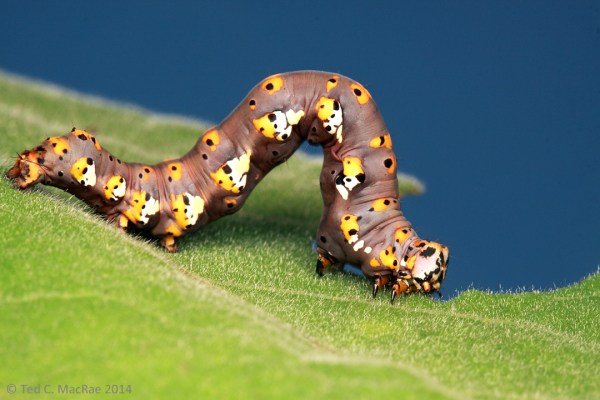
A striking mallow caterpillar

Tarache delecta ("mallow caterpillar") on Hibiscus lasiocarpus | Hickman Co., Kentucky

Tarache delecta (“mallow caterpillar”) on Hibiscus lasiocarpus | Hickman Co., Kentucky

Last month while searching stands of Hibiscus lasiocarpus (hairy rose mallow) in western Kentucky, I encountered this rather large caterpillar feeding on the foliage. I presumed that something as large and striking in appearance as this should be a cinch to identify by scanning through photos on BugGuide, and not surprisingly I found photographs (here, here and here) of two very similar looking caterpillars from Oklahoma posted by Charles Schurch Lewallen. None of the photos, however, had an identification associated with them other than subfamily Acontiinae (family Noctuidae). The contributor mentioned in one of the photos that he had found nothing similar in the Wagner (2005) “bible” (a book that I do not yet own but hope to soon). Armed with this scant information (but definitive knowledge of its host plant), I searched Noctuidae of North America and settled on Tarache delecta as a good possibility. According to that site, T. delecta is the only member of the Acontiinae that feeds on plants in the genus Hibiscus. The site references Crumb (1956) for a larval description, but more useful was a plate of black & white photos that I found in Weiss (1919) and that seemed to be a good match for the species I had photographed. Weiss (1919) refers to the larva as the “mallow caterpillar” and notes that full grown larvae are 34–36 mm in length and dark purple with black spots edged with orange—consistent with the caterpillar shown here.

Apparently this species has been considered a pest of ornamental mallows. Weiss (1919) notes that the larvae feed on the upper and lower leaf surfaces usually near the margins, making large holes in the leaves and sometime devouring parts of the bracts around the buds. I will also note that, in recommending control of the caterpillars, he states that “there does not seem to be any reason why spraying with arsenate of lead should not be successful.” My, how times have changed!

REFERENCE:

Crumb, S. E. 1956. The larvae of the Phalaenidae. U. S. Department of Agriculture, Technical Bulletin 1135, 356 pp. + 10 plates [Google Books].

Wagner, D. L. 2005. Caterpillars of Eastern North America: A Guide to Identification and Natural History. Princeton University Press, Princeton, New Jersey, 512 pp. [Amazon].

Weiss, H. B. 1919. The more important insect enemies of the rose-mallow in New Jersey. New Jersey Department of Agriculture, Bureau of Statistics and Inspection Circular 25, 9 pp. + 4 plates [Google Books].

© Ted C. MacRae 2014
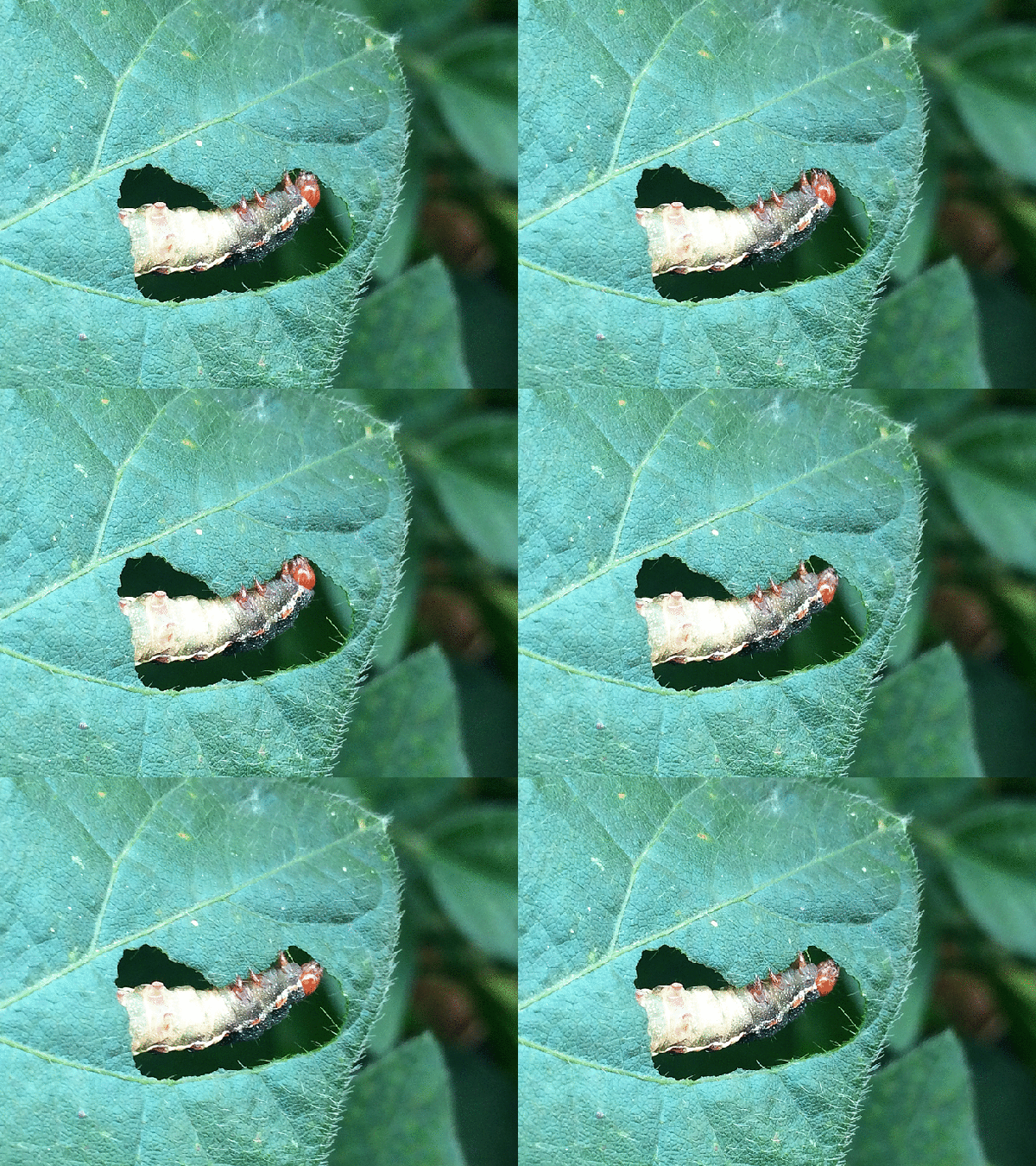
Southern armyworm feeding on soybean

Southern armyworm (Spodoptera eridania) late-instar larva feeding on soybean.

Southern armyworm (Spodoptera eridania) late-instar larva feeding on soybean.

Here is another animated gif that I made recently, this one showing a late-instar larva of southern armyworm (Spodoptera eridania) feeding on soybean (Glycine max). This polyphagous species is widely distributed from the southern U.S. through the northern half of South America and feeds on a variety of weeds, especially pigweed (Amaranthus spp.) and pokeweed (Phytolacca americana). It also occasionally attacks vegetable, fruit, and ornamental crops; however, in recent years it has become increasingly important on cultivated soybean in Brazil and Argentina, especially in regions where cotton is also cultivated. As a result, they have become one of the insects that I deal with regularly in my own research. More information on this and other armyworm species that affect soybean can be found in my earlier post, Quick Guide to Armyworms on Soybean.

Like many other lepidopteran caterpillars that feed on foliage, late-instar larvae become “feeding machines” that remain active both day and night as they try to cram as much nutrition into their expanding bag of a body as possible in preparation for an adult life focused solely on finding mates and laying eggs. Large larvae actively feeding during the day can be rather conspicuous, and as a result they often secrete themselves on the undersides of the leaves while feeding to make themselves less visible to predators. As they feed, however, a “window” opens up that gradually eliminates their cover. Rather than remaining in the same spot and feeding until they are completely exposed, however, larvae will move when the feeding hole reaches a certain size and find another place to conceal themselves before resuming feeding. Different caterpillar species have different exposure tolerances, and as a result, this combines with slight differences also in preferred tissue types to create recognizable differences in the damage patterns resulting from feeding by different species.

For those interested, making these animated gifs is really simple and allows those of us without expensive macro-video gear to simulate short videos of insect behavior. I make my animated gifs at GIFMaker.me—all you do is take a series of photos, touch them up in photo editing software (I use Photoshop Elements to adjust levels, color and sharpness), upload them to the site in the sequence desired, and click “Create Now”. It couldn’t be easier! You don’t even need a “real” camera—I took the photos for this gif with my iPhone using the “burst” function to take a rapid sequence of photos (all you do is hold your finger down on the shutter button for the desired length of time).

© Ted C. MacRae

Not all soybean caterpillars are ‘ugly’!

Although photographs of beetles dominate this site (they are my true love, after all), I am nevertheless an agricultural entomologist by day and, as such, find occasion to post photos of the insects I encounter in my area of expertise—soybean. I think by and large those soybean insects—especially the caterpillars—don’t generate as much interest as the beetles that I feature. I guess this is understandable—caterpillars of the agricultural pest variety seem generally unable to compete with the visual and behavioral charisma exhibited by jewel beetles, tiger beetles, tortoise beetles, etc. Here, however, is an example of a soybean caterpillar that is as beautiful as any beetle you will find—the larva of the silver-spotted skipper, Epargyreus clarus (Lepidoptera: Hesperiidae). Not only are the colors to die for, but that comically big head makes for a truly laughable frontal portrait!

Epargyreus clarus (silver-spotted skipper) late-instar larva on soybean | Baton Rouge, Louisiana

Epargyreus clarus (silver-spotted skipper) late-instar larva on soybean | Baton Rouge, Louisiana

This particular individual was found last September in a soybean field near Baton Rouge, Louisiana (amazingly, this is the first insect I have featured from Louisiana). Silver-spotted skippers feed on a wide variety of plants in the family Fabaceae (of which soybean is a member), but their occurrence on soybean rarely reaches levels that cause any economic impact. Normally the caterpillars hide during the day in a silken nest constructed by folding over a leaflet or tying adjacent leaflets together, emerging only at night to feed.

What a pretty face!

What a pretty face!

I suppose the orange spots on the head are intended to serve as false eye spots—for some reason the larger the eyes the more a potential predator seems to take pause before deciding to eat something. The actual eyes can be seen along the outer edge of the orange spot as a row of simple ocelli—incapable of forming sharp images and serving as little more than light and motion detectors. I can’t even begin to speculate on the function of the curious asperate/rugose texture of the head!

Copyright © Ted C. MacRae 2014