Brazil Bugs #1

ID Challenge #3 update: I knew this would be a hard one, and so far nobody has figured this one out (only one commenter got the right order!).  I’ve released the comments gotten so far so you can see where things stand, and maybe with the additional information (and my pointing out an important clue) it will be enough for one of you to arrive at a full ID.  Further comments are still being moderated until I decide to close the challenge.  Right now the points are there for the taking!


This past Monday I embarked on an extended business trip to Brazil.  “Wow, Brazil!” – you say, and while getting to travel to an exotic tropical locality on my company’s dime definitely rocks, I do have to justify the trip by actually working.  Add that to the time involved with planes, automobiles, and hotel transfers, and there is precious little time for more esoteric activities such as photographing insects.  It is Brazil, however, and summer at that, so whatever time does become available over the next ten days, I’ll be on it!  I’m stationed in Campinas, about 2 hours north of São Paulo, and this evening I had my first opportunity to break out the camera and do a little exploring around the hotel grounds during the waning hours of daylight. I’m not normally one to take short walks just looking for any random insect to photograph, but hey – it’s Brazil!  I also don’t normally like to post photographs of insects without knowing much about them – especially their identity. But hey, it’s Brazil!  I think I’ll be lucky to figure out most things to family, although I might be able to drill down a little further on occasion.  With that prelude, I hope you’ll indulge me these random postings over the next 10 days or so, primarily photographs but perhaps accompanied by a little bit of text.
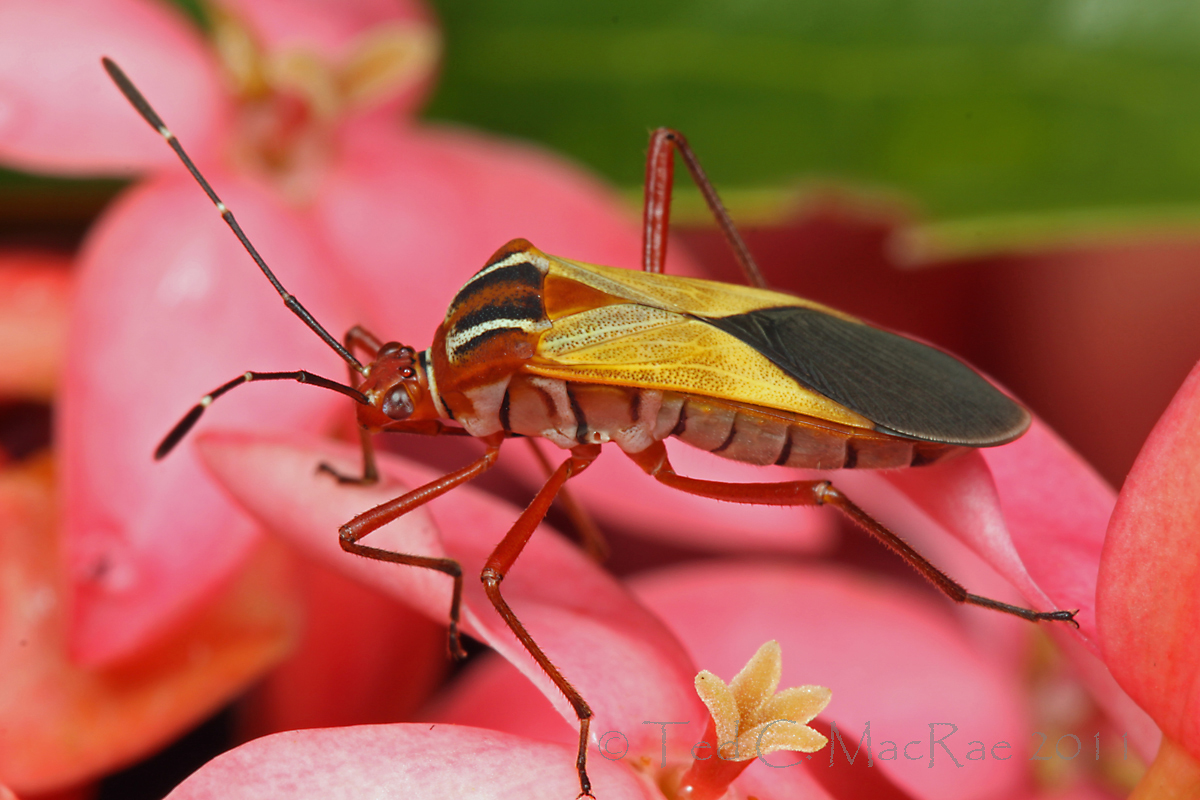
Coreidae?

At first I thought this was a member of the hemipteran family Pyrrhocoridae (red bugs), as some North American species have similar coloration; however, members of that family apparently lack ocelli, which this insect clearly possesses. This would seem to indicate instead some species of Lygaeidae (seed bugs), but the forewing membrane with numerous veins arising from a transverse basal vein and presence of what appears to be a distinct metathoracic scent gland opening suggest instead some “unleaf-footed” species of leaf-footed bug (Coreidae). Whatever its identity, I would imagine it is quite distasteful, based on what clearly seems to be aposematic coloration and the fact that there were numbers of these bugs hanging out quite conspicuously on these flowers.
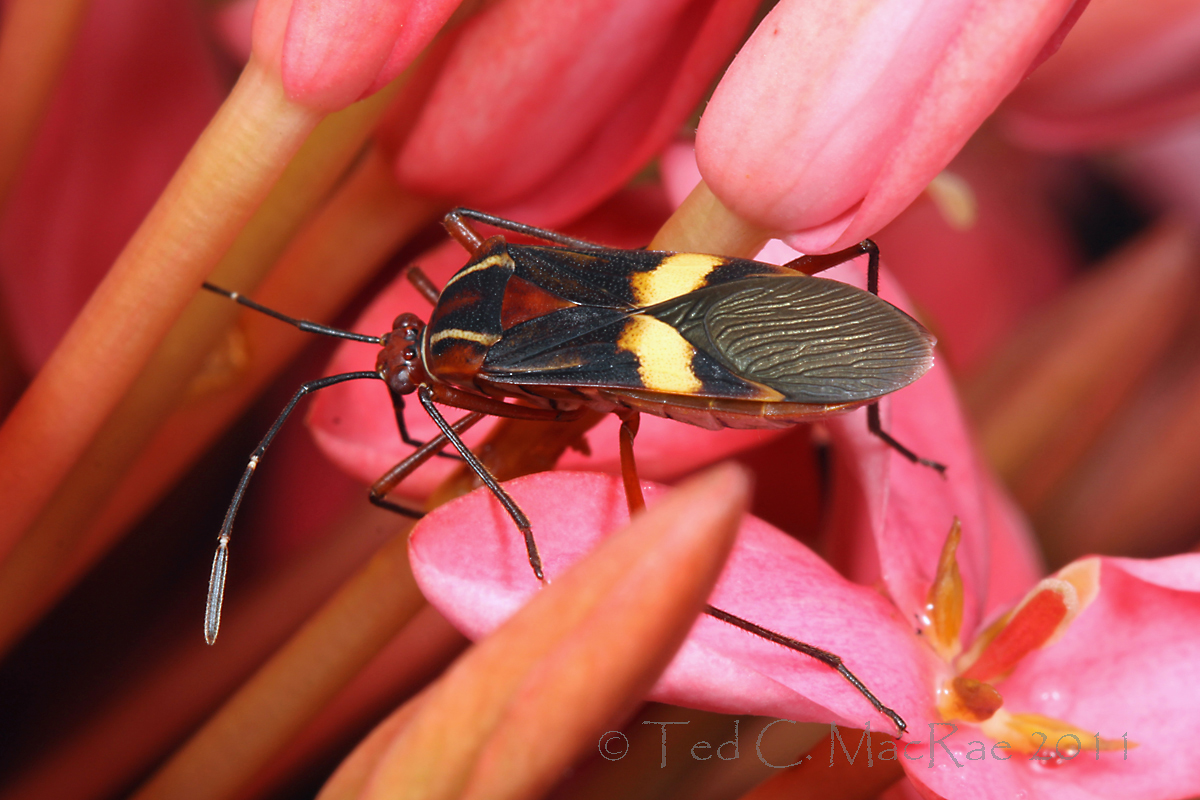
Same species?

This individual was differently colored than the others, but otherwise it seemed structurally and behaviorally identical.  Is it merely a highly melanized individual?  Maybe a case of sexual dimorphism, and I only saw this one individual of one of the sexes?  Maybe it truly is a different species – it is Brazil, afterall!

Pseudoplusia includens?

Daylight began to slip away much too soon, and I was about to pack it up when  I noticed some blurs at the flowers.  I realized that moths had begun to visit the flowers in the obscurity of dusk and became determined to photograph one, despite the fact that they never actually landed on the flowers but hovered in front of them instead.  It was quite difficult to even get them framed in the viewfinder, and on those few occasions when I managed to do this it was all but impossible to spend any time trying to focus – I used the lamp on the flash unit to help me see the moth, then just framed and quickly took the shot.  This one actually turned out not too bad – a little bit of blur in the wings but otherwise acceptable enough to let me tentatively identify it as Pseudoplusia includens (soybean looper).  Brazil is well on its way to becoming the world’s largest producer of soybean, and the caterpillars of these moths are enjoying the bounty!
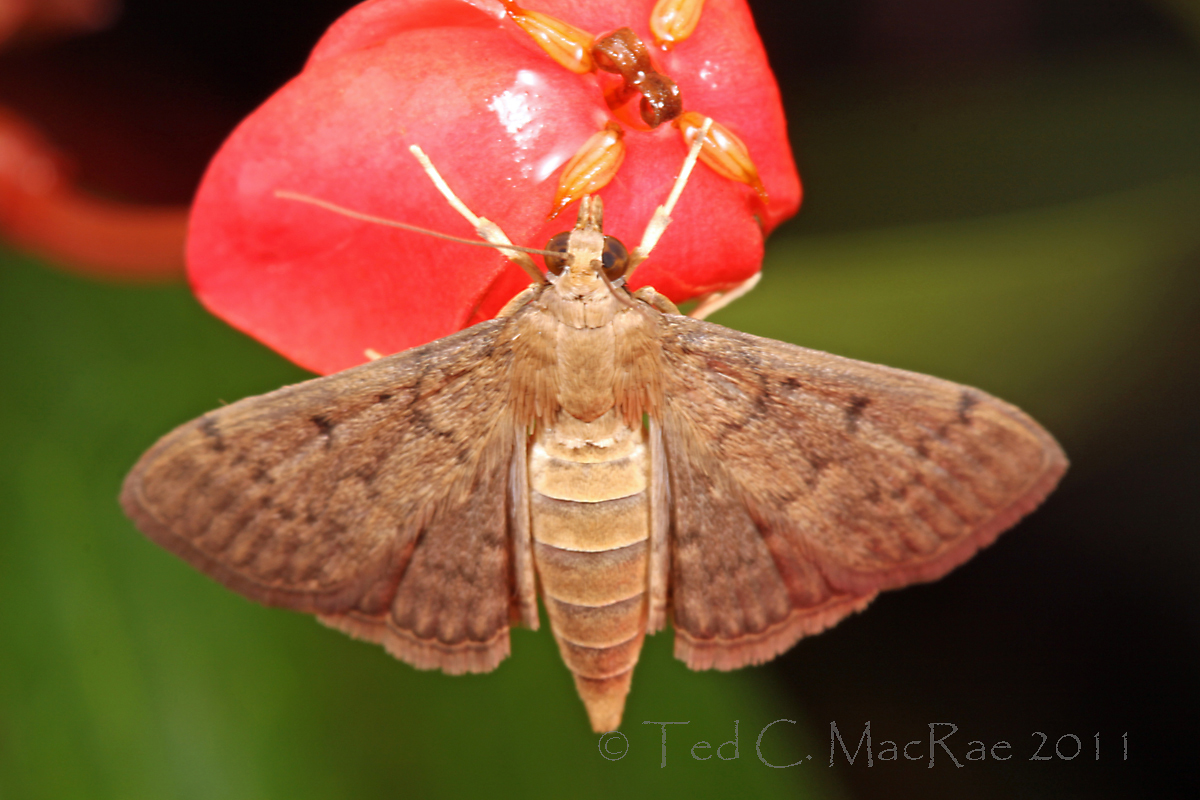
Family Crambidae, possibly Herpetogramma phaeopteralis (ID by Chris Grinter)

I saw one last moth before the final traces of daylight disappeared – I don’t have any idea about its identity, but it’s a pretty picture nonetheless.  It has the generic look of the large family Noctuidae, so that’s what I’m gonna go with until somebody tells me differently.  Edit 1/20/11 – Somebody just told me differently!  According to Chris Grinter, this is a species of Crambidae, possibly Herpetogramma phaeopteralis (tropical sod webworm).  Thanks, Chris!

I don’t know the name of the plant whose flowers these insects were visiting, but the hotel staff has promised to ask their gardener in the morning and let me know – now that’s service!

Copyright © Ted C. MacRae 2011

Magodo – giant twig wilter

petascelis-remipes

In previous posts, I have highlighted some of the insects I observed on a trip to South Africa in November-December 1999.  All of the photos I have shown to this point were taken at Borakalalo National Park in North West Province or at the Geelhoutbos farm of Susan Strauss below the Waterberg Range in the formerly Northern, now Limpopo Province.  Both of these locations are deep inside the bushveld, providing ample opportunity to observe an incredible diversity of insect life.  This is not to say that insects, even spectacular ones, cannot be found in more urban areas.  During the weekend between those two mini-expeditions, I stayed with my friend and colleague, Chuck Bellamy, at his home in Pretoria, a beautiful city with lovely architecture, elegant gardens… and some very impressive bugs!  The bug in this photo was found on a tree in a shrubby enclave, and at well over 35 mm in length it is easily the largest leaf-footed bug (order Hemiptera, family Coreidae) that I have ever seen.  Its chunky build, velvety black coloration with thin yellow lines along the sides and down the center of the thorax, and greatly enlarged hind femora quickly led me to a provisional identification of a male Petascelis remipes, or giant twig wilter.  This ID was confirmed by my friend and colleague Harry Brailovsky, an entomologist at UNAM (Universidad Nacional Autónoma de México) and world expert on Coreidae (and who, incidentally, just recently published a review of this Afrotropical genus – Brailovsky 2008).

According to Picker et al. (2002), these insects are found on plants in the genus Combretum.  Like most species in the family, they have scent (“stink”) glands that provide defensive capabilities. Adults are gregarious and bold, walking towards intruders with antennae vibrating when disturbed, and they are apparently capable of squirting their defensive secretions for some distance.  The nymphs are black as well but futher advertise their noxiousness with warning coloration of red spots on a whitish background. Interestingly, and despite their powerful chemical defenses, this species is considered a delicacy in parts of Mozambique where it is known as Magodo.  In a post called Insects for Dinner (in a blog with the eerily similar title, Beating about the Bush), Bart Wursten of Gorongosa National Park in Mozambique describes how local folk burn small patches of the grassland in which these insects are found to smoke them out and catch them.  The Magodo hunters kill the bugs by breaking off the head and removing the scent glands, which releases a very strong almond-like smell.  In doing this, the locals are able to catch considerable quantities of the bugs, which they eat with supper.

Lest you believe such practices are an anomaly, van Huis (2003) has compiled a list of about 250 insect species used as food in sub-Saharan Africa.  Lepidoptera, Orthoptera and Coleoptera represented the bulk (78%) of species eaten, with Isoptera, Hemiptera, Hymenoptera, Diptera and Odonota making up the rest.  Several examples of toxic insects and the traditional methods used to remove the poisons were given.  It was noted that whether or not insects are eaten depends not only on taste and nutritional value, but also on customs and ethnic preferences or prohibitions.  I’m not one to shy away from the thought of eating insects – after all, shrimp are just bugs that live in water, and insects rank far lower in ‘slime factor’ than many other invertebrates (e.g., oysters) that enjoy great popularity in our culture.  I’ve eaten roasted beet armyworm (Spodoptera exigua) pupae and munched on chocolate covered ants, but that’s kid stuff – the armyworms tasted like the soy sauce in which they were roasted, and the ants tasted like, well… chocolate.  I did once eat a softshelled crab (alive!), and I actually hope to one day taste the enormous grub of the giant metallic ceiba borer, Euchroma gigantea, eaten by indigenous cultures in Central and South America.   Still, I think I’d need a lot of faith in my chef’s scent gland removal prowess before I started scarfing Magodo down like popcorn.

What insects have you eaten?

REFERENCES:

Brailovsky, H.  2008. Notes on the genus Petascelis Signoret and description of one new species (Hemiptera: Heteroptera: Coreidae: Coreinae: Petascelini).  Zootaxa 1749:18–26.

Picker, M., C. Griffiths and A. Weaving. 2002. Field Guide to Insects of South Africa. Struik Publishers, Cape Town, 444 pp.

van Huis, A. 2003. Insects as food in sub-Saharan Africa. Insect Science and Its Application 23(3):163-185.

Copyright © Ted C. MacRae 2009

Add to FacebookAdd to NewsvineAdd to DiggAdd to Del.icio.usAdd to StumbleuponAdd to RedditAdd to BlinklistAdd to Ma.gnoliaAdd to TechnoratiAdd to Furl