Best of BitB 2013

Welcome to the 6th Annual “Best of BitB”, where I pick my favorite photographs from the past year. Like last year, 2013 was another year of heavy travel. For work I did my annual tour of soybean field sites throughout Argentina during late February and early March, then cranked it up for my own field season with frequent travel to sites in Illinois and Tennessee from May to October. In the meantime I spent a week at company meetings in Las Vegas in August, toured field sites across the southeastern U.S. for two weeks in September, visited Argentina again in October to finalize research plans for their upcoming season, and finished off the travel year by attending the Entomological Society of America (ESA) Meetings in Austin, Texas during November. On top of all this, I managed to slip in two of the best insect collecting trips I’ve had in years, with 10 days in northwestern Oklahoma in early June and another 10 days in California, Nevada, Utah, and Colorado during late August, and I got to play “visiting scientist” during short trips to Montana State University in late July and the Illinois Natural History Survey in late October! Of course, during my brief interludes at home I wasn’t sitting still, giving entomology seminars to several local nature societies and hosting two ESA webinars on insect photography. Needless to say, come December I was more than ready to spend some quite time at home (well, except for hiking most weekends) and am happy to report that I’ve successfully become reacquainted with my family and office mates. It’s a peripatetic life—and I wouldn’t have it any other way!

Okay, let’s get down to business. Here are my favorite BitB photographs from 2013. This year was less about learning new techniques as it was about refining the techniques I’ve found most useful for the style I’ve chosen as a photographer, i.e., hand-held, in situ field shots that (hopefully) excel at both natural history and aesthetic beauty. Links to original posts are provided for each photo selection, and I welcome any comments you may have regarding which (if any) is your favorite and why—such feedback will be helpful for me as I continue to hone my craft. If you’re interested, here are my previous years’ picks for 2008, 2009, 2010, 2011, and 2012. Once again, thank you for your readership, and I hope to see you in 2014!


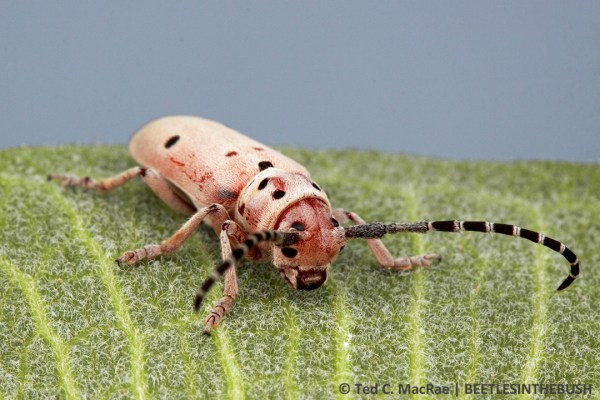
Tremex columba, female ovipositing | Sam A. Baker State Park, Missouri

Tremex columba female drilling for oviposition into hardwood trunk | Sam A. Baker State Park, Missouri

From Ovipositing Pigeon Horntail (posted 6 Jan). I like this photo for the combination of vibrant, contrasting colors between the wasp and moss-covered wood and the visualization it provides of the remarkable depth to which this wasp will insert its ovipositor into solid wood!


Eurhinus cf. adonis on Solidago chilensis | Chaco Province, Argentina

Eurhinus cf. adonis on Solidago chilensis flowers | Chaco Province, Argentina

From Giving me the weevil eye! (posted 28 Apr). While a little soft, the color combination is pleasing and the pose taken by the beetle almost comically inquisitive.
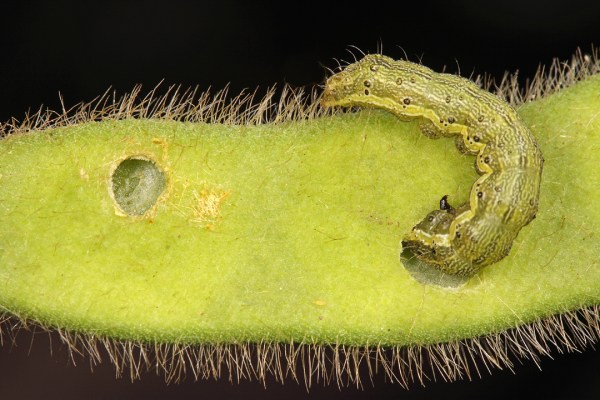

Helicoverpa gelotopeon feeding on soybean pod | Buenos Aires Prov., Argentina

Helicoverpa gelotopeon feeding on soybean pod | Buenos Aires Prov., Argentina

From Bollworms rising! (posted 30 Mar). This is the first photo of an economic pest that has made one of my “Best of BitB” lists. The two holes in the soybean pod, one with the caterpillar and its head still completely inserted, visualizes how the feeding habits of these insects can so dramatically affect yield of the crop.


cf. Eremochrysa punctinervis | Gloss Mountains, Major Co., Oklahoma

cf. Eremochrysa punctinervis | Gloss Mountains, Major Co., Oklahoma

From “Blue-sky” tips and tricks (posted 1 July). Insects with a lot of delicate detail and long, thin appendages are especially difficult to photograph against the sky due to wind movement. See how I dealt with the antennae of this delicate lacewing without resorting to the standard black background typical of full-flash macrophotography.


Cicindela scutellaris lecontei x s. unicolor

Cicindela scutellaris lecontei x s. unicolor intergrade | Holly Ridge Natural Area, Stoddard Co., Missouri

From The Festive Tiger Beetle in Southeast Missouri (posted 25 Oct). I like this photo a lot more now than I did when I first took it. Its shadowy feel and the beetle “peering” from behind a leaf edge give a sense of this beetle’s attempts to hide and then checking to see if the “coast is clear”


Batyle suturalis on paperflower (Psilostrophe villosa) | Alabaster Caverns State Park, Woodward Co., Oklahoma

Batyle suturalis on Psilostrophe villosa flowers | Alabaster Caverns State Park, Woodward Co., Oklahoma

From Tips for photographing shiny beetles on yellow flowers (posted 10 Aug). “Bug on a flower” photos are a dime a dozen, but shiny beetles on yellow flowers with natural sky background can be quite difficult to take. All of the techniques for dealing with the problems posed by such a photo came together nicely in this photo.
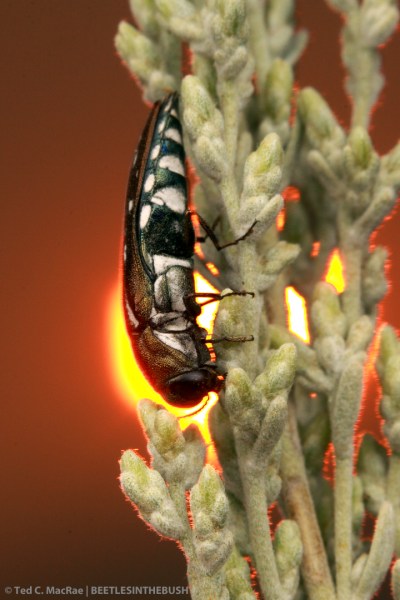

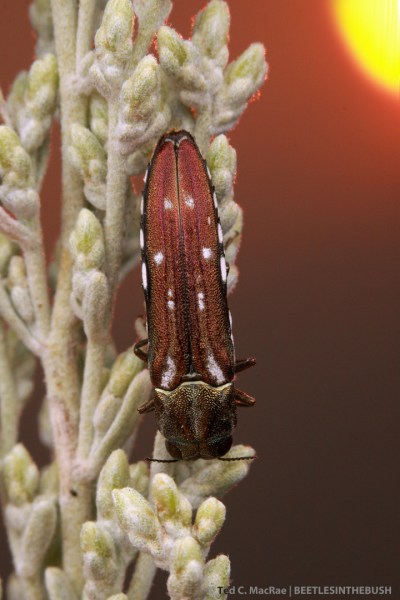
Agrilus walsinghami | Davis Creek Regional Park, Washoe Co., Nevada

Agrilus walsinghami | Davis Creek Regional Park, Washoe Co., Nevada

From Sunset for another great collecting trip (posted 1 Sep). This photo is not without its problems, with a little blurring of the backlit fuzz on the plant, but the placement of the sun behind the subject’s head and resulting color combination make it my favorite in my first attempts at achieving a “sun-in-the-sky” background with a true insect macrophotograph.


A tiny male mates with the ginormous female.

Pyrota bilineata on Chrysothamnus viscidflorus | San Juan Co., Utah

From Midget male meloid mates with mega mama (posted 8 Nov). Another blue-sky-background photograph with good color contrast, its real selling point is the natural history depicted. with some of the most extreme size dimorphism among mating insects that I’ve ever seen.
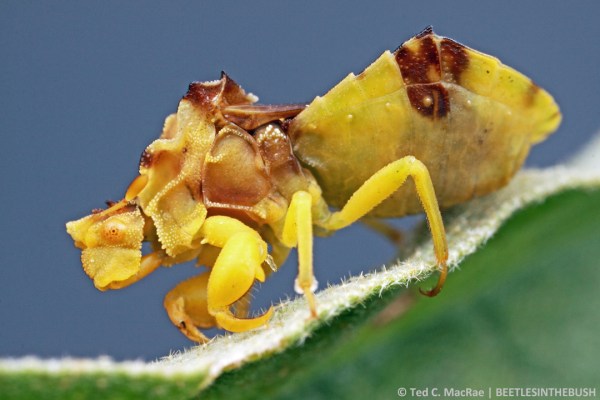

Phymata sp.

Phymata sp. on Croton eleagnifolium foliage | Austin, Texas

From ESA Insect Macrophotography Workshop (posted 13 Nov). The oddly sculpted and chiseled body parts of ambush bugs makes them look like they were assembled from robots. Contrasting the body against a blue sky gives a more unconventional view of these odd beasts than the typical top-down-while-sitting-on-a-flower view.
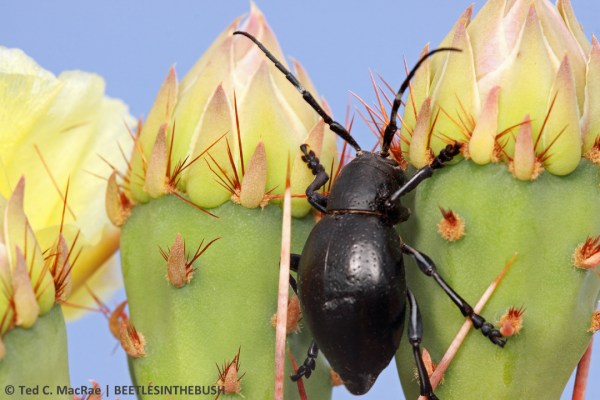

Fourth attempt - holding detached pad up against sky for cleaner background.

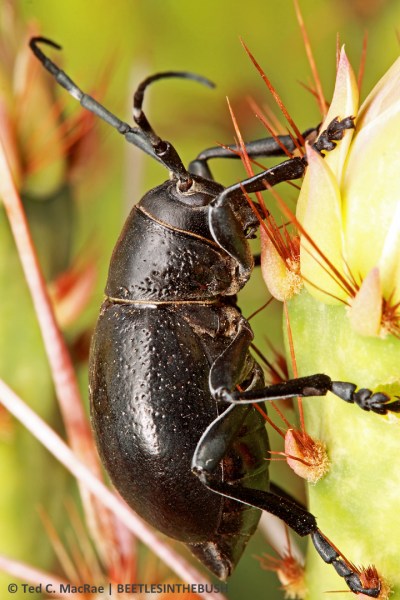
Moneilema armata on Opuntia macrorhiza | Alabaster Caverns State Park, Woodward Co., Oklahoma

From Q: How do you photograph cactus beetles? (posted 24 Nov). Photographing cactus beetles requires patience, persistence, long forceps, and strong forearms. Natural sky provides a much more pleasing background than a clutter of cactus pads and jutting spines.


I hope you’ve enjoyed this 2013 version of “Best of BitB” and look forward to seeing everyone in 2014.

Copyright © Ted C. MacRae 2013

Hairy milkweed beetle

Across the Great Plains of North America, sand dune fields dot the landscape along rivers flowing east out of the Rocky Mountains. Formed by repeated periods of drought and the action of prevailing south/southwest winds on alluvium exposed by uplifting over the past several million years, many of these dunes boast unique assemblages of plants and animals adapted to their harsh, xeric conditions. Some are no longer active, while others remain active to this day. Among the latter is Beaver Dunes in the panhandle of northwestern Oklahoma.

Beaver Dunes, Oklahoma

Beaver Dunes State Park, Beaver Co., Oklahoma

As I explored the more vegetated areas around the perimeter of the dunes, I spotted the characteristically hairy, fleshy, opposite leaves of Ascelpias arenaria. Known also as “sand milkweed,” this plant is associated with sand dunes and other dry sandy soil sites throughout the central and southern Great Plains. I always give milkweeds a second look whenever I encounter them due to the association with them by longhorned beetles in the genus Tetraopes. It wasn’t long before I spotted the black antennae and red head of one of these beetles peering over one of the upper leaves from the other side.

Tetraopes pilosus on Asclepias arenaria

Tetraopes pilosus on Asclepias arenaria | Beaver Dunes State Park, Oklahoma

This was no ordinary Tetraopes, however. Its large size, dense covering of white pubescence, and association with sand milkweed told me immediately that this must be T. pilosus (the specific epithet meaning “hairy”). Like its host, this particular milkweed beetle is restricted to Quaternary sandhills in the central and southern Great Plains (Chemsak 1963), and also like its host the dense clothing of white pubescence is presumably an adaptation to prevent moisture loss and overheating in their xeric dune habitats (Farrell & Mitter 1998).

Tetraopes pilosus

Species of Tetraopes have the eyes completely divided by the antennal insertions—thus, “four eyes.”

Tetraopes is a highly specialized lineage distributed from Guatemala to Canada that feed as both larvae and adults exclusively on milkweed (Chemsak 1963). Larval feeding occurs in and around the roots of living plants, a habit exhibited by only a few other genera of Cerambycidae but unique in the subfamily Lamiinae (Linsley 1961). Milkweed plants are protected from most vertebrate and invertebrate herbivores by paralytic toxins, commonly termed cardiac glycosides or cardenolides. However, a few insects, Tetraopes being the most common and diverse, have not only evolved cardenolide insensitivity but also the ability to sequester these toxins for their own defense. Virtually all insects that feed on milkweed and their relatives have evolved aposematic coloration to advertise their unpalatability, and the bright red and black color schemes exhibited by milkweed beetles are no exception.

Species of the genus Tetraopes are characterized by the completely divided eyes.

Adult beetles, like the leaves of their hosts, are clothed in white pubescence.

As  noted by Mittler & Farrel (1998), variation in coloration among the different species of Tetraopes may be correlated with host chemistry. Milkweed species vary in toxicity, with more basal species expressing simpler cardenolides of lower toxicity and derived species possessing more complex and toxic analogs. Most species of Tetraopes are associated with a single species of milkweed, and it has been noted that adults of those affiliated with less toxic milkweeds on average are smaller, have less of their body surface brightly colored, and are quicker to take flight (Chemsak 1963, Farrell & Mitter 1998). Thus, there seems to be a direct correlation between the amount of protection afforded by their host plant and the degree to which the adults advertise their unpalatability and exhibit escape behaviors. Asclepias arenaria and related species are the most derived in the genus and contain the highest concentrations of cardenolides. In fact, they seem to be fed upon only by Tetraopes and monarchs while being generally free from other more oligophagous insect herbivores such as ctenuchine arctiid moths and chrysomelid beetles that feed on less derived species of milkweed (Farrell & Mitter 1998). Accordingly, T. pilosus is among the largest species in the genus and has the majority of its body surface red. Also, consistent with it being more highly protected than others in the genus, I noted virtually no attempted escape behavior as I photographed this lone adult.

Asclepias arenaria

Asclepias arenaria (sand milkweed) growing at the base of a dune.

In addition to metabolic insensitivity to cardenolides, adult Tetraopes also exhibit behavioral adaptations to avoid milkweed defenses (Doussard & Eisner 1987). The milky sap of milkweed is thick with latex that quickly dries to a sticky glue that can incapacitate the mouthparts of chewing insects that feed upon the sap-filled tissues. Adult Tetraopes, however, use their mandibles to cut through the leaf midrib about a quarter of the way back from the tip. This allows much of the sticky latex-filled sap to drain from the more distal tissues, on which the beetle then begins feeding at the tip. Leaves with chewed tips and cut midribs are telltale signs of feeding by adult Tetraopes.

REFERENCES:

Chemsak, J. A. 1963. Taxonomy and bionomics of the genus Tetraopes (Coleoptera: Cerambycidae). University of California Publications in Entomology 30(1):1–90, 9 plates.

Doussard, D. E. & T. Eisner. 1987. Vein-cutting behavior: insect counterploy to the latex defense of plants. Science 237:898–901 [abstract].

Farrell, B. D. & C. Mitter. 1998. The timing of insect/plant diversification: might Tetraopes (Coleoptera: Cerambycidae) and Asclepias (Asclepiadaceae) have co-evolved? Biological Journal of the Linnean Society 63: 553–577 [pdf].

Linsley, E.G. 1961. The Cerambycidae of North America. Part 1. Introduction. University of California Publications in Entomology 18:1–97, 35 plates.

Copyright © Ted C. MacRae 2013
A winter longhorned beetle

According to the calendar it’s still autumn; however, in practical terms winter has settled in across much of the U.S. For those of us who study wood-boring beetles in the families Buprestidae (jewel beetles) and Cerambycidae (longhorned beetles), our time for collecting ended long ago. Adults of most species are active in spring and early summer, although some species don’t really make their appearance until summer is in full swing and a few rather distinctive species in genera such as Crossidius and Megacyllene make their appearance exclusively during fall. There is one longhorned beetle, however, that can actually be encountered in its greatest numbers during the dead of winter—Rhagium inquisitor, or the “ribbed pine borer.”

Rhagium inquisitor | Reynolds Co., Missouri

Rhagium inquisitor overwintering adult | Reynolds Co., Missouri

Rhagium inquisitor is unique among North American cerambycids in several respects. Most species in the family overwinter as mature or immature larvae, the former triggered to pupation by the first warm days of late winter and early spring in preparation for emergence as adults a few weeks later. Rhagium inquisitor, on the other hand, pupates during late summer and fall and then transforms to the adult before winter sets in (Linsley & Chemsak 1972), passing the winter in this stage and emerging during the earliest days of spring. Also unique among North American cerambycids is the place of pupation—directly under the bark. This contrasts with most other species, which either feed and pupate within the sapwood or feed under the bark but then bore into the sapwood for pupation. The species breeds exclusively in the trunks of dead conifers, with pines (Pinus spp.) especially favored, and as a result one can easily encounter the adults by peeling back the bark of dead pines during winter. Pupation takes place within distinctive rings of frass and coarse, fibrous wood shavings, prepared by the larva prior to pupation, so even when adults and larvae are not present the occurrence of this species can be determined by the occurrence of their pupation rings.

Adults overwinter in cells lined with frass and fibrous wood shavings.

Adults overwinter in cells lined with frass and fibrous wood shavings.

Not only are the overwintering and pupation habits of this species unique, but the adults themselves are distinctive from all other North American cerambycids (Yanega 1996) in their appearance—”big-shouldered” build, heavily “ribbed” elytra, and unusually short antennae (that are anything but “longhorned”). Lastly, the species is distributed not only in the boreal forests of North America, but Europe and Asia as well. The species is extremely variable in size and sculpturing, which combined with its Holarctic distribution has led to an unusually high number of synonyms. In fact, much of the North American literature prior to Linsley & Chemsak (1972) concluding that the North American and Eurasian forms represented the same species refers to this species as R. lineatum.

REFERENCES:

Linsely, E. G. & J. A. Chemsak. 1972. Cerambycidae of North America, Part VI, No. 1. Taxonomy and classification of the subfamily Lepturinae. University of California Publications in Entomology 69:viii + 1–138, 2 plates.

Yanega, D. 1996. Field Guide to Northeastern Longhorned Beetles (Coleoptera: Cerambycidae). Illinois Natural History Survey Manual 6: x + 1–174 [preview].

Copyright © Ted C. MacRae 2013

Q: How do you photograph cactus beetles?

A: Very carefully!

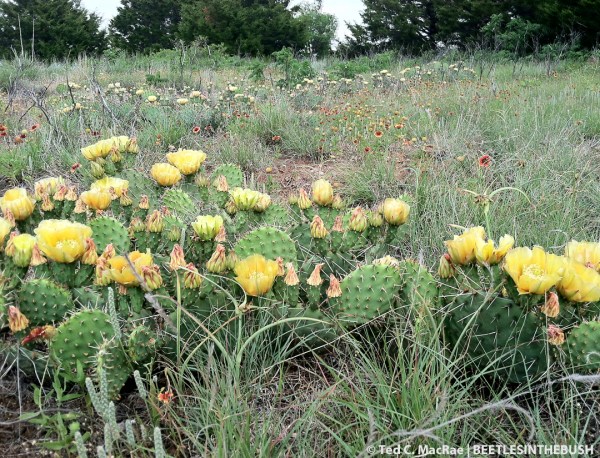
This past June I went out to one of my favorite spots in northwestern Oklahoma—Alabaster Caverns State Park in Woodward Co. The park, of course, is best known for its alabaster gypsum cavern—one of the largest such in the world—and the large population of bats that occupies it. Truth be told, in my several visits to the park during the past few years I have never been inside the cavern. The draw for me is—no surprise—it’s beetles. On my first visit in 2009 I found what is now known to be one of the largest extant populations of the rare Cylindera celeripes (swift tiger beetle), previously considered by some to be a potential candidate for listing on the federal endangered species list, and last year I found the northernmost locality of the interesting, fall-active jewel beetle Acmaeodera macra. This most recent visit was the earliest in the season yet, and as I walked the trails atop the mesa overlying the cavern I noticed numerous clumps of prickly pear cactus (Opuntia macrorhiza) dotting the landscape.

Opuntia phaecantha | Alabaster State Park, Woodward Co., Oklahoma

Opuntia macrorhiza | Alabaster Caverns State Park, Woodward Co., Oklahoma

Whenever I see prickly pear cactus anywhere west of Missouri I immediately think of cactus beetles—longhorned beetles in the genus Moneilema. A half-dozen species of these relatively large, bulky, clumsy, flightless, jet-black beetles live in the U.S., with another dozen or so extending the genus down into Mexico and Baja California, and all are associated exclusively with cactus, primarily species of the genus Opuntia. It wasn’t long before I found one, and deliberate searching among the cactus clumps produced a nice series of beetles representing what I later determined as M. armatum. The resemblance between Moneilema spp. and darkling beetles of the genus Eleodes is remarkable, not only in their appearance but also in their shared defensive habit of raising the abdomen when disturbed. The genus has been related taxonomically to the Old World genus Dorcadion, but Linsley & Chemsak (1984) regard the loss of wings and other morphological modifications to represent convergence resulting from the environmental constraints imposed by root-feeding, subterranean habits in arid environments and other situations where flightlessness is advantageous.

Moneilema armatum adult.

Moneilema armatum adult in situ on Opuntia macrorhiza pad.

I have encountered Moneilema beetles a number of times out west, including this species in Texas where it is most common, but since I have only been photographing insects for the past few years this was my first  chance to capture cactus beetle images as well as specimens. The above shot, taken with my iPhone, was straightforward enough, but I wanted some real photographs of the beetle—i.e., true close-up photos taken with a dedicated macro lens. I quickly learned that this would be highly problematic—those cactus spines are long and stiff and vicious, and these beetles are no dummies! Clearly their ability to adapt to such a terrifyingly well-defended plant has had a lot to do with the evolution of their slow, clumsy, flightless, you-don’t-scare-me demeanor. Normally when I photograph insects I do a little pruning or rearranging of nearby vegetation to get a clear, unobstructed view of the subject, and sometimes this also involves “pushing” my way into the vegetation to get the most desirable angle on the subject for the sake of composition. Not so here! In my first attempt, all I could think to do was locate a beetle sitting in repose and try to position myself in some way so that the beetle was within the viewfinder and the cactus’ spines were not impaled within my arms! The photo below shows the only shot out of several that I even considered halfway acceptable, but clearly the spines obstructing the view of the beetle were not going to be to my liking.

First attempt - looking down into plant where beetle was first sitting.

First attempt – looking down into plant where beetle was first sitting.

What to do? The beetle was behaving fairly well (i.e., it was not bolting for cover upon my approach), so I pulled out a pair of long forceps (that I carry with me for just such cases) and used them to gently prod the beetle into a more exposed position. The beetle crawled up onto one of the unopened cactus flower buds and perched momentarily, and I thought I had my winner photograph. I crouched down again, was able to get a little bit closer to the beetle than before, and fired a few shots. Looking at them in the preview window, however, left me still dissatisfied—the beetle was no longer obstructed, but the background was still jumbled, messy and dark, making it difficult for the dark-colored beetle to stand out. I would need to think of something else.

Second attempt - looking down on beetle after coaxing it up.

Second attempt – looking down on beetle after coaxing it up.

I actually take a lot of my photos with the insects sitting on plant parts that have been detached from the plant. This allows me to hold the plant in front of whatever background I choose and micro-adjust the position of the insect in the viewfinder for the best composition. This is “easier” (a relative term) with a shorter lens (think MP-E 65-mm) because the lens-to-subject distance matches almost perfectly the distance between my wrist and my fingers, allowing me to rest the camera lens on my wrist while holding the plant part with my fingers to “fix” the lens-to-subject distance. These beetles, however, are much too big for the MP-E 65-mm, so I had to use my longer 100-mm macro lens. The longer lens-to-subject distance does not allow resting the lens on my wrist, so I must come up with other ways of bracing myself and the subject to minimize movement. Detaching the pad on which the beetle was resting (and if you’ve never tried to detach an Opuntia cactus pad from its parent plant while trying not to disturb a beetle sitting on it, I can tell you it is not an easy thing), I also discovered that the pad was quite heavy and that holding it with the same forceps that I had used to prod the beetle (because of its vicious spines) was yet another unanticipated difficulty. I decided the best way to deal with it would be to get down on one knee in front of the plant, rest my arm on my other knee with the cactus pad extending out in front of me, and photograph the beetle with the plant as close in the background as possible to achieve a lighted and colored background that would help the beetle stand out. Following are examples of those attempts.

Third attempt - holding detaching pad with forceps for better view.

Third attempt – holding detaching pad with forceps for better view.

Detached allows even better close-ups.

Detached allows even better close-ups.

Better for sure, especially the latter, closer one. Still, I wasn’t satisfied—the backgrounds still just had too much clutter that detracted from the beetle and complicated the lighting. I decided to go for broke—why not go for the blue sky background, the cleanest, most natural and aesthetically pleasing background possible! This actually was my first thought when I saw the beetles, but I could never find one on a high enough plant that was growing in a situation where I was able to crouch low enough to get the angle with the sky in the background. By this time my arm was quite weak from holding the heavy cactus pad and squeezing the forceps firmly, and as I contemplated how I could possibly hold the pad up towards the sky and take the shots without being able to rest the camera on my arm I had an idea. Why not rest my arm on the camera? Specifically on top of the flash master unit atop the camera. I adjusted the camera settings for blue sky background, positioned the cactus pad in the forceps so that the pad (and beetle) were hanging down from the forceps but still in an upright position, pointed the camera to the brightest part of the sky (a few degrees from the sun), and then held the cactus pad out in front of the camera with my arm resting on the flash master unit. It worked! My arm still got tired quickly and needed frequent breaks, and I had to do a number of takes to get the exposure settings and composition I was looking for, but the photo below represents my closest approach to what I envisioned when I first knelt down to photograph these beetles. A clear view of the beetle, on its host plant, with lots of nice value contrast between beetle, plant and background.

Fourth attempt - holding detached pad up against sky for cleaner background.

Fourth attempt – holding detached pad up against sky for cleaner background.

Once I had the technique figured out, I was able to get some really close-ups shots as well, still, however, with enough blue sky in the background to make it clean and pretty…

Zooming in with sky background gives a nice, clean close-up.

Zooming in with sky background gives a nice, clean close-up.

…as well as playing with some unusual compositions that one can afford to try only after they are confident they have gotten the required shots. I am particularly fond of the following photo, in which the beetle appears to be “peeking” from behind its well-defended hiding place on its host plant.

Having a little fun with the close-ups - he's peaking!

Having a little fun with the close-ups – he’s peaking!

If you have any experiences photographing these or other such “well-defended” insects (without resorting to the white box!) I would love to hear about them.

REFERENCE:

Linsley, E. G. and J. A. Chemsak. 1984. The Cerambycidae of North America, Part VII, No. 1: Taxonomy and classification of the subfamily Lamiinae, tribes Parmenini through Acanthoderini. University of California Publications in Entomology 102:1–258 [preview].

Copyright © Ted C. MacRae 2013

GBCT Beetle #4—Crossidius hirtipes rubrescens

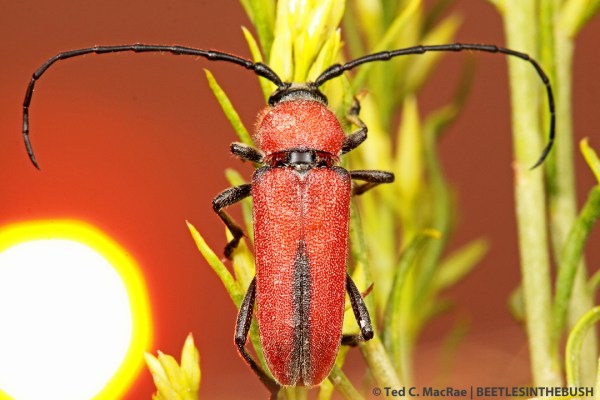
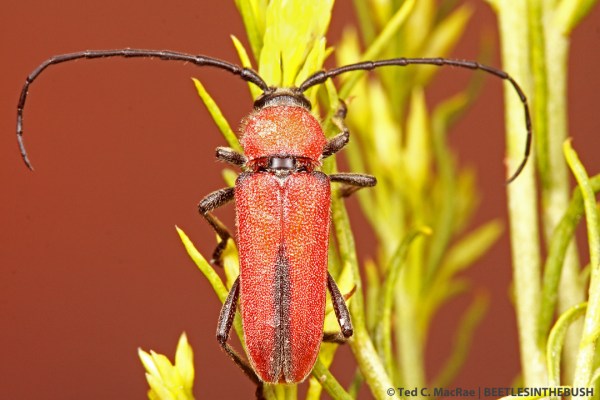
Crossidius hirtipes rubrescens (male) | Lyon Co., Nevada

Crossidius hirtipes rubrescens (male) | Lyon Co., Nevada

Linsley & Chemsak (1961) characterize the longhorned beetle species Crossidius hirtipes as “probably the most diverse species within the genus.” Occurring throughout the Great Basin and adjacent areas, the variability it expresses in punctation, color, elytral pattern and pubescence have resulted in the recognition of 16 named subspecies and numerous additional distinct but unnamed populations. During our Great Basin Collecting Trip (GBCT) in late August, we targeted ten of the named subspecies (representing the majority of populations found across the southern half of the species’ distribution) and succeeded in finding eight of them. I’ve already featured C. h. immaculatus, occurring across northern Nevada and northeastern California and the first beetle we found on the trip, and the photo above shows a male of what we consider to represent C. h. rubrescens—one of three C. hirtipes subspecies restricted to a very small area in west-central Nevada. Linsley & Chemsak (1961) described this subspecies from a series taken just north of Yearington on Chrysothamnus greenei (now Ericameria greenei), noting that it differs from other subspecies by its pinkish cast to its coloration and its pale appendages.

We almost did not find this subspecies.  We had stopped at several places along the road as we approached Yearington from the north and finally stopped at a spot 2.6 miles north of town with good stands of E. greenei. Although we found a few C. coralinus temprans on the plants, we did not see C. hirtipes. While we were searching we noticed a much smaller yellow-flowering asteraceous plant that at first we thought might be something in the genus Haplopappus but which I now believe represents a variety of Chrysothamnus viscidiflorus—the normal host plant for most subspecies of C. hirtipes (a plant voucher was collected and has been sent off for identification). We searched these plants as well but didn’t see any beetles on them, and after a while we decided we’d given the locality a good enough look and that we should move on. We began walking back towards the car, and as we approached the car I happened to look down and saw a mating pair of C. hirtipes sitting on a C. viscidiflorus flower. The pair split and bolted right when I saw them, but we managed to capture one of them and decided maybe we should look around a little more. The beetles were scarce, and another hour of searching produced only a handful—mostly in a small area further north of the area we had been searching. We then checked a couple of other nearby spots but found only a few host plants and no beetles, so we decided to go back to the site and search again. While none were seen in the original spot, we found much better stands of the plant in the adjacent area even further to the north and managed to collect a decent though not large series of adults before the setting sun caused the beetles to retreat and end our day. The individual in the photo above (recognizable as a male by its relatively longer antennae and immaculate elytra) was photographed as the setting sun turned the smoke-filled sky to a soft, burnt orange color that nicely compliments the color of the beetle.

REFERENCE:

Linsley, E. G. & J. A. Chemsak. 1961. A distributional and taxonomic study of the genus Crossidius (Coleoptera, Cerambycidae). Miscellaneous Publications of the Entomological Society of America 3(2):25–64 + 3 color plates.

Copyright © Ted C. MacRae 2013

Under Blood Red Skies

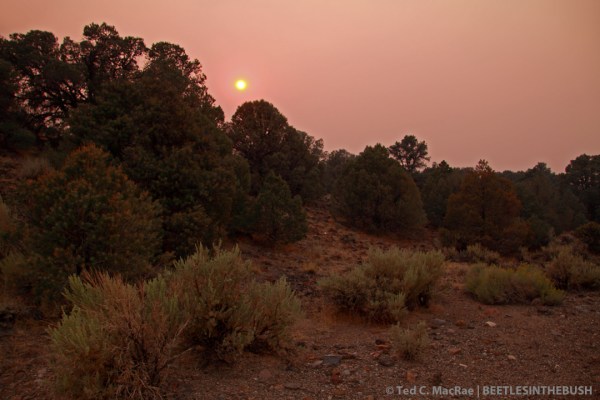
At the start of my recent Great Basin collecting trip, I found myself presented with a rather unique and unanticipated photographic opportunity. As I landed in Reno, Nevada, the then 6-day old Rim Fire was already well on it’s way to becoming the largest wildfire on record in the California Sierra Nevada. As acre after acre of the Sierra’s dramatic coniferous forest succumbed to the blaze, an enormous plum of smoke drifted northward for several hundred miles over eastern California and western Nevada, blanketing the area in a thick haze that turned the sun’s hot glare to a soft glow and limited visibility to under a mile. It was like a thick overcast foggy day, only without the cool, damp humidity. This was of little consequence to our business at hand—collecting beetles (although it did make pointless most attempts to photograph the area’s stunning landscape). At day’s end, however, a dramatic transformation took place in the sky as the sun sank lower and lower, turning to an increasingly red globe as it strained to shine through the ever thicker layer of smoke and haze. Then, for a few brief moments, the sun floated—a dark red globe under blood red skies—before the thick bottom layers of haze finally extinguished its fading light.

I’ve just begun trying to incorporate setting suns into my photography, having made to this point only a few attempts over Midwestern landscapes. I’m not really sure what gave me the idea, but I thought it might be fun to try incorporating the spectacular sun and unusual sky I was seeing as backgrounds in full-flash insect macrophotographs. Perhaps it seemed a logical progression from the natural sky background macrophotographs that I’ve put a lot of effort into perfecting this year. It was certainly a learning experience, but the basic principle is the same as it is for blue sky background—finding the right combination of camera and flash settings to balance flash illumination of the subject with ambient illumination of the background. The most difficult thing was, surprisingly, getting the sun in the desired position within the composition, as it does not appear through the viewfinder as the discrete ball that is seen in the photos. Rather, it appears as a large, amorphous, blinding flash that comes and goes as one pans across it, leading to a lot of guesswork regarding its actual position within the composition.

I gave a sneak preview of one of these photos in Sunset for another great collecting trip, and several of the photos I’ve shared since then have featured the remarkably colored sky in the background. Here are some other attempts that I was happy with:

Agrilus walsinghami (female) | Washoe Co., Nevada

Agrilus walsinghami (female) | Washoe Co., Nevada

Agrilus walsinghami (male) | Washoe Co., Nevada

Agrilus walsinghami (male) | Washoe Co., Nevada

Crossidius coralinus temprans (male) | Pershing Co., Nevada

Crossidius coralinus temprans (male) | Pershing Co., Nevada

Initially hot yellow (previous photo), the sun turns to soft yellow...

Initially hot yellow (previous photo), the sun turns to soft yellow…

...then yellow-red...

…then yellow-red…

...and finally blood-red!

…and finally blood-red!

Crossidius hirtipes macswainei (female) | Lyon Co., Nevada

Crossidius hirtipes macswainei (female) | Lyon Co., Nevada

Sunset over Toiyabe National Forest | Lyon Co., Nevada

Sunset over Toiyabe National Forest | Lyon Co., Nevada

Gray rabbitbrush (Ericameria nauseosa) | Lyon Co., Nevada

Gray rabbitbrush (Ericameria nauseosa) | Lyon Co., Nevada

Copyright © Ted C. MacRae 2013

GBCT Beetle #3—Crossidius coralinus temprans

On Day 2 of our late August Great Basin Collecting Trip (GBCT), we headed east from Reno towards Fallon (Churchill Co.) and surrounding areas of western Nevada. Our quarry on this day was one of the spectacular Crossidius coralinus subspecies—in this case C. c. temprans. This subspecies was described by Linsley & Chemsak (1961) from large series of specimens collected in Lassen Co., California, but also mentioned were specimens from several locations in west-central Nevada. This material was not included in the type series because of the disjunct distribution but was otherwise not distinguished from the temprans populations, and for us the drive to Churchill Co. was much more feasible logistically than Lassen Co.

Crossidius coralinus temprans (female) | Churchill Co., Nevada

Crossidius coralinus temprans (female) | Churchill Co., Nevada

The female in the photo above is the first individual I encountered at the first stop we made to look for them—a swale about 12 miles west of Fallon in which we noted thick stands of gray rabbitbrush (Chrysothamnus nauseosus) in the early stages of flowering. It was still fairly early in the day, and though we scoured the area thoroughly only a few individuals were seen. The female exhibits some of the main characteristics that set this subspecies apart from the other red/black coralinus subspecies, including the faint bluish overtones, the deep red color, the relatively fine but dense elytral punctation, and its smaller average size. Females in particular exhibit a uniform, broadly expanded black pattern on the elytra that extends along the suture to at least the basal third of the elytra and also possess broadly black humeri connected by a black basal band.

A male from Churchill Co. shows reduction of elytral markings relative to females.

A male, also from Churchill Co., shows reduced elytral markings compared to females.

We had better luck finding individuals in the area 10–15 miles south of Fallon. I’m not sure whether this was due to actual greater abundance or the fact that it was now late morning and temperatures had warmed since our first stop. Nevertheless, we found a mating pair on one of the plants that I had hoped to photograph, but the female got skittish and took flight. Normally when one partner flees the other one does as well, but for some reason the male stayed put—nicely perched on top of the plant—and allowed me to take some photographs. Because I had already disturbed the female, I was pretty sure any attempted handling of the plant to position it with the sky in the background would cause the male to flee as well, so I photographed it as it sat—messy background and all. Still, the male shows the typical characters for males of the subspecies, in particular the faintly bluish dark pattern that is slightly expanded laterally and tapers anteriorly along the suture to the basal one-third of the elytra.

Lateral profile of the male shows a hint of black at the elytral base.

Lateral profile of the male (same individual as above) shows a narrow black band at the base of the elytra.

This lateral shot of the same male was taken, in part, to get an angle that allowed for a cleaner background, but it also more clearly shows the very narrow black band at the base of the elytra that connects the humeri, though the black markings are not as broad as in the female. After photographing this male, we found a spot near Carson Lake where the rabbitbrush was common not just along the road, but in the adjacent rangelands and along dikes adjacent to the wetlands surrounding the lake. There we found pretty good numbers of adults and worked the area for a couple of hours until we had adequate series.

This male from Pershing Co., Nevada has the elytral marking reduced to a narrow sutural stripe.

This male from Pershing Co., Nevada has the elytral markings reduced to a narrow sutural stripe.

Another reason for going east on this day was to take a shot at C. hirtipes bechteli, a subspecies known from only a few localities along the I-80 corridor in north-central Nevada. The westernmost locations were close to Lovelock—a 90-minute drive from where we were, so when we finished up in the area around Fallon we headed towards Lovelock. We knew finding this subspecies was a long shot, since all of the records in Linsley & Chemsak (1961) were from mid- to late September, but since making the effort didn’t impact our ability to arrive at the first planned stop the next day at a decent hour we had nothing to loose by looking for it. We found one of the localities, but the plants at this relatively higher altitude site were still in the earliest stages of bloom, and we didn’t see any adults within about a half-mile stretch of roadside. The effort, however, was not for naught (I love saying that!), as the lateness of the hour and a heavy blanket of smoke from the nearby Rim Fire created a most beautiful blood red sky. Before the day slipped away completely, we stopped at a spot closer to Lovelock to see if we could find a C. coralinus temprans adult to photograph against this unusual backdrop and were immediately rewarded with the fine male shown in the photograph above. Sitting against this marvelous background, the male shows a much reduced black elytral marking that is sometimes the case with males of this subspecies. I hurriedly took as many shots as I could (getting that one photo that I really like is, for me, still a numbers game), but the conditions were fleeting and within a short time it became too dark to take any more.

REFERENCE:

Linsley, E. G. & J. A. Chemsak. 1961. A distributional and taxonomic study of the genus Crossidius (Coleoptera, Cerambycidae). Miscellaneous Publications of the Entomological Society of America 3(2):25–64 + 3 color plates.

Copyright © Ted C. MacRae

GBCT Beetle #1: Crossidius hirtipes immaculatus

In my recent Great Basin Collecting Trip (GBCT) overview, I provided some general comments about the longhorned beetles in the genus Crossidius that were the focus of the trip and, in many cases, photographs of the habitats in which the beetles were found. I didn’t show many photos of the beetles themselves, however, and such will be the focus of a series of posts intended to provide a little more detail about the individual taxa that we encountered. I was fortunate to obtain photographs of every species and subspecies that we found and, thus, will include these in the posts as well. Many of the images are bona fide, in situ field photographs—i.e., the beetles were photographed in their native habitat on the host plants on which they were encountered (although in most cases the plant part on which the beetle was resting was detached from the plant and hand-held to control the background). Some beetles were too active to photograph at the time they were encountered, in which case they were confined with their host and photographed that evening after they had settled down—either with a natural background or in front of blue-colored fabric intended to simulate a sky background. I believe in full disclosure when it comes to nature photography and will indicate if photos are anything other than in situ field photographs.

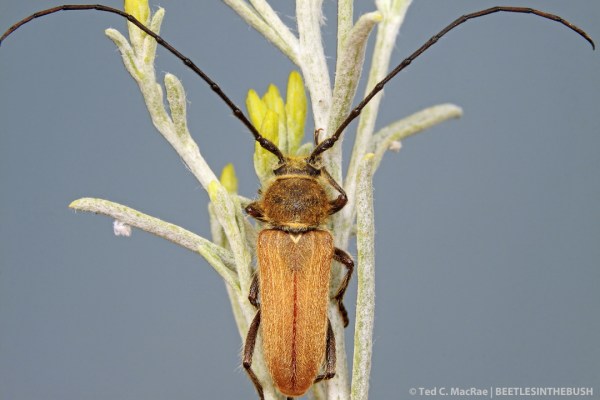
Crossidius hirtipes immaculatus (male) | Davis Creek Park, Washoe Co., Nevada

Crossidius hirtipes immaculatus (male) | Davis Creek Park, Washoe Co., Nevada

No need, however, for such disclosures in this first post of the series, as these images are true field photographs of Crossidius hirtipes immaculatus—the first longhorned beetle that we encountered on the trip. One of 16 currently recognized subspecies of C. hirtipes, populations assignable to this taxon are rather widely distributed from eastern Oregon to east-central California across northern Nevada (Linsley & Chemsak 1961). We found good numbers of these beetles in west-central Nevada at Davis Creek Regional Park (Washoe Co.) on flower heads of what I believe to be Chrysothamnus viscidiflorus. According to Linsley & Chemsak (1961), this subspecies differs from the nominotypical subspecies (the latter occurring further north in Oregon and Washington) by its paler coloration and (as the subspecies epithet indicates) reduced maculations of the elytra. In males the elytra are often completely immaculate (above), while in females the maculae are reduced to a narrow sutural stripe (below). A similar subspecies, C. h. setosus, occurs at the western edge of the distribution of C. h. immaculatus in east-central California (Nevada Co.) but is distinguished by the presence of short, dark, bristle-like hairs interspersed with longer hairs on the antennal scape—these are lacking in C. h. immaculatus.

Crossidius hirtipes immaculatus (female) | Davis Creek Park, Washoe Co., Nevada

Crossidius h. immaculatus (female) | Davis Creek Park, Washoe Co., Nevada

In addition to C. viscidiflorus were healthy stands of Ericameria nauseosa, but as was the case with nearly all subsequent C. hirtipes encounters adults were found almost exclusively on flower heads of the former. This contrasts somewhat with published information that suggests the species breeds as larvae in the roots only of C. viscidiflorus but readily feeds as adults on flowers of E. nauseosa. We saw several dozen individuals at this site, but only a small handful were found on E. nauseosa. We also noted the early exit of the adults, which started disappearing after ~5 pm local time. We suspect they crawl down to the base of the plant to spend the night hiding among debris, although we were unable to find any adults on the lower stems or around the base of the plants despite careful searches.

REFERENCE:

Linsley, E. G. & J. A. Chemsak. 1961. A distributional and taxonomic study of the genus Crossidius (Coleoptera, Cerambycidae). Miscellaneous Publications of the Entomological Society of America 3(2):25–64 + 3 color plates.

Copyright © Ted C. MacRae 2013