Cosmetid harvestman with parasitic/phoretic mites in Argentina

Metalibitia sp. poss. paraguayensis | Corrientes Province, Argentina

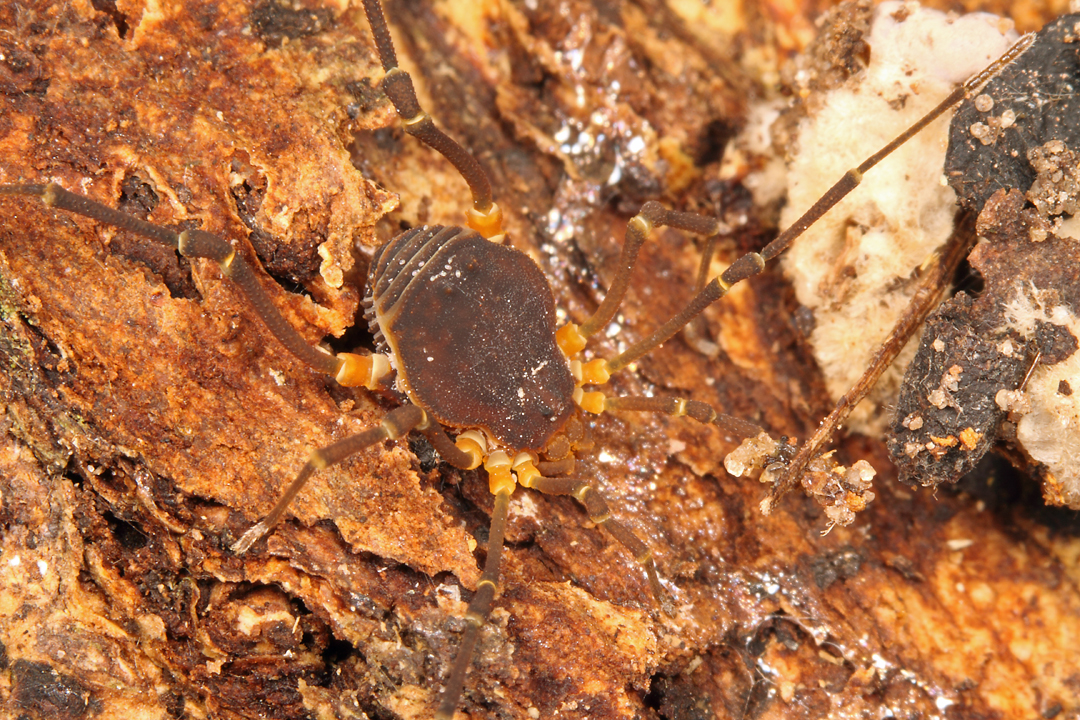
While searching logpiles last month in a relatively intact tract “Selva Paranaense” near Paso de la Patria (Corrientes Prov., Argentina), the most interesting find for me was , a bizarre longhorned beetle that is either amazingly cryptic or a curious mimic (I couldn’t decide). There wasn’t much else to be seen in the logpiles—it had been a very dry summer in northern Argentina, but I did find this interesting species of harvestman (class Arachnida, order Opiliones) huddled together in one of the punkier piles of wood.

Knowing little about harvestman taxonomy (but knowing of several specialists who do), I sent the photos around for expert opinion. Everyone responded with the same opinion—family Cosmetidae, apparently distinguished by its spoon-shaped pedipalps. Marshal Hedin compared them to this similar-looking species photographed in Bolivia, Christopher Taylor (Catalogue of Organisms) thought they might be a species of Metalibitia and Ricardo Pinto-da-Rocha suggested M. paraguayensis as having been recorded from the province of Corrientes (although a specimen would need to be examined to confirm the identification). My thanks to each of these gentlemen for weighing in on a possible ID.

Argentina represents the southernmost extent of this strictly New World family of harvestmen, while to the north the family extends up to the southern U.S. (genus Vonones). In between, the family is diverse and comprises up to one-third to one-half of the harvestman fauna (Kury & Pinto-da-Rocha 2007). Many species in the family are ornately marked, giving rise to the family name which is derived from the Greek kosmetós (= ornate)—check out this gallery of photos at Flickr to see some truly spectacular examples.

While I was photographing these individuals, and even when I first began processing the photos, I thought that they were quite dirty and debated whether to clean them in PhotoShop. Then I realized that the numerous white spots were not debris, but mites! Whether these represent a parasitic or phoretic relationship is not clear to me, however, and none of the gentlemen I sent the photos to offered any comment about them. Erythraeid and thrombidiid mites are well documented as harvestman ectoparasites during their larval stage, with recorded hosts including Neotropical species of Cosmetidae (Townsend et al. 2008). The tiny, white mites on these individuals, however, do not resemble the large, red erythraeid mites (probably genus Leptus) that I have seen parasitizing our North American harvestman species, and their numbers on multiple individuals is, to me, more indicative of a phoretic relationship. If you want to become thoroughly confused by the tremendous diversity of mites the parasitize harvestmen, see the comprehensive review by Cokendolpher (1993).

REFERENCES:

Cokendolpher, J. C. 1993. Pathogens and parasites of Opiliones (Arthropoda: Arachnida). The Journal of Arachnology 21:120–146.

Townsend, V. R., D. N. Proud, M. K. Moore, J. A. Tibbetts, J. A. Burns, R. K. Hunter, S. R Lazarowitz & B. E. Felgenhauer. 2008. Parasitic and phoretic mites associated with Neotropical harvestmen from Trinidad, West Indies. Annals of the Entomological Society of America 101(6):1026–1032.

Kury, A. B. & R. Pinto-da-Rocha. 2007. Cosmetidae Koch, 1839. Pp 182–185. In: R. Pinto-da-Rocha, G. Machado & G. Giribet (Eds.). Harvestmen: The Biology of the Opiliones. Harvard University Press, Cambridge and London, x + 597 pp.

Copyright © Ted C. MacRae 2012

Holy conglobulation, Batman!

It’s a pill bug… no, it’s a roach. It’s a pill roach!

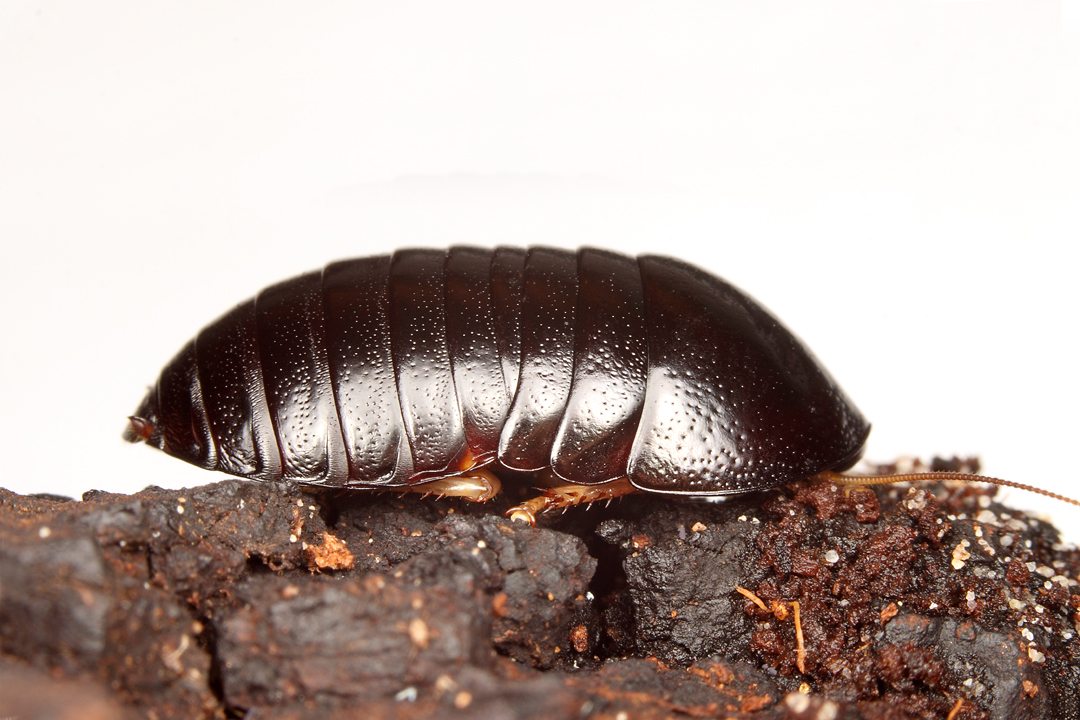
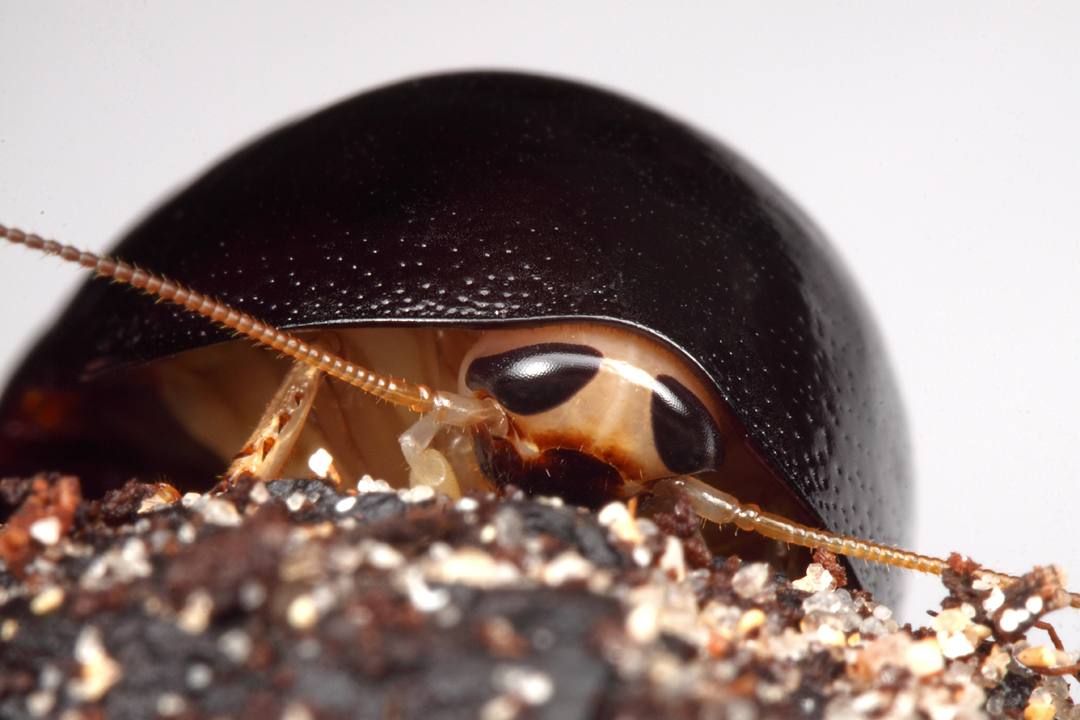
Earlier this month I made a quick trip out to California to see my good friend Chuck Bellamy receive his Honorary Membership in The Coleopterist Society. While I was there, I got a chance to spend some time with Chuck’s labmate Martin Hauser. Although Martin is a specialist of flies, he shares my fascination with unusual arthropods of all types and made available for me to photograph this adult female Perisphaerus sp. (order Blattodea, family Blaberidae), or “pill roach”. Seventeen species from southeast Asia and Australia have been described in this genus (Beccaloni 2007), but which (if any) this individual represents remains unknown.

In contrast to ”normal”-looking males, adult females exhibit a ”wingless, half-ellipsoid” morphology.

The most obvious characteristic of species in this genus is the ability of females to roll up into a ball; i.e., conglobulate.¹ Clearly this is a defensive morphotype, but curiously only females possess this ability—males are winged and exhibit the more flattened morphology typical of many cockroaches. Martin and I were unable to get this particular individual to completely enroll (we must not have been scary enough), but when it does the posterior abdomen fits tightly against the pronotal margin, covering all sensory organs and leaving no soft tissues exposed, gaps to enter or external projections to grab (Bell et al. 2007).

¹ I must thank Brady Richards, who, in his answer to ID Challenge #18, used this word to coin the phrase that would eventually become the title of this post.

Adult females apparently exhibit not only maternal protection but also nutrition.

But why should only females and not males exhibit this defensive morphotype? One would think that both males and females are equally threatened by predators. Apparently this is related to their unusual form of uniparental (maternal) care (Choe & Crespi 1997).  Early-instar nymphs in this genus remain closely associated with their mother and cling to her underside until they reach the third instar. These early-instar nymphs are not only blind, but they also exhibit a narrowed head with specially modified mouthparts that fit precisely into two pairs of orifices located on the female underside between the middle and hind pairs of legs. Whether the nymphs are feeding on glandular secretions or female hemolymph remains unknown, but regardless only a limited number of nymphs can be handled by a female at one time. This represents an unusual level of energetic investment in offspring among insects—especially among cockroaches, and thus the female has an interest in protecting that investment. Sealing them up inside an impenetrable ball is certainly one way to protect the nymphs.

Despite first impressions, six legs and a very ”cockroach-ish” head belie its true identity.

Conglobulation has actually arisen several times amongst arthropods. Obviously pill bugs (a.k.a. roly-poly bugs) are the first group that comes to mind in this regard, but Eisner & Eisner (2002) illustrate nearly identical morphology in two oniscomorph millipedes as well as isopods and Perispharus and also describe strikingly similar behavior by the larva of Leucochrysa pavida  (family Chrysopidae).

Many thanks to those of you who participated in ID Challenge #18. As of now, the comments for that challenge are closed, and I will reveal the comments and award points shortly. My sincere thanks again to Martin Hauser for allowing me to photograph this most interesting insect!

Edit 5/28/12, 12:55 a.m.: For the first time ever, we have a 3-way tie for a BitB Challenge win—Sam Heads, Brady Richards, and Mr. Phidippus all earned 12 points to share the top spot in this challenge. Since these three gentlemen were already the three leaders in BitB Challenge Session #6, there is no change to the leaderboard in the overall standings (44, 42 and 37 points, respectively). However, Dennis Haines (34 points) is hanging close, and Tim Eisele (25 points) still has a shot at the podium. Any number of others following closely behind could also find themselves on the podium if any of the three leaders should falter down the stretch.

REFERENCES:

 Beccaloni, G. W. 2007. Blattodea Species File Online. Version 1.0/4.1. World Wide Web electronic publication. <http://Blattodea.SpeciesFile.org&gt; [accessed 27 May 2012].

Bell, W. J., L. M. Roth & C. A. Nalepa. 2007. Cockroaches: Ecology, Behavior, and Natural History. The Johns Hopkins University Press, Baltimore, Maryland, 230 pp.

Choe, J. C. & B. J. Crespi. 1997. The Evolution of Social Behavior in Insects and Arachnids. Cambridge University Press, Cambridge, U.K., 541 pp.

Eisner, T. & M. Eisner. 2002. Coiling into a sphere: defensive behavior of a trash-carrying chrysopid larva Leucochrysa (Nodita) pavida (Neuroptera: Chrysopidae). Entomological News 113:6–10.

Copyright © Ted C. MacRae 2012

Science Outreach in Action

This evening I had the distinct pleasure of presenting to the Missouri Master Naturalist™ program, a community-based natural resource education and volunteer service program for adults whose mission is to “engage Missourians in the stewardship of our state’s natural resources through science-based education and volunteer community service.”  The purpose of this organization is to develop a corps of well-informed volunteers to provide education, outreach and service to benefit natural resources and natural areas management within the community. Master Naturalists receive training and contribute volunteer service to become a certified Master Naturalist™.

There are several chapters serving different areas of the state—my presentation was made to the Miramiguoa Chapter serving Franklin County in east-central Missouri. My talk was titled, “Tiger Beetles of Missouri,” and, as an “expert” in my chosen field, attendees received advanced training credit in addition to the basic training they receive in more general aspects of Missouri ecosystems. It is tempting to think that attendees were there just to get the credit, but what I found was one of the most engaged and interested audiences to which I’ve had the pleasure to speak in quite a long time. Naturally, it is not difficult for me to show a lot of passion when I get to present on something as dear to my heart as tiger beetles, but as a presenter I feed off audience enthusiasm as well. As a result, the combination of subject and audience engagement made for a fun discussion, and I only hope the audience enjoyed the 90 minute session as much as I did.

I write about this because I see Science Outreach by practicing scientists as critical to advancing appreciation of and participation in science by the general public—not just because I think they will have fun, but because a science-friendly community tends to make community and policy decisions favorable to and based on science. You might call it my brand of politics! I’ve been heavily involved in science outreach for many years now, talking to everyone from pre-schoolers to secondary school science classes to natural history organizations. The specifics of my message are tailored to the audience, but the underlying principle is the same—to help the audience gain appreciation of entomology in particular and science in general. I think I will chalk up tonight’s presentation as another win!

For those interested, here is a link to a PDF version of the presentation, which provides the best ‘snapshot’ look at the tiger beetle fauna of Missouri available so far:

Miramiguoa – May 2012 – TB of Missouri

Copyright © Ted C. MacRae 2012

Maddening mutillid

Traumatomutilla graphica (Gerstaecker, 1874) | Parque Nacional Chaco, Argentina

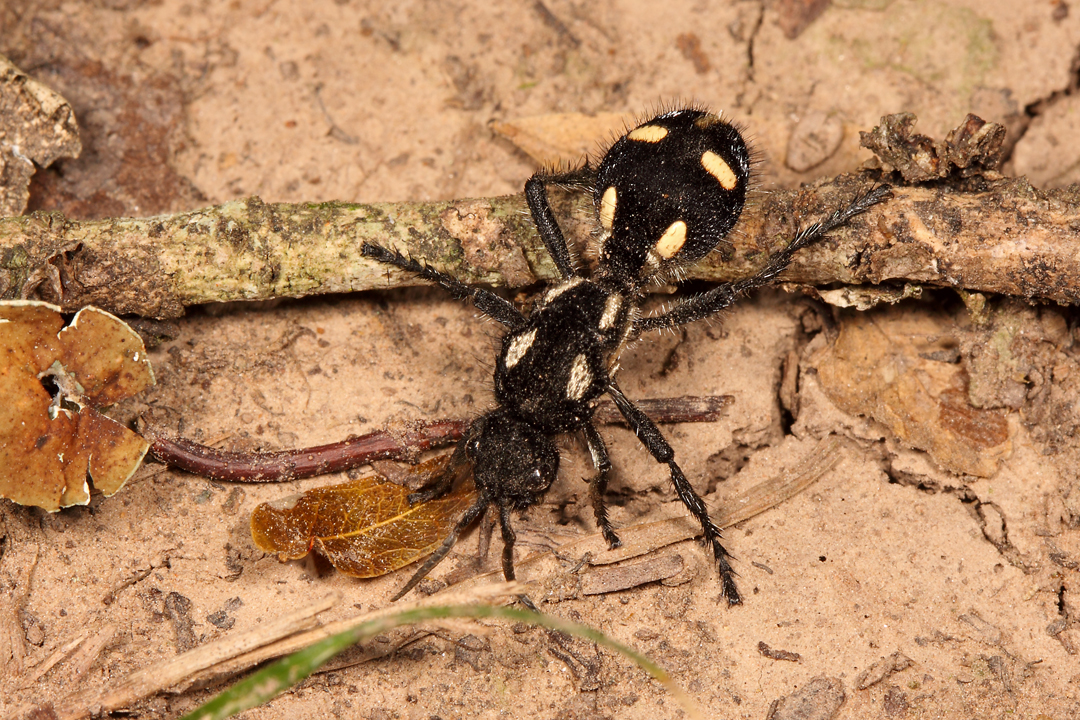
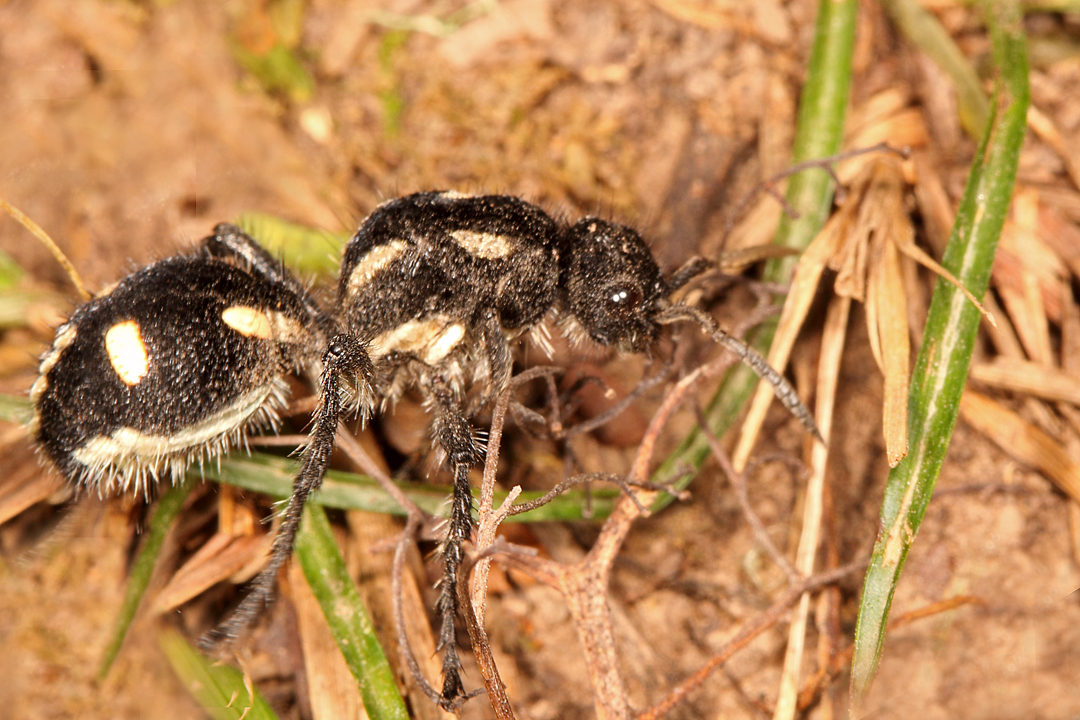
During my stay in Corrientes, Argentina, I had two distinct biomes to explore—the relatively moist “Selva Paraguayense” to the east in Corrientes Province (a southern adjunct to the Atlantic Forest of southeastern Brazil, and home to the cryptic longhorned beetle that I featured in Desmiphora hirticollis: Crypsis or Mimicry?), and the drier “Gran Chaco” to the west, home of the insect featured in today’s post. Precious few remnants remain of the original Gran Chaco, which once covered nearly 1 million square kilometers in northern Argentina, Paraguay and Bolivia and the best example of which can be found at Parque Nacional Chaco in north-central Argentina. I’ve already mentioned that conditions are typically quite dry by early April in northern Argentina, and this is especially true of Chaco Province, where droughts during the months of January through March are common. As a result, I didn’t expect to see much insect activity during my visit last month. For the most part this was true, but one insect I did see at several points along the trails through the park was this rather large velvet ant (order Hymenoptera, family Mutillidae). Not an ant, of course, but a true wasp, these insects must be treated with respect as they are capable of delivering a painful sting. This, combined with their ceaseless, erratic wanderings makes them incredibly difficult to photograph. However, with few other insects to see, I thought I would spend the time and effort to see if I could get some good field photographs of this very attractive species. I spent about half an hour attempting to photograph it by panning through the viewfinder while getting closer and adjusting the focus on the move, and then firing shots when I thought I might be close enough and had the individual more-or-less within the frame. This was wildly unsuccessful, as I had only a 3-ft wide path within which to work and had to constantly get up to block its escape into the adjacent vegetation. Moreover, it was exhausting! The constant moving and body contortions while in crouched or kneeling positions used muscles I didn’t even know I had (but was well aware of the following day by their soreness!). Out of the countless shots that I fired, these two photographs are the only ones that I consider worthy of posting—pretty good, but not great.

The distinctive color pattern is diagnostic for the species.

According to Kevin Williams (many thanks!), the distinctive color pattern readily identifies this individual as Traumatomutilla graphica (Gerstaecker, 1874). Nearly the size of our common eastern North American Dasymutilla occidentalis (a.k.a., cow killer), the bold, conspicuous patterning surely must serve as advertisement of its powerful defensive capabilities—I know I was deterred from trying to handle it. Kevin mentions it as a “great find!” and that the male of the species is still unknown, and I could find nothing about the biology of this species. However, mutillids in general are known to develop as external parasitoids of various wasps, bees, beetles and flies, the excessively long female ovipositor enabling piercing of host nest cells before injecting their powerful venom and placing the eggs (Hogue 1993).

REFERENCE:

Hogue, C. L. 1993. Latin American Insects and Entomology. University of California Press, Berkeley and Los Angeles, 536 pp.

Copyright © Ted C. MacRae 2012

One-Shot Wednesday: Upside down bee fly

Bombylius sp. cf. mexicanus | Scott Co., Missouri

This has got to be one of the strangest photos I’ve ever taken. Three weeks ago after visiting Sam A. Baker State Park (and photographing the scorpionfly featured in last week’s One-Shot Wednesday post), my dad and I visited a couple of sand prairie remnants in the Mississippi lowlands of extreme southeastern Missouri. I was hoping to see (and photograph) some individuals of the unique population of Cicindela scutellaris that occurs in that part of the state—apparently disjunct, this populations shows an intergrade of characters typical of subspecies C. s. lecontei to the north and C. s. unicolor to the south. I’ve photographed this population before, but those photographs were taken with a small (though quite good) point-and-shoot camera before I acquired my current dSLR camera setup.

Unfortunately, temperatures were quite cool that day, and no beetles were seen at either of the two locations we visited where I’ve seen good populations in past years. When I don’t find what I’m looking for, I start noticing other things, one of which was this very fresh-looking bee fly (order Diptera, family Bombyliidae) resting on the sandy ground. I’ve not really attempted to photograph many bee flies—they are as skittish and difficult to approach as the tiger beetles I adore but, unlike the latter, not a subject of my research and, thus, harder to justify spending inordinate amounts of time attempting photographs. This one, however, was sitting so nicely on the ground, and with no tiger beetles around to demand my attention I thought I would give it a shot (pun intended!). I carefully assembled my rig and slowly crouched down to attempt a photograph, but before I could get in position the fly spooked and tried to fly away. As it took off, however, it hit a plant and fell to the ground on it’s back. As it laid there,seemingly stunned, I got myself into position and took a quick shot to make sure I had the settings and exposure that I wanted. In that regard, I couldn’t ask for better, but of course what I really wanted was a photograph of the fly right-side up, resting on its feet rather than its back. Just as I was considering what to do next, the fly abruptly righted itself and flew away, leaving me with this single, rather unconventional photograph.

After perusing the bee fly pages at BugGuide, I was fairly certain this was something in the tribe Bombyliini, with the genera Bombylius and Systoechus being the likeliest candidates. Apparently the location of the r-m vein on the wing is an important distinguishing character between these genera, but I wasn’t quite sure about its location on the wing in this photograph. Nevertheless, some of the comments under the different species in these two genera suggested that members of Bombylius tend to be active as adults in the spring, while those of Systoechus tend more towards fall. I sent the photo to dipterist Joel Kitts at University of Guelph for his opinion—he confirmed that it belonged to the genus Bombylius and suggested its appearance was consistent with that of B. mexicanus—many thanks Joel!

Copyright © Ted C. MacRae 2012

Aglaoschema rufiventre in Chaco, Argentina

Aglaoschema rufiventre | Chaco Province, Argentina

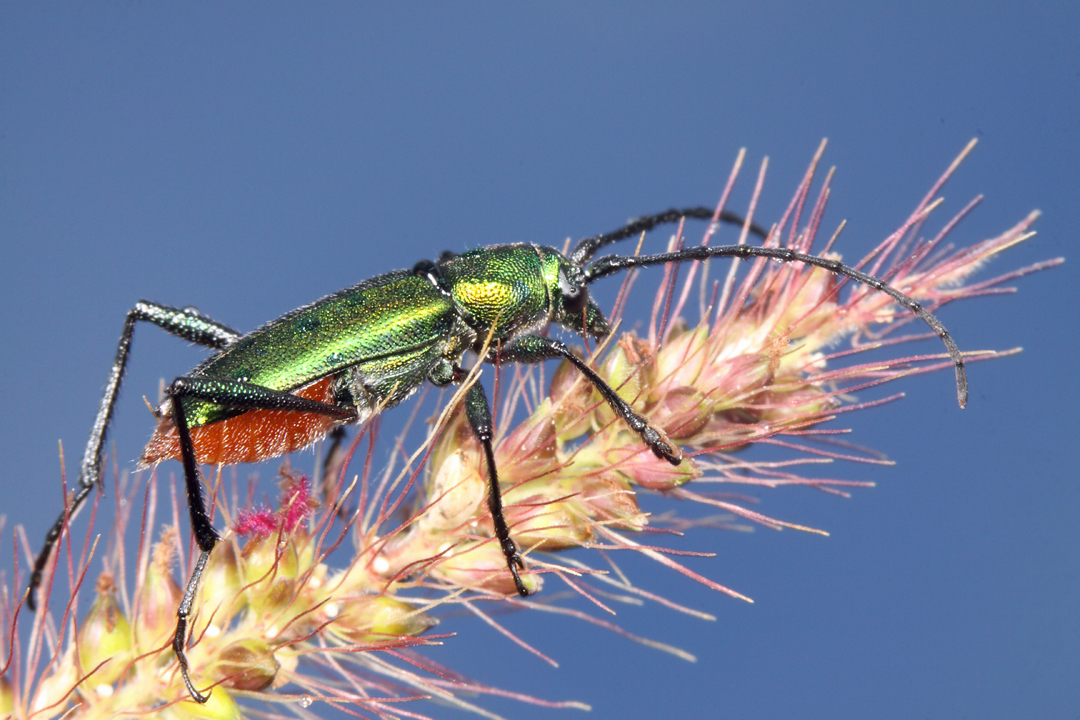
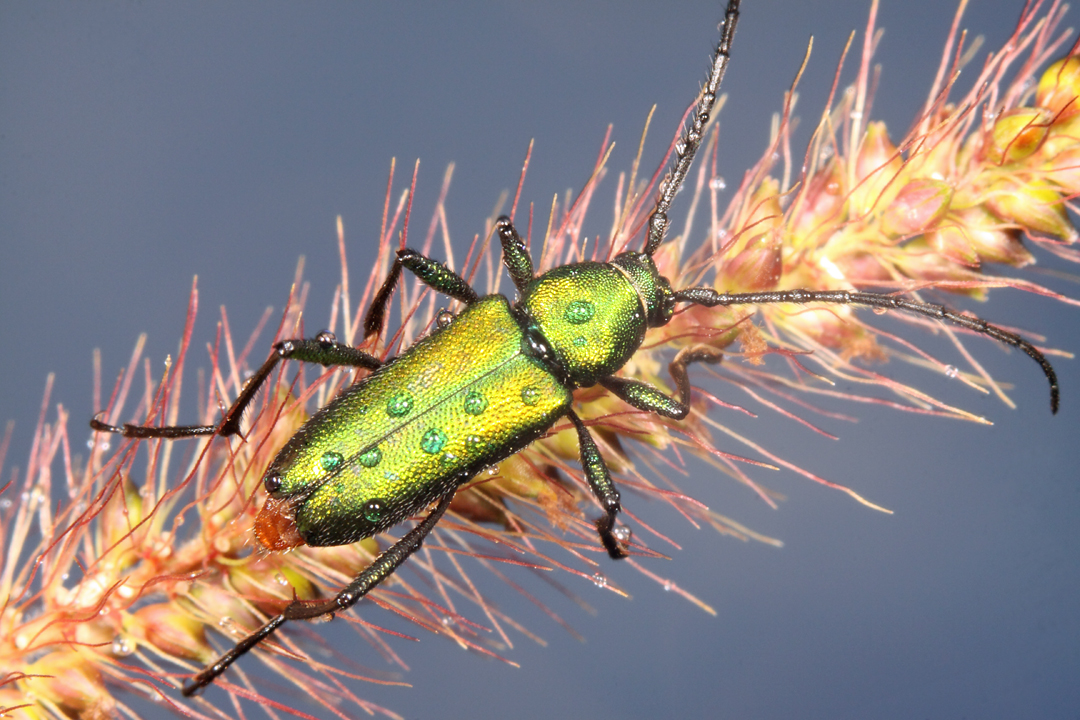
I’ve mentioned a few times that April is not a very good time to look for beetles in northern Argentina, as the months preceding April are typically hot and dry. September through January would be a much better time, especially to look for the wood boring beetles (families Buprestidae and Cerambycidae) that I am so fond of. Still, if I am in Argentina in April then I must look for beetles in April, and while I didn’t see a single buprestid during my week in Corrientes and Chaco Provinces last month I did a fair number of cerambycid beetles on stands of goldenrod (Solidago chilensis) at a few localities in Chaco Province. One particularly common species was Aglaoschema rufiventre, a beautiful metallic green species with, you guessed it, a red abdomen. Aglaoschema is a rather large (27 species), exclusively Neotropical genus whose members superficially resemble the diurnal, brightly colored species of the tribe Trachyderini but actually belong to the tribe Compsocerini. Most of the species occur in Brazil, but six extend further south into Argentina. Of these, A. rufiventre most resembles A. haemorrhoidale and A. ventrale but is distinguished by its subcylindrical antennal scape—or first segment (clavate in A. ventrale) and non-roughened elytra (roughened—or “asperate”—in A. hemorrhoidale) (Napp 2007). No hosts have been reported for A. rufiventre (Monné 2001), so my finding of adults on flowers of S. chilensis seems to be the first reported host association for the species.

The species name refers to its “red belly”

I photographed several of these beetles on S. chilensis flowers at two locations in Chaco Province along Ruta 16 west of Resistencia, but I was generally unsatisfied with how the photos turned out. The combination of the beetles’ metallic sheen and the bright yellow color of the flowers made getting the right exposure and lighting difficult—I either blew out the yellow on the flowers or ended up with deep shadows on the beetles. One morning I encountered this female sitting on the seed head of an grass unidentified grass. Torpid from the cool temperatures and covered in morning dew, she was a most cooperative subject, and the colors of the seed head turned out to be much more complimentary for photographing the beetle that the bright yellow goldenrod flowers.

REFERENCES:

Monné, M. A. 2001. Catalogue of the Neotropical Cerambycidae (Coleoptera) with known host plant—Part I: Subfamily Cerambycinae, tribes Achrysonini to Elaphidiini. Publicações Avulsas do Museu Nacional 88:1–108.

Napp, D. S. 2007. Revisão do gênero Aglaoschema Napp (Coleoptera, Cerambycidae). Revista Brasileira de Zoologia 24(3):793–816.

Copyright © Ted C. MacRae 2012

Friday Flower: Phacelia purshii

Phacelia purshii (Miami mist) | Sam A. Baker State Park, Wayne Co., Missouri

It’s been rather a long time since I’ve featured a botanical subject here, so it seems a good time to resurrect my “Friday Flower” meme with this delightful little wildflower seen on my birthday field trip a few weeks ago. Phacelia purshii (family Hydrophyllaceae), also known as Miami mist, is one of only four species in this rather large genus (159 species in North America according to the USDA Plants Database) found in Missouri. Though the flowers are small, their deeply fringed petals are quite striking. The late Dan Tenaglia¹ notes at his Missouriplants.com website that the species is limited in Missouri to the extreme eastern portions of the state—the plant shown here was one of several I saw in rich, bottomland forest along Big Creek at Sam A. Baker State Park in Missouri’s southeastern Ozark Highlands.

¹ Dan Tenaglia was not only an expert botanist but a enthusiastic cyclist. He died in February 2007 after being struck by a car while riding his bicycle. Dan’s wife has kept Missouriplants.com up and running since then in honor of his passion for plants. You can help support its maintenance by making a donation to the “Dan Tenaglia Foundation”: 1416 Victoria Avenue, Opelika, Alabama 36801.

This particular woods is one of the richest I’ve seen in the state, and in the past two years I’ve featured a number of interesting plants (Phlox bifida and Tradescantia longipes), invertebrates (Drosphila sp., Magicicada sp.Calosoma scrutator, Pleuroloma flavipes, Graphisurus trianguliferG. fasciatus, Arrhenodes minutus, Neoclytus scutellaris, Corydalus cornutus and Panorpus helena) and even snakes (Crotalus horridus and Agkistrodon contortrix phaeogaster) from there. This year marks the third consecutive birthday that I’ve visited these woods, and since I’ve found something I’ve never seen before each time (hint: just wait till you see what I still have coming from there!), I have a feeling the trend will continue next year as well.

Copyright © Ted C. MacRae 2012
One-Shot Wednesday: Panorpa helena scorpionfly

Panorpa helena, male | Wayne Co., Missouri

Last month I introduced a new meme called One-Shot Wednesday as a fun outlet for those occasional instances where I was able to fire off just one shot of an insect before it took off. At the time I guess I was hoping it was a meme that I wouldn’t need to use frequently, as I really do like to get more than just one shot of the insects that I photograph. Eventually, however, I decided it might actually encourage me to attempt photographs of insects that I wouldn’t normally try to photograph—not because I don’t find them attractive or interesting, but rather the fear of becoming too distracted and missing opportunities for the types of insects that I prefer to photograph. Freeing myself from the “need” to spend inordinate amounts of time with every subject I try to photograph might actually make me more willing to fire off more shots willy-nilly. Most of these shots probably won’t be anything special, but a few should turn out pretty good—and what better way to get more practice and experience?

Today’s feature is my first attempt at something in the order Mecoptera. I am admittedly a novice when it comes to scorpionfly taxonomy, but after perusing The Mecoptera of North America, an excellent website by Norm Penny (Collections Manager at the California Academy of Sciences and specialist in the taxonomy, biology, and biogeography of the Mecoptera and Neuropterida), I’m fairly confident that this male represents the common and widespread species Panorpa helena Byers, 1962. Penny includes Missouri in the distribution of six species of this monogeneric family, but the three complete bands across yellow wings and presence of an anal horn on the sixth abdominal tergum seem to support my identification (although I suppose examination of the male genitalia would be required for conclusive identification).

Frankly I was surprised I even got this shot. I see scorpionflies commonly in dense, moist woods throughout Missouri—this one was seen in wet bottomland forest along Big Creek in Sam A. Baker State Park in the southeastern Ozark Highlands—and have noted their tendency to flit nervously through dense foliage when approached. I already had the camera out and with the proper lens attached, so I thought I’d take a shot—I got this one reasonably well-composed, focused, and exposed shot before it flew deeper into the foliage. That was good enough for me (I had other quarry on my mind…), so I didn’t bother to try to track it. That was on April 23 (my first official day as a ‘senior citizen’—harrumph!), and it’s interesting to note that this is nearly two weeks earlier than the first date of occurrence (May 4) recorded for the species at Penny’s website.

Copyright © Ted C. MacRae 2012