Fire ant winged reproductives: male and female

While in Austin at the Entomological Society of America meetings, I had the chance to tour The University of Texas at Austin’s Brackenridge Field Laboratory.  Located on 82 acres of land bordering the Colorado River, the station supports studies in biodiversity, ecosystem change and natural history. A major focus of research at the station involves efforts to establish biological control agents for control of imported fire ant (Solenopsis invicta) using entomopathogens and parasitoids (e.g. phorid flies in the genus Pseudacteon). This research relies on maintaining cultures of fire ants to support rearing of the phorid fly. While time was limited and I did not have much opportunity to photograph either the ant or the fly, I did manage to quickly sneak in a shot or two of some winged reproductives that were removed from the teaming formicid mass in a rearing tray and placed on a table top for all to see (and when I say “a shot or two” I mean it. I had the chance only for one shot of the female and two of the male as they crawled crazily about and the tour leader quickly tried to move us on). I’m sure Alex Wild has all stages/forms of this species covered in spades, but the sexually dimorphic winged reproductives were new for me, and perhaps some readers of this blog as well.

Solenopsis invicta winged reproductives: male (top), female (bottom).

Solenopsis invicta winged reproductives: male (top), female (bottom).

Copyright © Ted C. MacRae 2013

The “silky-bellied humpbacked” ant

Last year during my extended work stay in Argentina, I was able to slip away from my duties during the first week of April and spend some time in the city of Corrientes in the northeastern part of the country. The city is one of my favorites in Argentina, but what I love most about it is its convenience as a base camp for exploring some of the habitats in the Grand Chaco ecoregion of northern Argentina. One day I had a chance to visit Chaco National Park about 100 km northwest of the city, site of some of the last remnants of the great quebracho forests that once covered much of northern Argentina. The forest preserved at Chaco NP takes its name from the quebracho colorado chaqueño (Schinopsis balansae) trees that dominate it, standing in defiant contrast to the vast, hot sea of cotton fields and mesquite fence-rows that surrounds it. While hiking a trail through the heart of the forest, I looked down to see a most impressive ant crawling across the forest floor:

Camponotus sericeiventris

Camponotus sericeiventris | Chaco National Park, Argentina

Because of its black color and the striking, silky sheen of the abdomen, I was immediately reminded of the Camponotus mus ants that I had photographed a year earlier further south in Buenos Aires. However, this fellow (er, fella…) was considerably larger than that species, and looking at the photographs later I was also struck by the acute spines at the humeral angles of the pronotum (in C. mus the humeral angles were obtuse) and the flattened legs. All of this combined to make it one of the most handsome ants that I had ever seen! I posted the above photo on my Facebook page asking for ID help, and James Trager quickly responded that the ant represents Camponotus sericeiventris, which translates roughly to “silky-bellied humpbacked” ant. Now there’s a common name I can get behind.

Camponotus sericeiventris

Of course, it turns out that I could have easily determined the species on my own using the characters I had already noted—primarily the acute spines. Googling “camponotus acute spines” retrieves as its first result a paper by Wheeler (1931) that discusses this ant and a newly discovered (at the time) cerambycid beetle, Eplophorus velutinus [now Euderces velutinus] mimicking the ant (Fisher 1931). As soon as I read Wheeler’s first paragraph I knew I had the right species:

Camponotus (Myrmepomis) sericeiventris, owing to its size, wide distribution and dense covering of silver or golden pubescence, is one of the handsomest and most conspicuous ants of the American tropics.

Apparently this ant is a popular choice of models for mimics in a number of insect groups. Lenko (1964) reported another cerambycid beetle, Pertyia sericea, as a mimic of C. sericieventris (the similarity of species epithets being no coincidence), and friend and colleague Henry Hespenheide has not only described a zygopine weevil, Copturus paschalis, from Costa Rica as a mimic of this ant (Hespenheide 1984) but also postulated mimicry by Apilocera cleriformis [now Euderces cleriformis] and three other species of Cerambycidae collected by him in central Panama. Henry further noted mimics in the families Cleridae and Mutillidae and the fact that all of the beetle mimics of this arboreally foraging ant are themselves woodborers or predators of woodborers as larvae.

It is interesting that Fisher (1931), in his description of E. velutinus, made no mention of the mimicry, while Wheeler (1931) in his paper about C. sericeiventris discussed this in great detail. He further noted the diversity of cerambycids here in our North American fauna that mimic ants. These include species in the genera Clytoleptus, Euderces, Cyrtophorus, Tilloclytus and—most strikingly—Cyrtinus pygmaeus, our smallest species of Cerambycidae which occurs on dead wood among small ants such as Lasius americanus, and Michthisoma heterodoxum which resembles small Camponotus pennsylvanicus workers. I’ve not yet encountered M. heterodoxum, which seems restricted to the southeastern Coastal Plain, but I have beaten C. pygmaeus from dead branches and can personally attest to the effectiveness of their mimicry—some slight something about the way they moved made me question my immediate assumption that they were ants and caused me to take a closer look at them before I shook them off the beating sheet. I wonder how many times before that I collected this species without realizing it!

REFERENCE:

Fisher, W. S. 1931. A new ant-like cerambycid beetle from Honduras. Psyche 38:99–101.

Hespenheide, H. A. 1984. New Neotropical species of putative ant-mimicking weevils (Coleoptera: Curculionidae: Zygopinae). The Coleopterists Bulletin 38(4):313–321.

Lenko, K. 1964. Sobre o mimetismo do cerambicideo Pertyia sericea (Perty, 1830) com Camponotus sericeiventris (Guerin, 1830). Papéis Avulsos de Zoologia (São Paulo) 16:89–93.

Wheeler, W. M. 1931. The ant Camponotus (Myrmepomis) sericeiventris Guérin and its mimic. Psyche 38:86–98.

Copyright © Ted C. MacRae 2013

The 2nd-oldest Known Myrmicine Ant

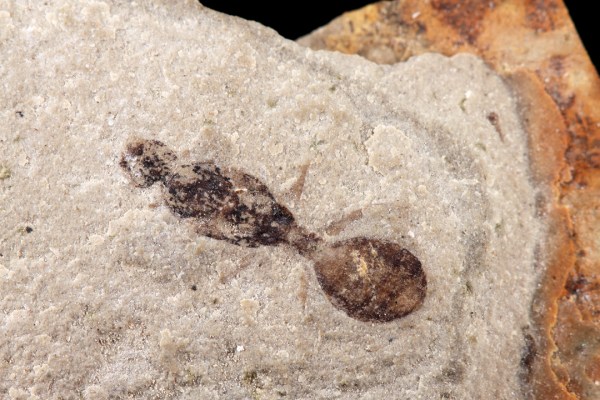
Among the 20 or so insects represented in the Green River Formation (GRF) fossils that I currently have on loan, this rather obvious ant (family Formicidae) is the only one that is firmly assignable to the order Hymenoptera (wasps, bees and ants). This is not surprising, as hymenopterans are not well represented among GRF insect fossils. In fact, of the 300+ insect species that have been described from GRF deposits (Wilson 1978), more than two-thirds belong to just three orders—Diptera (flies), Coleoptera (beetles) and Hemiptera (true bugs). Hymenoptera, on the other hand, comprise only 4% of GRF fossils (Dlussky & Rasnitsyn 2002). I presume these numbers are more a result of taphonomic (fossil formation) bias than a true reflection of insect diversity in western North America during the Middle Eocene (47–52 mya).

cf. Myrmecites rotundiceps | fossil impression from the Green River Formation (45 mya, middle Eocene)

cf. Myrmecites rotundiceps (length = 6.7 mm).

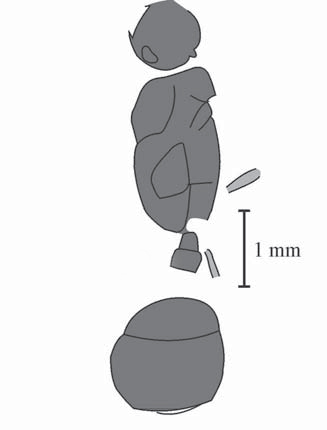
Ants in particular have been poorly represented by GRF deposits. Only four named species were known until Dlussky & Rasnitsyn (2002) reviewed available GRF fossils and increased the number to 18 (15 described as new, one older name placed in synonymy). Diagnoses, line drawings, and keys to all covered subfamilies, genera and species provide one of the best treatments to GRF insect fossils that I’ve come across. According to that work, the fossil in these photos seems comparable to the description and illustration given for Myrmecites rotundiceps, a unique fossil with the general appearance of ants in the subfamily Myrmicinae but differing from all known Eocene and New World fossil ants by its very short, two-segmented waist. The only difference I noted was size—6.7 mm length for my fossil versus 5.5 mm for the holotype (see figure below). Of course, I’m more comfortable identifying extant Coleoptera than extinct Formicidae, so I contacted senior author Gennady M. Dlussky to see if he agreed with my opinion. He graciously sent the following reply:

I agree that specimen on your photo is very similar to Myrmecites rotundiceps. It is larger (holotype is 5.5 mm long), but it may be normal variability. I cannot see another differences.

Myrmecites rotundiceps, holotype (Gennady & Rasnitsyn 2002)

Myrmecites rotundiceps Gennady & Rasnitsyn 2002, holotype (reproduced from Gennady & Rasnitysyn 2002)

If correctly assigned, M. rotundiceps is the second oldest known member of the subfamily Myrmicinae—the oldest being Eocenidris crassa from Middle Eocene Arkansas amber (45 mya). In fact, the only older ant fossil of any kind in North America is Formicium barryi (Carpenter) from Early Eocene deposits in Tennessee (wing only). [Edit: this is actually the only older Paleocene ant fossil—there are some Cretaceous-aged fossils such as Sphecomyrma freyi (thanks James Trager).] Since myrmicine fossils of comparable age are lacking from other parts of the world, this might suggest a North American origin for the subfamily; however, it could also be an artifact of incomplete knowledge of ants from older deposits in other parts of the world. Myrmicine ants make their first Eurasian appearance in Late Eocene Baltic amber deposits (40 mya) and become more numerous in North America during the early Oligocene (Florissant shales of Colorado, 33 mya). (Dlussky & Rasnitsyn (2002) consider the Middle–Late Eocene ant fauna to represent the beginnings of the modern ant fauna, with extant genera becoming numerous and extinct genera waning but still differing by the preponderance of species in the subfamily Dolichoderinae over Formicinae and Myrmicinae.

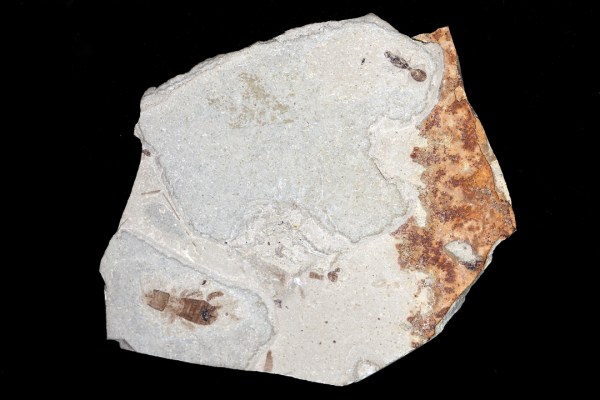
IMG_1919_enh_1080x720

USA: Colorado, Rio Blanco Co., Parachute Creek Member.

The photo above shows the entire fossil-bearing rock (also bearing the putative orthopteran posted earlier).

My thanks to Gennady Dlussky and James Trager for offering their opinions on the possible identity of this fossil.

REFERENCES:

Dlussky, G. M. & A. P. Rasnitsyn. 2002. Ants (Hymenoptera: Formicidae) of Formation Green River and some other Middle Eocene deposits of North America. Russian Entomological Journal 11(4):411–436.

Wilson, M. V. H. 1978. Paleogene insect faunas of western North America. Quaestiones Entomologicae 14(1):13–34.

Copyright © Ted C. MacRae 2012

Pseudomyrmex in Corrientes, Argentina

Early April is early autumn in northeastern Argentina, but seasons just south of the Tropic of Capricorn bear little resemblance to the well-defined spring, summer, fall and winter that we are accustomed to in eastern North America. Early fall here is not a riot of color, pungent smells, and sharp shadows cast from an oblique sun, but rather dull greens and browns, muted and dusty after eight months under a searing overhead sun with only the sparsest of rains for the past two. Such conditions are generally not conducive to insect life, and for the most part insects that live in warm, seasonally wet environments adapt by timing their adult activity (the time for reproduction) to the moist seasons—which in this part of Argentina means September through January. Thus, despite warm temperatures and a subtropical environment, early April is not the best time to be looking for insects here.

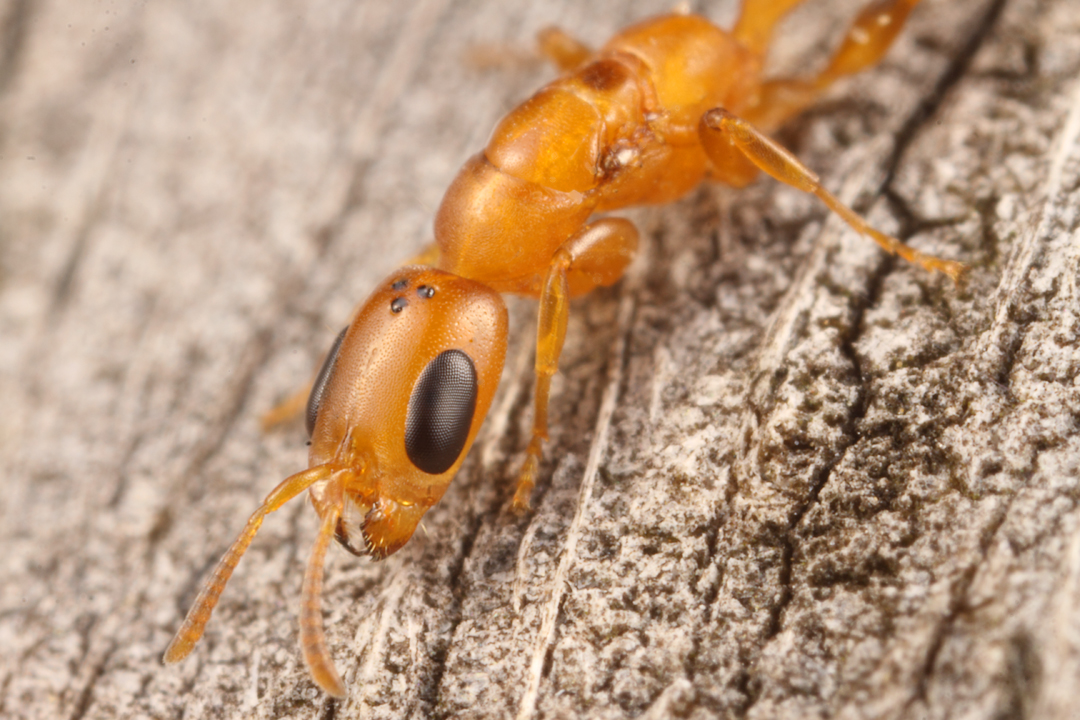
Pseudomyrmex sp. | Corrientes, Argentina

Nevertheless, not all insect groups respond in this fashion, and one in particular is as ubiquitous and diverse now as at any other time of year—ants! I had to trek into sand and mud along the Rio Paraná to find tiger beetles (a few), and it took some dedicated searching to ferret out a few stands of late-season blooming plants and fresh-cut woodpiles to encounter a small diversity of longhorned beetles. I think I may have even seen a single jewel beetle, a chrysobothrine of some type, as it landed on and then flash flew away from the same woodpile with which I had modest longhorned beetle success. The ants, however, have been everywhere—no tree, shrub, or square meter of ground is without them in astounding diversity of size and form.

At this point it appeared to be eating something it plucked from the bark.

I probably shouldn’t admit this, as I hear rumor there are a few myrmecologists that frequent this blog, but I have a hard time getting excited about ants. I know, their unique social structures and evolutionary history are among the most fascinating in the insect world, and watching their behaviors is a lesson in charisma beyond reproach. Still, however, for me there are just so many of them and their taxonomy so completely foreign to me that every time I try digging further I feel immediately overwhelmed. Coleopteran taxonomy may be an order of magnitude more diverse, but since I only pay attention to about 1.5% of the order, it’s as comfortable to me as an old shoe.

Close...

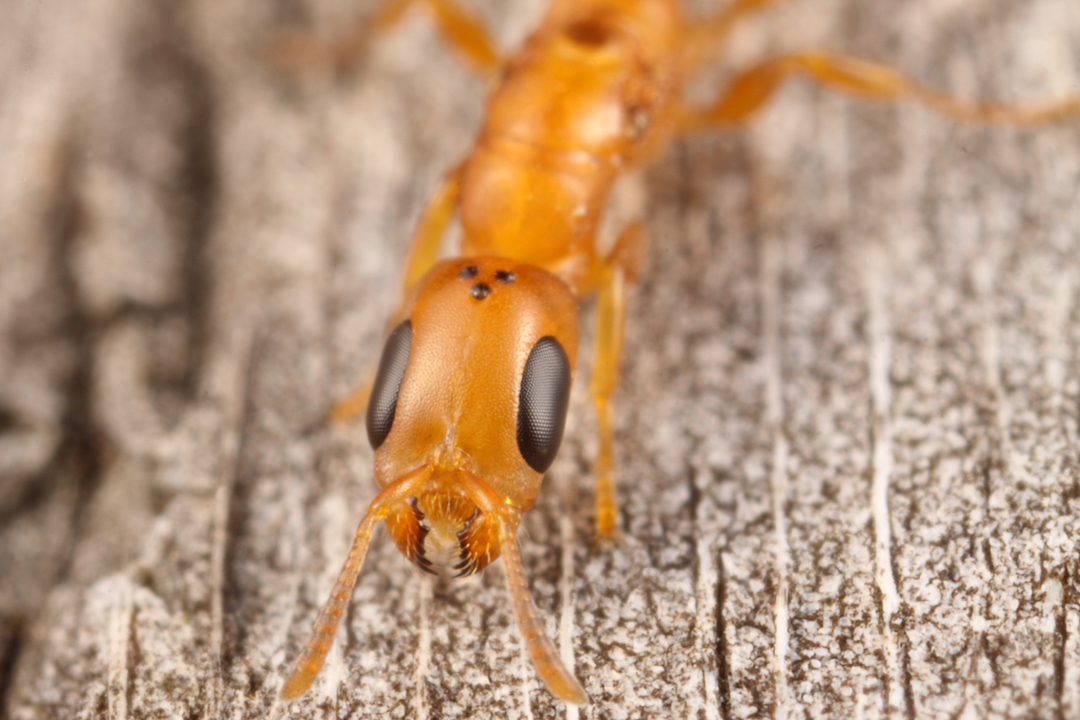
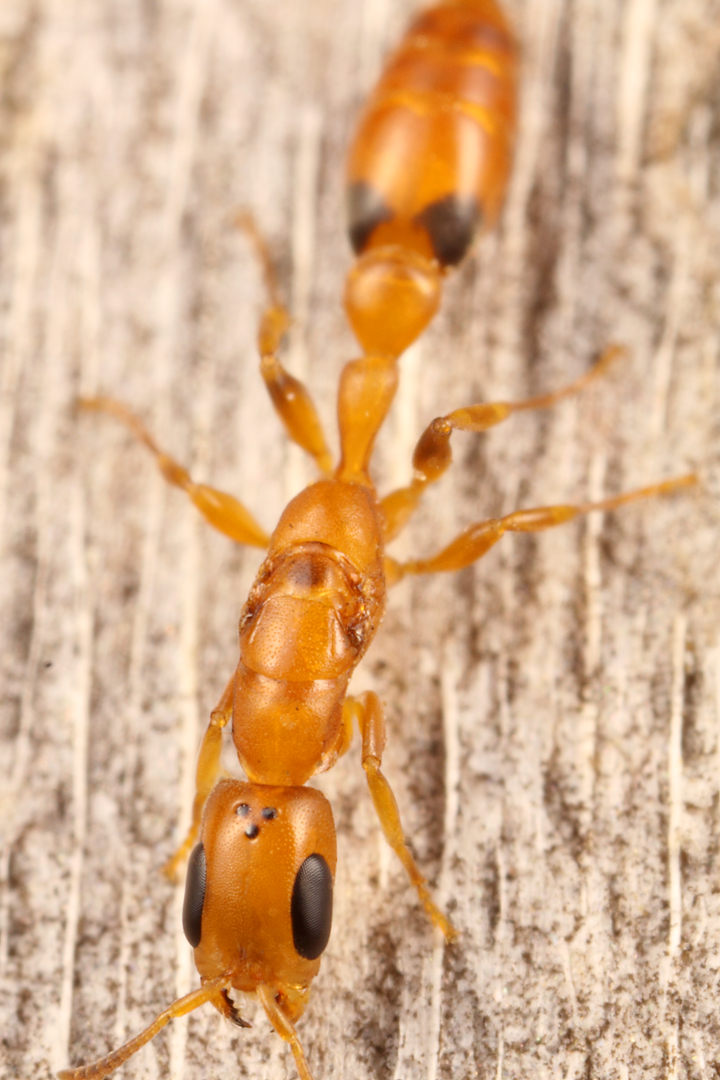
There is one group of ants that I do find endlessly fascinating—the genus Pseudomyrmex. I don’t know why that should be the case—there are plenty of other ant genera that seem to have the tools and structures that usually grab my attention (e.g., grossly oversized mandibles, sharp spines, heavy duty surface sculpturing, etc.). Pseudomyrmex spp. have none of these morphological gimmicks—just a simple, elongate, wasp-like form. Perhaps it’s their association with branches (like wood-boring beetles) rather than the ground—nope, tiger beetles are decidedly ground dwellers and I dig them (Get it? Heh!). No, it must be their super-sized eyes. Most ants have beady little eyes that make it hard to look into their soul. Pseudomyrmex eyes have charisma—you can see them looking at you (and almost read their thoughts).

closer...

Anyway, among the many ants that I’ve noted wandering the banks of the Rio Paraná here in Corrientes are these smallish, orangish Pseudomyrmex spp. This particular individual was the first one I saw, revealed when I happened to pull away a bark chip from trunk of the palm tree on which it was hiding. It wandered all over the palm trunk for the next 15 minutes or so as I chased after it with my 65mm lens. For such tenaciously crawling subjects I’ve found that simply firing off shot after shot as you track it in the view-finder rather than waiting for it to pause and trying to compose each shot is the best way to get some usable images. It’s simply a numbers game—the more shots you fire off, the better chance you have that at least some will be in-focus, nicely composed, and well-lit. These are the ones I was happiest with from the session. (And, OMG, did I really just give advice on how to photograph ants?)

Closest!

It goes without saying that a more specific ID, if possible, would be greatly appreciated (should any prominent myrmecologists happen across these photos). There are scads of species in this genus right across the river in Paraguay, and presumably the diversity in Argentina is similarly high.

Copyright © Ted C. MacRae 2012

Leafcutter ants on corn

Leafcutter ants attacking corn | western Buenos Aires Prov., Argentina

North American corn farmers certainly have their share of insect pests to worry about. Between corn borer, earworm, armyworm, and rootworm, there isn’t much of the plant that isn’t vulnerable to attack by at least one of these insects. Argentina corn farmers have all this and more—have you ever seen ants attacking corn? I took these photographs yesterday in a corn field in western Buenos Aires Province showing leafcutter ants dining on the developing kernels of late-planted corn. Okay, “dining” may not be the proper word, as they are not actually eating the kernels, but rather harvesting them to bring them back to their “hormiguera” (ant nest) for cultivation of the fungi on which they feed. The four pairs of spines on the pro-mesonotum and narrow distal antennal segments suggest this is a species of Acromyrmex, three species of which are mentioned as pests of corn in Argentina (A. lundii, A. striatus, and A. lobicornis). Of these, the individuals in these photos seem to best match AntWeb’s photos of Acromyrmex lundii, but that is just my guess.

Acromyrmex sp. poss. lundii?

Copyright © Ted C. MacRae 2012
Predator or Prey?

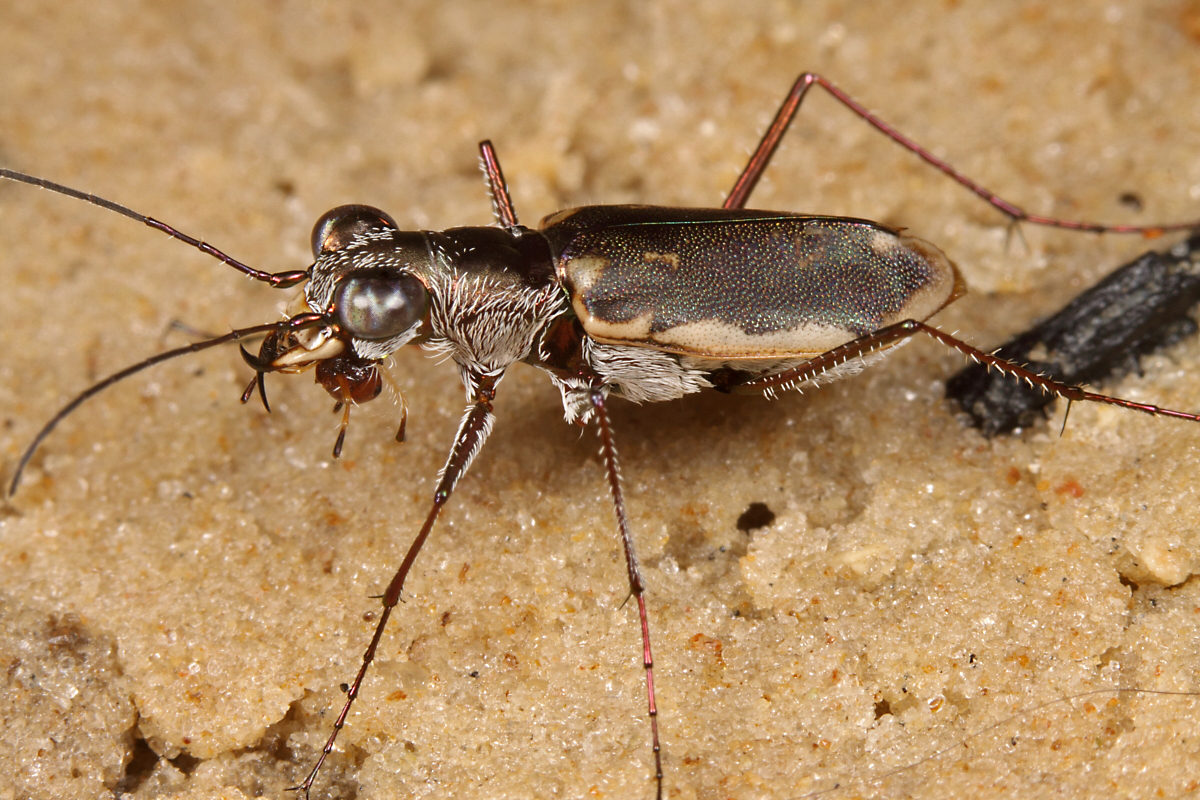
Ellipsoptera hamata lacerata | Dixie Co., Florida

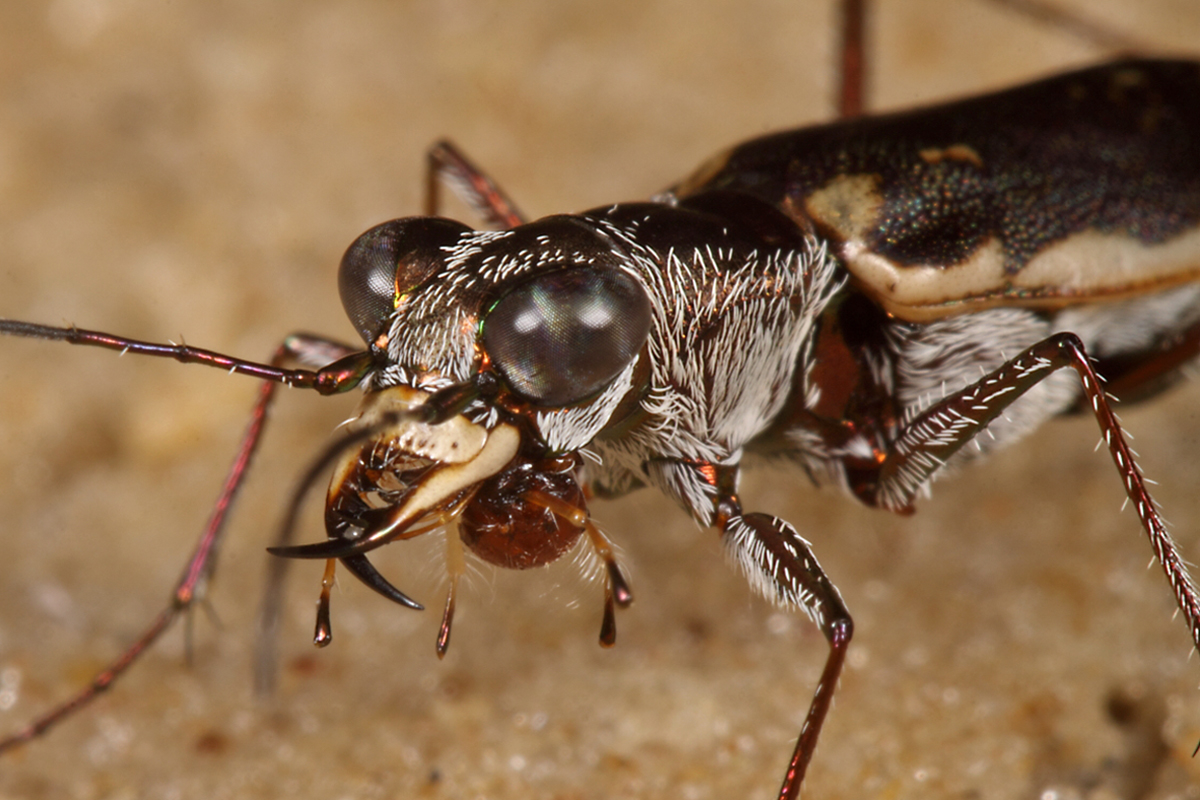
Everyone knows that tiger beetles are predators, but look closely at the underside of the head of this female Ellipsoptera hamata lacerata (Gulf Beach Tiger Beetle), photographed in a coastal marsh in Dixie Co., Florida earlier this month.  See the ant head attached by its mandibles to the base of the tiger beetle’s left maxillary palpus?  Detached ant heads latched onto the palp or antenna of a tiger beetle are a fairly common sight—Pearson and Vogler (2001) show the head of an ant attached to the antenna of Eunota togata (Cloaked Tiger Beetle), and Pearson et al. (2006) show one attached to the antennae of Cicindela formosa (Big Sand Tiger Beetle).  I’ve also photographed Cylindera celeripes (Swift Tiger Beetle) with an ant head attached to its antenna.  Pearson and Vogler (2001) and Pearson et al. (2006) both suggest that the ant heads are the result of predation attempts by groups of ants attempting to overpower and kill the tiger beetle, making the ants the predators and the tiger beetles the prey.

Note ant head attached by its mandibles to the base of the tiger beetle's left maxillary palpus.

Although some ants are well known for their predatory horde behavior, I’m not sure I buy this as an explanation for the common occurrence of ant heads attached to tiger beetles.  Tiger beetles themselves often prey on ants, and while I have seen numerous tiger beetles with ant heads attached to them, I have never seen one actually being overpowered by ants (scavenging an already dead tiger beetle, yes—but not overpowering and killing one).  Moreover, the ant heads are nearly always attached to the base of an antenna or palpus—right next to the tiger beetle’s mouth, and almost never on more distal parts of the antennae or other parts of the body.  If the ants were attempting to prey on the tiger beetle, wouldn’t they also (if not even more commonly) be found attached to the tiger beetle’s legs or soft intersegmental membranes?  And how would the ants have come to be decapitated while in the act of attempting to overpower the beetle?  I suggest it is more likely that the ants were prey, latching onto the nearest part of their killer’s body in a last ditch attempt to avoid their inevitable fate.  The antennal and palpal base are about the only tiger beetle body parts that would be within reach of an ant in a tiger beetle’s toothy grasp.  While the rest of the ant was consumed, the head remained because it was firmly attached to the beetle.

I realize that an identification based only on the detached head of an ant may be difficult, but if one is possible it would be appreciated.  The ant head shown in Pearson and Vogler (2001) was identified as Polyergus sp.

REFERENCES:

Pearson, D. L., C. B. Knisley and C. J. Kazilek. 2006. A Field Guide to the Tiger Beetles of the United States and Canada. Oxford University Press, New York, 227 pp.

Pearson, D. L. and A. P. Vogler.  2001. Tiger Beetles: The Evolution, Ecology, and Diversity of the Cicindelids.  Cornell University Press, Ithaca, New York, 333 pp.

Copyright © Ted C. MacRae 2011

Bichos Argentinos #10 – Friday Formicine

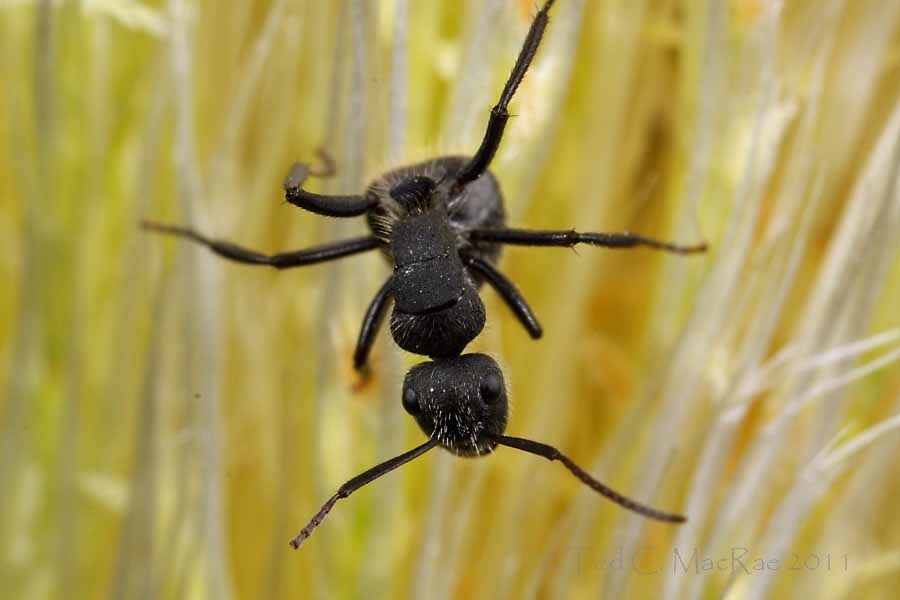
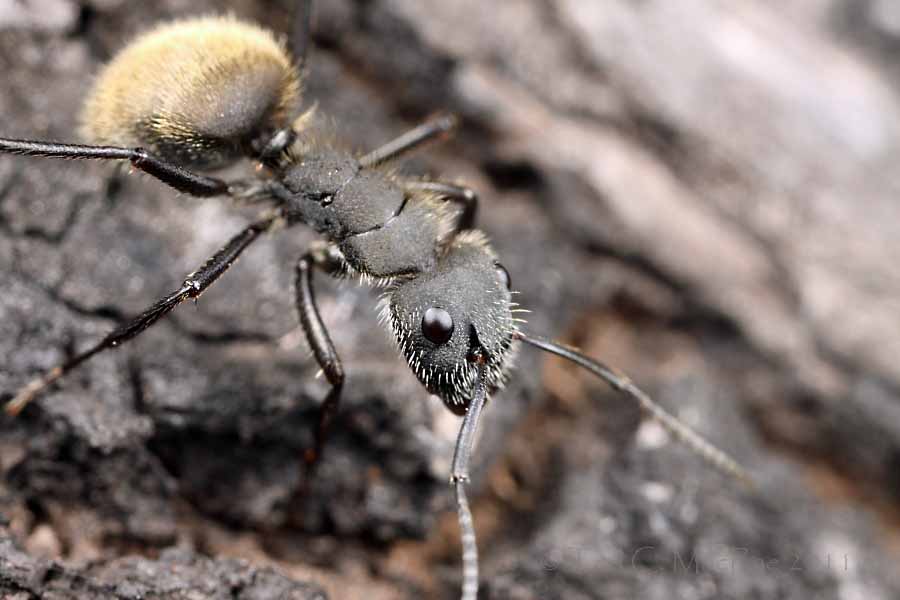
One of the insects I saw abundantly during my visit last month to La Reserva Ecológica Costanera Sur (Buenos Aires, Argentina) was this species of black ant that looks well enough like one of our typical North American species. They were quite common, seen on virtually every plant that I examined closely. I made a few feeble attempts at photographs in the early part of the day, but desire faded quickly in the face of their frenetic behavior and occurrence in exclusively tough-to-photograph situations.  I mean, they’re just ants!¹ Around midday I noticed that many of the flower heads of the pampas grass clumps in the area had at least one ant perched in this interesting head-down, abdomen-curled forward position – I tried to capture the situation, but even this best of the bunch turned out, well… boring!

¹ Just kidding Alex and James!

Finally, late in the day, I saw one crawling on the trunk of a recently fire-killed tree that I was inspecting in (futile) hopes of encountering adult jewel beetles or longhorned beetles that would have been attracted to this newly available resource.  This was the easy-to-photograph situation I was waiting for, and the dark color of the charred bark brought out nicely the hairs on the body despite both ant and bark being nearly the same color.

I’m a beetle guy, and normally I would be happy to just call this Formica nigra and move on.  Whatever possessed me to even begin the process of trying to identify this particular ant is beyond me (maybe I’ve actually learned something after a couple of years of reading Myrmecos!).  It had the look of our North American Camponotus, so I entered “Camponotus Argentina” into Google Images and found this photo of Camponotus mus, taken by our friend Alex in nearby Santa Fe, Argentina, near the top of the very first page.  Now, I realize that closely (and even distantly) related species can look quite similar (especially to the untrained eye), but everything about this ant looks right – the bulbous-abdomen, the shape of the thorax, the matt black color, and the velvety yellowish pilosity of the abdomen. A little searching on the name reveals this species to be quite abundant in Argentina, where it goes by the common names “hormiga de madera” (wood ant) and, not surprisingly, “hormiga carpintera” (carpenter ant). Alex? James? Did I get it right?

Copyright © Ted C. MacRae 2011

Bichos Argentinos #2 – Pseudomyrmex sp.

Pseudomyrmex sp. (twig ant) | Reserva Ecológica Costanera Sur, Buenos Aires, Argentina

One of the insects I tracked at La Reserva Ecológica Costanera Sur in Buenos Aires, Argentina last weekend was this twig ant in the genus Pseudomyrmex.  I had noticed these slender, wasp-like ants previously on trips to the U.S. desert southwest, but it wasn’t until I read a couple of recent posts about them at Myrmecos and 6legs2many that I knew specifically what they were. 

Alex characterizes these ants as “delightfully gentle, quirky little insects.”  What he didn’t mention is how frenetic and unceasing they are as they forage amongst the shrubbery.  I must have taken a couple dozen shots of several individuals over the course of the day, deleting every single one on the spot because I couldn’t get a clear, close, focused, nicely composed, unobstructed image.  Their habit of crawling rapidly along slender twigs is problematic enough, with little opportunity to brace the camera against anything steady and spend time composing the shot.  Add to that the frequently thorny nature of the trees they were roaming and their annoying habit of darting around to the backside of whatever twig they were on whilst trying to follow them in the viewfinder, and I almost decided I’d met my match and could do without the shot.  In the latter part of the day I encountered this individual, and as I already had my 65mm lens mounted I decided to give it another try.  I can’t say that I actually figured out the secret to getting the shot, but rather that I just lucked out and happened to have hit the shutter release at just the right moment – and with reasonable focus – as I tracked the ant along the branch on which it was crawling.  It was the only shot of one of these ants that stayed on the card that day.

The genus is huge, with 209 species occurring primarily throughout the Neotropics.  As a result, it would be foolish for me to even attempt a species ID.  Still, I can’t help noticing its great resemblance to this photo of Pseudomyrmex phyllophilus, taken by Alex in – you guessed it, Buenos Aires, Argentina.  I’ll wait for the correction, but in the off-chance that I’m right I think I deserve points on somebody’s scorecard!

Copyright © Ted C. MacRae 2011