A couple of pictures from my hotel room, one taken about five hours ago…
…and another taken just about an hour ago…
You need a lot of lights for 13.1 million people!
Copyright © Ted C. MacRae 2011
A couple of pictures from my hotel room, one taken about five hours ago…
…and another taken just about an hour ago…
You need a lot of lights for 13.1 million people!
Copyright © Ted C. MacRae 2011
As one of North America’s largest, most written about, and most photographed beetles, Dynastes tityus (eastern Hercules beetle) hardly needs an introduction. I photographed this male specimen from my collection back in December while testing my DIY diffuser for the MT-24EX twin flash and 100mm macro lens. It’s a good test subject for such – its glossy exoskeleton may be beauty to the eye but is the bane of flash photographers, and its nearly 60mm of length demand a huge subject-to-lens distance that gives even the largest lens-mounted flash a small apparent size. Nevertheless, the diffuser did a pretty good job of creating even illumination and preventing harsh specular highlights, giving almost the effect of an indirect strobe in a white box.
I hadn’t really noticed until I took the photos the dense adornment of setae (hairs) on the underside of the thoracic horn. While setae in insects most often perform a tactile function, the density and placement on the horns of the males of these beetles makes me wonder if they might serve more of a display function.
Despite the overwhelming popularity of this beetle amongst hobbyist breeders and its widespread occurrence across the eastern United States (and the internet), it is not one that I have encountered with much frequency myself. I suspect this is due to the position of Missouri near its western limit of distribution – likely a function of the species’ preference for moist treehole cavities with rotting wood in which the larvae can develop. This particular specimen was given to me many years ago by a nursery grower in Jefferson Co. during my first job out of graduate school – before I’d ever found one myself, but since then I’ve encountered perhaps half a dozen or so at blacklights in mesic forests across the eastern Ozark Highlands. Most recently (last summer) I found a female sitting on my driveway, apparently attracted to the mercury vapor lamp above the garage that I leave on occasionally during the months of June and July just for such purpose.
Copyright © Ted C. MacRae 2011
Of the several insect groups that I most wanted to see and photograph during my trip to Brazil a few weeks ago, treehoppers were near the top of the list. To say that treehoppers are diverse in the Neotropics is certainly an understatement – South America boasts an extraordinary number of bizarre and beautiful forms that still, to this day, leave evolutionary biologists scratching their heads. The development of this amazing diversity is a relatively recent phenomenon (thinking geological scale here), as there are no known membracid fossils prior to Oligo-Miocene Dominican and Mexican amber – well after the early Cretaceous breakup of Gondwanaland split the globe into the “Old” and “New” Worlds. With its origins apparently in South America, numerous groups continued to spring forth – each with more ridiculous pronotal modifications than the last and giving rise to the dazzling diversity of forms we see today. Even North America got in the evolutionary act, benefiting from northern dispersal from South America’s richly developing fauna via temporary land bridges or island stepping stones that have existed at various times during the current era and giving rise to the almost exclusively Nearctic tribe Smiliini (whose species are largely associated with the continent’s eastern hardwood forests). Only the subfamily Centrotinae, with its relatively unadorned pronotum, managed to successfully disperse to the Old World, where it remains the sole representative taxon in that hemisphere. With a few notable exceptions, treehoppers have virtually no economic importance whatsoever, yet they enjoy relatively active study by taxonomists, evolutionists, and ecologists alike – due almost completely to the bizarreness of their forms and unique mutualistic/subsocial behaviors.
I did manage to find a few species of treehoppers during the trip (a very primitive species being featured in Answer to ID Challenge #4 – Aetalion reticulatum), and of those that I did find the nymphs in this ant-tended aggregation on a small tree in the rural outskirts of Campinas (São Paulo State) were perhaps the most striking in coloration and form. Most were jet black, although a few exhibited fair amounts of reddish coloration, and all exhibited sharply defined white bands of wax and long erect processes on the pronotum, mesonotum, and abdomen. I’ve seen a fair number of treehopper nymphs, but I did not recognize these as something I had seen before, and given the incomplete state of immature taxomony I feared an identification might not be possible. Still (and I know this is probably beginning to sound like a broken record), I gave it the old college try.
I usually like to start simple and get more creative if the results aren’t satisfactory, so I went to my old friend Flickr and simply typed “Membracidae” as my search term. Predictably, pages and pages of results appeared, and I began scanning through them to see if any contained nymphs at all resembling what I had. After just a few pages, I encountered this photo with very similar-looking nymphs, and although no identification beyond family was indicated for the photo, I recognized the lone adult sitting with the nymphs as a member of the tribe Aconophorini – a diverse group distinguished from other treehoppers by their long, forward-projecting pronotal horn. Luck was with me, because I happen to have a copy of the relatively recent revision of this tribe by Dietrich and Deitz (1991). Scanning through the work, I learned that the tribe is comprised of 51 species assigned to three genera: Guayaquila (22 spp.), Calloconophora (16 spp.), and Aconophora (13 spp.). The latter two genera can immediately be dismissed, as ant-interactions have not been recorded for any of the species in those two genera – clearly the individuals that I photographed were being tended by ants. Further, the long, laterally directed apical processes of the pronotal horn, two pairs of abdominal spines, and other features also agree with the characters given for nymphs of the genus Guayaquila. In looking at the species included in the genus, a drawing of a nymph that looked strikingly similar to mine was found in the species treatment for G. gracilicornis. While that species is recorded only from Central America and northern South America, it was noted that nymphs of this species closely resemble those of the much more widely distributed G. xiphias, differing by their generally paler coloration. My individuals are anything but pale, and reading through the description of the late-instar nymph of the latter species found every character in agreement. A quick search of the species in Google Images was all that was needed to confirm the ID (at least to my satisfaction).
In a study of aggregations of G. xiphias on the shrub Didymopanax vinosum (Araliaceae) in southeastern Brazil, Del-Claro and Oliveira (1999) found an astounding 21 species of associated ant species – a far greater diversity than that reported for any other ant-treehopper system. The most frequently encountered ant species were Ectatomma edentatum, Camponotus rufipes, C. crassus, and C. renggeri, and after perusing the images of these four species at AntWeb I’m inclined to believe that the ants in these photos represent Camponotus crassus (although I am less confident of this ID than the treehoppers – corrections welcome!). The authors noted turnover of ant species throughout the day in a significant portion of the treehopper aggregations that they observed, which they suggest probably reflects distinct humidity and temperature tolerances among the different ant species and that might serve to reduce interspecific competition among ants at treehopper aggregations. Since treehopper predation and parasitism in the absence of ant mutualists can be severe, the development of multispecies associations by G. xiphias results in nearly “round-the-clock” protection that can greatly enhance their survival.
Update 3/3/11, 9:45 a.m.: My thanks to Chris Dietrich at the Illinois Natural History Survey, who provided me in an email exchange some clarifying comments on the origins and subsequent dispersal of the family. The first paragraph has been slightly modified to reflect those comments.
REFERENCES:
Del-Claro, K. and P. S. Oliveira. 1999. Ant-Homoptera interactions in a Neotropicai savanna: The honeydew-producing treehopper, Guayaquila xiphias (Membracidae), and its associated ant fauna on Didymopanax vinosum (Araliaceae). Biotropica 31(1):135–144.
Dietrich, C. H. and L. L. Deitz. 1991. Revision of the Neotropical treehopper tribe Aconophorini (Homoptera: Membracidae). North Carolina Agricultural Research Service Technical Bulletin 293, 134 pp.
Copyright © Ted C. MacRae 2011
It’s been a while since I’ve done a Monday Moth post, so I thought I’d feature one of the prettier specimens in my very limited Lepidoptera collection. This is Syntomeida epilais (polka-dot wasp moth), one of four species in the genus that occurs in the United States. This particular specimen was collected by me way back in the mid-1980s (I was not quite yet the discriminating beetle collector that I am now) in Everglades National Park (yes, I had a permit). The bright, contrasting coloration obviously screams aposematism (warning coloration), and in fact the tissues of the adult moths of this species are chock-full of several cardiac glycosides sequestered by the larva from its now preferred food plant, oleander (Nerium oleander). Add to it their somewhat wasp-like appearance, and there should be no question to any would-be predator that these moths are a bad idea. Wasp moths are related at the tribal level to another group of wasp-like moths called maidens which are restricted to the Old World. I featured one of these from South Africa last year in the post, Monday Moth – Simple Maiden (Amata simplex).
If the cardiac gycosides stored in the tissues of this moth aren’t enough to cause gastric distress, trying to digest the higher taxonomic history of this group surely will. Back in my school days, this moth belonged to the family “Ctenuchidae.” As best I understand it, this group was later subsumed into the tiger moth family “Arctiidae” – itself later subsumed within the borg of all moth families, the Noctuidae. In the most recent classification I’ve found, the arctiine moths have been pulled back out of the Noctuidae and combined with the former “Lymantriidae” (propelled to infamy by the gypsy moth) to form the family Erebidae (Lafontaine and Schmidt 2010). Are you ready to purge yet? It’s still not clear to me whether this latest incarnation represents a consensus monophyletic unit, but it really doesn’t matter – whenever I see wasp moths, maidens, and especially the ctenucha moths that are so common in my area on goldenrod flowers during the fall, “ctenuchid” will still be the first name that comes to my mind.
REFERENCE:
Lafontaine, J. D. and B. C. Schmidt. 2010. Annotated check list of the Noctuoidea (Insecta, Lepidoptera) of North America north of Mexico. ZooKeys 40:1–239. doi: 10.3897/zookeys.40.414
Copyright © Ted C. MacRae 2011

Despite their hyperdiversity, leaf beetles (family Chrysomelidae) as a group are for the most part among the most easily recognized of all beetle families, and within the family none are more recognizable than the tortoise beetles (subfamily Cassidinae). Named for their distinctively armoured elytra and prothorax and associated behavior of drawing the head and legs under them when threatened, they are worldwide in distribution and especially diverse in the New World tropics. Even though I know little about the group (chrysomelids as a whole are far too intimidatingly diverse a group for me to add to my already burgeoning list of interests), I can’t resist collecting them whenever I encounter them. Having traveled to Mexico and South America many times over the years, I’ve accumulated almost a full Schmidt box of these beauties – most of which remained unidentified, save for the well-known representatives from our relatively depauperate North American fauna.

Thus, when I encountered this striking example on a leaf in the Barão Geraldo District near Campinas, Brazil, I figured the photos I took would go into one of those “Brazil Bugs” posts featuring a variety of pleasing to look at but otherwise unidentified insects. Still, after having had success identifying some other Brazilian insects using Google, Flickr, and carefully selected search terms, I figured I should at least give this one a try. It didn’t take long – searching on nothing more than “Cassidinae” in Flickr yielded a very similar looking beetle on page 6 from Panama identified by Rob Westerduijn as Paraselenis tersa. While not likely the same species, it seemed almost certain to represent the same genus, so further searching on the genus name eventually led me to the cassidine mother lode: Cassidinae of the World: An Interactive Manual. This web page, authored by Lech Borowiec, features species lists, identification keys and images of a large number of specimens, including nearly all of the 29 species currently placed in this exclusively Neotropical genus (you can bet I’m bookmarking this site – perhaps my Schmidt box of specimens will finally get some attention!). A quick perusal through the images yielded an ID: Paraselenis (Spaethiechoma) flava, recorded broadly across South America. Everything fit – the black scutellar marking, the elytra broader than the prothorax, the bicolored antennae, the thin black anterior elytral marginal band, and – appropriate for the species name – the even yellow coloration. My ID was confirmed when I found a key to all the species of Paraselenis (Borowiec 2003). I surmise this is a female based on the more rounded humeral elytral projections, which seem to be more strongly and angularly produced in the males based on the photos I looked at.

Interestingly, this particular species is considered a pest of sweet potato and commonly referred to as “fusquinha”¹ (Montes and Raga 2010). Many species of tortoise beetles, in fact, utilize as host plants members of the sweet potato family (Convolvulaceae). This individual was not on a convolvulaceous plant, but a small tree. I looked for additional individuals but didn’t find any, nor did I find larvae or any evidence of feeding, so this must have been a wayward individual – probably searching for a suitable host on which to oviposit.
¹ “Fusquinha” is the Brazilian Portuguese word for “Volkswagon Beetle”!
References
Borowiec, L. 2003. Two new species of the genus Paraselenis Spaeth, 1913 (Coleoptera: Chrysomelidae: Cassidinae). Genus 14 (3): 403-411.
Montes, S. M. N. M. and A. Raga. 2010. “Fusquinha” Paraselenis flava (L. 1758) praga da batata-doce. Instituto Biológico – APTA, Documento Técnico 004, 8 pp..
Copyright © Ted C. MacRae 2011
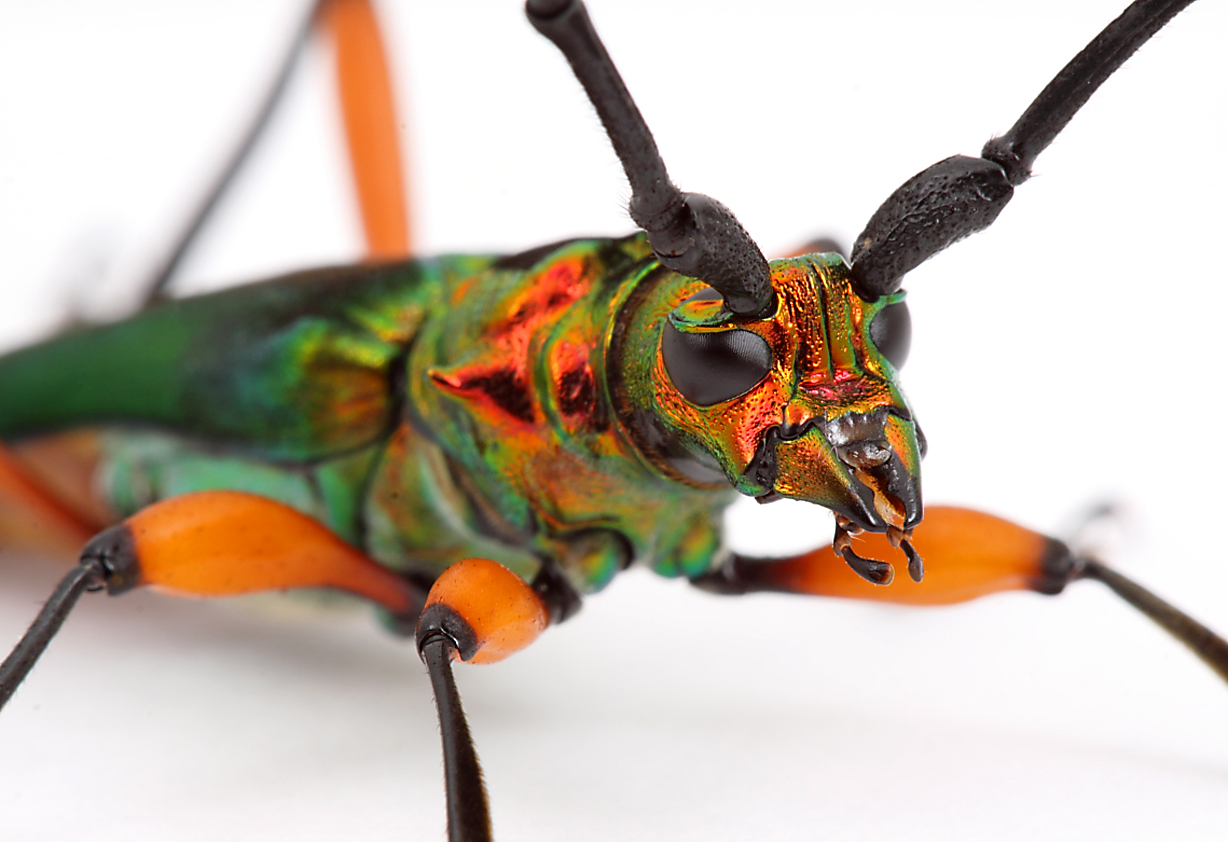
Even though we’re now in the latter part of February, I wanted to spread the word about a cool insect-themed calendar shown to me by a colleague during my recent trip to Brazil. Produced by Frenatae, the Graduate Student Entomology Club at the University of Minnesota, the calendar features original work by students using computer illustration techniques taught in a UMN course titled, ENT 5051, Scientific Illustration of Insects. The mastermind behind this course is Dr. Ralph W. Holzenthal, who – as can be seen by the stunning image above of a female (L) and male (R) Tabanus lineola – knows a thing or two about insect illustration! While the course covers traditional techniques such as pen & ink, pencil, watercolor, etc., its major emphasis is on computer-assisted techniques using Adobe Illustrator® and Photoshop®. This includes instruction on preparing full habitus color illustrations of insects on the computer. How I wish a course such as this had been available when I was in graduate school (of course, how I wish computers had been available when I was in graduate school!).
While Dr. Holzenthal’s illustrative skills are obvious, it’s also clear that he excels at teaching these skills to his students, as evidenced by this selection of my favorite images (not surprisingly, all beetles!) from the course website galleries:
.
It should be pointed out that all of these Photoshop illustrations represent original artwork and not modified photographs!
I ordered my copy of the calendar as soon as I returned home from my trip. You can order one too by sending a check for $12 to the following address:
Frenatae
1980 Folwell Ave Rm 219
St Paul, MN 55108
My thanks to Dr. Holzenthal for allowing me to post this small selection of images from his website.
Copyright © Ted C. MacRae 2011
The December 2010 issue of the journal CICINDELA came out a little over a week ago. Leading off inside is the first in a series of papers that I, along with colleagues Chris Brown and Kent Fothergill, have prepared detailing our work with several species of tiger beetles in Missouri of potential conservation interest. At the start of our surveys, Missouri’s tiger beetle fauna was already fairly well characterized, at least qualitatively, due to the efforts of heavy hitters Ron Huber and Dave Brzoska, who for many years lived in nearby eastern Kansas. Despite their attentions, however, questions lingered regarding the precise distribution and status of several species of restricted geographical occurrence within the state, and our surveys over the past 10 years have sought to resolve these questions and, if necessary, recommend conservation efforts to secure the long-term survival of these species within the state.
One of these species of interest is Habroscelimorpha circumpicta johnsonii (Johnson’s tiger beetle). This subspecies is widely distributed in inland areas of the central and south-central United States, where it is associated exclusively with barren areas surrounding saline seeps. Despite the broad occurrence of the main population, the Missouri population of this subspecies has long been of particular interest for several reasons: 1) its widely disjunct isolation, occurring several hundred miles east of the nearest populations in central Kansas, 2) its strict association with the highly restricted saline seeps of central Missouri (Fig. 1), and 3) the exclusive blue-green coloration of the adults (Fig. 2) that contrasts with the varying proportions of reddish and/or dark morphs, in addition to blue-green morphs, found in other populations. The highly disjunct and isolated occurrence of this population and its unique coloration have been considered by some workers as grounds for separate subspecific status. Another restricted, disjunct population of this species in North Dakota has already been accorded subspecific status – H. circumpicta pembina.
Despite its restricted occurrence in Missouri, a long history of collection records exist for the subspecies. Numerous specimens are housed in the Enns Entomology Museum in Columbia, Missouri, with a majority of these coming from a single location (Boone’s Lick Historic Site) and dating back as early as 1954. In more recent years (1985-1992), Ron Huber and Dave Brzoska found significant numbers of beetles at two additional locations near Boone’s Lick. Despite these numerous records, the subspecies was listed as a “Species of Conservation Concern” by the Missouri Natural Heritage Program with a status of “S2S3” (vulnerable or imperiled) due to the rarity of its required saline seep habitats in Missouri. Unfortunately, this alone did not appear to be sufficient protection for the species, as my own observations beginning in the mid-1990s suggested that populations of the beetle had declined significantly from their historical levels. Concomitant with these apparent declines was the observation that the sites supporting these beetles had themselves suffered severe degradation that reduced their apparent suitability as habitat for the beetle. As a result of these observations, Chris and I initiated comprehensive surveys during the 2001 field season to assess the conservation status of the Missouri population and identify potential new sites. Our first order of business was to petition a status change to “S1” (critically imperiled), and for the next three years we regularly visited the historical sites throughout the presumed adult activity period, noting occurrence of adults and recording their numbers and the circumstances of their habitat associations. Included in these surveys also were two new sites identified using the Missouri Natural Heritage Database.
The results were not good – during the 3-year survey, only a single beetle was observed at the historical location of Boone’s Lick, and none were observed at the two other locations discovered by Ron Huber and Dave Brzoska. More significantly, all three sites had suffered severe degradation due to vegetational encroachment, cattle trampling, or other anthropogenic disturbance. Moreover, of the two potential new sites identified, only one of these (Blue Lick Conservation Area) was found to support a small population of the beetle. Three apparently suitable saline seeps exist at this latter site; however, beetles were observed at only one of them. During the final year of the survey, prolonged flooding occurred at this site (frustratingly, a result of earth-moving operations by site personnel), which was followed in subsequent years by significant vegetational encroachment (Fig. 3). No beetles were observed at this site during the final year of the survey, nor has the species been seen there in multiple visits to the site in the years since.
Is the Missouri disjunct population of Johnson’s tiger beetle extirpated? There is little reason to be optimistic. What is clear is that the beetle is now below detectable limits, and with the loss of suitable habitat at all sites known to have supported the beetle in the past and little chance that new, high-quality sites will be identified, prospects for an unaided comeback are dim. The saline seep habitats at the three historic sites appear to have suffered irreparable degradation and offer little restoration potential to the degree required to support viable beetle populations; however, there are still two saline seeps at Blue Lick that do offer at least a semblance of suitable habitat. It is imperative that these last remaining examples of Missouri’s critically imperiled saline seeps habitats receive the highest priority for protection if the beetle (should it still exist) is to have any chance of surviving in Missouri. Johnson’s tiger beetle is only one of several tiger beetle species whose presence in Missouri appears to be in jeopardy (others being Dromochorus pruinina – loamy ground tiger beetle, and Cylindera celeripes – swift tiger beetle). I end this post with our closing admonition in the paper:
The loss of this beautiful and distinctive beetle from Missouri’s native fauna would represent a significant and tragic loss to this state’s natural heritage. We urge the Missouri Department of Conservation, the Missouri Department of Natural Resources, and other conservation organizations within the state to identify and allocate the resources needed to develop and implement a recovery plan for the species in Missouri.
REFERENCE:
Brown, C. R. and T. C. MacRae. 2011. Assessment of the conservation status of Habroscelimorpha circumpicta johnsonii (Fitch) in Missouri CICINDELA 42(4) (2010):77-90.
Postscript. On a happier note, I am pleased to be joining the editorial staff for CICINDELA. While my role as layout editor is more functional than academic, I am nevertheless thrilled with the chance to “rub shoulders” with the likes of Managing Editor Ron Huber and long-time cicindelid experts Robert Graves and Richard Freitag. I hope my contributions to the journal’s production on the computer end of things will be favorably received by its readership.
Copyright © Ted C. MacRae 2011

I arrived at our facility in Campinas, Brazil just before lunchtime. I had spent the previous 20 hours on planes, trains, and automobiles (well, not trains), so when my colleague suggested that we take a short walk outside to the campus cafeteria I readily agreed. Fresh air and at last a taste of that sumptuous Brazilian fare that I love so much sounded like a great idea. As we walked to the cafeteria, I spotted these orchid blossoms on the tips of tall, reed-like stems growing in beds around the campus grounds… Orchids! Growing in the ground, outside! What a beautiful and appropriately tropical welcome to start things off. I love orchids (and used to maintain a small collection back when I had time for such leisurely pursuits), so I asked my colleague if he knew which it was. He didn’t, so I studied it carefully trying to remember its features so I could identify it later. The terrestrial part struck me as a little odd for a Neotropical orchid, and I commented to my colleague that I’d bet it was something introduced from Asia. That is precisely the case, although it took me a while to figure it out. My initial Google and Flickr searches using terms such as “Brazil orchid” and the like produced pages and pages of Brazil’s famous diversity of native epiphytic species, but no obvious matches to this terrestrial species. It later dawned on me that I should conduct my searches in Portuguese, and within the first page or two I found it – the appropriately named bamboo orchid (“orquidea bambusa”), Arundina graminifolia.

I would later see this orchid blooming not only in tended gardens, but from cracks in the pavement between buildings. Originating from south and southeast Asia, this sole member of the genus is popularly cultivated in gardens across the tropics and has become naturalized in many areas. Mary Farmer at A Neotropical Savanna has an excellent post on recognition and occurrence of this species in Panama, including detailed discussion and photographs of vegetational and floral morphology and its potential (or lack thereof) for becoming an invasive weed.
Copyright © Ted C. MacRae 2011