A bit of housekeeping

I hope you’ll forgive the lack of pretty bug pictures and witty prose in today’s post – I have a few updates and adminstrative issues that I’d like to take care of.

Circus of the Spineless
This notice is a few days late, but Circus of the Spineless # 43 is up at Wanderin’ Weeta.  Susannah has done a great job of assembling blog posts on a diversity of invertebrates from anemones to annelids, bryozoans to barnacles, decapods to gastropods, and of course – insects.  In the latter group, all of the major orders are covered (including beetles by some guy that likes tiger beetles).

Expanded Blogroll
It has been quite a while since I last made mention of new additions to my ever-expanding blogroll.  I’m trying to maintain a fairly comprehensive list of blogs that either focus primarily on insects or feature compelling natural history discussions, and it seems that almost every week I find another one that either began recently or somehow escaped my earlier attention.  A few of these more recent additions deserve special mention for their interesting subjects, superior writing, quality photographic content, etc.

Rate My Posts
WordPress has a new widget that allows readers to rate the quality of posts.  I thought I would open myself up to this potential for praise or criticism and have activated this feature on this blog (and also my other blog, Bikes Bugs and Bones).  It’s a little jickery in that the “comments” link must be clicked in order to see the rating widget, which appears at the bottom of the post as 5 blank stars.  It’s a typical rating scale, with 1 star being the worst and 5 stars being the best.  I know a lot of readers don’t like to leave comments (although I heartily encourage them), but perhaps you would be willing to provide feedback in the form of a rating.  The ratings are completely anonymous – no IP addresses are recorded by the rating widget, so there is no way for me to know who voted or how.  Over time, as ratings accumulate for posts, I will be able to see what kinds of posts people really like (and which they really don’t).  This can be your way to contribute to the future direction of this blog!

  • 5 Stars = Excellent – use this for my very best pieces.
  • 4 Stars = Very Good – you really liked it, maybe just minor criticisms.
  • 3 Stars = Average – not bad, not great, it did the job.
  • 2 Stars = Fair – not one of my better pieces, a bad day perhaps.
  • 1 Star = Poor – well, let’s just hope I don’t get too many of these.

Editorial Duties
One of my long term goals is to be Managing Editor for an entomological journal.  Despite the volunteer nature of such a position, it’s not one that somebody can just walk into – dues must be paid.  I got a foot in the door a few years ago when I began serving as Coleoptera Subject Editor for The Pan-Pacific Entomologist, the journal of the Pacific Coast Entomological Society (we would welcome your manuscript dealing with western entomology in any aspect).  It has been an enjoyable experience, and I guess I’m doing a decent job since I was invited this summer to join the editorial team of the online journal Zootaxa.  This “mega-journal for zoological taxonomists in the world” has quickly become the leading journal for new taxa and taxonomic or nomenclatural acts, based on the coverage and indexing of Zoological Record since 2004.  This is possible only because of its team of 141 editors that cover the entire breadth of animal taxa – 17 of which (including me) handle the vast insect order Coleoptera.  Ever the glutton for punishment, I’ve also just accepted an invitation by the Webster Groves Nature Study Society to take over editorship of their monthly newsletter, Nature Notes.  I suppose the combination of these three editorial positions will let me know if I really want to pursue full editorship of a major journal at some point!

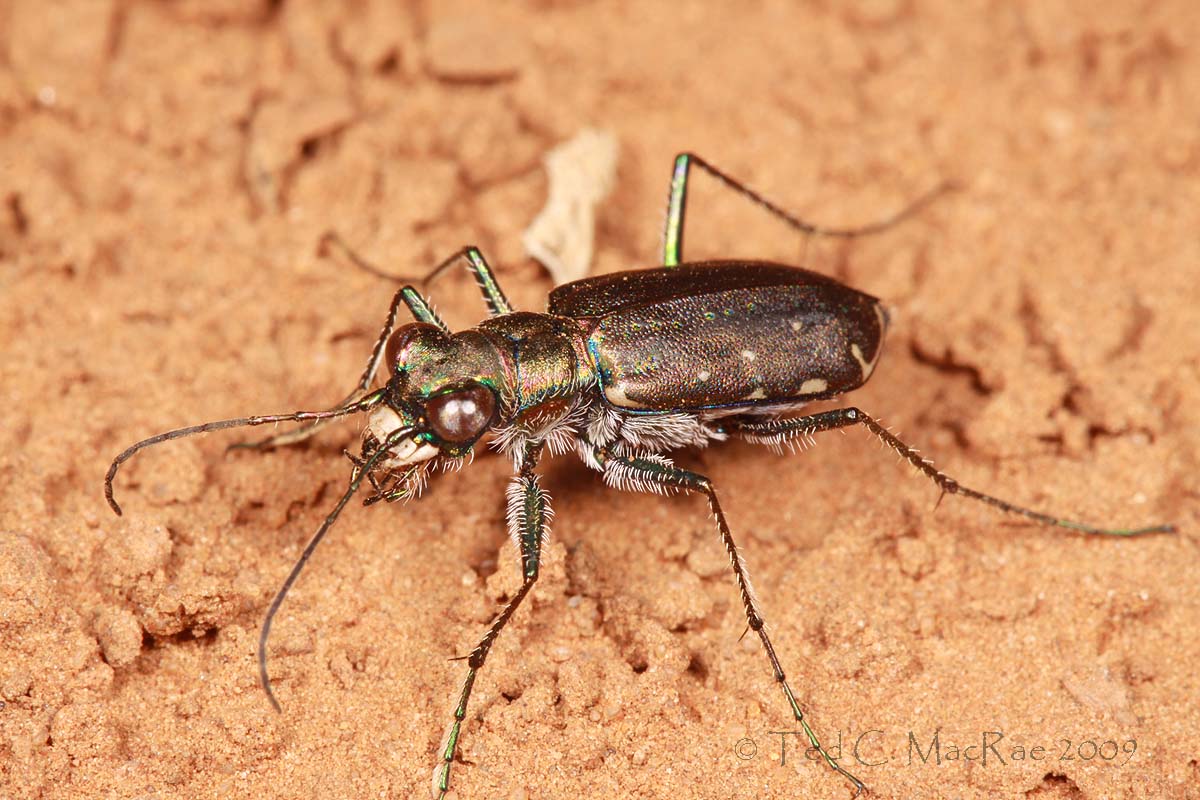
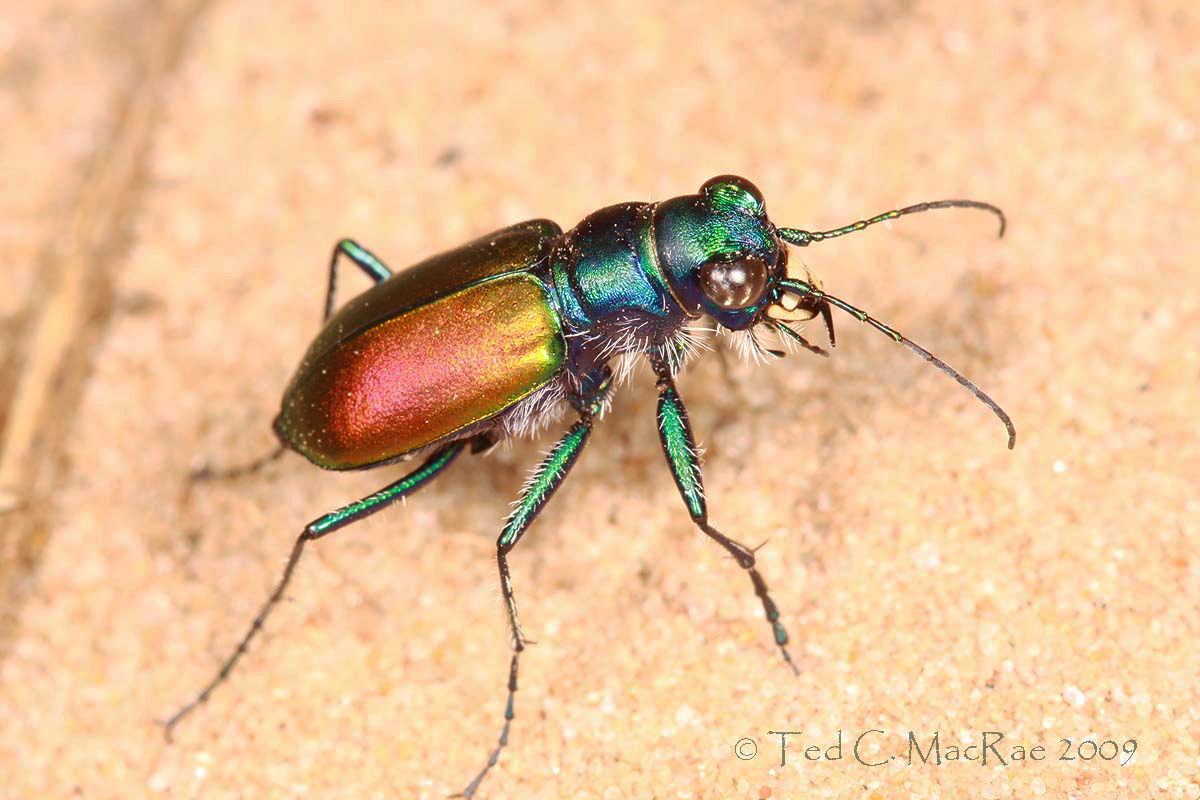
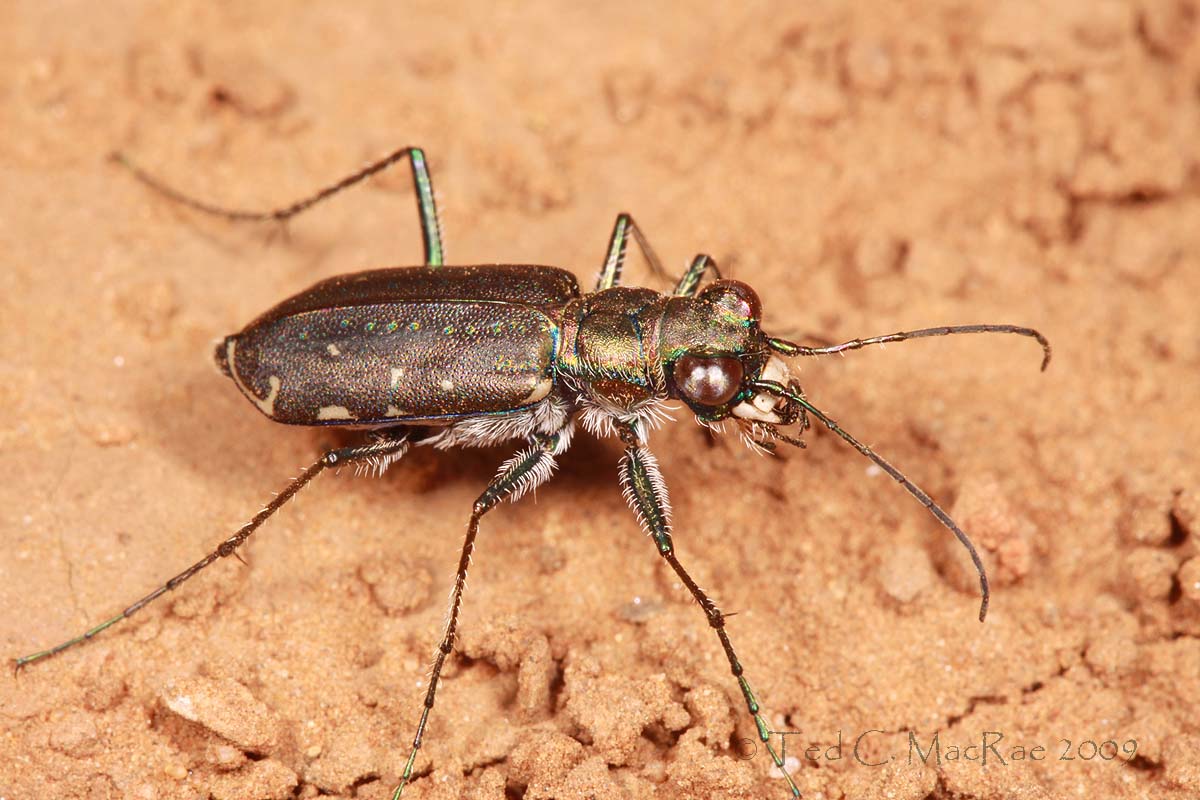
Okay, I can’t leave you without any kind of photograph – here are a couple of shots of Cicindela scutellaris, or festive tiger beetle. This male individual represents the stunningly beautiful nominotypical subspecies occupying the western part of the species’ range – it was photographed on sand exposures in shinnery oak shrubland habitat at Packsaddle Wildlife Management Area in extreme northwestern Oklahoma this past June.

IMG_0540_1200x800_enh

IMG_0547_1200x800

Photo details: Canon 100mm macro lens on Canon EOS 50D (manual mode), ISO-100, 1/250 sec, f/14-16, MT-24EX flash 1/4 power through diffuser caps.

Copyright © Ted C. MacRae

Add to FacebookAdd to NewsvineAdd to DiggAdd to Del.icio.usAdd to StumbleuponAdd to RedditAdd to BlinklistAdd to Ma.gnoliaAdd to TechnoratiAdd to Furl

The ubiquitous tiger beetle

Cicindela ubiquita

Cicindela ubiquita - ubiquitous tiger beetle

Back in early June as I began my exploration of The Nature Conservancy’s Four Canyon Preserve in northwestern Oklahoma, one of the very first insect species that I encountered was Cicindela ubiquita¹ (the ubiquitous tiger beetle).  This ubiquitous species is restricted to nearly the entire North American continent and is found only in just about any habitat you can imagine.  It seems to especially favor wet or dry areas in lowland or upland habitats with little or lots of vegetation.  At Four Canyon Preserve, it showed a distinct preference for dry upland sand and clay sites and wet bottomland sand sites.  I did not find it in wet bottomland clay sites – probably because no such habitat exists within the preserve.

¹ Originally described as Cicindela punctulata (punctured tiger beetle) by Olivier (1790).  This name has been accepted by virtually all subsequent authors and is still used in such recent works as Freitag (1999), Pearson et al. (2006), and Erwin and Pearson (2008).

IMG_0371_1200x800I had seen this species previously in Missouri on just about every collecting trip I’ve ever taken within that state.  Populations in Missouri seem to look exactly like the population here at Four Canyon Preserve but favor other habitats, including lawns, soybean fields, any dirt road, gravel parking lots, and cement sidewalks (although I have so far failed to find larval burrows in the latter, suggesting a greater level of habitat selectivity during the larval stage).  Based on examination of specimens in both my collection and that of the Enns Entomology Museum at the University of Missouri-Columbia, I can’t seem to find any county in Missouri where this beetle does not occur.

IMG_0372_1200x800An interesting feature of this species is that its adult activity period seems to exclude the winter months.  Thus far, I have only succeeded in finding active adults during those months when temperatures routinely surpass the freezing point (April through November).  It also apparently has been unable to colonize the Pacific Coast of North America – the reasons for this extreme selectivity will remain unclear until further research can be done.

Despite the common usage of the name Cicindela punctulata for this species, the following quotes are offered to support my contention that the valid name of this species should be Cicindela ubiquita:

The ubiquitous Cicindela (Cicindelidia) punctulata battling ants. — somatochlora.

This species and C. repanda are the most common and ubiquitous in the state. — Graves (1963).

C. punctulata punculata is almost ubiquitous in Colorado. — J. P. Schmidt

Notes: Abundant statewide; ubiquitous… — Mike Reese

this same pond were the ubiquitous C. repanda Dejean and C. punctulata Olivier. — Charlton and Kopper (2000).

Photo details: Canon 100mm macro lens on Canon EOS 50D, ISO 100, 1/250 sec, f/16, MT-24EX flash 1/4 power through diffuser caps.

REFERENCES:

Charlton, R. E. and B. J. Kopper.  2000.  An unexpected range extension for Cicindela trifasciata F. (Coleoptera: Carabidae: Cicindelinae).  The Coleopterists Bulletin 54(2):266-268.

Erwin, T. L. and D. L. Pearson. 2008. A Treatise on the Western Hemisphere Caraboidea (Coleoptera). Their classification, distributions, and ways of life. Volume II (Carabidae-Nebriiformes 2-Cicindelitae). Pensoft Series Faunistica 84. Pensoft Publishers, Sofia, 400 pp.

Freitag, R.  1999.  Catalogue of the tiger beetles of Canada and the United States.  National Research Council Canada, Ottawa, Ontario, 195 pp.

Graves, R. C.  1963.  The Cicindelidae of Michigan (Coleoptera).  American Midland Naturalist 69(2):492-507.

Olivier, G. A.  1790.  Entomologie ou histoire naturelle des insectos.  Paris, 2, 1-32.

Pearson, D. L., C. B. Knisley and C. J. Kazilek. 2006. A Field Guide to the Tiger Beetles of the United States and Canada. Oxford University Press, New York, 227 pp.

Copyright © Ted C. MacRae 2009

Add to FacebookAdd to NewsvineAdd to DiggAdd to Del.icio.usAdd to StumbleuponAdd to RedditAdd to BlinklistAdd to Ma.gnoliaAdd to TechnoratiAdd to Furl

The last tiger beetle

Our recent discovery of Cylindera celeripes (swift tiger beetle) in Missouri was arguably the most exciting moment that I and colleague/fieldmate Chris Brown have experienced since we first began surveying the tiger beetles of Missouri back in the year 2000.  It was the 24th species that we had recorded for the state and the latest of several for which we had searched through targeted surveys during the past few seasons.  Earlier surveys have already produced a new record for Cicindela trifasciata ascendens (ascendant tiger beetle), “rediscovered” Cylindera cursitans (ant-like tiger beetle) and Dromochorus pruinina (frosted dromo tiger beetle), precisely characterized the limited in-state distributions of Habroscelimorpha circumpicta johnsonii (Johnson’s tiger beetle) and Cicindela obsoleta vulturina (prairie tiger beetle), and generated copious distributional data for the remaining more generally distributed species.

Yet, there still remained one species that we had not managed to find ourselves – Ellipsoptera macra (sandy stream tiger beetle).  This species was recorded from a few localities along the Missouri River in northwestern Missouri by Willis (1967), and we have examined a small number of additional specimens in the Enns Entomology Museum.  According to the literature, this species occurs near the water’s edge on sandy habitats along large rivers – precisely the type of habitats in which we have encountered the closely related E. cuprascens (coppery tiger beetle), which we have found at several locations along the Missouri and Mississippi Rivers.  Each time we found E. cuprascens we expected/hoped to see E. macra as well but never did.  The reasons for this remained a mystery to us until I noted a comment on the Tiger Beetles of Nebraska website stating that blacklighting is usually more productive for this species than daytime collecting.  With its known occurrence in northwestern Missouri, our planned survey for C. celeripes in that part of the state this season offered a perfect opportunity to try to find this, the last tiger beetle species in Missouri that we had not yet collected ourselves.  Our plan was to search loess hilltop prairie habitats during the day for C. celeripes, then blacklight along the Missouri River at night to look for E. macra.  Both species seemed like longshots – we’d searched for each many times, and we were willing to spend several consecutive weekends from late June to mid-July on our survey so that we could claim that we had given it our best shot.  Of course, as you know, we succeeded in finding C. celeripes on the first day of our first weekend, and we would also enjoy the same success with E. macra later that evening.

Chris Brown looks for Ellipsoptera macra amongst the swarm.

Chris Brown braves the swarm to look for individuals of Ellipsoptera macra.

We setup two blacklights at a public fishing access along the Missouri River (explaining to some puzzled locals exactly what we were doing and why), turned the lights on, and sat back with pizza and merlot as we waited for things to start coming to the sheets.  We had been to this site before in previous years and found E. cuprascens here, suggesting that suitable habitat was present in the area.  Almost immediately a growing cloud of all manner of aquatic insects began swarming around the lights, landing on the sheets – and flying down our shirts and in our hair whenever we tried to approach!  I don’t blacklight as much as I did in my younger days, but even then I wasn’t much of a fan of blacklighting near water for precisely these reasons.  We hadn’t had the lights going for more than 15 minutes or so before we saw the first tiger beetle crawling on the bottom of the sheet below the light.  It looked like cuprascens, but I placed it live in a vial anyway for photographs the next morning.  Then there was another… and another…  Soon, they were coming in with regularity, and I quickly ran out of vials in which to keep live individuals separately.  I’ve never seen tiger beetles come to blacklights like this, but we still weren’t convinced they were E. macra until later that night when we got back to the hotel and had a chance to take a close look at them with good light.  There was no doubt about it – we had finally found E. macra in Missouri!

This species is very similar to E. cuprascens, but the elytra are not as shiny and with smaller, shallower punctures than the latter.  Some references mention a more recurved lower portion of the humeral lunule and a generally more green than bronze coloration (Pearson et al. 2006), but these characters were tenous at best with the specimens we had in hand (see photo below).  The best character we have found to separate the two species is by examining the female elytra – in E. macra the sutural apex is acute, while in E. cuprascens it is rounded (Willis 1967).  We returned to the site the next morning to see if we could find them during the day, and although we did manage to find a few, they were nowhere near as numerous as we had seen them at the blacklights the night before.  The following photograph is of an individual captured that evening and then “released” back into the field the following morning – they were quick to fly once released, and only after several individuals and trying the “lens cap” technique did we succeed in getting some good shots.

Ellipsoptera macra

Ellipsoptera macra

We didn’t get a chance to use blacklights in subsequent weekends to see if we could find E. macra in other localities along the Missouri and Mississippi Rivers – with E. macra and C. celeripes success already in hand, I quickly turned my attention to the White River Hills of southwestern Missouri and their gorgeous glade habitats to look for one of North America’s most beautiful cerambycid beetles, Plinthocoelium suaveolens (more on that in a future post).  However, I am confident that E. macra will be found at other spots in Missouri should we decide to look for them with blacklights.  Having encountered all 24 species of tiger beetles known from Missouri, I present here a checklist of those species.

CHECKLIST OF TIGER BEETLES IN MISSOURI
(classification and common names by Erwin and Pearson 2008)

Tribe CICINDELINI
Subtribe MEGACEPHALINA
Tetracha (s. str.) carolina carolina – Carolina Metallic Tiger Beetle
Tetracha (s. str.) virginica – Virginia Metallic Tiger Beetle

Subtribe CICINDELINA
Cicindela (s. str.) duodecimguttata – 12-spotted Tiger Beetle
Cicindela (s. str.) formosa generosa – Eastern Sand Tiger Beetle
Cicindela (s. str.) hirticollis shelfordi – Shelford’s Tiger Beetle
Cicindela (s. str.) limbalis – Common Claybank Tiger Beetle
Cicindela (s. str.) purpurea purpurea – Cowpath Tiger Beetle
Cicindela (s. str.) repanda – Bronzed Tiger Beetle
Cicindela (s. str.) scutellaris lecontei – LeConte’s Tiger Beetle
Cicindela (s. str.) sexguttata – Six-spotted Tiger Beetle
Cicindela (s. str.) splendida – Spendid Tiger Beetle
Cicindela (s. str.) tranquebarica tranquebarica – Oblique-lined Tiger Beetle
Cicindela (Cicindelidia) obsoleta vulturina – Prairie Tiger Beetle
Cicindela (Cicindelidia) punctulata punctulata – Punctured Tiger Beetle
Cicindela (Cicindelidia) rufiventris rufiventris – Eastern Red-bellied Tiger Beetle
Cicindela (Cicindelidia) trifasciata ascendens – Ascendant Tiger Beetle
Cylindera (s. str.) celeripes – Swift Tiger Beetle
Cylindera (s. str.) cursitans – Ant-like Tiger Beetle
Cylindera (s. str.) unipunctata – One-spotted Tiger Beetle
Dromochorus pruinina – Frosted Dromo Tiger Beetle
Ellipsoptera cuprascens – Coppery Tiger Beetle
Ellipsoptera lepida – Ghost Tiger Beetle
Ellipsoptera macra macra – Sandy Stream Tiger Beetle
Habroscelimorpha circumpicta johnsonii – Johnson’s Tiger Beetle

Photo details:
Blacklighting: Canon 17-85mm zoom lens on Canon EOS 50D (manual mode), ISO 100, 1/30 sec, f/11, on-camera flash.
Ellipsoptera macra: Canon 100mm macro lens on Canon EOS 50D (manual mode), ISO 100, 1/250 sec, f/14, MT-24EX flash 1/4 power w/ diffuser caps.

REFERENCES:

Erwin, T. L. and D. L. Pearson. 2008. A Treatise on the Western Hemisphere Caraboidea (Coleoptera). Their classification, distributions, and ways of life. Volume II (Carabidae-Nebriiformes 2-Cicindelitae). Pensoft Series Faunistica 84. Pensoft Publishers, Sofia, 400 pp.

Pearson, D. L., C. B. Knisley and C. J. Kazilek. 2006. A Field Guide to the Tiger Beetles of the United States and Canada. Oxford University Press, New York, 227 pp.

Willis, H. L.  1967. Bionomics and zoogeography of tiger beetles of saline habitats in the central United States (Coleoptera: Cicindelidae).  The University of Kansas Science Bulletin 47(5):145-313.

Copyright © Ted C. MacRae 2009

Add to FacebookAdd to NewsvineAdd to DiggAdd to Del.icio.usAdd to StumbleuponAdd to RedditAdd to BlinklistAdd to Ma.gnoliaAdd to TechnoratiAdd to Furl

Salt Plains National Wildlife Refuge

IMG_0687_1200x800

I’ve written quite a few posts about my June trip to northwestern Oklahoma. Four days at the ruggedly scenic Four Canyon Preserve and nearby Packsaddle Wildlife Management Area yielded a few interesting jewel beetles (though not many tiger beetles), but the followed two days in the red clay/gypsum hills just north of there were as successful a two-day period as I’ve ever had, with new localities for Cylindera celeripes (swift tiger beetle) and true field photographs of Dromochorus pruinina (frosted dromo tiger beetle¹). The next day was spent at nearby Salt Plains National Wildlife Refuge, just east of the red clay hills in Alfalfa Co. Salt Plains is best known for its Selenite Crystal Dig Area, where an estimated 30,000 annual visitors dig for Oklahoma’s State Crystal with its unique hour glass-shaped inclusion (the only known site where these crystals are found). A dominant feature of the refuge, however, is its 10,000 acre saline flat – left behind by the vast Permian seas that once covered the interior of the continent and the largest such salt flat in the Great Plains.  It was this feature that drew my interest.

¹ Common names according to Erwin and Pearson (2008).

IMG_0689_1200x800

I first visited Salt Plains a few years ago when fieldmate Chris Brown and I were near the end of a rather unproductive (yet still enjoyable) fall tiger beetle trip to the nearby Gypsum Hills of south-central Kansas (Cicindela pulchra had eluded us – for the time being!).  We noted the refuge on the map and decided to take a look – becoming instantly enamoured with the diversity of tiger beetles seen running on its barren, salt-encrusted mud flats.  I returned the following fall with long-time fieldmate Rich Thoma and Hardtner, KS resident “Beetle Bill” Smith, who introduced us to the refuge biologist so we could get permits to do some proper collecting.  Most of the tiger beetles we saw were widespread and familiar to me – Cicindela species proper such as C. formosa formosa (big sand tiger beetle), C. tranquebarica (oblique-lined tiger beetle), C. punctulata (punctured tiger beetle), and C. repanda (bronzed tiger beetle), but it was the creamy white Eunota togata globicollis (alkali tiger beetle) that had me swiping my net for the next hour or two.  Sadly, those were in my pre-photographer days, so I have no visual record of that species other than the pinned specimens in my collection.

My visit during this trip was completely unplanned.  After the mid-week’s thunderstorms chased me back to this part of the state, I thought this would be a nice contrast to the red clay/gypsum hills where I saw C. celeripes and D. pruinina.  In addition, the selection of tiger beetles active on the saline flats during this summer trip would likely be quite different from the fall/spring species I had seen on my previous two visits.  Trouble was, the unplanned nature of the visit also meant that I didn’t have a permit, but I was prepared to limit my activities to only photography in case I was unable to convince the refuge staff to renew my prior permit.  That eventuality was unnecessary, however, as the refuge biologist located my permit in a gray, dusty file cabinet and graciously typed up a new permit for me – good until next summer!  With that, I was off to SandPiper Trail and seven hours of stalking, netting, and photographing.  Some familiar faces were there again – C. formosa, C. repanda, C. punctulata, and C. tranquebarica (as they are almost everywhere), but I also encountered three beautiful species that I had not seen there before (one of which I had never seen previously).  Like E. togata, each of these species is an alkaline habitat specialist that makes its living only in these harsh, saline environments. They were not the easiest species to photograph, easily alarmed in the heat of the day, but the vast open spaces allowed me to follow their escape flights with relative ease, and one-by-one they gradually became accustomed to my presence and eventually allowed me to get at least one or two good shots.

Ellipsoptera nevadica knausii - Knaus' tiger beetle

Ellipsoptera nevadica knausii - Knaus' tiger beetle

Habroscelimorpha circumpicta johnsonii - Johnson's tiger beetle

Habroscelimorpha circumpicta johnsonii - Johnson's tiger beetle

Cicindela fulgida fulgida - crimson saltflat tiger beetle

Cicindela fulgida fulgida - crimson saltflat tiger beetle

Along with E. togata globicollis, these species bring the total number of species that I’ve observed at Salt Plains to eight – quite a hyperdiversity given the very small portion of the refuge that I’ve explored during my three visits.  Willis (1967) has observed as many as 11 species in a single habitat, and while this may seem to violate the principle of competitive exclusion (limiting the number of species that can occupy a given niche), careful observation reveals small but distinct partitionings of this harsh environment by the different species.  For example, C. fulgida was seen in the drier, more vegetated fringes around the flats, E. nevadica knausii was observed in moist, open areas near the water’s edge, and H. circumpicta johnsonii was more generally free ranging across the open salt surfaces.  Temporal separation combines with spatial separation to further subdivide the habitat – the latter two species occur as adults during summer, while E. togata globicollis and C. fulgida adult occurrence is primarily during spring and fall (the individual I saw was likely a stragler).  I have noted the same phenomenon with species occurring in clay habitats here in Missouri, with as many as six species seen at a single highway intersection in the White River Hills a few years ago.

Photo details:
Landscapes: Canon 17-85mm zoom lens on Canon EOS 50D (landscape mode), ISO 100, 1/50-60 sec, f/7.1-6.3, natural light.
Beetles: Canon 100mm macro lens on Canon EOS 50D (manual mode), ISO 100, 1/250 sec, f/14, MT-24EX flash 1/4 power w/ diffuser caps.

REFERENCES:

Erwin, T. L. and D. L. Pearson. 2008. A Treatise on the Western Hemisphere Caraboidea (Coleoptera). Their classification, distributions, and ways of life. Volume II (Carabidae-Nebriiformes 2-Cicindelitae). Pensoft Series Faunistica 84. Pensoft Publishers, Sofia, 400 pp.

Willis, H. L.  1967.  Bionomics and zoogeography of tiger beetles of saline habitats in the central United States (Coleoptera: Cicindelidae).  The University of Kansas Science Bulletin 47(5):145-313.

Copyright © Ted C. MacRae 2009

Add to FacebookAdd to NewsvineAdd to DiggAdd to Del.icio.usAdd to StumbleuponAdd to RedditAdd to BlinklistAdd to Ma.gnoliaAdd to TechnoratiAdd to Furl

Oklahoma is for lovers

A few rather risqué photos from my June trip to northwestern Oklahoma.

Eleodes suturalis (family Tenebrionidae) - June 6, 2009 at Four Canyon Preserve, Ellis Co., Oklahoma

Eleodes suturalis (family Tenebrionidae) - June 6, 2009 at Four Canyon Preserve, Ellis Co., Oklahoma

Chrysobothris ignicollis (family Buprestidae) - June 6, 2009 at Four Canyon Preserve, Ellis Co., Oklahoma

Chrysobothris ignicollis (family Buprestidae) - June 6, 2009 at Four Canyon Preserve, Ellis Co., Oklahoma

Ellipsoptera nevadica knausii ("family" Cicindelidae) - June 12, 2009 at Salt Plain National Wildlife Refuge, Alfalfa Co., Oklahoma

Ellipsoptera nevadica knausii ("family" Cicindelidae) - June 12, 2009 at Salt Plain National Wildlife Refuge, Alfalfa Co., Oklahoma

Photo details:
Eleodes suturalis: Canon 100mm macro lens on Canon EOS 50D, ISO 100, 1/250 sec, f/13, MT-24EX flash 1/4 power through diffuser caps.
Chrysobothris ignicollis: Canon 65mm 1-5x macro lens on Canon EOS 50D, ISO 100, 1/250 sec, f/13, MT-24EX flash 1/8 power through diffuser caps.
Ellipsoptera nevadica knausii: Canon 100mm macro lens on Canon EOS 50D, ISO 100, 1/250 sec, f/14, MT-24EX flash 1/4 power through diffuser caps.

Copyright © Ted C. MacRae 2009

Add to FacebookAdd to NewsvineAdd to DiggAdd to Del.icio.usAdd to StumbleuponAdd to RedditAdd to BlinklistAdd to Ma.gnoliaAdd to TechnoratiAdd to Furl

Dromochorus pruinina in Oklahoma

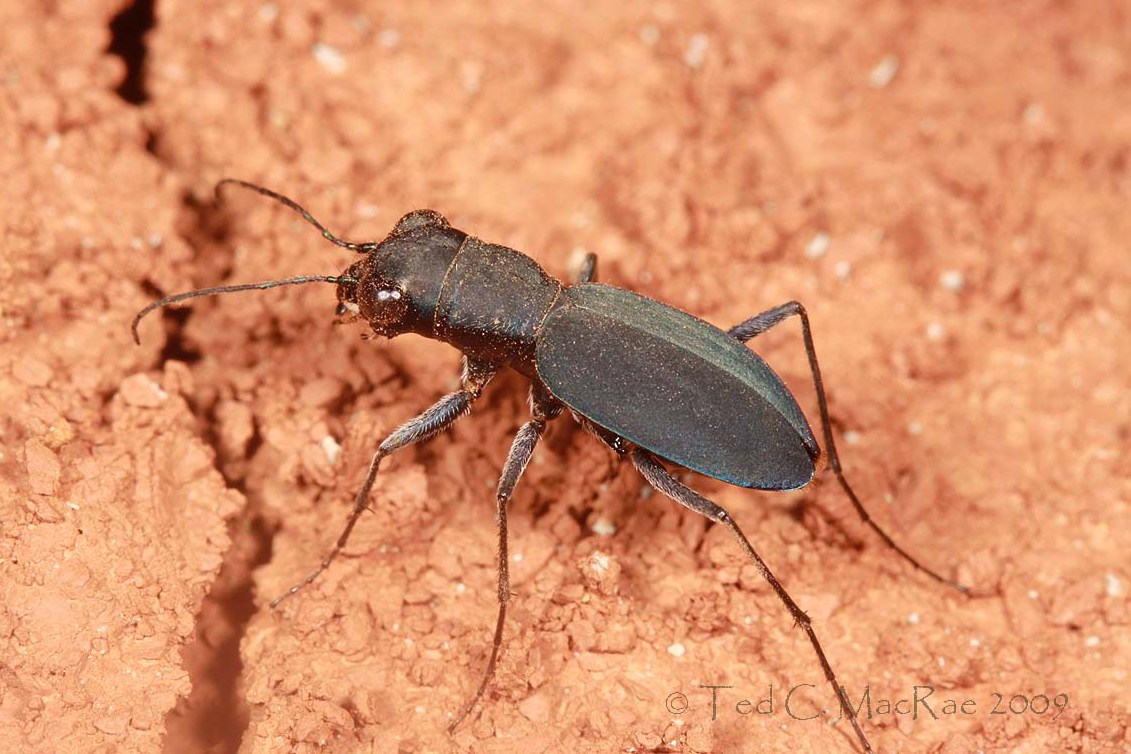
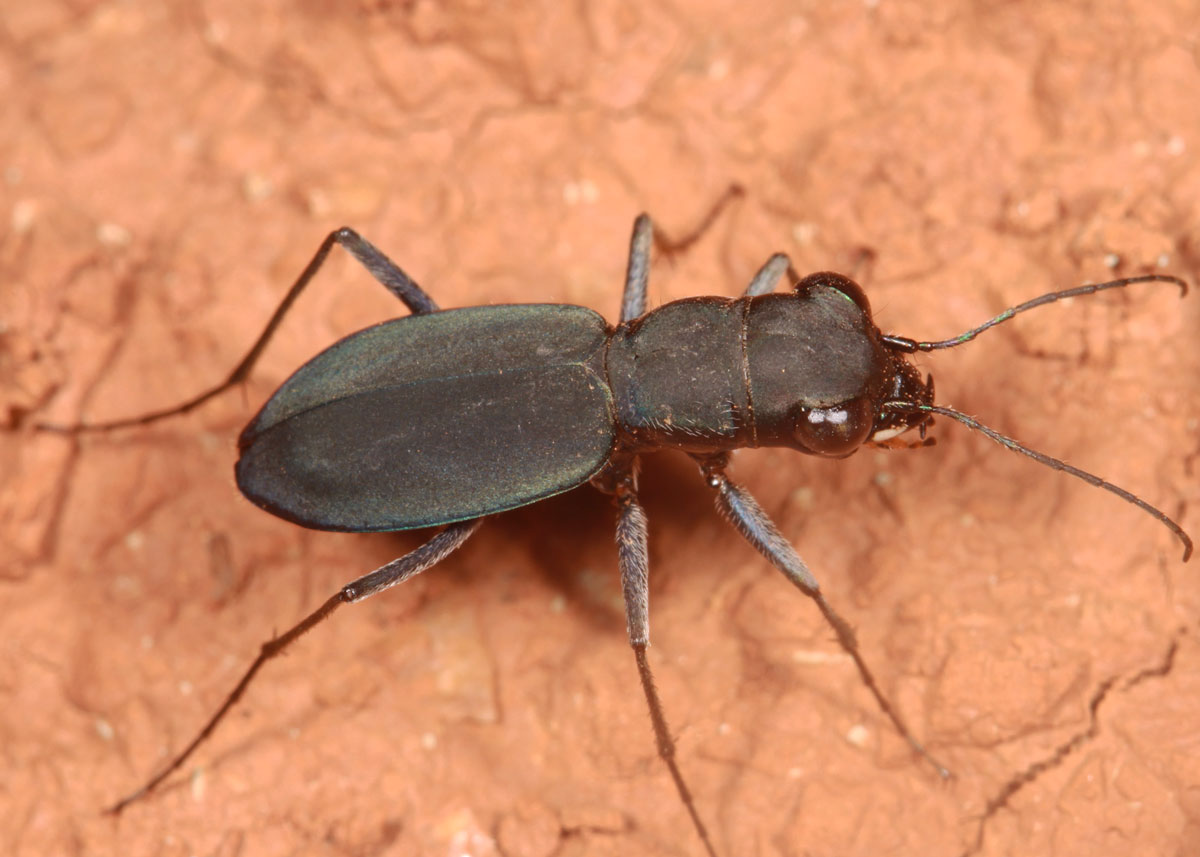
As my colleague Chris Brown and I continue to study the tiger beetle fauna of Missouri, one of the species we have become very interested in is Dromochorus pruinina (frosted dromo tiger beetle).  This is another of North America’s more enigmatic species and is one of a handful of species in Missouri – along with Cylindera cursitans (ant-like tiger beetle), C. celeripes (swift tiger beetle), Habroscelimorpha circumpicta johnsonii (Johnson’s tiger beetle), and Cicindela (Cicindelidia) obsoleta vulturina (prairie tiger beetle) – whose highly restricted distributions within the state make them worthy of special consideration for conservation (see Saving Missouri’s tigers and Revisiting the Swift Tiger Beetle – Part 3).  Of these, D. pruinina appears to be the most highly localized – thus far we have found this species only in west-central Missouri along a 2.5 mile stretch of roadside habitat in Knob Noster State Park.  This tiny population is not only the easternmost known occurrence of the species, but is also disjunct from the main population in Kansas, Oklahoma, and Texas by nearly 100 miles.  As a result of this extreme localization within the state, the species has been accorded a conservation status in Missouri of S1 – the state’s highest conservation ranking. 

IMG_0624_1200x800

Dromochorus pruinina is secretive and easily overlooked, and as a result little is known about it – in fact, the larva was unknown until just last year (Spomer et al. 2008).  There has also been little agreement on what to call it – many authors (e.g., Freitag 1999, Pearson et al. 2006) have considered it a synonym or subspecies of D. belfragei (loamy-ground dromo tiger beetle) from Texas; however, Spomer et al. (2008) and Erwin and Pearson (2008) consider it a valid species based on its smooth elytra in contrast to the granulated elytral surface of D. belfragei and the apparent lack of intergrades in central Texas where their geographical distributions overlap.  It was one of the species I had hoped to see during my early June visit to The Nature Conservancy’s Four Canyon Preserve in northwestern Oklahoma; however, I would not see this species there despite its abundance of exposed red clay slopes.  Following that visit, as I sat in a coffee shop in north-central Oklahoma trying to predict where the pounding rainstorm outside was least likely to spoil my collecting plans for the next few days, this species again came to my mind when I decided to go back to the red clay/gypsum hills just north of Four Canyon Preserve – where I had just seen the even more enigmatic C. celeripes.  I noted that this corner of Oklahoma was just at the western edge of the distribution given by Pearson et al. (2006) for the species, but still read through the notes on its habits and habitats in the off chance that I might still encounter it.  Despite all the forethought, it was nevertheless a surprise when an adult bolted across my path soon after beginning my search of the Gloss Mountains the next day (see Revisiting the Swift Tiger Beetle – Part 2).  Like C. celeripes, this species is flightless and runs swiftly – perhaps even more so – as it dashes between clumps of vegetation before disappearing.  It’s larger size would seem to make it easier to capture than C. celeripes, but that is not the case, yet I still managed to capture all three individuals I saw during the course of the several hours I spent on the lower talus slopes at the Gloss Mountains Scenic Overlook that morning.  With none of them could I even make an attempt at field photographs – their repeated mad dashes for cover eliminated all opportunity.  I placed the three individuals into a terrarium of native soil, resigned that I would have to settle for photographs in confinement (there is nothing wrong with confined photographs, which look every bit as natural as true field photographs – still, there is just something about not succeeding in photographing the subject in its native habitat).

IMG_0622_1200x800_2I returned to the Gloss Mountains late in the day and completed my search for C. celeripes in the State Park across the highway (and also saw my first massasauga rattlesnake).  By then it was about 7:00 pm, and my thoughts turned back to the D. pruinina I had seen across the highway earlier that day.  I recalled the tendency of the Missouri population of D. pruinina to be most active in the few hours before dusk and decided to have another go at them.  No sooner than I had begun to climb the talus slope did I see another one – he bolted into a grass clump, and despite my best attempts to tear the vegetation apart he was gone.  Frustrated, I got up and started walking up the slope again – and saw another one, with the same result!  Now I was mad.  I started searching the rankly vegetated clay slope with determination, and it wasn’t long before I saw a third individual higher up on the slope.  It was then and there that I decided I was going to get a field photograph.  I stopped dead in my tracks so as not to further disturb the beetle, and carefully took off my backpack and put my camera together as I kept a watchful eye on him.  Once ready, I moved slowly toward him – and he bolted.  This time I managed to catch him before he disappeared.  Okay – I’ve got one in the hand, now what?  I decided to try the time-out trick – placing him in the middle of an open area on top of the small mesa and covering him with my camera lens cap.  With luck, being covered momentarily would cause him to “settle down” long enough for me to get some shots.  I waited a few minutes, then carefully lifted up the lens cap – out he bolted with a vengeance.  Time for a new strategy.  I started blocking his path with my free hand everytime he tried to run out of the open area I had designated for him, hoping that he would eventually tire and rest momentarily – this was the strategy I successfully employed to get my first field photographs of C. celeripes the day before at Alabaster Caverns (see Revisiting the Swift Tiger Beetle – Part 1).  I did this for several minutes, and the little bugger just refused to settle down.  Finally, as I took my eye off of him for a split second, he disappeared into an adjacent grass clump and was never seen again.  IMG_0626_1200x800By now I was so frustrated that I considered giving up. Of course, I couldn’t – there was still daylight, and if there’s one thing I’ve learned in this game, it’s persistence. I started walking back down the slope searching for another individual, and right at the edge of the vegetated area I saw one running for cover.  This time I cut him off at the pass and forced him to run back towards the more open area of the upper slope.  Once out in the open, I continued to follow him as he nervously ambled across the slope into and out of erosion channels, looking for a place to hide.  Everytime he siddled up against a chunk of clay or tried to crawl into a crack I forced him out.  In the open expanse of the upper slope where I had him trapped, he eventually started pausing – not for long, but just long enough that I could get a shot or two in before he started running again.  Eventually, I got several shots that I thought might turn out acceptable.  I briefly looked at my camera to try another setting, looked up, and he was gone!  By now it was past 8:30 pm, and the sun was sinking fast.  I decided that I had given it my best effort, and that whatever shots I had would have to do.  I share with you here three of the five shots that I kept.

Photo details: Canon 100mm macro lens on Canon EOS 50D, ISO 100, 1/250 sec, f/14-16, MT-24EX flash 1/4 power through diffuser caps.

REFERENCES:

Erwin, T. L. and D. L. Pearson. 2008. A Treatise on the Western Hemisphere Caraboidea (Coleoptera). Their classification, distributions, and ways of life. Volume II (Carabidae-Nebriiformes 2-Cicindelitae). Pensoft Series Faunistica 84. Pensoft Publishers, Sofia, 400 pp.

Freitag, R.  1999.  Catalogue of the tiger beetles of Canada and the United States.  National Research Council Canada, Ottawa, Ontario, 195 pp.

Pearson, D. L., C. B. Knisley and C. J. Kazilek. 2006. A Field Guide to the Tiger Beetles of the United States and Canada. Oxford University Press, New York, 227 pp.

Spomer, S. M., P. D. Nabity and M. L. Brust. 2008. Larval description of Cicindela (Dromochorus) pruinina (Casey) (Coleoptera: Carabidae: Cicindelinae) with notes on habitat and adult behavior. The Coleopterists Bulletin 62(1):37-41.


Copyright © Ted C. MacRae 2009
Add to FacebookAdd to NewsvineAdd to DiggAdd to Del.icio.usAdd to StumbleuponAdd to RedditAdd to BlinklistAdd to Ma.gnoliaAdd to TechnoratiAdd to Furl

Typocerus deceptus in Missouri

It has been fifteen years now since I published an annotated checklist of the longhorned beetles (families Cerambycidae and Disteniidae) of Missouri (MacRae 1994).  That publication (and a similar one on Buprestidae) was the product of eight years of collecting – of specimens in the field and of data in any other public or private collection I could find that contained Missouri specimens – during my stint as a field entomologist with the Missouri Department of Agriculture.  I collected during the week while on my rounds.  I collected on weekends as well.  I visited every college and university in the state that had an insect collection of any size, and a few in neighboring states as well.  I made the acquaintance of private collectors with significant Missouri material – most notably Richard Heitzman, Marlin Rice, and the late Gayle Nelson.  By the time I left Missouri for a new position in Sacramento, I had documented 219 species and subspecies of longhorned beetles from the state – 66 of which were new state records.

Typocerus deceptus on flower of Hydrangea arborescens

Typocerus deceptus on flower of Hydrangea arborescens

Despite my best efforts, however, I knew the list was not complete – they never are.  In the years since returning to Missouri, I’ve documented an additional 10 species and subspecies in the state (MacRae and Rice 2007), and in a newly published paper (McDowell and MacRae 2009) the rare species, Typocerus deceptus, is documented from Missouri for the first time.  I cannot take credit for this discovery – that honor goes to the paper’s lead author, Tom McDowell of Carbondale, Illinois.  Tom first encountered this species in 2005 at Trail of Tears State Park in southeastern Missouri near Cape Girardeau while conducting routine insect surveys.  After seeing additional individuals on a subsequent visit to the park the following year, Tom contacted me to tell me of his find and graciously invited me to join him on further studies of this rarely encountered species.  I readily agreed, and in July of last year I met up with Tom at Trail of Tears to see the beetle for myself.

Typocerus deceptus on flower of Hydrangea arborescens

Typocerus deceptus on flower of Hydrangea arborescens

Typocerus deceptus has been recorded sporadically from across the eastern U.S.  Nothing is known of its biology other than adult flower hosts and activity periods, and the larva and larval host(s) remain completely unknown.  The species is aptly named, as its appearance is deceptively similar to the common and widespread species, T. velutinus.  Both of these species belong to the so-called “flower longhorn” group (subfamily Lepturinae), characterized by adults that are largely diurnal (active during the day) and attracted to a great variety of flowers upon which they feed.  Tom had found T. deceptus feeding on flowers of wild hydrangea (Hydrangea arborescens) in the company of several other flower longhorns, including T. velutinus.  The similarity of T. deceptus to T. velutinus makes distinguishing individuals amongst the vastly more abundant T. velutinus quite difficult.  However, Tom was able to recognize the species during his surveys as a result of prior experience with it in Illinois.  As Tom and I searched the wild hydrangea plants growing along an intermittent drainage between the road and the park’s unique mesic forest, we succeeded in picking out a total of four individuals of this species amongst the dozens of T. velutinus and other lepturines also feeding on the flowers.

Typocerus velutinus on flower of Hydrangea arborescens

Typocerus velutinus on flower of Hydrangea arborescens

I gradually developed a sense of the subtle differences that distinguish this species from T. velutinus and that allow its recognition in the field.  Typocerus deceptus is slightly more robust than T. velutinus, and whereas the transverse yellow elytral bands of the latter are distinct and well delimited, they are weaker and often interrupted at the middle in T. deceptus, giving the beetle a slightly darker brownish appearance.  The lateral margins of the elytra are also more strongly emarginated near the apices, giving the beetle a more distinctly tapered appearance.  Finally, while both species possess a distinct band of dense, yellow pubescence along the basal margin of the pronotum, this band is interrupted at the middle in T. deceptus. My ability to recognize this species in the field was confirmed a few weeks ago when I returned to Trail of Tears (with longtime field companion Rich Thoma) to attempt what seemed to be an impossible task – photograph these active and flighty insects in the field on their host plants.  Conditions were brutally humid, and I only saw two individuals that day – the first I immediately captured and kept alive as a backup for studio photographs should I fail to achieve my goal in the field, but the second individual (not seen until almost two hours later!) posed just long enough for me to whip off a series of frames, two of which turned out well enough to share with you here.  The first photo clearly shows the interrupted basal pubescent band, and both photos show the distinctly emarginate lateral elytral margins and weak transverse yellow bands (compare to the uninterrupted pronotal pubescent band and well developed transverse elytral bands of T. velutinus in the third photo).

Me with the discoverer of Typocerus deceptus in Missouri Trail of Tears State Park, July 2008

TCM with the discoverer of Typocerus deceptus in Missouri at Trail of Tears State Park, July 2008

It is possible that T. deceptus is not as rare as it appears and is simply overlooked due to its great resemblance to another much more abundant species. However, I believe this is unlikely given its rarity in collections of eastern U.S. Cerambycidae by casual and expert collectors alike.  Moreover, T. deceptus is not the only “rare” longhorned beetle to have been documented at Trail of Tears State Park – a number of other species have also been found there but not or only rarely elsewhere in Missouri (e.g., Enaphalodes cortiphagus, Hesperandra polita, Metacmaeops vittata, and Trigonarthris minnesotana).  This may be due to the unique, mesic forest found at Trail of Tears, being one of only a few sites in southeastern Missouri that support more typically eastern tree species such as American beech (Fagus grandifolia), tulip poplar (Liriodendron tulipifera), and cucumbertree (Magnolia acuminata).  Whether one of these trees serves as a larval host for T. deceptus is unknown.  Nevertheless, I will be returning to Trail of Tears in the future to see what other treasures remain hidden within its unique forests.

Photo details (insects): Canon 100mm macro lens on Canon EOS 50D, ISO 100, 1/250 sec, f/18-20, MT-24EX flash 1/4 power through diffuser caps.

REFERENCES:

MacRae, T. C. 1994. Annotated checklist of the longhorned beetles (Coleoptera: Cerambycidae and Disteniidae) known to occur in Missouri. Insecta Mundi 7(4) (1993):223–252.

MacRae, T. C. and M. E. Rice. 2007. Distributional and biological observations on North American Cerambycidae (Coleoptera). The Coleopterists Bulletin 61(2):227–263.

McDowell, W. T. and T. C. MacRae. 2008. First record of Typocerus deceptus Knull, 1929 (Coleoptera: Cerambycidae) in Missouri, with notes on additional species from the state. The Pan-Pacific Entomologist 84(4):341-343 DOI: 10.3956/2008-23.1

Copyright © Ted C. MacRae 2009

Add to FacebookAdd to NewsvineAdd to DiggAdd to Del.icio.usAdd to StumbleuponAdd to RedditAdd to BlinklistAdd to Ma.gnoliaAdd to TechnoratiAdd to Furl

Revisiting the Swift Tiger Beetle – Part 3

…continued from Revisiting the Swift Tiger Beetle – Part 2.

The Oklahoma trip had been an unqualified success. Not only had I managed to find the rare Cylindera celeripes (swift tiger beetle) at Alabaster Caverns, I had also determined the population there was healthy and, in fact, occurred robustly across a large swath of red clay/gypsum hill habitat in the vicinity of the Cimarron River (Woodward and Major Counties) in northwestern Oklahoma. This is good news for the species, who some have regarded as a potential candidate for federal listing on the endangered species list. There is no doubt that the species has suffered greatly in many parts of its range during the past century – most likely due to loss of habitat; however, the presence of a strong population in Oklahoma gives reason for optimism about its long-term prospects. It would have been even better had I found the species at the two Nature Conservancy preserves (Four Canyon and Tallgrass Prairie) that I had targeted, and the reasons for its apparent absence at those two sites despite an abundance of apparently suitable habitat remain a mystery to me (although I have my suspicions). Nevertheless, I returned to St. Louis happy, with new localities in my database and live individuals in containers of native soil for another attempt at rearing.

Our work with this species was not done, however. While C. celeripes has never been recorded in Missouri, my colleague Chris Brown and I have long suspected that it might occur here – most likely, we felt, in extreme northwestern Missouri where the Loess Hills landform reaches its southern terminus. We had looked for it in this area a few times before on the few remaining dry, hilltop prairie relicts that are so common further north in Iowa, and we had also looked for it in the larger tallgrass prairie remnants of west-central Missouri. None of these searches were successful, and with each unsuccessful effort it seemed less and less likely that the species actually occurred within the state – especially considering the declines that the species has experienced throughout its range. However, when we managed to find a small, newly discovered population of the species last summer in the Loess Hills of southwestern Iowa, just 60 miles north of Missouri (see The Hunt for Cicindela celeripes), we decided that one more thorough effort to locate the species in Missouri was in order.

Star School Hill Prairie Natural Area (north tract), Atchison Co., Missouri.

Star School Hill Prairie Natural Area (north tract), Atchison Co., Missouri.

Our plan was straightforward – we would travel to northwestern Missouri each weekend beginning in late June and search the most promising hilltop prairie relicts that still remain in Missouri. There aren’t many of these, so I contacted Tom Nagel of the Missouri Department of Conservation – who probably knows more about Missouri’s hilltop prairie relicts than anyone else – for assistance in identifying these parcels. Tom graciously sent me descriptions and aerial photographs of the highest quality relicts still remaining in Missouri. None of these are large (12 contiguous acres or less), and all have been impacted to some degree by woody encroachment and are in various stages of restoration. We had already searched one of these tracts (Star School Hill Prairie) a few times, but two others were new to us. So, on a Friday evening before the first of three planned weekends for our study (and only two weeks after returning from Oklahoma), Chris and I made the long drive across Missouri and north along the Missouri River and began our search the next morning.

Fieldmate Chris Brown surveys loess hilltop prairie habitat at Star School Hill Prairie Natural Area, Atchison Co., Missouri

Fieldmate Chris Brown surveys loess hilltop prairie habitat at Star School Hill Prairie Natural Area (south tract), Atchison Co., Missouri

Our first stop was High Creek Hill Prairie in Brickyard Hill Conservation Area (Atchison Co.). We had been to Brickyard Hill a few times but had not previously found this particular hilltop prairie. We found the tract, a long, narrow series of ridge tops and southwest-facing slopes, thanks to Tom Nagel’s map and began searching with all the enthusiasm and optimism that accompanies any new search. Our optimism waned with each hilltop ridge that we traversed not seeing the beetle, until we reached the easternmost ridge amidst a jumble of eastern red-cedar cadavers that halted any further progress or promise. As we stood atop that last hill, we debated our next move. Chris had noted apparently good habitat on the lower slopes below us, while I had spotted another very small hilltop tract across a wooded ravine and disjunct from the main prairie. We decided these areas should be explored before moving on to the next site, but as we searched those lower slopes our optimism continued to wane. The habitat was perfect based on what we had seen in Iowa last year and what I had seen in Oklahoma earlier in the month – small clay exposures amongst clumps of undisturbed little bluestem and grama, but still no beetles. Chris, refusing to accept defeat, continued to search the slope, while I worked my way over to the smaller hilltop tract I had seen from above. After crossing through the wooded ravine, I found an old 2-track running along the base of the tract and began walking along it. The small slope above the 2-track was littered with large cadavers of the invasive eastern red-cedar (Juniperus virginiana), apparently left in place after chainsawing to provide fuel for a planned, future burn. As I walked, a white-tailed deer bolted from a nearby cadaver, giving me a bit of a start, and I veered towards the cadaver to have a look at where it had bedded down. By this time I almost wasn’t even really thinking about C. celeripes anymore – we had been there for about an hour and a half and searched the most promising habitats without success – the small tract where I was now working was almost a last gasp before moving on. As I approached the deer’s bedding site, a “flash” in the thick vegetation caught my eye, and I knew instantly what it was. Immediately I dropped to my knees and tried to “trap” the evasive little beetle (I’ve found that forming a “trap” between the crotches of my hands and gradually closing my hands together forces the beetle to run up and over one of my hands, at which time I can try to pin it down with my other). The beetle behaved exactly as expected, running over my left hand – but I missed it. I trapped it again, and once again it ran over my hand too fast to pin down. I tried to follow it as it zigzagged erratically through the thick vegetation, but in the blink of an eye it was gone. I spent the next several minutes frantically pulling apart the vegetation in a 2-foot radius around the spot in what I knew was a vain attempt to relocate the beetle before ultimately accepting that I had missed it. No matter – I had seen it and had absolutely no doubt about what it was – C. celeripes does indeed occur in Missouri! Wow – big news! I knew if I had seen one, I had a good chance of seeing another, so I began searching the area again – now with much more deliberation. I walked back and forth along the old 2-track, up and down the cadaver-littered slope, and back to the original spot several times. As time passed, a gnawing fear began to grow inside me that this new state record might lack a voucher. Suddenly, very near the original spot, I saw another. This time I pounced with authority and made no mistakes, and after securing the live beetle in a vial I gloated and congratulated myself unabashedly inside while bursting to give the news to Chris. I searched the slope some more, but I couldn’t take it anymore – I had to tell someone. I pulled out my cell phone and began texting a message to my daughter Mollie (who really doesn’t care about beetles but loves to receive text messages). As I was texting, Chris appeared on the lower slope, obviously noting that my net had been left on the ground purposely to mark a spot. As I finished texting I told Chris to come here, I wanted to show him something, and then non-chalantly handed him the vial. I would give anything to have a video of the look on Chris’ face as it changed from quizzical dumbfoundedness to shocked elation. Chris, too, had reached a low point in his optimism after thoroughly searching the previous slope without success, but now we were both as giddy as school boys – our long efforts had finally paid off with a new state record for one of North America’s rarest tiger beetles (the way we were acting, you’d have thought we’d just discovered plutonium!). We searched the slope for another half hour or so, with Chris seeing one more individual very close to where I had seen the first one. Whether it was the same or a different individual is unknown, so we decided that we had seen at least two individuals at this site. The discovery of C. celeripes here caused us to once again search the lower slope that Chris had previously searched so thoroughly, but again the beetle was not seen. Our giddiness was beginning to give way to concern over the few individuals we had seen and how localized they seemed to be. We had been at the site now for about three hours, and I was famished. I hiked back to the truck, noting some habitat at the far western end of the main prairie where we had begun our search that looked like it deserved another search. As I ate, Chris worked his way over to that spot, and after a period of time I heard him yell down to me and give me the “thumbs up.” I hurriedly finished eating and worked my way up to where he stood, and together we located two more individuals – taking one as a voucher for the site and ganging up on the other to keep it pinned into an open area where each of us could take field photographs before we finally let it “escape.” Seeing the species on the larger parcel had relieved our concern a little bit, and we felt a little less worried about its status here now.

Cylindera celeripes - High Creek Hill Prairie, Brickyard Hill Conservation Area, Atchison Co., Missouri (new state record)

Cylindera celeripes - High Creek Hill Prairie, Brickyard Hill Conservation Area, Atchison Co., Missouri (new state record)

Later in the day we would see the species again at Star School Hill Prairie Natural Area , the northernmost substantial loess hilltop prairie within Missouri, and one that we had searched at least twice previously for the species. Again, we saw only two individuals in almost three hours of searching, confirming the impression first gained at Brickyard Hill that the species is not present in very high densities. Like Brickyard Hill, the beetles at this site were found in areas of undisturbed hilltop prairie with moderately thick shortgrass vegetation and were seen only when they IMG_0789_1200x800ran from one grass clump to another after being disturbed by our approach. We also looked for it at a smaller disjunct parcel just to the north, but the lateness of the hour limited the time we had to explore this site. Star School Hill Prairie is some 6 miles north of Brickyard Hill, thus, finding C. celeripes at two sites not in close proximity increased our optimism that the species might actually occur in many of the loess hilltop prairie remnants still remaining in northwestern Missouri. This optimism was further increased the next day when we saw two more individuals at one of Missouri’s southernmost hilltop prairie relicts at McCormack Loess Mounds Natural Area in Holt Co. However, our optimism is tempered by the fact that, again, we saw only two individuals, both of which were seen in a small, unburned spur extending northward off the main prairie, while none were seen in the much larger main parcel that appeared to have been recently burned in its entirety.

Cylindera celeripes macrohabitat at Star School Hill Prairie.  Beetles were seen along the narrow trail in the foreground and on the mild upper slopes (below bur oak in upper left).

Cylindera celeripes macrohabitat at Star School Hill Prairie. Beetles were seen along the narrow trail (foreground) and on the mild upper slopes (below bur oak, upper left).

The presence of this rare Great Plains species in Missouri’s critically imperiled hilltop prairies is cause for both excitment and concern. Cylindera celeripes represents a unique and charismatic addition to the state’s rich natural heritage. However, like soapweed yucca (Yucca glauca var. glauca), skeletonweed (Lygodesmia juncea), and the dozen or so other plant and animal species of conservation concern found within the hilltop prairies of IMG_0774_1200x800Missouri’s Loess Hills, C. celeripes appears to be entirely dependent upon these habitats for its survival within the state. Ensuring its continued survival will require careful reconsideration of the management approaches used for these rapidly shrinking natural communities. Prescribed burning has been and will continue to be an important tool in restoring our hilltop prairies; however, nonjudicious use of fire could lead to local extirpaton of C. celeripes within these habitats. Should that occur, recolonization from nearby parcels is unlikely due to the small, highly disjunct, and upland character of Missouri’s hilltop prairie remnants and the flightless nature of C. celeripes. As a result, rotational cool-season burns should be utilized as much as possible to avoid localized extirpations, especially on smaller parcels (Panzer 2002).

Hilltop prairie at McCormack Loess Mounds Natural Area, Holt Co., Missouri.  The main tract (pictured) was recently burned - beetles were found in a small unburned spur (off left center).

Hilltop prairie at McCormack Loess Mounds Natural Area, Holt Co., Missouri. The main tract (pictured) was recently burned - beetles were found in a small unburned spur (off left center).

Photo details:
Beetles: Canon 100mm macro lens w/ 68mm extension on Canon EOS 50D, ISO 100, 1/250 sec, f/18, MT-24EX flash 1/2 power through diffuser caps.
Landscapes: Same except Canon 17-85mm zoom lens (17mm at Star School, 20 mm at McCormack), 1/60 sec, f/8-9 (Star School) or f/13 (McCormack), natural light.

REFERENCE:

Panzer, R. 2002. Compatibility of prescribed burning with the conservation of insects in small, isolated prairie reserves. Conservation Biology , 16(5):1296-1307.

Copyright © Ted C. MacRae 2009
Add to FacebookAdd to NewsvineAdd to DiggAdd to Del.icio.usAdd to StumbleuponAdd to RedditAdd to BlinklistAdd to Ma.gnoliaAdd to TechnoratiAdd to Furl