A new look at an old friend

Chris Wirth just wrote a nice post summarizing the use of digital SLR camera systems for insect macrophotography.  Having just gone through the process of upgrading to a dSLR system from a point-and-shoot myself, I can relate to much of what he discusses.  The advantages are clear – higher image quality, far greater magnification capabilities, and control over lighting, shutter speed, aperture, etc.  He also discusses the disadvantages – chiefly co$t, weight, and initial learning curve.  He ends with this recommendation:

…if you are serious about insect photography and have the monetary resources, a DSLR is your only choice. Again, as of yet, nothing else provides similar quality or control.

Although I dabbled in insect photography many years ago with an Olympus OM-10 SLR film camera and a Zeiko 50mm macro lens, it wasn’t until I started this blog 18 months ago that I started making a real effort to photograph insects, using a Panasonic Lumix DMC-FX3 point-and-shoot that my dad had given to me for my birthday earlier that year. At first, I was amazed at the macro capabilities of this little camera – point, autofocus, and shoot! Yes, the photo needed to be cropped, and the reliance on natural light was not only limiting but often resulted in deep shadows – but nothing a little Photoshop couldn’t fix! It wasn’t long, however, before I began to see the limitations – not just on size, with tiger beetles being near the lower end of the size of subject I could photograph, but also with the quality of the images themselves. The perfectionist in me started envisioning what I could do if only I had the equipment. Mind you, I’m proud of the photographs I’ve acquired over the past months, given what I had to work with. But now that I have the equipment to do it right, I see a conflict on the horizon – do I attempt to go back and re-photograph all of those species that I’ve already photographed, or do I move on and and not look back? Perhaps a little of both is the best approach.
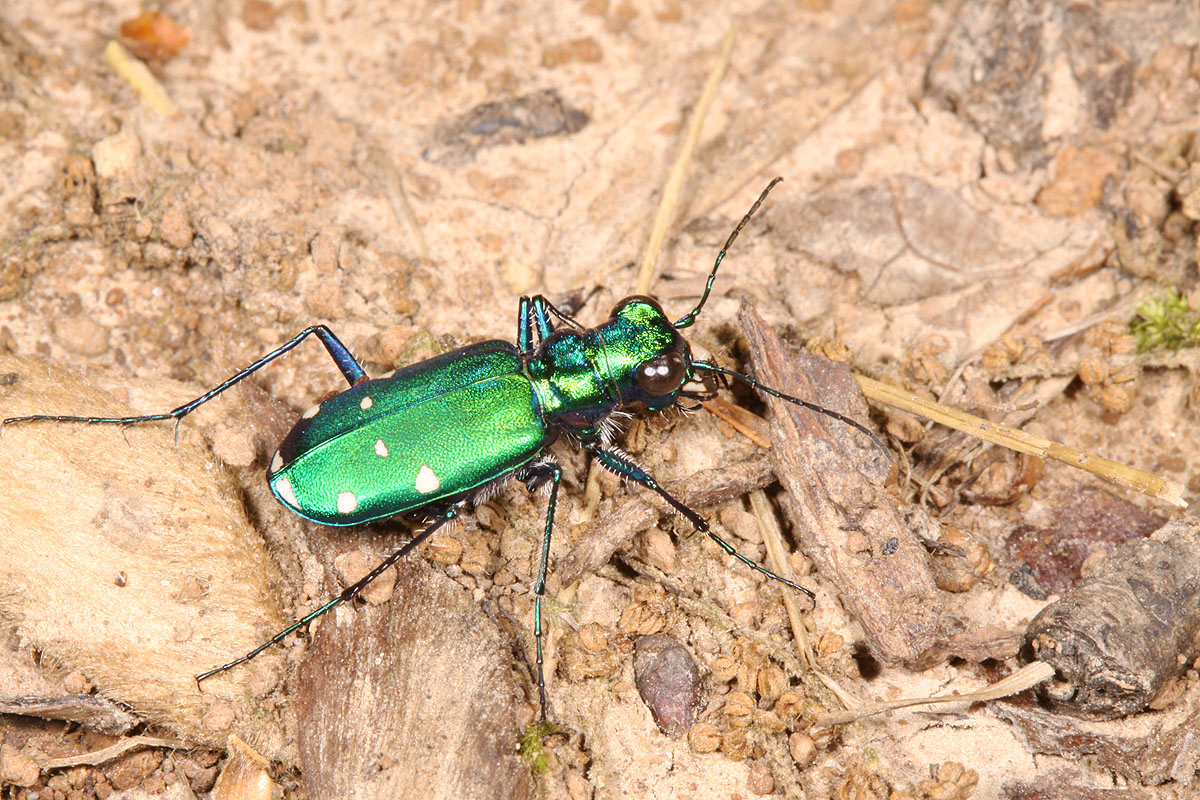
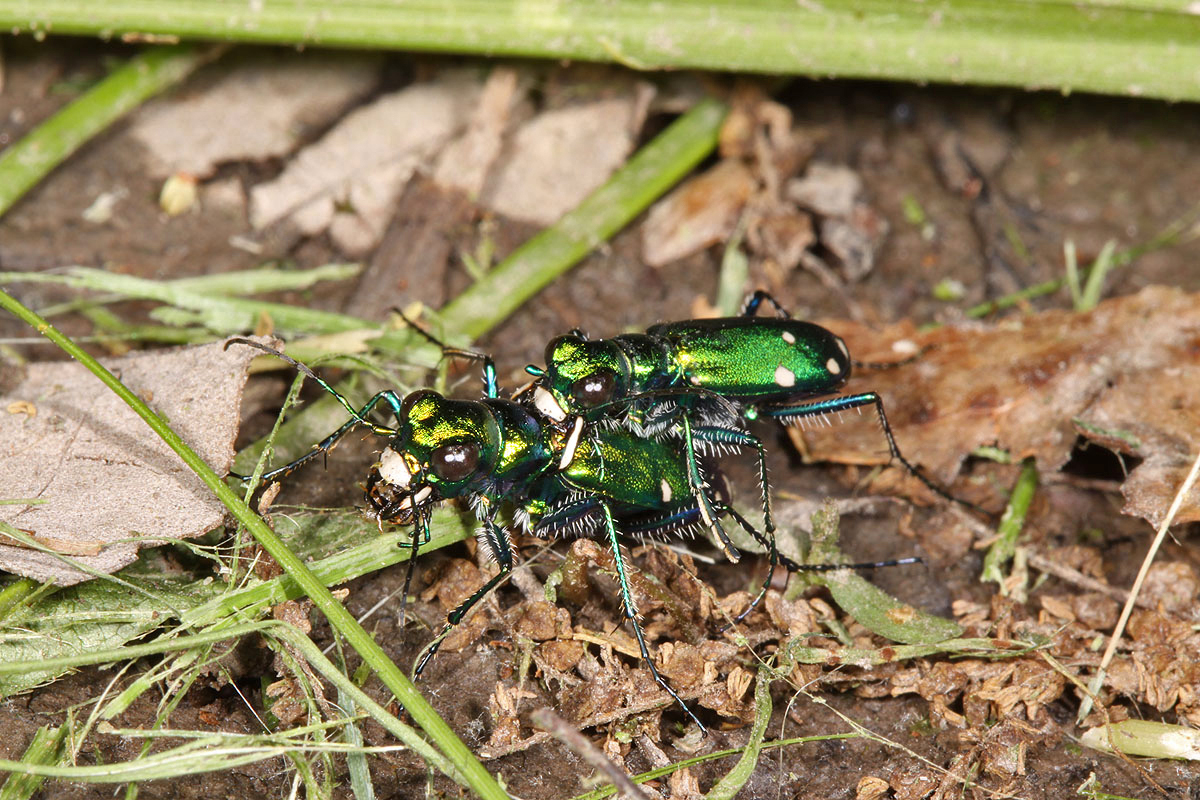
Cicindela sexguttataIn the meantime, I’ve got to learn how to use this camera. The first weekend I had it, I accompanied my friend and colleague, Chris Brown, to nearby Shaw Nature Reserve, where Chris had previously noted good populations of the very uncommon Cicindela unipunctata (one-spotted tiger beetle) [now Cylindera unipunctata, fide Erwin & Pearson 2008 – more on this in a future post] – what a fantastic species for my first photo shoot with the new setup. Unfortunately, we did not find this species (although I will eventually). Instead, I focused on the very prolific population of Cicindela sexguttata (six-spotted tiger beetle) that we found at this site. Cicindela sexguttata is the one tiger beetle that is, more than any other North American species, known by entomologists and non-entomologists alike. Cicindela sexguttataAnyone who has ever taken a walk in the eastern forests during spring has encountered this beetle – flashing brilliant green in the dappled sunlight, always a few yards ahead on the path. While belonging to the “spring/fall” group of species, adults of this species break ranks and stay put in their burrows during fall while other spring/fall species come out and explore for a bit before digging back in for the winter (Pearson et al. 2006). While many individuals do show the six white spots on the elytra that give the species its common name, this character is actually quite variable, with some northern populations completely lacking spots.
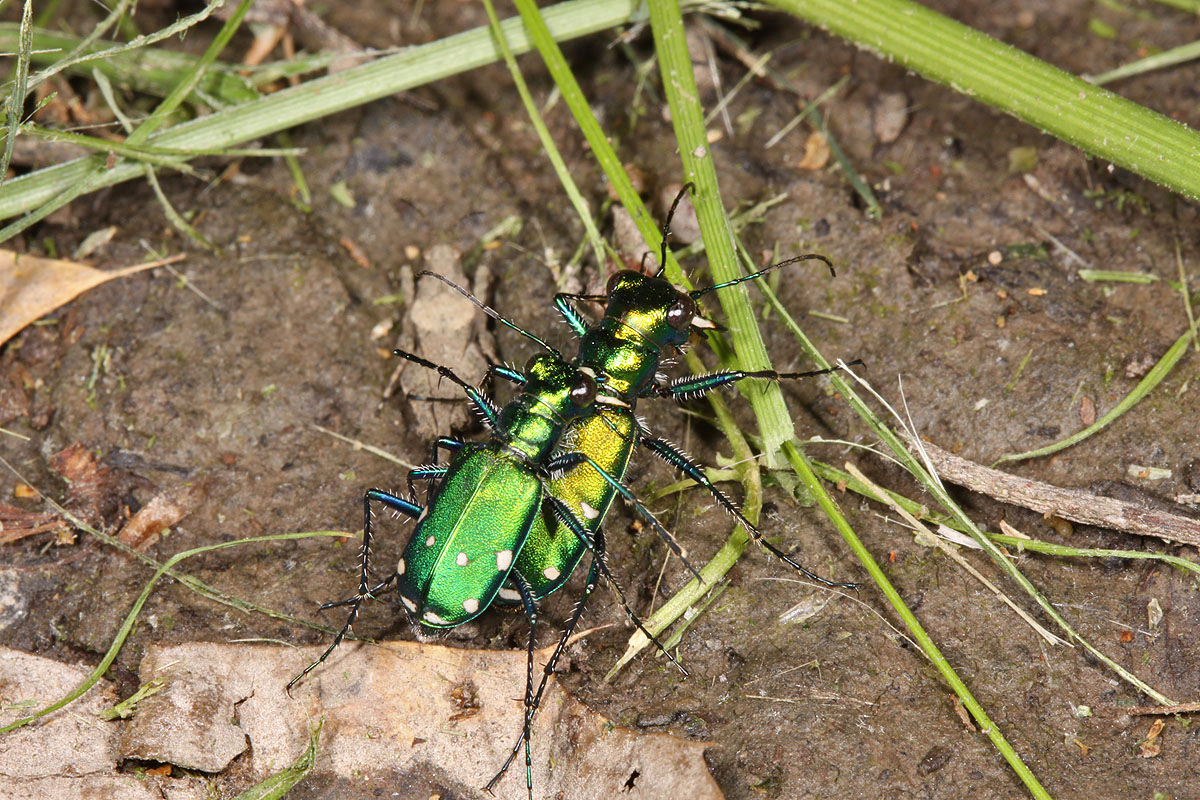
Cicindela sexguttataAs tiger beetles go, it’s one of the more difficult to photograph because of its shiny, metallic coloration (as opposed to the flat, dull coloration of Cyl. unipunctata). This was probably a good thing in terms of starting the learning process. I limited myself during this session to the 100mm macro lens (leaving the 1-5x beast for another day), with the photographs shown here being some of the better ones. While I like them, I also see a few things I did wrong. First was the flash – I set the flash units to 1/4 power and didn’t use any kind of diffusers, and as a result the lighting turned out harsh – especially for this brilliantly-colored, metallic species. Cicindela sexguttata I’ve softened the highlights a little bit in Photoshop, but the results are still not as good as if I had used a lower power and diffused the light, and ultimately my goal is to achieve well lit photographs that do not need post-processing to make them look right. Other than that, the day was mostly about getting used to handling the camera and learning how to judge f-stop based on my manual settings for exposure (1/200 sec) and ISO (100). The single individuals (above) were taken in full sunlight, and in that situation my f-stops tended to be too low (resulting in overexposure), while the mating pair was in shade where my f-stops tended too high (underexposed). Next time, I’ll try the diffusers I bought, use less flash power, and do more f-stop bracketing until I get a good feel for what I need in a given situation.
For comparison, here is the one C. sexguttata photograph I took with the point-and-shoot last year. This is about as good a photograph as I could get of this species using that camera. Besides being heavily cropped, it differs by being not very well exposed (despite post brightening), showing heavy shadows (despite post lightening), and lacking detail.
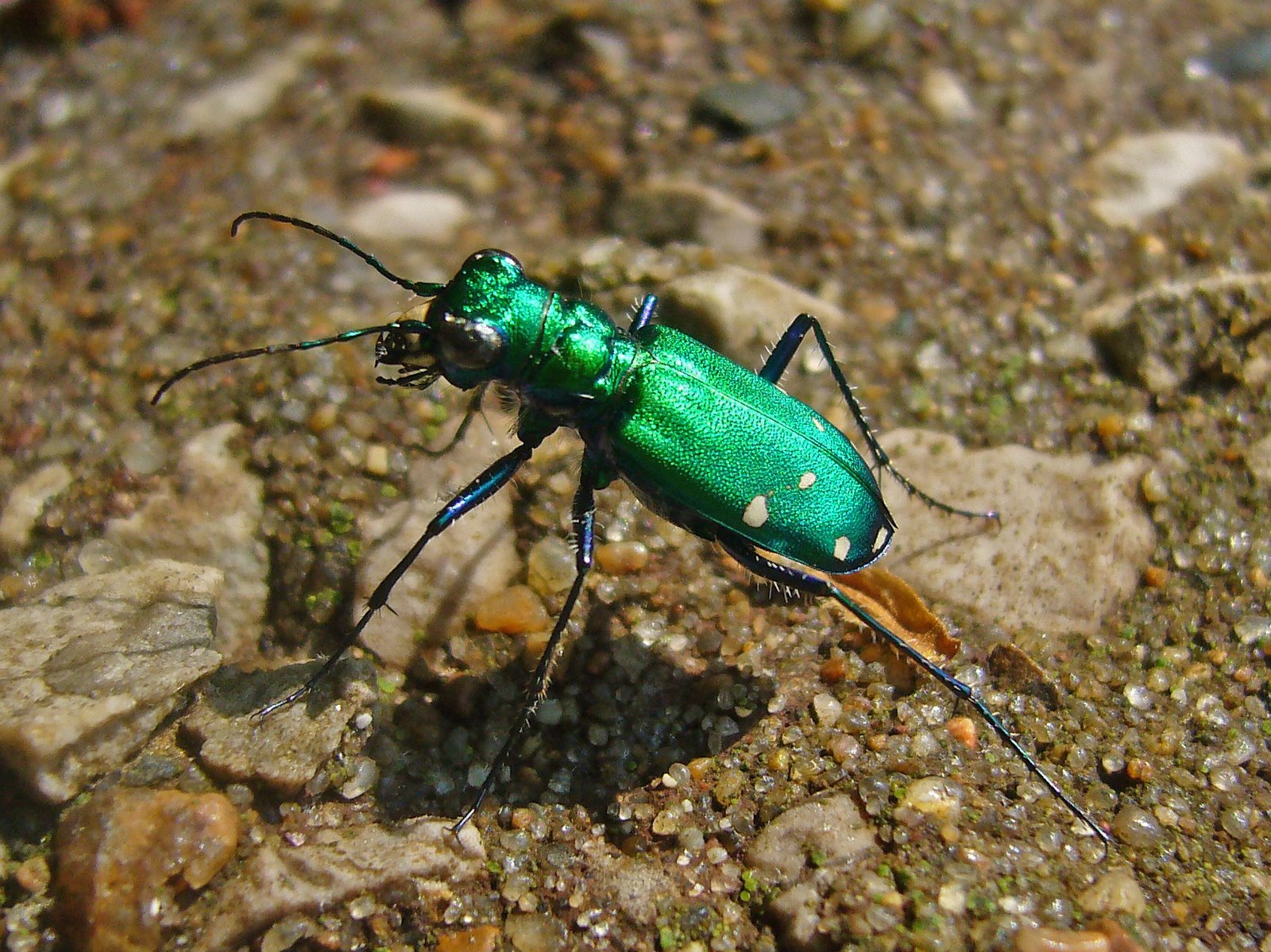
Cicindela sexguttata

REFERENCES:

Erwin, T. L. and D. L. Pearson. 2008. A treatise on the Western Hemisphere Caraboidea (Coleoptera). Their classification, distributions, and ways of life. Volume II (Carabidae-Nebriiformes 2-Cicindelitae). Pensoft Series Faunistica 84. Pensoft Publishers, Sofia, 400 pp. + 33 color plates.

Pearson, D. L., C. B. Knisley and C. J. Kazilek. 2006. A Field Guide to the Tiger Beetles of the United States and Canada. Oxford University Press, New York, 227 pp.

Copyright © Ted C. MacRae 2009

Add to FacebookAdd to NewsvineAdd to DiggAdd to Del.icio.usAdd to StumbleuponAdd to RedditAdd to BlinklistAdd to TwitterAdd to TechnoratiAdd to Furl

Tiger Beetle Rearing

I recently found an interesting website called Tiger Beetle Rearing.  This website by doctoral candidate Rodger Gwiazdowski in the Joseph S. Elkinton lab, University of Massachusetts, Amherst contains a wealth of information and photographs covering equipment, techniques, and methods for rearing tiger beetles from egg to adult, with a primary focus on rearing endangered and threatened species of tiger beetles for conservation and re-release into the wild.  The lab has reared a number of tiger beetle species but is particularly interested in the Puritan tiger beetle (Cicindela puritana), threatened in the northeastern U.S.  After the first year of rearing, 90 2nd and 3rd instar C. puritana larvae were obtained and, as of the last update, were overwintering in individual tubes.  You’ll need to register with the site with a username and password to access the site, but this is accomplished quickly and easily.

Welcome to the Hotel Cicindela!

Welcome to the Hotel Cicindela!

I found this website of great interest as I begin my own efforts at rearing these beetles in the laboratory.  My primary interest is in rearing larvae that I collect in the field to adulthood – adults are much more easily identified than larvae (indeed, the larvae of many species remain undescribed), and rearing field-collected larvae is one way to get around the often limited temporal occurrence that many tiger beetle species exhibit as adults.  My operation isn’t nearly as sophisticated as the one developed in the Elkinton lab, but then I’m just a working stiff trying to do this (and a million other things) on the side. Despite this, I have had my first success, rearing to adulthood a larva I collected during the summer last year (see my post It’s a girl!).  In addition, I currently have a number of larvae collected last fall in Nebraska and South Dakota, which I put in terraria of native soil and kept in a cold incubator during the winter.  I pulled them out earlier this spring, and soon afterwards a number of larvae opened up their burrows and have been feasting on fall armyworm and corn earworm caterpillars every 2-3 days or so.  The larvae were collected from a variety of habitats and soil types, including sand, alkaline seeps, and red clay banks, so I’m hopeful that the ensuing adults will represent a variety of interesting species – perhaps some that I did not encounter in the field during that trip.

Cicindela_scutellaris_rearing_P1020931_2Beyond this, however, I am also interested in trying my hand at cross-breeding experiments – particularly with Missouri’s unique population of Cicindela scutellaris (festive tiger beetle).  I’ll need to wait until fall for this, however, since adults that are active in the field right now are sexually mature and have presumably already mated.  In the fall, a new generation of sexually-immature adults will emerge and feed for a time before burrowing back in for the winter and re-emerging the following spring ready to mate.  I would like to cross individuals from southeastern Missouri – representing an intergrade between the northern subspecies lecontei and the southern subspecies unicolor – with individuals from the northern part of the state that are clearly assignable to subspecies lecontei.  If possible, I would also like to obtain individuals from even further south that are clearly assignable to subspecies unicolor and cross them with both the southern and northern Missouri populations.  These crossing experiments may provide some insight into which of the subspecies the intergrade population is more closely related to, and it will be interesting to see how closely the progeny from the lecontei x unicolor cross resemble individuals from the intergrade population and the range of variation that they exhibit.  I should mention that Matt Brust (Chadron State College, Nebraska) has done a number of these inter-subspecific crosses with C. scutellaris, with some very interesting results among the progeny.

What I can do right now is work on techniques to make sure I can get females to lay eggs and then rear the larvae all the way through to adulthood.  For this, I brought back 9-10 live individuals from two localities of the intergrade population encountered on my recent trip to the southeastern lowlands.  Adults imbibing moisture from polymer gelI put equal numbers of males and females from each locality into separate terraria – each filled with native soil and a hydrophilic polymer gel made of anionic polyacrylamide. The beetles, who normally obtain moisture from their food or by “chewing” moist soil, chew instead on the gel. This eliminates the need to maintain a water dish or cotton batting that must be changed daily in order to prevent the growth of mold and bacteria. A few of the adults in each terrarium died shortly afterwards, possibly a result of stress or dehydration during transport (the photo right shows how eagerly they imbibed moisture from the polymer gel after being placed in the terrarium), but the remainder have lived for four weeks now and have been digging burrows and feeding whenever food is offered.  According to Matt Brust, C. scutellaris does not lay eggs on the surface of the soil (as does C. celeripes), but rather lays them about 1.5 to 2 inches below the surface.  It takes 2-3 weeks before the eggs start hatching, so I am expecting to see larval burrows appearing anytime now.  Matt tells me the key to getting eggs is to feed the adults “big-time” – thus, I have been offering fat, juicy fall armyworm or corn earworm larvae to the adults whenever they are out of their burrows.  Watch this entertaining video of one adult having lunch:

Copyright © Ted C. MacRae 2009

Add to FacebookAdd to NewsvineAdd to DiggAdd to Del.icio.usAdd to StumbleuponAdd to RedditAdd to BlinklistAdd to Ma.gnoliaAdd to TechnoratiAdd to Furl

A festive (tiger beetle) birthday

Last Thursday was my birthday, and as has become my custom, I took the day off and went on my ‘Annual Season Opening Birthday Bug Collecting Trip.’  One or two of you might remember how these plans were scrubbed last year by a last minute business trip, during which I discovered Pipestone National Monument in southwest Minnesota. That experience – and the post that I wrote about it – remain high among my all-time favorites. Despite that, nothing was going to derail my plans to go collecting this year, and at 5:30 in the morning I awoke to begin what would turn out to be as enjoyable and successful a day as I could hope for. I had convinced my colleagues and long-time collecting buddies Rich Thoma and Chris Brown to take the day off as well and accompany me down to the lowlands of southeastern Missouri to search for additional localities of the festive tiger beetle – Cicindela scutellaris.

Records of Cicindela scutellaris in southeast Missouri

Records of Cicindela scutellaris in southeast Missouri

As far as is currently known – C. scutellaris is represented in Missouri by three highly disjuct populations in the extreme northwestern, northeastern, and southeastern corners of the state.  The two northern populations are unambigously assignable to the northern subspecies lecontei, although their absence from areas further south in Missouri along the Missouri and Mississippi Rivers remains a mystery.  The southeastern population apparently represents an intergrade population with influences from both lecontei and the southeastern subspecies unicolor.  While this population was discovered many years ago (I first collected it in the mid-1980s), it remained known only from sand forests in Holly Ridge Conservation Area on Crowley’s Ridge.  A second population was discovered several years ago on sand exposures in the extreme western lowlands near the Ozark Escarpment when Chris Brown and I began our formal survey of tiger beetles in Missouri, and last year I succeeded in locating several populations of the beetle in the critically imperiled sand prairie relicts located along the spine of the Sikeston Sand Ridge.

cicindela_scutellaris_p1020910_2This year, we wanted to determine if intergrade populations also occurred on the Malden Sand Ridge – the southernmost expanse of sand exposures in the southeastern lowlands.  We didn’t know if they did – presettlement sand prairies were less abundant on the Malden Ridge due to its higher soil organic content.  As a result, no sand prairie relicts survived the Malden Ridge’s complete conversion to agriculture.  Undeterred, I got onto Google Maps and scoured satellite imagery of the ridge and located several spots that seemed to have potential – even though they were agricultural fields, they appeared to be of sufficient expanse and with enough sand to possibly support populations of the beetle.

So, on the morning of April 23, my ‘Annual Birthday Season Opening Bug Collecting Trip’ began by meeting up with Rich and Chris and driving the 223 miles from Wildwood to Kennett to explore several locations for a beetle based only on the suggestion of a flickering computer screen.  The first of these locations was a bust – there was a house constructed right in the middle of the site that wasn’t on the Google Map.  cicindela_scutellaris_p1020889_2Maybe the beetle occurred here and maybe it didn’t, but the last thing I wanted to do on a Thursday morning was interrupt a homeowner from their morning routine and ask them if we could collect bugs in their front yard.  Besides, there was another locality just a couple miles up the road that looked equally promising.  We found the spot and drove by slowly – it was an agricultural field that looked like it had been fallow for at least a short time, and although it did not look great (not as much sand as I had hoped) we eventually decided that since we were there we might as well take a look.  It wasn’t long before we saw an individual near the highest part of the field, and through a couple hours of exploring and digging adult burrows we had observed a limited number of adults.  Success!  The landowner happened by while we were there and graciously allowed us to continue our searches.  Through her, we learned that the field had been under soybean cultivation during the previous season.  This was good news to learn that beetles were inhabiting sand exposures on the Malden Ridge despite its complete conversion to agriculture.

Having confirmed the occurrence of C. scutellaris on the Malden Ridge, we then began driving to the next putative locality some miles north along the ridge.  Along the way, Chris spotted a rather large sand expanse in another agricultural field right next to the highway.  cicindela_scutellaris_p1020906_2Even though I hadn’t detected it in my Google Map search, it looked promising enough to explore, and so we did a quick U-turn and found a place to pull over.  This spot can only be described as the ‘festive tiger beetle motherlode’ of southeast Missouri!  Even though the field was obviously under active agricultural use, the beetles were abundant within the fairly large expanse of exposed sand within the field (photo below).  We were quickly able to collect a sufficient series to document the beetle’s range of variation and set about obtaining additional photographs.  I felt fortunate to be able to photograph this mating pair, which nicely illustrates the white labrum of the male (top) versus the dark labrum of the female (bottom) – one character that distinguishes this intergrade population from the similar-appearing six-spotted tiger beetle (C. sexguttata – commonly encountered along woodland trails throughout the eastern U.S., and with both sexes exhibiting a white labrum).  Note also how the male is holding his legs out horizontally (a behavior I’ve seen with other mating pairs) and the more heavily padded tarsi on his front legs. The latter specialization is thought to aid in grasping and holding the female (Pearson et al. 2006), although in this instance it clearly is not serving that function, but I have not yet determined for what purpose the horizontal posturing of the front legs is all about (perhaps it is related to alarm behavior).

cicindela_scutellaris_habitat_p1020899_2We completed the day by documenting the occurrence of this species on the third of only three sizeable sand prairie relicts that remain on the Sikeston Sand Ridge – a private parcel located a few miles south of the other two preserves.  These observations have increased our confidence that C. scutellaris is secure in Missouri’s southeastern lowlands, and that – thankfully – no special conservation measures will be required at this time to assure its continued existence.  We also now have enough material on hand to characterize the range of variation exhibited by individuals across this population.  We hope this will allow a greater understanding of the relative influence of lecontei populations to the north versus unicolor populations to the south in contributing to the makeup of this population.

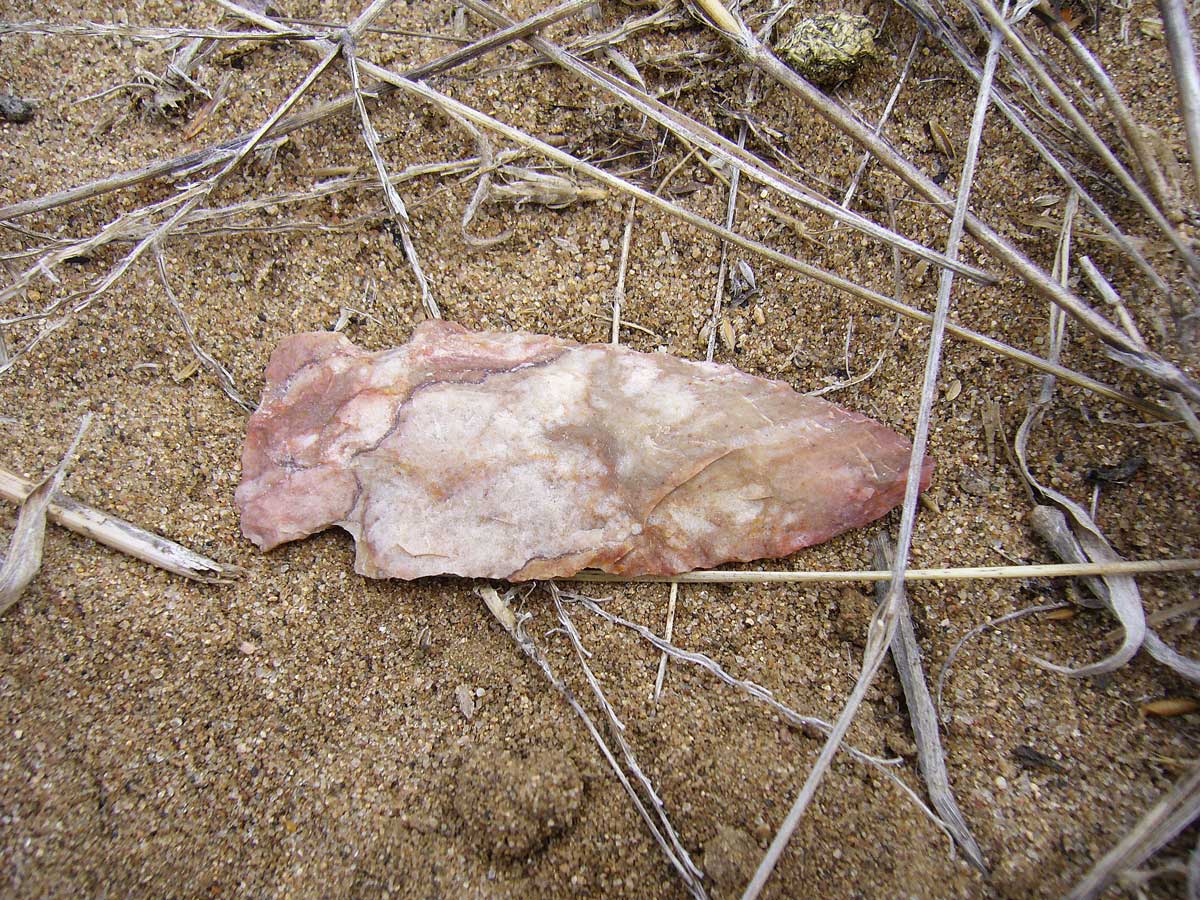
Since it was my birthday, it was appropriate that I should discover this “gift” next to the rim of my net after I slapped it over a mating pair of beetles.  I haven’t found a large number of Native American artifacts during my time in the field, but this has to be most impressive of those that I have found – it is in almost perfect condition, with only the smallest of chips off of one of the lower corners.  Edit 5/5/09: After a little research, I believe this to be a spear point from the Archaic period (12,000 to 2,500 years ago).

arrowhead_p1020900_2

p.s. – my 100th post!

REFERENCE:

Pearson, D. L., C. B. Knisley and C. J. Kazilek. 2006. A Field Guide to the Tiger Beetles of the United States and Canada. Oxford University Press, New York, 227 pp.

Copyright © Ted C. MacRae 2009

Add to FacebookAdd to NewsvineAdd to DiggAdd to Del.icio.usAdd to StumbleuponAdd to RedditAdd to BlinklistAdd to Ma.gnoliaAdd to TechnoratiAdd to Furl

Bon appétit!

I collected this larva in northwest Nebraska during last year’s Fall Tiger Beetle Trip.  I collected an adult Cicindela lengi (blowout tiger beetle) at the spot – a species that greatly resembles but is much less common than the ubiquitous C. formosa (big sand tiger beetle – see my post Cicindela lengi vs. Cicindela formosa for a comparison of the two species).  Before finally finding that adult, however, I had fished out several larvae from the site in the hopes that they represented that uncommon species (see how I did this in my post Goin’ fishin’).  After collecting the larvae and placing them in a small terrarium with native sandy soil, they burrowed in but then closed up shop – I wasn’t sure whether they had survived or not.  In early December I put the terrarium in a 10°C incubator for the winter and brought it back out earlier this month.  Yesterday, happily, this larva and one other opened up their burrows again, so with any luck I’ll feed them well and they’ll complete their development.  While I do hope they represent C. lengi, other possibilities include C. scutellaris (festive tiger beetle), which would not be exciting, and C. nebraskana (prairie long-lipped tiger beetle), which would be VERY exciting.  One species I do not have to worry about it being is C. formosa, as the larvae of that species make very unique excavations in the sand with the burrow opening directed towards the excavation (I don’t believe I’ve posted photos of that here, yet – I’ll have to do so soon).

In the meantime, here is a closeup of the larva in the video prior to feeding. Those of you who have ever reared or photographed tiger beetle larvae will know just how easily “spooked” these larvae can be – any sudden movement will cause the larva to “drop” into its burrow and sit there for awhile. As a result, it was a real challenge to go through the whole process of taking first the photos and then the video while feeding it without causing it to drop.

cicindela_sp_larva_p1020936

Coming soon – lunchtime for adults!

Copyright © Ted C. MacRae 2009

Add to FacebookAdd to NewsvineAdd to DiggAdd to Del.icio.usAdd to StumbleuponAdd to RedditAdd to BlinklistAdd to Ma.gnoliaAdd to TechnoratiAdd to Furl

Coral Pink Sand Dunes tiger beetle – range map

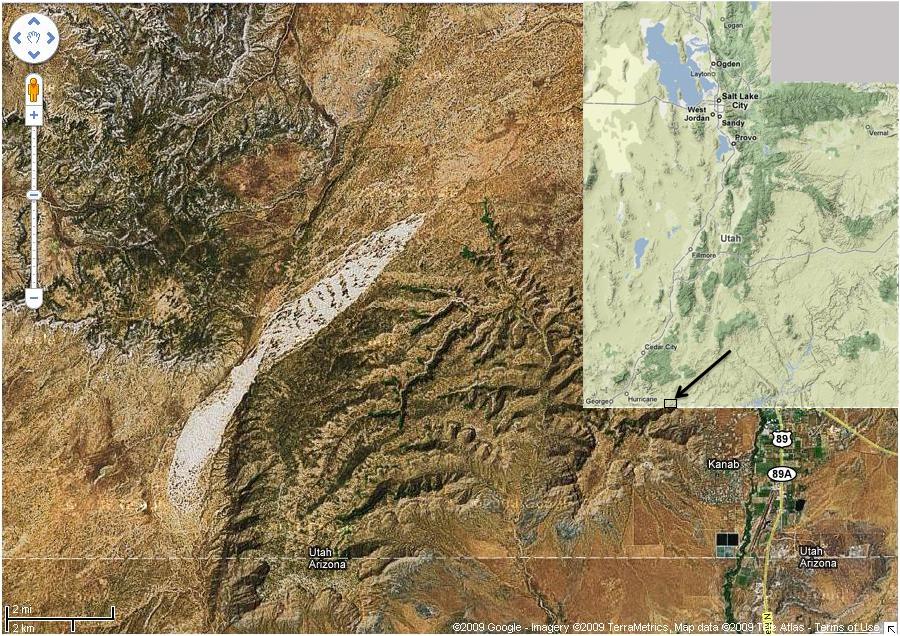
Those of you on RSS feed might be interested in revisiting my previous post, Coral Pink Sand Dunes tiger beetle on ARKive.  I’ve added a Google screen shot to the post that shows a visual perspective of the entire range of Cicindela albissima within a tiny inset of the state of Utah.  The image provides a sobering reminder of just how vanishingly small the range of this species is.  If we, as a society, cannot take the steps required to ensure the survival of a beautiful little species such as this one – living on only the tiniest sliver of the lands under our stewardship, it speaks ill of our ability to do so for other species with much greater habitat requirements.

Copyright © Ted C. MacRae 2009

Add to FacebookAdd to NewsvineAdd to DiggAdd to Del.icio.usAdd to StumbleuponAdd to RedditAdd to BlinklistAdd to Ma.gnoliaAdd to TechnoratiAdd to Furl

Coral Pink Sand Dunes tiger beetle on ARKive

I’ve been meaning to write about ARKive for awhile now. ARKive is a unique collection of videos, images and fact-files assembled from among the world’s very best wildlife videographers and photographers in an attempt to create a centralized digital library of life on Earth. Their short to mid-term priority is the completion of audio-visual profiles for the 16,300-plus species on The IUCN Red List of Threatened Species, before moving on to profiling all species that have ever been filmed or photographed. With backing from many of the world’s leading conservation organizations, ARKive hopes to “promote public understanding and appreciation of the world’s biodiversity and the need for its conservation, through the power of wildlife imagery.”

With tiger beetle season almost now upon us, it seems appropriate to highlight the media collection that ARKive has assembled for one of North America’s most spectacularly beautiful and critically imperiled tiger beetles, Cicindela albissima (Coral Pink Sand Dune tiger beetle). This amazing species is not only stunning in appearance, with its nearly pure white elytra, but has perhaps the most restricted habitat of any tiger beetle species in North America – the entire population being restricted to 400 hectares within coral-pink-sand-dunes_3Utah’s Coral Pink Sand Dunes State Park and the adjacent Bureau of Land Management (BLM) dune management area (Pearson et al. 2006). The Google screen shot at right shows the entire range of this species as a light pink swath (inset shown on larger map of the state of Utah).  Regarded initially as a subspecies of the widespread C. limbata (sandy tiger beetle), recent molecular studies showed this beetle to be only distantly related to that species and, thus, deserving of full species status (Morgan et al. 2000).

Unfortunately, the beetle’s highly restricted habitat continues to be adversely affected by ongoing, recreational off-road vehicle use, especially in the interdunal swales used by the larvae. Impacts occur not only by direct run-over mortality, but also through disruption of normal adult and larval activity, damage to vegetation, reduction of arthropod prey of C. albissima, and mixing of the upper soil layer which increases desiccation of the larval microhabitat (Knisley and Hill 2001). The species was nominated for federal protection under the Endangered Species Act in 1996 (when it was still considered a subspecies of C. limbata), and two years later a Conservation Agreement between BLM, U.S. Fish and Wildlife Service, Utah Department of Parks and Recreation and Kane County was established in an effort to protect the critically sensitive habitats in which this species lives. Despite these conservation measures, ongoing monitoring and research within the protected areas has documented a continuing decline in the population, suggesting that these areas may not be of sufficient size to enable the population to increase, and off-road vehicle use continues outside of the protected areas (U.S. Department of Interior, Fish and Wildlife Service (FWS) 2008). While still only a candidate for federal listing as an endangered or threatened species, the FWS now considers the magnitude of the threat from off-road vehicles, in view of these recent findings, to be high and imminent. As a result, the FWS has increased the priority of the species’ candidacy from 8 to 2 (1 being the highest priority a candidate species can receive).

While I would dearly have loved to embed one of ARKive’s extraordinary videos or photographs of C. albissima within this post, copyright considerations do not allow that.  What I can do is provide hyperlinks directly to the site, and I encourage everyone to visit ARKive and see their images of this gorgeous species.

Photos by Christine Breton: adult beetle, dorsal view, adult beetle, adults mating, habitat

Videos by Ganglion Films: overview, adults mating, adult burrowing in sand, OHVs threatening protected habit.

In addition to the ARKive images, Chris Wirth, author of the blog Cicindela, has taken photographs of this species and presents stunning examples of both the larva and the adult in his post Cicindela albissima (Re-post). I myself am making plans to visit Coral Pink Sand Dunes – perhaps this season – to find and photograph this species for myself. When I succeed, rest assured those photographs will appear on this site.

REFERENCES:

Knisley, C. B., and J. M. Hill. 2001. Biology and conservation of the Coral Pink Sand Dunes tiger beetle, Cicindela limbata albissima Rumpp. Unpublished report.

Morgan, M., C. B. Knisley and A. Vogler. 2000. New taxonomic status of the endangered tiger beetle Cicindela limbata albissima (Coleoptera: Cicindelidae): evidence from mtDNA. Annals of the Entomological Society of America 93(5):1108-1115.

Pearson, D. L., C. B. Knisley and C. J. Kazilek. 2006. A Field Guide to the Tiger Beetles of the United States and Canada. Oxford University Press, New York, 227 pp.

U.S. Department of Interior, Fish and Wildlife Service. 2008. 50 CFR Part 17. Endangered and threatened wildlife and plants; review of native species that are candidates for listing as endangered or threatened; annual notice of findings on resubmitted petitions; annual description of progress on listing actions; proposed rule. Federal Register 73(238) (December 10, 2008):75176-75244.

Copyright © Ted C. MacRae 2009

Add to FacebookAdd to NewsvineAdd to DiggAdd to Del.icio.usAdd to StumbleuponAdd to RedditAdd to BlinklistAdd to Ma.gnoliaAdd to TechnoratiAdd to Furl

Tiger Beetle Safari

In looking back at my posts over the past few weeks, I realized that it has been far too long since I’ve actually talked about beetles.  Perhaps “Petals In The Bush” would be a better name for this blog!  I still have some botanical thoughts to get off my chest before the insect season starts in earnest, but until then, and in anticipation of the upcoming summer’s hunts, I offer this fun, light-hearted introduction to collecting and keeping tiger beetles by Peter Schriemer.  Pay particular attention to the method he uses to capture these elusive little creatures:

Tiger Beetles are my favorite type of beetle! Entomologist John Acorn got me hooked on these little guys. They live across the country in various habitats, so you may not need to travel far to go on a Tiger Beetle Safari of your own!

Vodpod videos no longer available.

more about “Tiger Beetle Safari“, posted with vodpod

Capturing tiger beetle adults can a little (lot) more difficult than implied by this video. Adults have excellent eyesight, and many species are extremely wary. It takes practice, patience, and lots of second chances. The collecting method shown in the video is what I refer to as the “stalk and slap” method – the beetle is slowly stalked until within net reach, and the net bag is slapped over the beetle.  This method works well enough, but it has its limitations.  If there are any gaps between the ground and the net rim, the beetle will quickly dart through them and fly away.  This is easy to prevent on sandy and soft clay substrates, as the net rim can be sealed against the ground by kneeling quickly on each side of the rim to embed it slightly and using the hands to hold up the net bag and locate the beetle.  Still, there are a few things I don’t like about this method – the beetle may hide against the inside of the rim and be difficult to locate, and once found it may be difficult to grab the beetle through the net if it is against the ground (don’t even try lifting the rim and reaching under – the beetle will zip out and be gone).  This method can also be taxing on the legs, as each attempted capture involves kneeling and standing back up (getting harder and harder for these 50+ year old knees to do).

The major limitation of the slap method, however, is that it doesn’t really work on hard, uneven surfaces. Many species are found in glades and other habitats with exposed rock substrates. In these types of habitats, the net rim simply cannot be clamped tightly enough to eliminate the gaps (not to mention the added difficulties in kneeling on these surfaces).  Because of this, I have adopted a technique that I call the “tap and swipe” method.  Here again, the beetle is stalked until within net reach (made easier with a longer handle), but rather than slapping the net bag over the beetle, the rim of the net is tapped against the ground next to the beetle and then assertively swiped sideways to catch the beetle just as it starts flying.  A quick 180° flip of the net rim closes the opening to prevent the beetle from escaping, and it is easily seen in the hanging net bag, where it can be grabbed from outside the net bag with one hand to secure it before reaching into the net bag with the other hand.  With a little practice, one eventually learns to reach down into the open net bag and grab the beetle while preventing it from flying up and out.  All of this can be done while standing, so it’s easier on the knees.

The tap method does require more knowledge about the beetle’s escape behavior in order to anticipate how quickly and in which direction the beetle will fly – some species delay take off just slightly, thus requiring a slight “pause” between the tap and the swipe. However, once their behavior is learned I have found this method to be more consistently successful than the slap method – even on soft substrates.  For species that I haven’t encountered in the field before, I use the slap method at first (if I can) until I have a feel for their escape behavior. If I can’t, I use the tap method and hope for the best!

Copyright © Ted C. MacRae 2009

Add to FacebookAdd to NewsvineAdd to DiggAdd to Del.icio.usAdd to StumbleuponAdd to RedditAdd to BlinklistAdd to Ma.gnoliaAdd to TechnoratiAdd to Furl

Illinois Butterfly Monitoring Network

For those of you who plan to be in the Chicago area on Saturday, March 7th, perhaps you’ll be interested in attending the 2009 Illinois Butterfly Monitoring Network Annual Indoor Workshop. I’ll be giving a talk entitled, “From Hilltops to Swamps: Insects in Missouri’s Rarest Prairies,” in which I’ll focus on the natural history and some associated insects in two of Missouri’s most critically imperiled natural communities – the loess hilltop prairies in the northwestern corner of the state, and the sand prairies of the southeastern lowlands. How a beetle guy ended up being invited to talk to a butterfly group is still a little confusing to me, but apparently IBMN Director, Doug Taron (author of Gossamer Tapestry) put in a good word for me.

The Illinois Butterfly Monitoring Network (IBMN) is a citizen scientist program monitoring the health of butterfly populations throughout northeastern and central Illinois.

The IBMN was initiated in 1987 by The Nature Conservancy to explore the effects of habitat management on invertebrates. From 7 sites in the Chicagoland area in its first year, the program has expanded greatly and is now monitoring more than 100 sites throughout Illinois.  Butterflies are ideal “indicator organisms” with which to monitor the effects of prescribed burning and other management techniques, since many species are restricted to intact prairie and savanna remnants by narrow habitat requirements.  The fact that they are relatively easy to identify allows them to be monitored in a cost effective manner with the help of dedicated amateurs.  Much the same can be said for tiger beetles (which will – surprise! – be featured prominently my talk).

The workshop will be held Saturday, March 7, 2009, 9:30 AM until 3:00 PM at the Gail Borden Public Library, 270 North Grove Avenue, Elgin (directions).  Registration is required, contact Mel Manner at (847) 464-4426 or by email.

Copyright © Ted C. MacRae 2009

Add to FacebookAdd to NewsvineAdd to DiggAdd to Del.icio.usAdd to StumbleuponAdd to RedditAdd to BlinklistAdd to Ma.gnoliaAdd to TechnoratiAdd to Furl