Bichos Argentinos #3 – “Bicho Torito”

Diloboderus abderus, male | Buenos Aires, Argentina

In her appeal for submissions for her upcoming issue of An Inordinate Fondness, Susannah lamented the paucity of beetles in the closing weeks of her northern winter and mentioned in passing that even I had gone more than a week without posting about this great order.  I hadn’t realized that myself, so here I present Diloboderus abderus, one of the beetles that I encountered during my visit last weekend to La Reserva Ecológica Costanera Sur in Buenos Aires, Argentina.  This species, known commonly in Argentina as bicho torito (“little bull bug”) is common enough in Argentina and southern Brazil, where its white grub larvae have become somewhat of a pest in lawns, pastures, and grass crops such as wheat by way of feeding on the roots.  I first encountered this species during one of my previous trips to Argentina, where during a rain storm I saw literally hundreds of adults emerging from mowed grass medians in the city streets of Pergamino.  These photographs show two of numerous dead individuals that I found laying on the ground of similar medians just outside the reserve.  As with many scarab beetles in the subfamily Dynastinae (containing also the recently featured Dynastes tityus), males (above) are armed with pronotal and cephalic horns – presumably for use in sexual combat – while females (below) are unarmed.

Diloboderus abderus, female | Buenos Aires, Argentina

Copyright © Ted C. MacRae 2011

North America’s largest scarab beetle

Dynastes tityus male - USA: Missouri, Jefferson Co., DeSoto

As one of North America’s largest, most written about, and most photographed beetles, Dynastes tityus (eastern Hercules beetle) hardly needs an introduction.  I photographed this male specimen from my collection back in December while testing my DIY diffuser for the MT-24EX twin flash and 100mm macro lens.  It’s a good test subject for such – its glossy exoskeleton may be beauty to the eye but is the bane of flash photographers, and its nearly 60mm of length demand a huge subject-to-lens distance that gives even the largest lens-mounted flash a small apparent size.  Nevertheless, the diffuser did a pretty good job of creating even illumination and preventing harsh specular highlights, giving almost the effect of an indirect strobe in a white box.

Dense setae adorn the underside of the thoracic horn of the male.

I hadn’t really noticed until I took the photos the dense adornment of setae (hairs) on the underside of the thoracic horn.  While setae in insects most often perform a tactile function, the density and placement on the horns of the males of these beetles makes me wonder if they might serve more of a display function.

Despite the overwhelming popularity of this beetle amongst hobbyist breeders and its widespread occurrence across the eastern United States (and the internet), it is not one that I have encountered with much frequency myself.  I suspect this is due to the position of Missouri near its western limit of distribution – likely a function of the species’ preference for moist treehole cavities with rotting wood in which the larvae can develop.  This particular specimen was given to me many years ago by a nursery grower in Jefferson Co. during my first job out of graduate school – before I’d ever found one myself, but since then I’ve encountered perhaps half a dozen or so at blacklights in mesic forests across the eastern Ozark Highlands.  Most recently (last summer) I found a female sitting on my driveway, apparently attracted to the mercury vapor lamp above the garage that I leave on occasionally during the months of June and July just for such purpose.

Copyright © Ted C. MacRae 2011

Frenatae 2011 Calendar

Ralph Holzenthal - Tabanidae. Adobe Illustrator, gradient mesh/Adobe Photoshop.

Even though we’re now in the latter part of February, I wanted to spread the word about a cool insect-themed calendar shown to me by a colleague during my recent trip to Brazil. Produced by Frenatae, the Graduate Student Entomology Club at the University of Minnesota, the calendar features original work by students using computer illustration techniques taught in a UMN course titled, ENT 5051, Scientific Illustration of Insects. The mastermind behind this course is Dr. Ralph W. Holzenthal, who – as can be seen by the stunning image above of a female (L) and male (R) Tabanus lineola – knows a thing or two about insect illustration! While the course covers traditional techniques such as pen & ink, pencil, watercolor, etc., its major emphasis is on computer-assisted techniques using Adobe Illustrator® and Photoshop®. This includes instruction on preparing full habitus color illustrations of insects on the computer. How I wish a course such as this had been available when I was in graduate school (of course, how I wish computers had been available when I was in graduate school!).

While Dr. Holzenthal’s illustrative skills are obvious, it’s also clear that he excels at teaching these skills to his students, as evidenced by this selection of my favorite images (not surprisingly, all beetles!) from the course website galleries:

Caitlin Krueger - Scarabaeidae

Martha Megarry - Scarabaeidae

Heather Cummins - Zopheridae

.
It should be pointed out that all of these Photoshop illustrations represent original artwork and not modified photographs!

I ordered my copy of the calendar as soon as I returned home from my trip. You can order one too by sending a check for $12 to the following address:

Frenatae
1980 Folwell Ave Rm 219
St Paul, MN 55108

My thanks to Dr. Holzenthal for allowing me to post this small selection of images from his website.

Copyright © Ted C. MacRae 2011

A bid for OpenLab

I’m going to do something I’ve not yet done before—ask for your support.  OpenLab is an annual compilation of the year’s best science-blog writing, as determined by a panel of judges, and the closing date for submissions for 2009 is December 1st—this coming Tuesday.  I’ve vacilated about whether to throw my hat into this ring—the world of science blogs is a crowded place with many erudite writers, and although science is my profession, the science that I write about is purely avocational.  Whether my particular brand of science writing can compete with that of the true academicians that seem to dominate the competition remains to be seen.  Nevertheless, I am willing to put my ego on the line and give it a shot.  If you have seen anything in the past year (since December 1, 2008) here at Beetles in the Bush that you consider exemplary, please consider submitting it.  Feel free to search the sidebar archives (“Taxa,” “Tags” or “Life History”), browse the site Contents, or select from the following list of my own personal favorites (arranged chronologically):

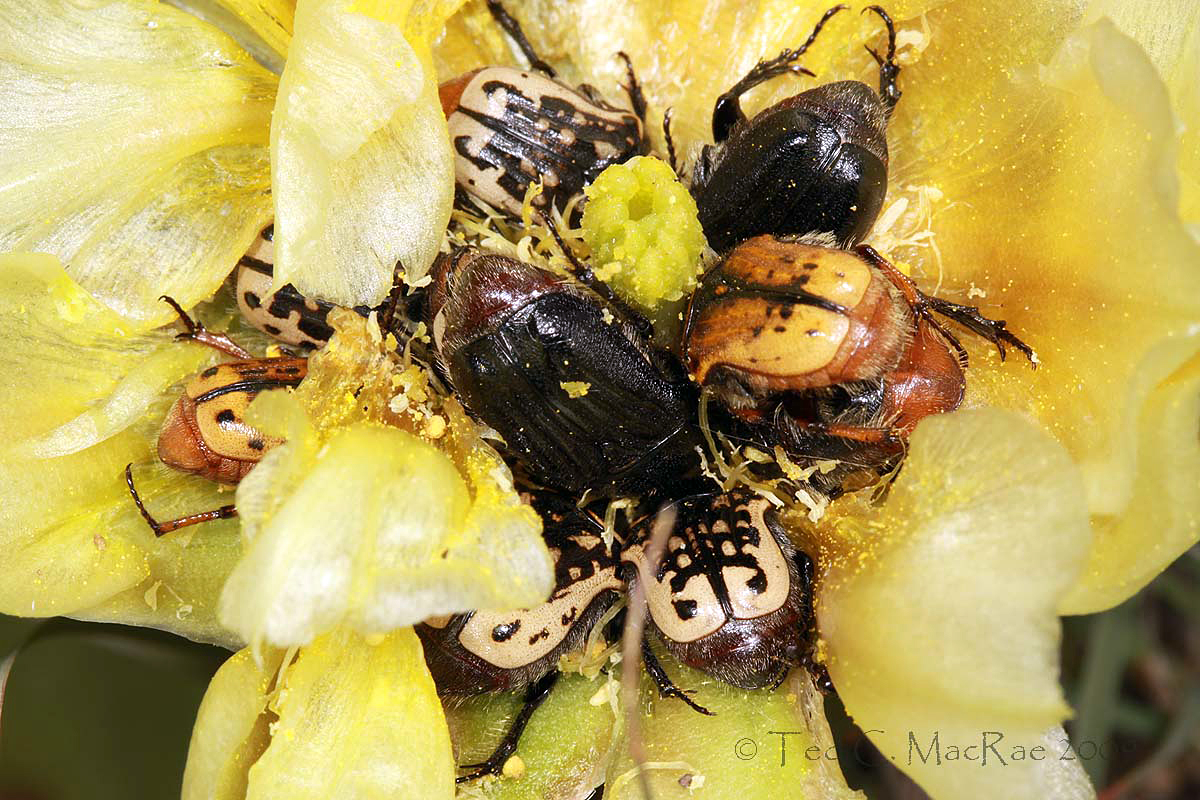
So I don’t get accused of asking but not giving, I leave you with this photograph of a group of Kern’s flower scarabs (Euphoria kernii, family Scarabaeidae) congregated in the flower of large-root prickly pear cactus (Opuntia macrorhiza, family Cactaceae).  Photographed this past June at Four Canyon Preserve in northwestern Oklahoma, this common, extremely variable species (ranging from all black to black and white to black and yellow to nearly all yellow) can be found throughout the southern Great Plains, where it congregates tightly in flowers of Opuntia , pricklypoppy (Argemone spp., family Papaveraceae), thistle (Cirsium spp., family Asteraceae), and yucca (Yucca spp., family Liliaceae).

Photo details: Canon 100mm f/2.4 macro lens on Canon 50D (manual mode), ISO-100, 1/250 sec, f/16, diffused MT-24EX flash.

Copyright © Ted C. MacRae 2009

Add to FacebookAdd to NewsvineAdd to DiggAdd to Del.icio.usAdd to StumbleuponAdd to RedditAdd to BlinklistAdd to TwitterAdd to TechnoratiAdd to Furl

Trilogy of Terror

Last week, Alex at myrmecos tagged me with a fun new meme called These are a few of my favorite stings…. It’s simple – list the things which have stung you (biting doesn’t count), and tag three others for their tales of envenomization. Of course, being the dedicated myrmecologist that he is, Alex leads off with a most impressive list of venomous arthropods, and he selected worthy competition in buzzybeegirl and bugeric.  But me?  I have, for the most part, succeeded in avoiding stings by focusing on a group of insects (beetles) that never evolved such structures.  My domestic list is short and mundane – honey bees, paper wasps, sweat bees, fire ants – and even those not very often.  Alex, however, suspected I might have some tales from exotic lands – thus, I offer the following trilogy and tag Art, Doug, and Kolby.

Tale 1
When I made my first Neotropical collecting excursion some 20 years ago to Ecuador, I was warned by my guide about large, black ants that he called “Congas.” I later learned the species to be what many people call the bullet ant (Paraponera clavata). Now, I’m not an expert on which arthropod truly has the most painful sting, but many people knowledgeable about such matters say it is this species – and I believe them! We were camped out in Sucumbios Province east of Nueva Loja (also called “Lago Agrio”) at an Amazon forest site where recent construction had left rows of month-old slash lining both sides of a 2-km stretch of new road through the forest – can you say woodboring beetles? I roamed up and down that stretch of road, picking a wonderful diversity of longhorned beetles (Cerambycidae) and jewel beetles (Buprestidae) off the slash. At one point, I encountered a whole tree crown laying by the side of the road that required some clambering to get at the beetles crawling on its inner branches. At one point, I braced myself with my arm against a branch and immediately felt an excruciating pain. I looked at my arm and saw one of these large ants clamped onto my arm and quickly slapped it off. I really don’t think words can describe how painful that sting was, and not only did it throb for the rest of the day, but I actually felt sick for the next several days (though I still managed to keep roaming the slash rows). I don’t know if the bullet ant I captured right afterwards was the one that stung me, but I still took great delight in impaling a insect pin through its thorax after I returned home.

Tale 2
Alex mentioned one plant – stinging nettle (Urtica dioica, which also lines one of my favorite mountain bike trails), but I’ve also had a run-in with a much more formidable plant in Mexico. Mala mujer (Cnidoscolus angustidens), which translates as “bad woman” in Spanish, deserves all the respect you can give it. Reported to be one of the most painful stinging nettle-type plants known, it grows commonly from the arid southwest down into the dry, tropical thorn forests of southern Mexico where my colleague Chuck Bellamy and I have made several trips in recent years to search for jewel beetles. One quickly learns to recognize this distinctive euphorbiaceous plant by its green palmate leaves with white veins and thick covering of yellow, stinging trichomes. Unfortunately, in my zeal for beating buprestids from Leucaena diversifolia (netting several of the rare Pelycothorax tylauchenioides and a now paratypical series of what was then an undescribed species of Agrilus), I forgot to maintain my lookout for this common understory plant and got a swipe across the knuckles. Not only did the extreme pain last for hours, but my ring finger began swelling so worrysomely that we stopped in a hospital looking for somebody to cut the ring off. My poor Spanish brought me no sympathy (or service), but fortunately the swelling began subsiding that evening and I didn’t lose my finger. I did, however, live with a rash for the next several days that developed into a hard, purple skin discoloration for the next several weeks.  Bad woman, indeed!

Tale 3
I debated whether to include this experience, but the terror was real so here it is. I wrote about it recently in an article called “Dungers and Chafers – a Trip to South Africa” that appeared in the December 2008 issue of SCARABS Newsletter. Enjoy this excerpt:

After arriving at the park [Borakalalo National Park, North West Province], I could hardly contain myself – I was so anxious to start collecting… We drove through the park for a little bit looking for a good spot to pull over and begin the hunt. After finding such a spot, I grabbed my trusty beating sheet and began doing what I have done so many times before – walking up to a tree, giving a branch a whack with the handle of my net, and hoping to see some prized buprestid laying on the beating sheet. The habitat was ideal for this – dominated by low, spreading acacias such as Acacia tortilis and A. karoo. Buprestids love acacias! I had already learned this in my travels through the American desert southwest and down into Mexico and South America – surely it was the same in South Africa. The first whack yielded nothing – typical. Even when collecting is good, buprestids are never “dripping from the trees,” and often one must literally beat dozens and dozens of trees to really get a good idea of the diversity and abundance of buprestid species that are active in a given area. I whacked a few more trees, with similar results. I then spotted one particularly large acacia tree – something about it said, “beat me!” I walked over to it and gave a branch a whack. All at once, it seemed as though the world was exploding! The air was suddenly abuzz with dozens of large, flying insects, whirring and swirling all around me. My first thought in that initial moment of terror was that I had whacked a hornet’s nest – who knew what kinds of deadly, venomous wasps one might encounter in Africa? Instinctively I ducked and started running, but within a few moments I realized that I was not being chased. Cautiously, I sneaked back towards the tree (after stuffing my heart back down my throat) and realized that they were not hornets after all, but instead beetles. I looked more closely and saw that the tree was literally alive with dozens and dozens of large, green cetoniines resembling our own green June beetle, Cotinis nitida (L.), which seemed to be attracted to the small, white blooms that covered the tree in profusion. I netted a few of the beetles, which I would later determine to represent the common savannah species Dischista cincta (de Geer) (Photo 2). Such was my welcome to Africa, where it seemed the trees literally are ‘dripping’ with beetles!

Disticha cincta (de Geer)

Photo 2. Disticha cincta (de Geer)

Copyright © Ted C. MacRae 2009

Add to FacebookAdd to NewsvineAdd to DiggAdd to Del.icio.usAdd to StumbleuponAdd to RedditAdd to BlinklistAdd to Ma.gnoliaAdd to TechnoratiAdd to Furl

I Brake for Dung Beetles!

A few days ago I learned of a new campaign by The WILD Foundation called “Make a Big Impact with Small Change.” Founded in 1974, WILD seeks to protect intact wilderness areas and the wildlife and people who depend upon them. Their new campaign pays homage to dung beetles – usually overlooked by conservationists in favor of the so-called “charismatic megafauna,” but who nevertheless provide an important ecological service by tirelessly processing megafaunal dung. From the WILD website:

Here at The WILD Foundation, we realize that it is not just those large, charismatic animals that inspire conservation – it is often the small, typically unnoticed and vastly under-appreciated ones that inspire us the most….and that are an indispensible part of the ecosystem!

As a way of generating support for their work, WILD is giving away bumper stickers like the one pictured above. I have got to have one of these bumper stickers! It is the best entomology bumper sticker I’ve seen since “I fear no weevil!” The WILD website also features this amusing little video that shows some dung beetles in action:

Vodpod videos no longer available.

more about “I Brake for Dung Beetles!“, posted with vodpod

The website doesn’t provide any clues as to the species of dung beetle or where it was recorded, but judging by its large size I’m guessing that it might have been recorded in Africa, perhaps representing a species of the genus Scarabaeus.  My most memorable dung beetle experiences occurred in Africa, which is blessed with a dizzying diversity of “dungers.”  Following is an excerpt from an article I wrote that appeared in the December 2008 issue of the SCARABS Newsletter, in which I discussed some of these marvelous beetles:

Chafers were not the only scarabs I encountered in abundance at Borakalalo [National Park], and I’ll give you one guess as to what other scarab group I encountered in abundance at this mammal game reserve. That’s right, dung beetles. Never before have I seen such an abundance and diversity of dung beetles in one spot, but then again, never before have I seen such an abundance of dung!  The ground was littered with the stuff – antelope such as gemsbok  and impala, warthogs, giraffes, and a host of other mammals thrive in the protected confines of the park, and the seasonally dry climate allows their dung to dry quickly and accumulate rather than breaking down and disappearing. It did, however, take a few days before I became aware of the area’s dung beetle diversity. Prior to our arrival in the park, the weather had been dry for some time, and so it remained for the first few days we were there. I collected a smattering of different dung beetles during that time, but it seemed like they should be more abundant considering the abundance of available resource. Our third day in the park was interrupted by heavy thundershowers that moved through during the afternoon. The next morning, as we arose and begin wandering away from the camp, the air seemed literally abuzz with dung beetles. They were flying everywhere and crawling all over the ground, frantically rolling and fighting over the reconstituted pieces of dung. Big, black scarabaeines proper such as Kheper clericus (Boheman) and Scarabaeus galenus Westwood (Photo 4), the small metallic

scarabaeus-galenus_1

Photo 4: Scarabaeus galenus (Westwood).

Phalops ardea Klug, the attractive green iridescent species Garetta nitens (Olivier) and Gymnopleurus virens Erichson, their darkened relative Allogymnopleurus thalassinum (Klug) (Photo 5),
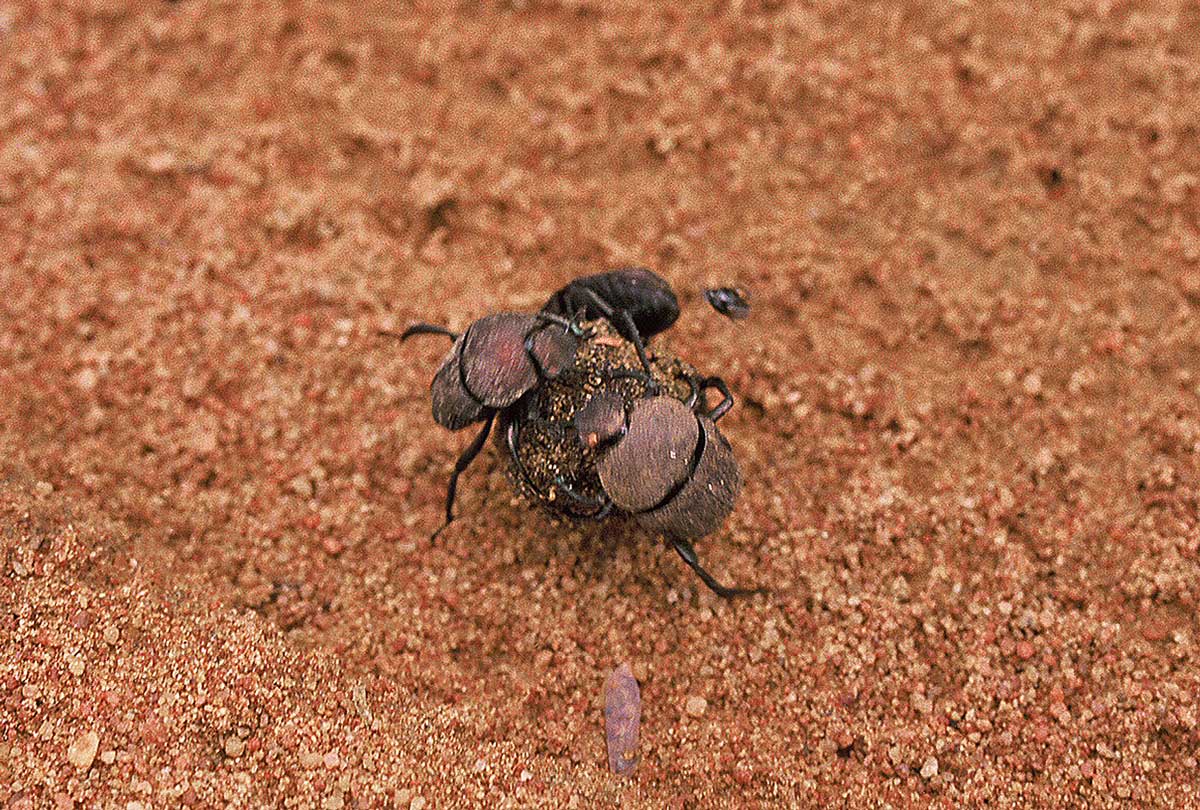
Photo 5: Allogymnopleurus thalassinum (Klug) individuals fighting over a mammal dung ball.

Photo 5: Allogymnopleurus thalassinum (Klug) individuals fighting over a mammal dung ball.

and the tiny little Sisyphus costatus (Thunberg),  standing tall on its elongated hind legs while pushing dung with its forward pairs of legs (opposite of what I’ve seen in any other dung beetle), all made their sudden appearance. I spent some time  watching one S. galenus individual excavating a burrow for the prized piece of poop it had snatched (Photo 6).
Photo 6: Scarabaeus galenus (Westwood) excavating a burrow.

Photo 6: Scarabaeus galenus (Westwood) excavating a burrow.

The most impressive dunger that I saw, however, was the enormous, flattened Pachylomera femoralis Kirby (Photo 7).
Photo 7: Pachylomera femorata Kirby.

Photo 7: Pachylomera femorata Kirby.

Looking like flying Tonka trucks and sounding like diesel engines from real trucks, their low-pitched, rumbling buzz filled the air as they searched among the freshly moistened turds. So loud was the noise caused by the beating of their wings that several times I ducked thinking one was about to collide with me. This sudden dunger super-diversity continued into the night, as Anachalcos convexus Boheman, Catharsius sp., Copris elphenor Klug, Metacatharsius sp., Pedaria sp., Scarabaeus goryi (Laporte), three species of Onitis, Caccobius ferrugineus (Fåhraeus), Digitonthophagus gazella (Fabricius), and nearly a dozen species of Onthophagus flew to our ultraviolet light-illuminated sheet.

REFERENCE:

MacRae, T. C. 2008. Dungers and chafers: A trip to South Africa. SCARABS 34:1-9.

Copyright © Ted C. MacRae 2009

Add to FacebookAdd to NewsvineAdd to DiggAdd to Del.icio.usAdd to StumbleuponAdd to RedditAdd to BlinklistAdd to Ma.gnoliaAdd to TechnoratiAdd to Furl

Done with dung, meat please!

ResearchBlogging.orgNo feces for this species.” “Carnivorous dung beetle shuns dung and decapitates millipede.” “Little dung beetle is big chopper.” “Dung beetle mistakes millipede for dung.” These were some of the clever headlines that I had to compete with in coming up with my own opener for a remarkable beetle that titillated the science blogosphere last week. At the risk of being redundant, I’d like to revisit that beetle and offer a few (hopefully novel) thoughts of my own. I can say that I have a unique and special treat for those willing to read further.

First the background. Deltochilum valgum is a so-called “dung beetle” in the family Scarabaeidae that lives in the lowland rain forests of Peru. As suggested by its common name, it belongs to a group of beetles that are well known for their dung feeding habits. Over 5,000 species of dung beetles are known throughout the world, all of which carve out balls of dung and bury them as provisions for larval development – or so it was thought.  As reported by Trond Larsen of Princeton University and colleagues in Biology Letters, D. valgum has apparently abandoned its ancestral dung ball-rolling behavior in favor of a predatory lifestyle. Its prey – millipedes! Moreover, the species exhibits several distinct morphological traits that appear to have evolved as a direct result of their predatory behavior. Adult beetles were repeatedly observed killing and eating millipedes, and their disdain for dung was rather conclusively demonstrated by an exhaustive, year-long trapping program in which pit-traps were baited with a variety of bait types known to attract dung beetles (e.g., various kinds of dung, carrion, fungus and fruit) – and millipedes.  In all, over 100,000 dung beetles representing 132 species were trapped (what a nice collection!), 35 of which were found to scavenge on dead millipedes, but only five of these dared tackle live millipedes.  Of these, only D. valgum ignored all other foods – it only came to traps baited with live millipedes.

Larsen et al. determined that adults of D. valgum are opportunistic hunters and were much more likely to attack injured millipedes than healthy ones, even those weighing 14 times as much as the beetle.  Ball rolling behavior was never observed by D. valgum.  Most dung beetles have wide, shovel-shaped heads used to scoop and mold dung balls, but D. valgum has a much narrower head with sharp “teeth” on its clypeus (Fig. 1A vs. 1B).  The teeth apparently aid in killing the millipede by piercing the ventral surface behind the head and prying upwards (decapitating it), and the narrow, elongate head facilitates insertion into the millipede body for feeding.  Further, the hind tibia are elongate and curved, which are used to “grip” millipedes by holding them up against the dorsally reflexed pygidium (Fig. 1C vs. 1D).  This allows the beetle to drag its coiled up victim with one hind leg while walking forward on the other five (Fig. 1E).  Once killed, the beetles proceeded to break their prey into pieces and consume their meaty innards, leaving the disarticulated millipede exoskeletons licked clean (Fig. 1F).  One of these “attack” episodes was filmed (using infrared lighting so as not to affect their nocturnal behavior) and can be seen in this BBC News video.
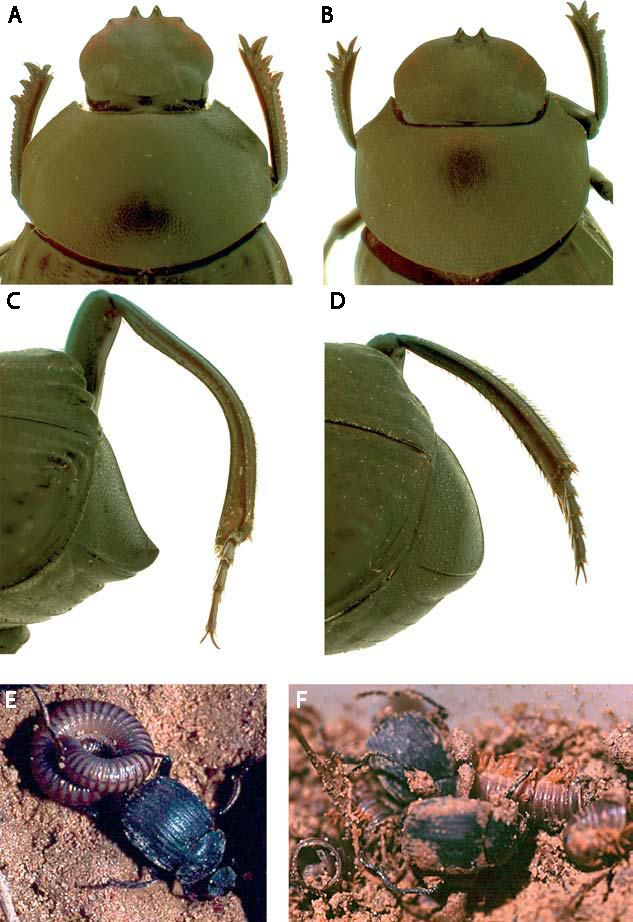
Deltochilum valgum

Figure 1. (a) Dorsal view of D. valgum head. Sharp clypeal teeth and angled clypeus act as a lever to disarticulate millipede. Narrow, elongate head permits feeding inside millipede; (b) dorsal view of Deltochilum peruanum head, lacking characters described in (a), head used to mould dung balls; (c) lateral view of D. valgum pygidium and hind tibia. Dorsally reflexed pygidial lip is used to support millipede during transport. Elongate, strongly curved hind tibia is used to grip millipede. (d ) Lateral view of D. peruanum pygidium and hind tibia, lacking characters described in (c), hind tibia used for rolling dung balls. (e, f ). Predation strategy by D. valgum. (e) Dragging live, coiled millipede with one hind leg, walking forwards; ( f ) feeding on killed millipede with head inside
segments; disarticulated empty millipede pieces nearby.
Credit: Larsen et al. (2009).

Much has been made about this remarkable shift from coprophagy to predation, which Larsen et al. speculate was driven by competition for limited resources with the many other dung beetle species that occur in the Peruvian rainforests. In fact, adult dung beetles are known to feed on a variety of resources besides dung, as exemplified by the range of baits used in their survey. Thus, my first thought after reading the coverage was actually a question: “Has this species abandoned dung provisioning completely as a reproductive strategy?” Everything I had read focused exclusively (quite understandably) on the bizarre feeding habits of the adults, but there was no mention of what the species’ larval provisioning strategies were. Wanting more information about this, I contacted Trond Larsen, who graciously sent me a PDF of the paper. Unfortunately (though not a criticism of the paper), no further insight about this was found in the paper either. Indeed, in all of the observations recorded by Larsen et al., millipedes killed by D. valgum were consumed entirely by the adults, and no mention was made of how or whether millipedes were utilized for larval provisioning. I wondered if D. valgum had truly abandoned dung provisioning for larval development (a remarkable adaptive switch), or if in fact the species might still utilize the strategy for reproduction (perhaps having specialized on a dung type not included in their survey), while also exploiting millipede predation as adults for a nutritional advantage. I asked Trond about this, to which he replied with this juicy tidbit (I told you I had a special treat!):

Yes, I would very much like to know what the reproductive/nesting behavior of D. valgum is. My best guess is that they also use millipedes as a larval food source, but as you say, we haven’t observed that behavior yet. I have observed other generalist dung beetle species rolling balls out of dead millipedes, presumably to bury for the larvae, so I certainly think it would be an adequate food source. Many dung beetle species use carrion for their larvae.

I am quite confident that D. valgum does not use any kind of dung. I have sampled these dung beetle communities very thoroughly, with many dung types and other bait types, and also with passive flight intercept traps that catch all beetles. Every dung beetle species that feeds on dung is at least sometimes attracted to human dung (this is not the case in African savannahs though, but is in neotropical forests – that is a whole different story). There are still a small handful of species we catch in flight intercept traps that we don’t know what they eat, although some of these mysteries have recently been solved – many of them live in leaf-cutter ant nests for example.

While predation of millipedes by a dung beetle is itself a fascinating observation, demonstrating the abandonment of dung provisioning in favor of captured prey for larval development would be a truly remarkable example of an ecological transition to exploit a dramatically atypical niche. I hope Trond (or anybody for that matter) actually succeeds in observing millipede/prey utilization for larval provisioning by this species.

Many thanks to Trond Larsen for his delightful correspondence.

SOURCE:
Larsen, T. H., A. Lopera, A. Forsyth and F. Génier. 2009. From coprophagy to predation: a dung beetle that kills millipedes. Biology Letters DOI: 10.1098/rsbl.2008.0654.

Copyright © Ted C. MacRae 2009

Add to FacebookAdd to NewsvineAdd to DiggAdd to Del.icio.usAdd to StumbleuponAdd to RedditAdd to BlinklistAdd to Ma.gnoliaAdd to TechnoratiAdd to Furl

“Dungers and Chafers – a Trip to South Africa”

Those of you who enjoy field trip accounts should check out the December 2008 issue of SCARABS. The lead article – authored by your’s truly – is a scarabcentric travelogue of an insect collecting trip I took to South Africa several years ago. Scarabs?!, you say? Well, even though I focus on bups, ‘bycids, and tigers (some would argue that actually demonstrates lack of focus), I never pass on the opportunity to collect “cool” insects of all types when traveling somewhere as “exotic” as Africa – and scarabs are definitely cool! Still, I did manage to sneak past the editors a few words and pictures about buprestids, one of the more impressive of which I offer here as further enticement. You can also read about heart attacks, flying Tonka trucks, and evil minions.

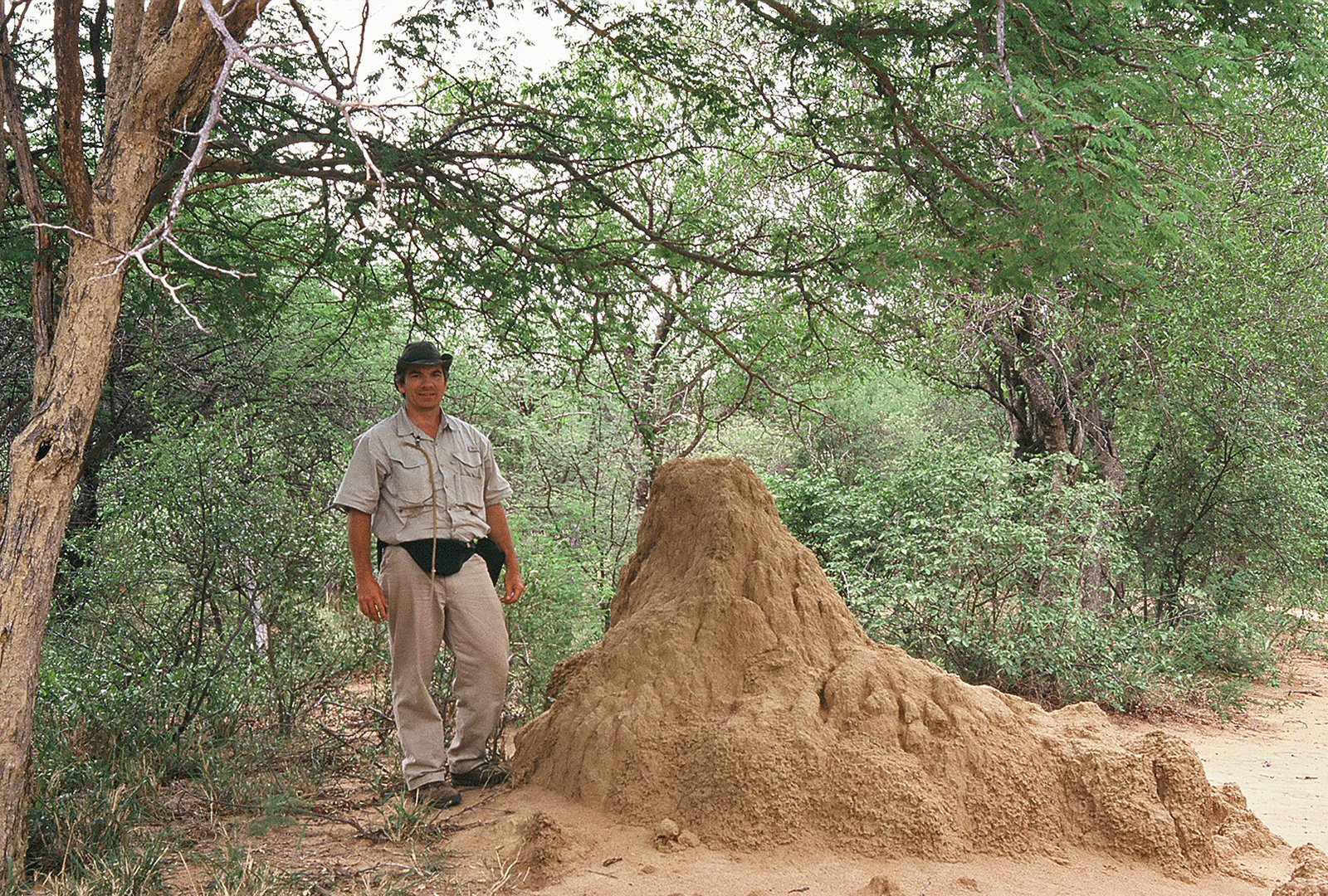
Photos: (above) me standing next to a termite mound near the Waterberg, Northern Province (photo by Chuck Bellamy); (left) Evides pubiventris (family Buprestidae, tribe Evidiini) suns itself on high terminal foliage of Lannea discolor (family Anacardiaceae), Waterberg, Northern Province.