Photographing the Limestone Tiger Beetle

Seeing and photographing the beautifully black Prairie Tiger Beetles (Cicindelidia obsoleta vulturina) in southwestern Oklahoma was a lot of fun, but by Day 5 I was ready to look for one of my top goals for the trip—Cicindelidia politula (Limestone Tiger Beetle). Occurring primarily in Texas (but also sneaking up into Oklahoma), this would be my first attempt to search for the species. I had gotten a few localities in northern Texas from trusty colleagues, and I knew the beetles occurred on limestone outcroppings in dry to xeric upland habitats (Pearson et al. 2006)—usually starting in late September.  Nevertheless, I always get a little apprehensive when I drive long distances to look for tiger beetles I’ve never seen before. Will I recognize it? What if I find another, similar looking but more common species and assume I’ve found it? Will the season be right? Many species, especially those associated with xeric habitats, depend on timely rains to make their appearance. Will I find the proper microhabitat? There are sometimes seemingly minor details that can make a habitat suitable or not for a particular species.
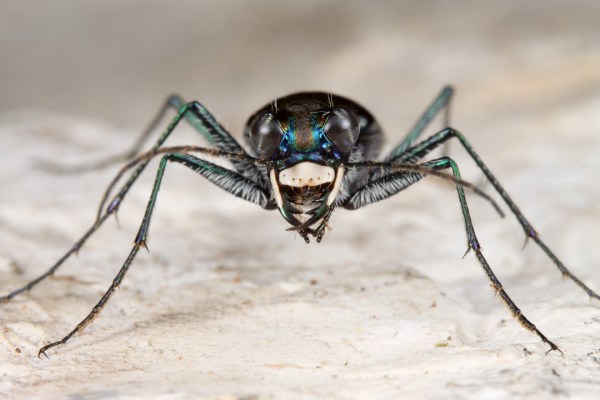
Cicindelidia politula politula | Montague Co., Texas

As can be seen by the above photo, I did succeed in finding the species. However, it wasn’t easy, and for the better part of Day 5 I wondered if I would even be able to capture a specimen, much less succeed in photographing the species in its native habitat. I actually saw the first individual of this species in Oklahoma—sitting on the very first exposed limestone rock at the very first locality I went to. My rule for photographing tiger beetles that I’ve never seen before is to collect the first individual and keep it alive in a vial. In the event I never see another individual or fail in my attempts to photograph them in the field, the first individual becomes my voucher specimen and studio backup. Fortunately, I rarely have to resort to studio shots, but in this case I muffed my attempt to capture the specimen! I searched the locality for a good hour and never saw another one until I circled back to where I started, and there it was again (it just had to be the same one). Believe it or not, I muffed the capture attempt once again! That was my last chance at the Oklahoma site, so it was a rather dejected 2-hour drive south to Montague Co. in northern Texas—knowing that I’d seen it and had my shot at it (two shots, actually) but still found myself empty-handed.

A serviceable photo, but like most of confined individuals it suffers from lack of ”pizzazz.”

My luck improved in Montague Co., although not right away or that much when it did. I had just about given up at this second locality when I saw one. This time I used the stalk-and-slap technique followed by a quick pounce to seal down the net around its perimeter and prevent escape by the beetle (they are real good at quickly finding the tiniest gap between the net rim and the ground and then zipping away in a flash). This time I succeeded in capturing the beetle and thus had my voucher, but my pounce was a little too rough on the beetle, resulting in an extruded genital capsule. This made it completely unusable for photographs (imagine a big orange blob sticking out of the butt of the beetle—not good, photographically!). Of course, finding a beetle at the site caused me to spend more time searching, but I never saw another beetle there.

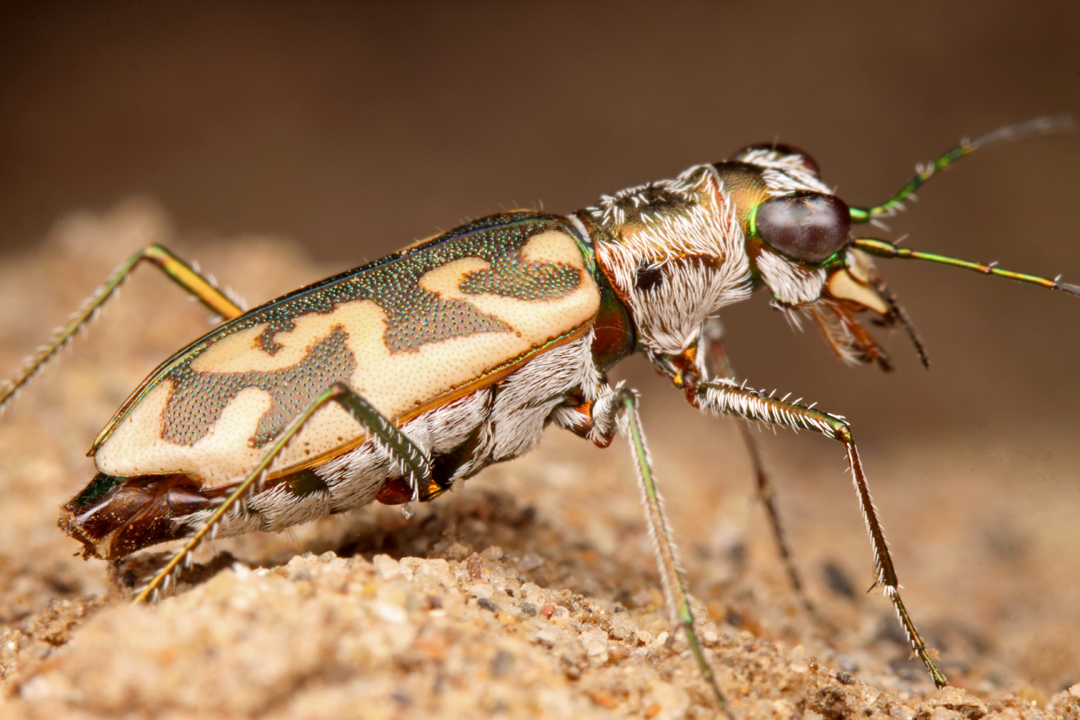
The shiny black to blue-black elytra with white markings absent or limited to the apices are characteristic for the species.

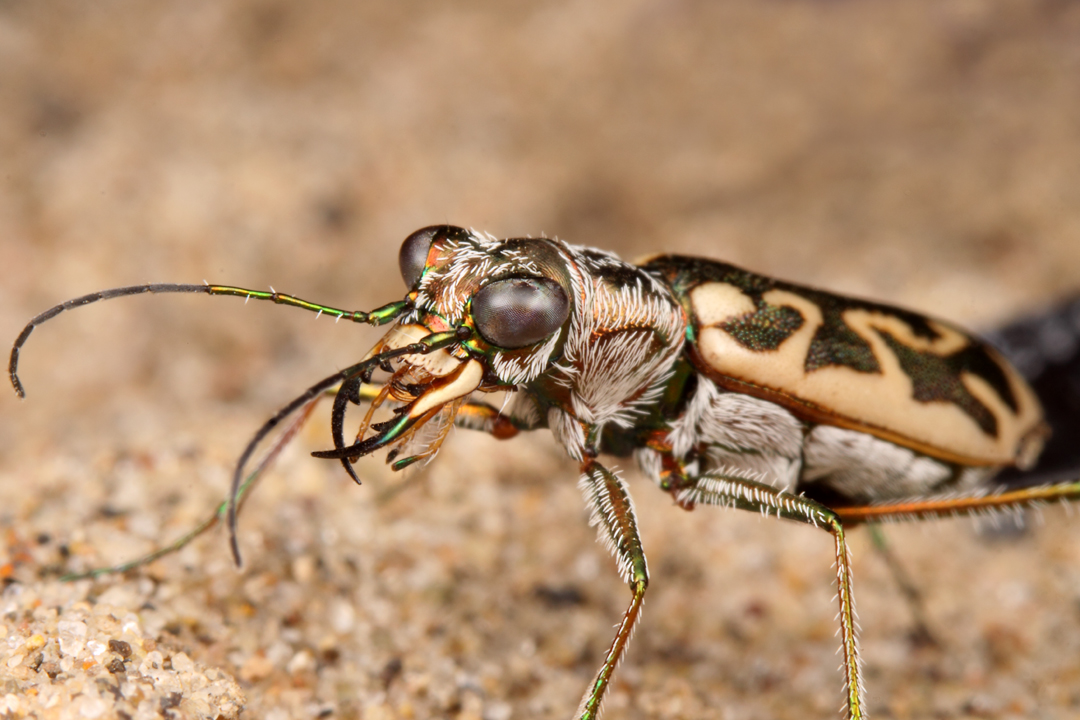
At this point I had a decision to make—if I drove to the next locality on my list (2-hour drive), I probably would not arrive with enough time before sunset to find beetles. I decided not to waste the remaining daylight and instead just bushwhack where I was to look for similar roadside habitats and drive on after sunset. I found another good habitat fairly quickly, and within minutes after starting the search I saw one—and missed it! But then I saw another one—and missed it, too! Now my confidence was shaken, as neither of the two techniques I use most commonly for capturing tiger beetles were working. When I used the “stalk-and-slap” method the beetles always found a gap on the rough, rocky ground and got away, and when I used the “tap-and-sweep” method the beetles would hunker down at first and then fly right after the net passed over them. I would miss a total of eight (eight!) beetles before I finally (finally!) caught one, and then I would miss three more beetles afterwards! That single beetle is shown in the above photographs, which were taken after placing the beetle on a large, flat limestone rock that I laid on the bed in my hotel room that night (carrying that huge limestone rock into the hotel room was an experience!).

I really dislike photographing confined insects. Even if one prepares a wholly natural looking set and manages to cajole the subject into standing still, they rarely look quite right. I do like the first photo in the series, just because it’s a well composed face shot, but I’m not so fond of the more ‘classic’ view of the beetle represented by the second photo. Technically it’s an adequate photo that shows the beetle and all of its salient characters; however, it lacks, well… oomph, because the beetle isn’t really doing anything—the photo tells no natural history story. Still, an adequate photo that lacks oomph is better than no photo at all, so I made the best of my opportunity to take studio shots of the one good beetle I had and hoped for better luck the next day.

Exposed limestone road bank in Johnson Co., Texas—perfect habitat for Cicindelidia politula

The next day brought the luck that I was looking for. I was close to the next locality on my list when I saw a road bank with exposed limestone that just seemed to call out, “Search me!” I stopped and began searching, and within a few minutes I saw the first beetle—and missed it! Arghhh, not again! I would actually miss a few more before I finally caught one, so by now my confidence was destroyed. It’s been a long since I’ve had this much trouble catching tiger beetles, and if I was having this much trouble catching them, how on earth could I even contemplate trying to photograph them. However, the nice thing about finding a spot where beetles are out in numbers is the opportunity to try again—practice makes perfect. I decided my previous attempts had all been a little too lackadaisical and started buckling down and really concentrating on my technique. Not surprisingly, I started having success in capturing the elusive beetles (tap-and-sweep worked best), and after a time I felt like I had a good enough feel for the beetle’s behavior to begin trying for field photographs.

Cicindelidia politula politula | Johnson Co., Texas

Not surprisingly, given how difficult they were to catch, this also proved to be one of the most difficult species of tiger beetle that I’ve ever tried to photograph. Like many other tiger beetles that live in hot, xeric, open habitats they were extremely wary and difficult to approach, a behavior that was exacerbated by the now midday sun. Their escape flights were not very far, but far enough that if I’d already gotten into a prone position I had to get up and start all over again. The task was made even more difficult by the hard, jagged, rough-edge rocks on which I had to lay and crawl—ouch! Several individuals are represented in the field photographs shown here, each of which I had to “work” for some amount of time before I was able to finally get close enough to start taking photos (and representing only a few of the many individuals that I actually spent time “working”). Usually, the first photos of an individual are never very good but start the process of getting the beetle accustomed to my presence and the periodic flash of light. Eventually, if I’m lucky, it settles down and resumes normal searching and thermoregulatory behaviors, and I can then get as close as I want and really work the angles for a variety of compositions. I no longer try to approach beetles from the ‘proper’ angle; they turn so much while moving about that it’s easier to just wait for them to assume desired angles as they move about and be ready to shoot when it happens. Field photography of unconfined tiger beetles in their native habitat is hard and time consuming, but the results are well worth the effort. Compare the staged photos of the Montague Co. individual with the field photos from Johnson Co. What marvelous displays of active beetles engaged in natural behaviors in their native habitat the latter represent!
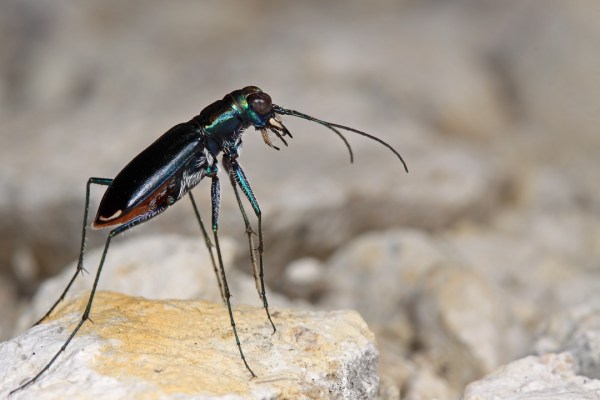
By midday the adults start ”sun-facing” to minimize thermal exposure in their hot, xeric habitats.

After getting several good photos of the beetle in its habitat, I decided it was time to try for some really close photos and added a full set of extension tubes to the camera. A set of tubes with a 100mm macro lens provides close to 2X magnification, but it also reduces the available working distance—a real challenge with wary tiger beetles under a midday sun! I spent quite a bit of time trying to get close enough to take advantage of the additional magnification, but I wasn’t successful until I encountered the individual in the photos below shade-seeking at the base of a yucca plant. Shade-seeking beetles tend to stay put and not move as much (although they still rarely just sit there).
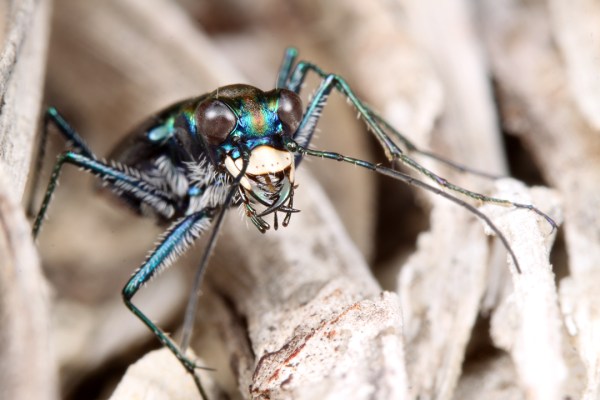
Shade-seeking is another strategy to avoid the midday heat.

I worked this beetle for several minutes and managed to get a number of shots, each closer than the previous and culminating in the nice portrait below.

The ”pièce de résistance”—Cicindelidia politula politula at 2X life size!

My photographic appetite now completely satiated, I spent the rest of the day searching for (and finding) additional localities for the species in the area. I found them more often associated with older, level exposures that had at least a small amount of vegetation. In contrast, newer or steeply sloped exposures or those completely devoid of vegetation rarely had beetles associated with them. I had now spent two days working on C. politula, but the results—both as a collector and as a photographer—made it time well spent. I felt like I “understood” the beetle. However, with only two days left in the trip, it was time to start working my way back towards Missouri and focusing on the few additional goals I still had for the trip.

REFERENCE:

Pearson, D. L., C. B. Knisley and C. J. Kazilek. 2006. A Field Guide to the Tiger Beetles of the United States and Canada. Oxford University Press, New York, 227 pp.

Copyright © Ted C. MacRae 2012

9th Annual Fall Tiger Beetle Trip: Day 3.1

I’d had a very enjoyable 2nd day on this year’s fall tiger beetle trip, but I couldn’t say it had been particularly successful. My primary reason for coming to the Glass Mountains in northwestern Oklahoma was to confirm a hunch that the stunningly beautiful Cicindela pulchra (Beautiful Tiger Beetle) might occur in the flats below the area’s red mesas. My hunch was based on the similarity of habitat to the nearby Red Hills in south-central Kansas, where the species does famously occur (MacRae 2006b). I’ve been here several times now and never found the species, and that did not change this time either. I did end up finding larval burrows and collecting the larvae of several other tiger beetle species (including the wonderfully ginormous Amblycheila cylindriformis), but again I could only consider this a moderate success. During the day, however, I had noted that eastern red-cedar (Juniperus virginiana) in the area was suffering branch and leader die back. Nearly every tree had at least one or more affected branches, and when I cut into a few of them I found evidence of fresh larval galleries of what I presumed were jewel beetles in the genus Chrysobothris. There are several species in this genus that breed in dead Juniperus, but I’m not familiar with any that attack living plants so pervasively as I was seeing here. Moreover, only a few of these species have been recorded from Oklahoma, so I made a mental note to return to the area in the morning and collect examples of dead/dying branches before driving to my Day 3 destination. I’ll put these up in rearing containers when I return home in an attempt to rear our the adult beetles.

Infested red-cedars atop main mesa.

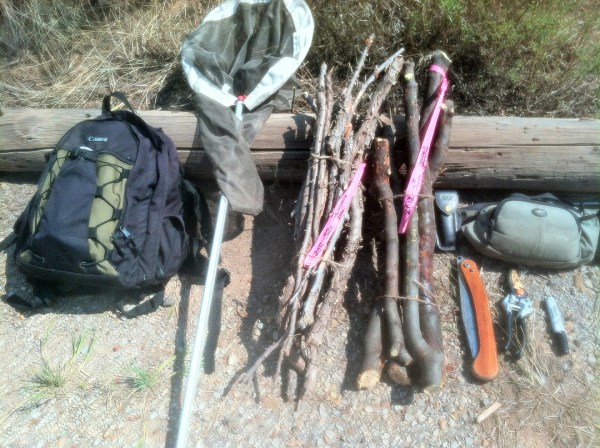
If you’ve never collected wood for rearing beetles before, all I can say is that it is hard and strenuous work. You have to get pretty good at discriminating infested wood in the field, because you don’t want to expend the effort to cut, de-twig, section, bundle, and carry back to the car batches of wood that don’t end up producing beetles. It was a little more effort than I anticipated to get a good sampling of Juniperus branches due to the hardness of the wood and dullness of my hand saw, along with not considering that I would have to hike up to the top of the mesa and then carry the wood all the way back down. Still, there is something enjoyable about this activity for me—perhaps because I’ve done so much in the past and reared so many great species as a result, and I’ll be anxious to see what species I am able to rear from this batch of wood and if they represent any significant new records.

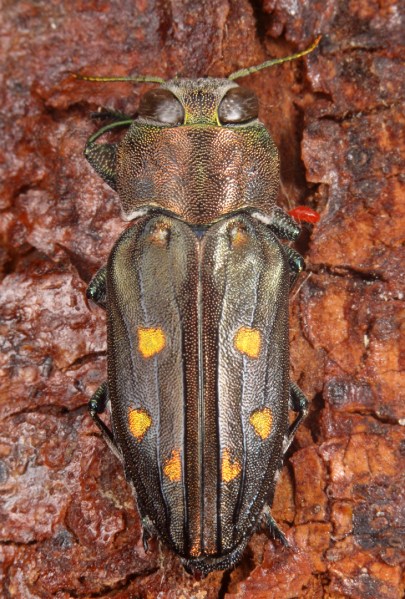
Returning to the car with the wood, I passed by a mesquite tree (Prosopis glandulosa)—a common denizen of the desert southwest but probably near its northeastern limit of distribution here—and noticed bleeding on the main branches. A little bit of slicing with my knife confirmed my suspicion that this was also the work of jewel beetles in the genus Chrysobothris. In the desert southwest, these trees are attacked commonly by one species in particular, C. octocola, and I wondered if this might be the work of that beetle. I also had my suspicions that this species had not yet been recorded from Oklahoma (I later confirmed that it has not), and since I was already hot and sweaty from collecting the Juniperus wood I figured I might as well use my remaining strength to hack out a few limb sections with bleeding and bring them back as well. As I did this, what did I see on one of the branches but the critter itself! I had a decision to make—stop what I was doing and get out the camera to try to take photos (and risk the beetle flying away), or secure the beetle for now, continue with my hack job, and take photos later. I opted for the latter.

Chrysobothris octocola on stressed Prosopis glandulosa | Major Co., Oklahoma

I have to be honest—the beetle found the day’s travels too much to handle, and by the time I was able to take some photographs it was close to dead. As a result, these photos show the beetle in that dreadful flat-on-its-belly pose that I so detest. Still, only the most observant would know the beetle is not alive and well, and a reasonable photo of a dying beetle is better than no photo at all, no matter how live the beetle may be.

This individual represents a new state record for Oklahoma

As I mentioned, this species has not been previously recorded as occurring in Oklahoma, so this individual represents a new state record and an expansion of its known distributional range. That’s publishable data, so I’ll be adding the record to a manuscript currently in progress that details new distributional and biological observations for nearly 100 North American species. It’s the latest in a string of such papers that I begun under the tutelage of the late Gayle Nelson (Nelson and MacRae 1990, Nelson et al. 1996) and am now carrying on the tradition (MacRae and Nelson 2003, MacRae 2006b). 

A successful morning of wood collecting.

By the time I had finished cutting up and bundling the wood and hauling everything back to the truck, it was already well past noon. My quick little morning stop had consumed nearly half the day. However, with one new state record already under my belt and the possibility of others still hiding within the cedar and mesquite branches that I’d collected, I’d have to say this was already the most successful days of the trip. I couldn’t help notice the irony that, as with Day 1, the most significant find of the day was a jewel beetle on a trip that was supposed to be focused on tiger beetles. Hey, I’ll take success in any taxon on any trip.

REFERENCES:

Nelson, G. H., and T. C. MacRae. 1990. Additional notes on the biology and distribution of Buprestidae (Coleoptera) in North America, III. The Coleopterists Bulletin 44(3):349–354.

Nelson, G. H., R. L. Westcott and T. C. MacRae. 1996. Miscellaneous notes on Buprestidae and Schizopodidae occurring in the United States and Canada, including descriptions of previously unknown sexes of six Agrilus Curtis (Coleoptera). The Coleopterists Bulletin 50(2):183–191.

MacRae, T. C., and G. H. Nelson. 2003. Distributional and biological notes on Buprestidae (Coleoptera) in North and Central America and the West Indies, with validation of one species. The Coleopterists Bulletin 57(1):57–70.

MacRae, T. C. 2006a. Distributional and biological notes on North American Buprestidae (Coleoptera), with comments on variation in Anthaxia (Haplanthaxia) viridicornis (Say) and A. (H.) viridfrons Gory. The Pan-Pacific Entomologist 82(2):166–199.

MacRae, T. C. 2006b. Beetle bits: The “beautiful tiger beetle”. Nature Notes, Journal of the Webster Groves Nature Study Society 78(4):9–12.

Copyright © Ted C. MacRae 2012

A classic fall ‘bycid

In eastern North America, autumn is the beginning of the end for most insect groups. Preparations for winter are either complete or well underway—eggs have been laid, nests have been provisioned, and larvae (hopefully) have eaten well enough to endure the long, cold months that lie ahead. But for a few insects, fall is just a beginning. Triggered by cooler temperatures, shortened daylength, and invigorating rains, adults of these insects burst forth under crisp, blue skies to feed amongst a plethora of fall flowers or prey upon other late season insects before the advancing cold, finally, forces a close to the season. As a beetle man, my favorite fall insects must be the “fall tigers” (i.e., tiger beetles) that come out in force and zip across barren sand dunes or bask on exposed rocks of dolomite glades. My fall insect collecting focuses almost exclusively on these insects, since my other favorite groups (jewel beetles and longhorned beetles) are, for the most part, restricted in their adult activity to the spring and summer months and long gone by the time fall rolls around. There are, however, a few longhorned beetles that buck the normal spring/summer rule for the family, namely species in the genus Megacyllene. The most commonly encountered of these is Megacyllene robiniae (locust borer), and anyone who has examined goldenrod (genus Solidago) and its profuse blooms during the fall has likely encountered this familiar beetle with its narrow, alternating, zig-zag bands of black and yellow.¹ I have seen this species many times and in many places; however, I still always enjoy seeing it anew in the field each fall—perhaps as some sort of confirmation that the fall season truly has arrived.

¹ If you see a “locust borer” in the spring, it is actually the closely related Megacyllene caryae (hickory borer), while further west in the Great Plains during fall you might find Megacyllene comanchei.

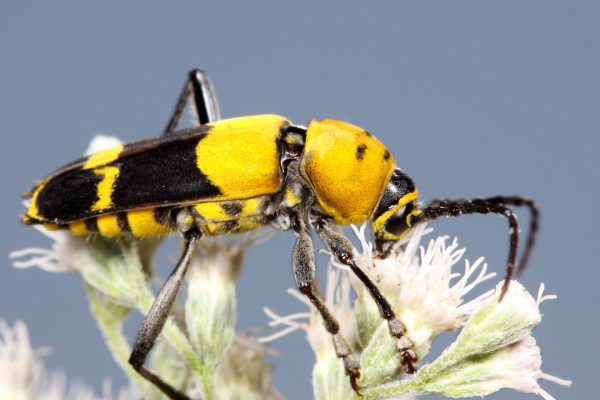
Megacyllene decora (amorpha borer) | Mississippi Co., Missouri

Another species in the genus that is far less commonly encountered, however, is Megacyllene decora (amorpha borer). I have encountered this stunningly beautiful species in only a handful of locations in Missouri (MacRae 1994)—all where stands of its larval host plant, Amorpha fruticosa (false indigo), grow in association with goldenrod and snakeroot (genus Eupatorium). These sites are primarily in the big river valleys of the state (Missouri and Mississippi Rivers), although I have found at least one site in the prairies of west central Missouri. Earlier this summer while traveling through the southeastern lowlands of Missouri, I noticed a stand of native Hibiscus growing within a wet ditch along the edge of a small city park and stopped by to look for the even rarer Hibiscus-associated jewel beetle, Agrilus concinnus (MacRae & Nelson 2003, MacRae 2006). While I did not find that species, I did notice fairly good numbers of A. fruticosa plants along the edge of the ditch as well and young goldenrod plants that had not yet reached flowering stage. At that moment I knew I had a good potential site to look for M. decora and made a mental note to stop at the site again later in the season when goldenrod began to bloom.

The species is distinguished from related species in the eastern U.S. by its wide black and yellow bands.

Last week I returned to the site to find not only goldenrod in its earliest stages of bloom, but an even greater number of Eupatorium serotinum plants already in bloom. I wanted to photograph the beetle, of course, but what I was really hoping for was to find and photograph the beetle on the stems of its Amorpha host plant (I have only seen this once before—all other sightings of the beetle have been on flowers of goldenrod and snakeroot). I approached each Amorpha clump cautiously and searched the stems carefully, also keeping an eye on the goldenrod and snakeroot blooms as I moved from one clump to the next. After searching a number of clumps, I finally found the adult shown in these photos. Fortunately, I knew from previous experience in collecting these beetles that they are not a particularly wary species (few aposematically- or mimetically-colored beetle are), so I was able to get a number of good photographs before I (stupidly) bumped the beetle with the diffuser over my flash heads and disturbed it.

”Blue sky” settings: ISO160–200, 1/200 sec, f/14–16, camera pointed near (not at) the sun.

It would be another half hour before I would find a second beetle, and in total on the day I saw only three (all on Eupatorium). This and the very early stage of the goldenrod blooms suggests to me that the beetles were just beginning to emerge—over the next few weeks I am sure they will become more numerous at the site, so I may yet have an opportunity to photograph one on its larval host plant when I pass by the area in a couple of weeks.

Normal ”normal” full-flash settings: ISO100, 1/250 sec, f/16.

REFERENCES:

MacRae, T. C. 1994. Annotated checklist of the longhorned beetles (Coleoptera: Cerambycidae and Disteniidae) known to occur in Missouri. Insecta Mundi 7(4) (1993):223–252.

MacRae, T. C. 2006. Distributional and biological notes on North American Buprestidae (Coleoptera), with comments on variation in Anthaxia (Haplanthaxia) viridicornis (Say) and A. (H.) viridfrons Gory. The Pan-Pacific Entomologist 82(2):166–199.

MacRae, T. C., and G. H. Nelson. 2003. Distributional and biological notes on Buprestidae (Coleoptera) in North and Central America and the West Indies, with validation of one species. The Coleopterists Bulletin 57(1):57–70.

Copyright © Ted C. MacRae 2012

Not quite a one-shot

This little jumping spider (~8 mm in length) was in one of my soybean fields in west-central Illinois last week. She(?) was quite fidgety and kept jumping from the leaf on which I found her as I tried to carry the leaf out of the field to a more open and convenient place  to take photographs. Once I got out to the grassy field border, I managed to get one photograph (not shown but similar to this one) right before she jumped off the leaf yet again. However, I was able to find her and coax her back onto the leaf for this last shot before she jumped off again—never to be found again! I presume this spider belongs to the genus Phidippus based on the cephalic tufts, and within that genus maybe a species in the P. clarus group (corrections welcome!).

When I look at insect macrophotographs, I like to do reverse engineering on the lighting to figure out what was the flash/diffuser setup. I have a few different diffusers that I use depending on which lens I’m using and how important the photographs are. In this case, I was taking photographs of soybean insects for work purposes and didn’t bother putting on the larger concave diffuser that I use when I’m really concerned about getting more even lighting. Instead, I was just using my snap-on Sto-Fens+Gary Fong Puffers. The difference between these two diffuser setups and their effect on lighting is minor in many cases, but when photographing very shiny surfaces (such as the eyes of this spider) the differences are much more apparent, and it is obvious from this photo that I was using a twin flash unit with separate diffusers on each flash head.

There is one more feature apparent about the lighting in this photograph—note that the “left” flash head appears much more diffuse than the “right” flash head. This is because the right diffuser had actually fallen off of the flash head without me noticing (also never to be found again!). As a result, the light from only one of the flash heads was diffused, while that from the other hit the subject in all its harsh glory. I don’t really like the twin highlights that are the hallmark of twin macro flash units, and if I had known I was going to be photographing jumping spiders when I was in the soybean field I would have gone ahead and used my concave diffuser. I’ve also learned, however, that great photographs are not something that I can expect to pop off while concentrating on other activities—I need to concentrate fully on the photographs and spend a good amount of time doing it until I feel like I’ve gotten the shots that I want. I never really liked the Sto-Fen+Puffer diffusers, as they were only marginally better than no diffuser (and this photograph shows it), so losing one of them might be a blessing in disguise as now I’ll be motivated to try out some of the many other diffuser ideas I’ve been toying around with but never really taken the time to sit down and try them out.

Copyright © Ted C. MacRae 2012

Program Announcment: 2012 ESA Annual Meeting

The Entomological Society of America recently posted the 2012 Program for their Annual Meeting this November in Knoxville, Tennessee, and I’m honored to announce that I’ll be giving a presentation in the Section A Symposium “Entomologists Beyond Borders: Hands on Macrophotography to Help Think Globally.” Let me say this straight out: this looks like a fabulous symposium, but I’m a bit intimidated at the prospect of sharing the stage with such renowned insect macrophotographers as Alex Wild, Thomas Shahan, Marlin Rice, etc. Nevertheless, I hope that the techniques I plan to share on locating and photographing live, often wary insects in their native habitats will be considered useful by at least some members of the audience. At this point, my talk is still an amorphous collection of ideas swirling around in my head (although, as you might predict, there will be many photos of tiger beetles!), thus, if there are any particular points you would like to see addressed now is the time to let me know.

I have been to a number of ESA meeting in the past, but the last was many years ago. I look forward to attending once again, reconnecting with old acquaintances and (hopefully) meeting many new ones. I hope to see you at the Entomologists Beyond Borders Symposium, and please don’t hesitate to come up and say hello.

When: Tuesday, November 13, 2012: 8:00 AM-12:45 PM
Where: Ballroom A, Floor Three (Knoxville Convention Center)
Organizers: Cheri M. Abraham and Ric Bessin
 
8:00 AM Welcoming Remarks
8:05 AM Introduction to insect macrophotography
Robert K. D. Peterson
, Montana State University
8:35 AM This is not that difficult: Techniques for shooting digital macro-photography images of insects
Marlin E. Rice
, Pioneer Hi-Bred International, Inc.
9:05 AM Approaching the unapproachable: Tips and tricks for photographing live insects in their native habitats
Ted C. MacRae
, Monsanto Company
9:25 AM Digital Imagery: Tips, tricks and tools to make impressive insect images
Jocelyn Gill
, Agriculture and Agri-Food Canada
9:45 AM Methods of magnification
Thomas Shahan
, N/a
10:15 AM Photographing insects on a budget
Alexander L. Wild
, University of Illinois
10:45 AM Digital image processing: One perspective on organization, correction and retrieval of images
Eugene D. White
, Rose Pest Solutions
11:15 AM Concluding Remarks
11:20 AM Hands on workshop

Copyright © Ted C. MacRae 2012

Life at 8X—soybean aphid

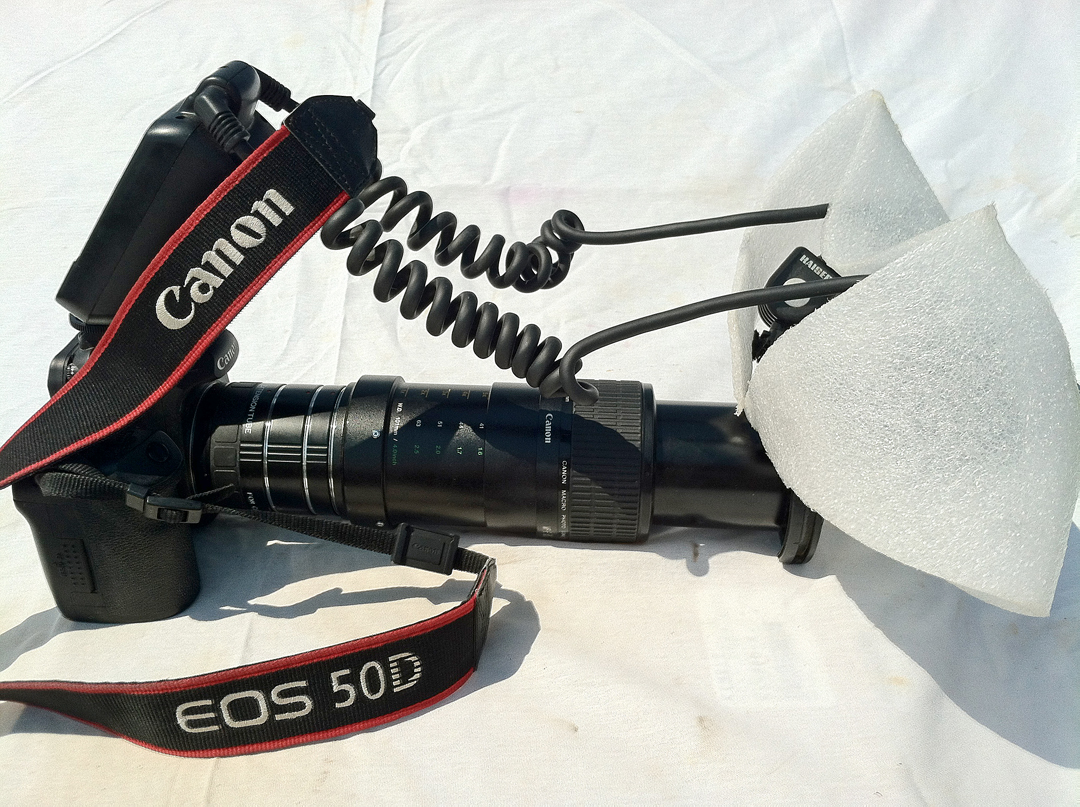
Although my first attempt at adding extension tubes to my Canon MP-E 65mm macro lens, effectively converting it from a 1–5X to a 1.7–8.0X lens, was nearly a year ago, it has only been recently that I’ve actually started experimenting with this combination to obtain high-mag photographs of very small insects in the field. The first example that I showed of such a photograph was a tiny seed weevil (Althaeus sp.) on its hibiscus host plant. I’ve since photographed a number of other insect subjects at high-mag using this setup and am getting a better feel for the capabilities—and limitations—inherent in using it. First, here is what the setup actually looks like:

Canon 50D body, MP-E 65mm macro lens on 68mm extension, MT-24EX twin flash w/ DIY diffuser.

Not the normal photo quality for this site (just a quick field setup photographed with my I-Phone), but it shows just how long the lens component becomes when fully extended to achieve 8X magnification. The camera is quite front-heavy, making the camera difficult to use hand-held, and the very shallow DOF (depth of field) due to the extreme level of magnification makes precise focusing difficult and magnifies the effect of any motion between the camera and subject. Obviously, one solution for these problems is to mount the camera on a tripod and place the subject on a stable surface; however, for reasons I’ve mentioned elsewhere, it is unlikely that I will ever take to bringing a tripod into the field, and the whole point of this exercise is to develop the capability for getting usable hand-held field photographs no matter what level of magnification they may require. As an alternative, I use a number of other techniques, discussed in my prior post on the subject, to stabilize the camera without using a tripod.

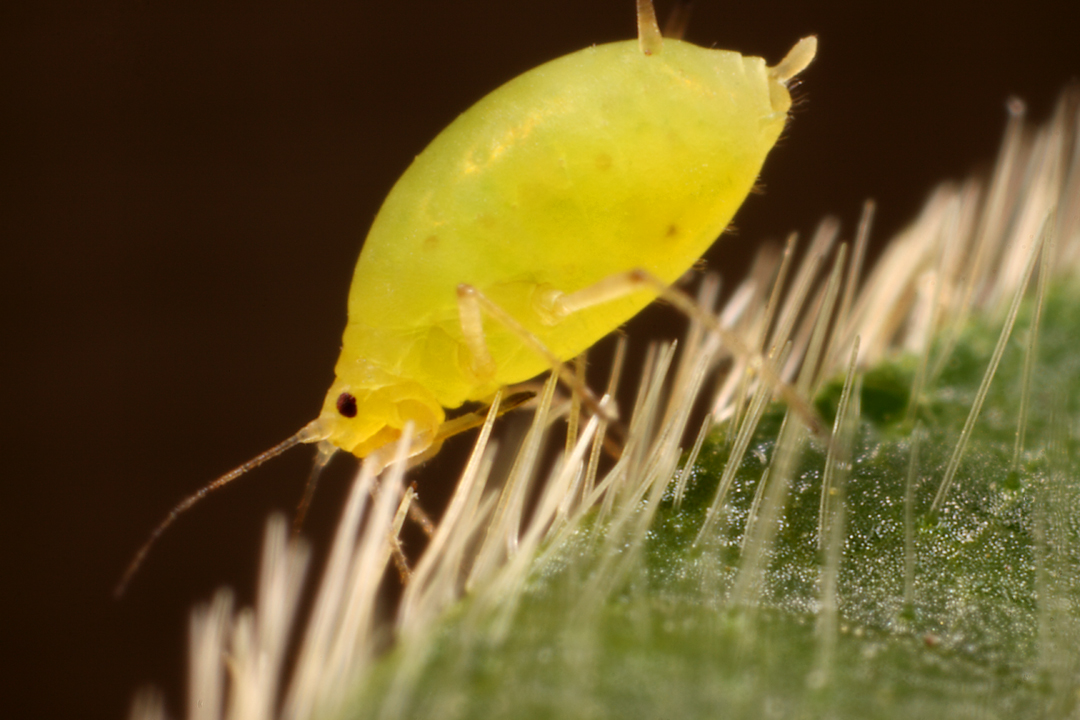
One of the recent subjects I photographed with this setup is the soybean aphid, Aphis glycines (order Hemiptera, family Aphididae). This distinctive Asian species has recently established in the U.S. as invasive pest of soybeans; adult females measure only 1–2 mm in length (and the nymphs are even smaller) and can quickly develop very high densities on the leaves and upper stems of soybean plants. The following photograph was taken at the camera setup’s minimum magnification of 1.7X and provides a typical view of adult aphids and their progeny:

Aphis glycines (soybean aphid) | Warren Co., Illinois

While the above photograph does a very good job of showing the colonial appearance of infestations by these aphids on soybean foliage, what about the aphids themselves? It would be nice to get a better look at individual aphids. The following photographs were all taken with the lens fully extended to achieve 8X magnification (and completely hand-held):

Adult female aphid—note the eye spots of the unborn nymphs visible within the body.

Another adult female navigates the hairs on the surface of the soybean leaf (I never knew soybean leaves were so hairy!).

A mother surrounded by her progeny. As above, eye spots of unborn nymphs can be seen inside her body.

These photographs are not without their problems—they are a bit soft, probably due to motion blur that results from the camera being hand-held and the extremely thin DOF that makes it difficult to get all of the desired components of the photos equally in focus. Lighting also is a challenge, as the very small subject-to-lens distance forces light from the flash to come from directly above or even behind the subject while minimizing front lighting (especially evident in the last photo with its straight down view). Nevertheless, these are decent, usable photographs that provide an uncommon view of these exceedingly tiny insects—without the encumbrance of carrying a tripod in the field, the time investment of studio photography and/or focus-stacking, or the expense of a microscope-mounted camera system (for those of us without access to such systems).

Copyright © Ted C. MacRae 2012

Shooting 8X hand-held in the field

Just to prove it can be done, here is an uncropped photograph of the seed weevil Althaeus hibisci (or the closely related A. folkertsi) (order Coleoptera, family Chrysomelidae, subfamily Bruchinae). Adults of these species measure only 1.5–2.5 mm in length (Kingsolver 2004), yet this individual almost completely fills the frame:

Althaeus hibisci/folkertsi on Hibiscus moscheutos lasiocarpus | Route 66 State Park, St. Louis Co., Missouri

I achieved 8X magnification by stacking 68 mm of extension tubes under my Canon MP-E 65mm 1–5X macro lens and extending the bellows of the lens out to its maximum. Shooting 8X is not for the timid—the small subject to lens distance complicates lighting (full flash required), and even finding the subject in the viewfinder can be next to impossible. However, doing it hand-held in the field requires more than just courage and patience—good bracing techniques to minimize movement by and between the camera and the subject are essential. Here is how I do it:

  • I sit down, prop my knees up, and rest the camera in the crotch between my knees (the camera quickly becomes very heavy since it’s being held by only one hand—see next bullet) while positioning it near my face. If possible, I lean back against something as well to provide even more stability, although this is often not possible depending on field conditions.
  • I hold the leaf or flower supporting the subject in my left hand. Subjects this small are rarely going anywhere (or if they are skittish then I use the same slow, deliberate techniques that I use with larger skittish insects), so it is possible to hold the leaf or flower and position the subject right in front of the lens. Hand holding the subject’s support also affords the ability to micro-adjust the position and angle of the subject for optimum composition or to adjust for movement by the subject (easier than trying to track it by moving the lens). In this case of the photo featured here, I detached the leaf with the beetle from the plant (use small scissors to snip the leaf petiole, as this avoids the “jolt” that happens if you try to pick the leaf and which usually results in the subject fleeing). In other cases, I leave the leaf attached and carefully “pull” it towards me to hold it steady.
  • I look through the viewfinder and brace my left wrist (yes, the same hand that is holding the subject) on the underside of the lens, then slowly move the subject towards the lens with my fingers until I see movement and can micro-adjust for proper focus. Bracing your wrist against the lens is key—it is nearly impossible to hold the subject steady in front of the lens without bracing your wrist against it. In effect, this “fixes” the subject to the lens. Also, before I begin looking for the subject through the viewfinder I study its position on the leaf and look for “landmarks” that I can recognize when looking through the viewfinder to minimize the time needed to find the subject (the more time you spend looking for the subject, the greater the chance it will move or flee). Again, the subject to lens distance is very small, but with practice you’ll get a feel for precisely how far from the lens you need to place the subject.
  • I hold my breath and micro-adjust the subject position to nail the focus (usually on the eye) and then fire a shot. If it takes too long to get the focus I exhale and try again, as body shake will only get worse once it starts. Important: After taking the first shot, do not move the hand holding the subject as you look at the image preview and/or histogram—the first shot rarely has the settings precisely where you need them, and keeping the subject in place prevents a lot of re-searching after making the needed setting adjustments with the right hand.

Other than lighting, nailing the focus is the most difficult aspect of shooting hand-held at such high magnifications. The more relaxed and stable you can keep the rest of your body, the less hand movement you’ll experience while holding the subject and the greater chance you have of hitting the focus. Again, a fully extended MP-E lens on 68 mm of extension tubes becomes very heavy very quickly when held in one hand (even when resting on your knees), so expect your forearm muscles to give out quickly until you have a chance to strengthen them through practice.

I use these same techniques to some degree at lower magnifications as well—certainly for anything above 2X. I’m interested in doing a lot more 8X photography, however, because there is a whole world of tiny insects that are not being photographed due to their very small size. These insects are no less fascinating and beautiful than their larger, more oft photographed brethren.

Finally, you might be asking why I don’t just carry a tripod or collect subjects and bring them back to the studio for more controlled conditions. There are many photographers who advocate the use of tripods, but I’m not one of them. I am first and foremost an entomologist, and when I’m in the field I’m generally already carrying at least a net and other equipment for collecting insects. There are opportunity costs involved if I also try to lug a heavy tripod with me. What’s that? I could leave it in the car and then go get it when I need it? Honestly, I would pass on a lot of shots if I had to go back to the car to get something for it. The same goes for studio photography—there are many shots I would simply pass on if getting them meant that I needed to collect subjects, keep them in good condition for the duration of the trip (which might be days or more), and then setup in a studio. Moreover, there are many shots—specifically regarding behavior—that would be impossible with collected subjects. But really, it has mostly to do with what I want to be and portray as an insect photographer, and that is somebody who has the ability to photograph unconfined subjects exhibiting natural behaviors in their native habitats. Having the ability to shoot 8X hand-held in the field if I want to gives me more options and makes me a better photographer.

Do you have any special bracing or stabilizing techniques that you use for high-mag hand-held macrophotography? If so I’d love to hear about them.

REFERENCE:

Kingsolver, J. M. 2004. Handbook of the Bruchidae of the United States and Canada. U.S. Department of Agriculture, Technical Bulletin 1912, 2 volumes, 536 pp.
 
Copyright © Ted C. MacRae 2012

Very cozy tigers!

In my post Very wary tigers!, I spoke of the frustrations of trying to photograph tiger beetles when conditions of temperature and terrain conspire to make them too wary to approach. This is a common feature of tiger beetle photography in general, but the problem seems to reach its zenith with the “wet sand beach” species—most species inhabiting these habitats tend to be “summer species” active during the hottest part of the season, and their habitats tend to be virtually devoid of any vegetative cover that can be used to the photographer’s advantage. A blazing sun on hot, open sand is not conducive to photographing anything! Still I try, and on that particular day I did manage a few relatively distant photographs of two species, Cicindela repanda (Bronzed Tiger Beetle) and C. hirticollis shelfordi (Shelford’s Hairy-necked Tiger Beetle) but none at all of a third species that was present on the beach, Ellipsoptera cuprascens (Coppery Tiger Beetle).

Ellipsoptera cuprascens (Coppery Tiger Beetle) | New Madrid Co., Missouri

Well, there is always more than one way to skin a cat (or a tiger), and as can be seen in these photographs I took a different approach to that latter species that allowed me to obtain several quite decent photographs of both males and females. Not long after that frustrating day at Cape Rock Park, I found myself again in southeastern Missouri with an opportunity to do some night collecting. It may not be widely known, but certain species of tiger beetles are also active at night and can actually be attracted to ultraviolet (UV) lights. This is particularly true of species in the genus Ellipsoptera, which as a group seem to depend almost exclusively on coastal and fluviatile sand habitats. I have used UV lights in the past to attract nocturnally active species of tiger beetles for photography (see Return to Nowhere), and since I had seen E. cuprascens a few years ago at Steward Towhead in New Madrid County I thought this might be a good spot to try again for photographs of that species.

The relatively coarsely and densely punctate elytra distinguish E. cuprascens from E. macra.

“Might be a good spot” turns out to be quite the understatement, as I have never seen E. cuprascens in such numbers as I did that night! Seeing the species common at the sheet guarantees that individuals will also be found milling around on the ground in the immediate vicinity of the sheet, and unlike during the heat of the day when their bodies shift to thermal overdrive, adults at night are much easier to approach due to the cooler temperatures and the distraction of abundant, easily captured prey sitting transfixed in their UV light-induced stupor. Of course, night photography brings its own set of challenges, primarily (for me) the need to use the camera flash head lamps for focusing—I often find myself repeatedly aborting a shot because the lamps turned off automatically before I had a chance to find the subject and compose the shot to my satisfaction. Still, this is a minor inconvenience compared to the exasperation of subjects blasting across the hot sand when your approach comes within 12 feet!

Males mandibles are modified for grasping the female pronotum during mating.

Ellipsoptera cuprascens is very closely related to E. macra (Sandy Stream Tiger Beetle—see The last tiger beetle), which it resembles greatly and whose ranges overlap here in Missouri (although the latter is far less commonly encountered than the former). The photos in this post show the relatively coarser and denser punctures on the elytra that distinguish E. cuprascens from E. macra, as well as their somewhat shinier surface and distinctly more coppery color. The rounded elytral apices of the female (middle photo) also serve to distinguish the species from E. macra, in which species the elytra of the females come to a point at the suture (Pearson et al. 2006). Note also the sexual dimorphism in the labrum and mandibles of the female (first photo) and male (last photo), with the mandibles relatively longer and slightly curved and the labrum shorter in the latter. Presumably this is related to the use of the mandibles by the males in grasping the female pronotum during mating—the longer, curved mandibles are shaped to precisely fit the contour of the female’s pronotum, while the shorter labrum allows the mandibles to gain better purchase farther down on the side of the female’s pronotum (Pearson and Vogler 2001).

REFERENCE:

Pearson, D. L., C. B. Knisley and C. J. Kazilek. 2006. A Field Guide to the Tiger Beetles of the United States and Canada. Oxford University Press, New York, 227 pp.

Pearson, D. L. and A. P. Vogler.  2001. Tiger Beetles: The Evolution, Ecology, and Diversity of the Cicindelids.  Cornell University Press, Ithaca, New York, 333 pp.

Copyright © Ted C. MacRae 2012