BugShot 2011 – Final Thoughts

As I suspected would be the case,  has proven to be an especially difficult challenge.  As a result, instead of posting the answer tonight I’m going to give folks another day to make their play for points (remember, nobody walks away empty-handed).  In the meantime, I’ve had a chance to ruminate over this past weekend’s BugShot insect photography workshop at Shaw Nature Reserve in Gray Summit, Missouri, and now seems to be an appropriate time to post some final thoughts while they’re still fresh in my mind. Suffice it to say that it was an incredible experience—both technically and socially.  I learned far more than I thought possible (and hope I can remember even a portion of it) and made some great friends in the process.  It’s really not possible for me to summarize here all of the techniques, insights, equipment choices, etc. that were covered, nor do I want to—such a list would be boring to read and not very meaningful without the context to go with it.  What I would like to do is shout out a few people who, beyond the collective, helped make the weekend what it was for me.

Instructors.  The three instructors, all accomplished insect photographers of the highest caliber, typified three very different yet complimentary approaches to the art.  Alex Wild (University of Illinois), ant photographer extraordinaire and author of the insect blog I’ve most tried to emulate, gave me tremendous insight on lighting and practical approaches on how to use it effectively.  My discussions with John Abbott (University of Texas) about equipment will be very helpful for the type of photography that I like to do (I’m not sure I’m ready for the tripod yet, but maybe the other ideas we discussed will be the “slippery slope”).  Finally, I thoroughly enjoyed my time with Thomas Shahan (Norman, Oklahoma), whose great artistic insight helped me see a whole new world of possibilities for tiger beetle portraiture.  I must admit to feeling a little star-struck when I first began talking to him, but his infectious enthusiasm and exuberance quickly put me at ease.

Friends.  I can’t begin to list everybody whose company I enjoyed, but standouts include Jo Holly (Alex’s better half!), as well as fellow bloggers Crystal, Lee, Dave, and DragonflyWoman.  Even though I only met them this weekend, it was if I had known them for years.  My time “fishing” tiger beetle larvae with Crystal and Lee was not only a highlight of the trip (watching them “jump” as the larva came flying up and out of the burrow was a real treat), but also represented a discovery in the truest sense of the word (as will become clear in a future post).  No discussion of friends would be complete without mentioning James Trager, not only for opening up Shaw Nature Reserve to this weekend’s event, but also for the access he’s given me over the past several years and our frequent, humorous email discussions about all things entomological (or botanical, ecological, etc.).

Gratitudes.  I want to thank Alex for inviting me to take part in this event as something more than just an attendee.  I hope my contribution, however small, was beneficial.  My thanks also to Patsy Hodge, who was so helpful and gracious to me in the days leading up to and during the event.  I also appreciate the kind comments that many of the attendees made to me about my blog and my photographs—your encouragement means a lot to me.

Regrets.  In an event like this, packed as it was with seminars and group discussions, it is sad but unavoidable that one cannot spend at least a little time with each and every person in attendance.  To those that I did have a chance to talk to, the pleasure was all mine.  To those that I missed, I will catch you next time!

I think I’ll close with this minimally processed photograph of what I take to be Misumenoides formosipes (whitebanded crab spider) and its honey bee (Apis mellifera) prey.  Although I photographed this spider using flash and looking straight up into an overcast sky, I managed to properly illuminate the subject and avoid blown yellows and an all-black background by using some of the very techniques and principles that I had just learned earlier that day.  I hope to learn more at BugShot 2012!
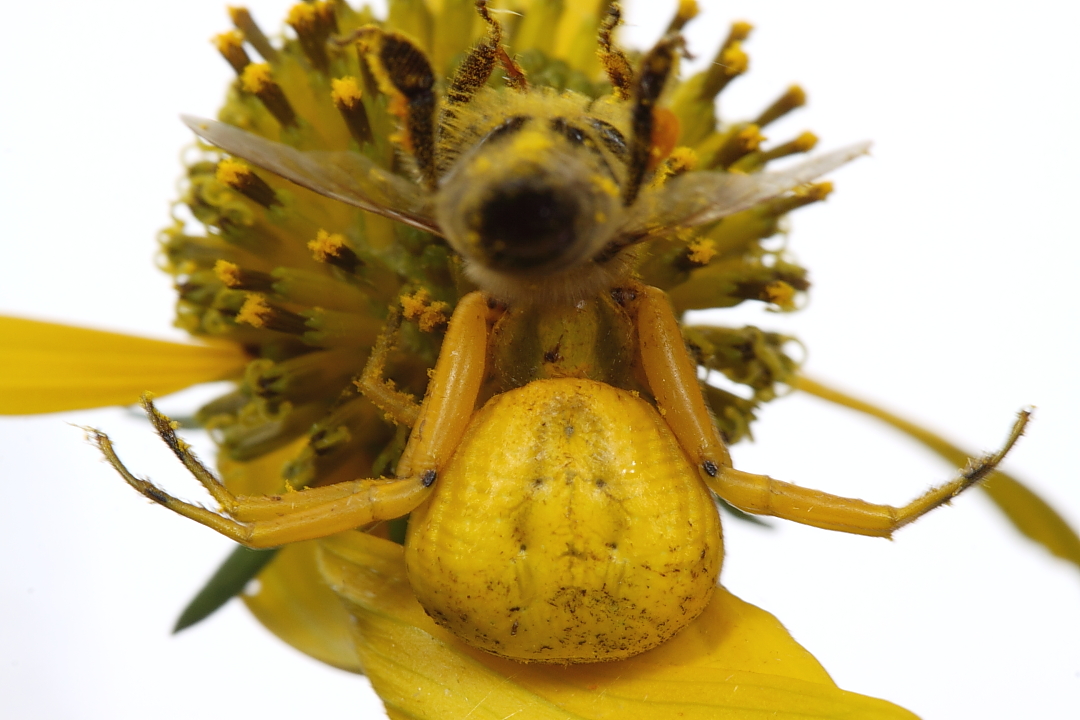
Misumenoides formosipes (whitebanded crab spider) | Shaw Nature Reserve, Franklin Co., Missouri

Mite on White

I found this velvet mite at Shaw Nature Reserve (Franklin Co.) in east-central Missouri on a trail through mesic upland forest. At 4 mm in length, this member of the superfamily Trombidioidea is a downright honker compared to most other mites. I suspect it belongs to the nominate family, but comments at BugGuide suggest a lateral view of the palps are necessary for a conclusive ID to family. Regardless of its identity, its screaming red color made it ideally suited to be photographed on a white background. On the other hand, its small size and refusal to ever stop crawling made it a frustrating subject to track through a 65mm lens (all photos shown uncropped).


Copyright © Ted C. MacRae 2011

Bichos Argentinos #6 – Jumping Spider

I photographed this jumping spider (family Salticidae) two weeks ago in Buenos Aires, Argentina at La Reserva Ecológica Costanera Sur. In gestalt it is very similar to our North American species of the genus Phidippus, but I can’t say for sure whether it actually belongs to that genus. I found it crawling on the foliage of a tree just about eye height, and I’m guessing from the muted markings and roundish shape to the abdomen that it is a female (I saw another individual later that I took to be a male of the same species – it was similarly but more boldly marked and with a much more tapered abdomen). I hope you’ll forgive my hubris, but I’m rather pleased with how these photographs turned out (although, admittedly, there were others that were not so good). In my opinion, they represent further improvement over my first two attempts at photographing jumping spiders (with the standard caveat that I am still no Thomas Shahan). These improvements involve primarily sharpness and detail but also composition, and I consider them to be largely due to lighting and learning how to handle the subject.

The detail in these photos results not only from proper focus, but also lighting techniques. All of these photos were taken hand-held using a Canon MP-E 65mm macro lens at f/13 with full flash lighting. Although I used an exposure setting of 1/200 sec, the actual exposure is determined strictly by the duration of the flash pulse, which is much shorter than 1/200 sec. While flash pulse duration can be set manually (and I started out doing so), I now prefer to use E-TTL mode (Evaluative Through The Lens), which adjusts the flash duration automatically based on the amount of light that the camera senses coming through the lens from a short pre-flash at the aperture chosen. The more light that is sensed, the shorter the flash pulse – the less light sensed, the longer the pulse. Obviously, with a shorter flash pulse there is less likelihood that image sharpness will be affected by movement – either by the subject or by the camera-holder. Since light intensity decreases in proportion to distance, it is desirable to get the light source as close to the subject as possible to achieve the highest intensity and, thus, shortest flash duration.

It’s not that simple, however. Most insect macrophotographers agree that diffused light gives better results than undiffused light, but no matter what diffuser one uses there will be loss of light. Loss of light leads to longer flash pulse duration and, thus, increased potential for movement during the flash pulse (especially in hand-held photography). The trick, then, is to diffuse the light as much as possible, while at the same time minimizing light loss. I continue to favor my Puffer+Sto-Fen double diffuser for use with the 65mm lens, because it places the outer diffuser almost right on top of the subject for maximal apparent light size. This is not to say that improvements still are not possible – the open-side design likely results in some loss of light, and a thin inner diffuser film to replace the Sto-Fens would probably further reduce light loss and allow for even shorter flash pulses (and probably also allow a bit more battery life). I’ll get around to effecting these improvements someday, but in the meantime the current setup is working pretty well.

Compositionally, I like this last photo the best due to the placement of the subject within the frame (all photos are shown completely uncropped, although I’m not above doing so), its slight upward-looking pose, and the evenly-blurred light-green background. This was achieved by using my left hand to hold the leaf on which the spider was sitting and to also serve as a brace for resting the camera, which I held with the right hand. This minimizes wind-movement and fixes the distance between the subject and the lens (as long as the subject sits still!). By carefully twisting and turning the leaf as the spider moved upon it, I was able to turn the spider into the desired positions, and by paying attention to what was behind the spider I could compose a nicely colored blurred background. Understanding subject behavior was a tremendous advantage in this case, as it allowed me to predict and anticipate how the spider would move in response to my finger-prodding and leaf turning to get desirable poses. I tend to get my best compositions after I’ve worked the subject for awhile and taken several shots to learn its behavior and get it accustomed to my presences – this is reflected in the accompanying photos, which are posted in the order in which they were taken. Make no mistake – patience and practice are still required. However, it’s techniques such as these that can make the difference between good photographs and great ones!

Edit 3/30/11, 11:50am: My thanks to G. B. Edwards, Curator at the Florida State Collection of Arthropods, who just sent me the following message:

Hi Ted,
Nice photos.  Most likely it is a female “Euophryssutrix, which is not a Euophrys nor even a euophryine, but a freyine, so eventually will have another genus name. It is one of the larger species in the subfamily.

This species is called “aranhas papa-moscas” in southern Brazil, where it is a principal predator of fruit flies in peach orchards (Wikipedia).

Copyright © Ted C. MacRae 2011

BitB Top 10 of 2010

Welcome to the 3rd Annual BitB Top 10, where I pick my 10 (more or less) favorite photographs of the year.  My goal for 2010 was to continue the progress that I began the previous year in my quest to become a bona fide insect macrophotographer.  I’m not in the big leagues yet, but I have gotten more comfortable with using my equipment for in situ field photographs and am gaining a better understanding of lighting and the use of flash.  I also began experimenting with different lighting techniques (e.g. white box) and diffusers and am putting more effort into post-processing techniques to enhance the final appearance of my photographs.  I invite you to judge for yourself how successful I’ve been toward those goals by comparing the following selections with those from 2009 and 2008 – constructive feedback is always welcome:


Best Tiger Beetle

Cicindela denverensis - green claybank tiger beetle

From ID Challenge #1 (posted December 23).  With numerous species photographed during the year and several of these dramatic “face on” shots, this was a hard choice.  I chose this one because of the metallic colors, good focus throughout the face, and evenly blurred “halo” of hair in a relatively uncluttered background.


Best Jewel Beetle

Buprestis rufipes - red-legged buprestis

From Special Delivery (posted July 13).  I didn’t have that many jewel beetles photos to choose from, but this one would have risen to the top no matter how many others I had.  The use of a white box shows off the brilliant (and difficult-to-photograph) metallic colors well, and I like the animated look of the slightly cocked head.


Best Longhorned Beetle

Desmocerus palliatus - elderberry borer

From Desmocerus palliatus – elderberry borer (posted November 18).  I like the mix of colors in this photograph, and even though it’s a straight dorsal view from the top, the partial dark background adds depth to the photo to prevent it from looking “flat.”


Best “Other” Beetle

Enoclerus ichneumoneus - orange-banded checkered beetle

From Orange-banded checkered beetle (posted April 22).  The even gray background compliments the colors of the beetle and highlights its fuzziness.  It was achieved entirely by accident – the trunk of the large, downed hickory tree on which I found this beetle happened to be a couple of feet behind the twig on which it was resting.


Best Non-Beetle Insect

Euhagenia nebraskae - a clearwing moth

From Euhagena nebraskae… again (posted October 21).  I photographed this species once before, but those photos failed to capture the boldness of color and detail of the scales that can be seen in this photo.


Best “Posed” Insect

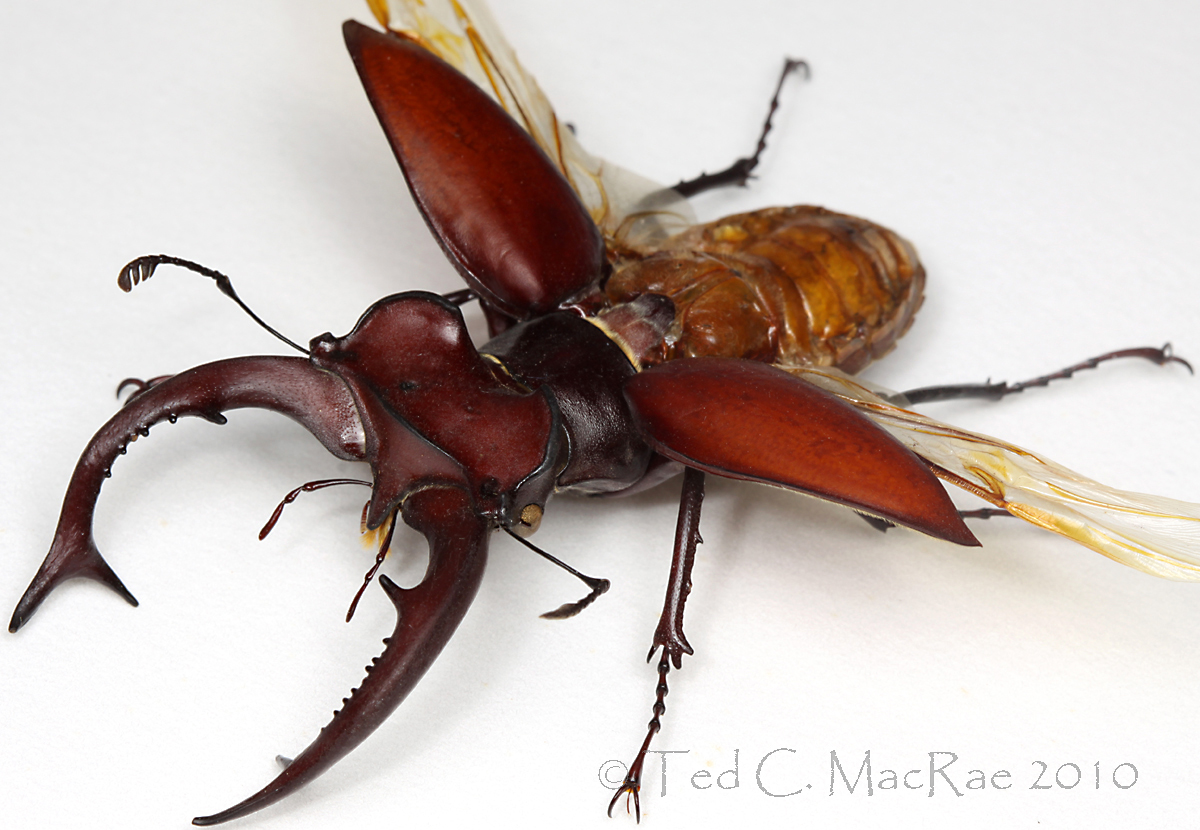
Lucanus elaphus - giant stag beetle

From North America’s largest stag beetle (posted December 30).  I’ve just started experimenting with photographing posed, preserved specimens, and in fact this male giant stag beetle represents only my second attempt.  It’s hard to imagine, however, a more perfect subject than this impressively stunning species.


Best Non-Insect Arthropod

Scolopendra heros - giant desert centipede

From North America’s largest centipede (posted September 7).  Centipedes are notoriously difficult to photograph due to their elongate, narrow form and highly active manner.  The use of a glass bowl and white box allowed me to capture this nicely composed image of North America’s most spectacular centipede species.


Best Wildflower

Hamamelis vernalis - Ozark witch hazel

From Friday Flower – Ozark Witch Hazel (posted March 26).  The bizarre form and striking contrast of colors with the dark background make this my favorite wildflower photograph for the year.


Best Non-Arthropod

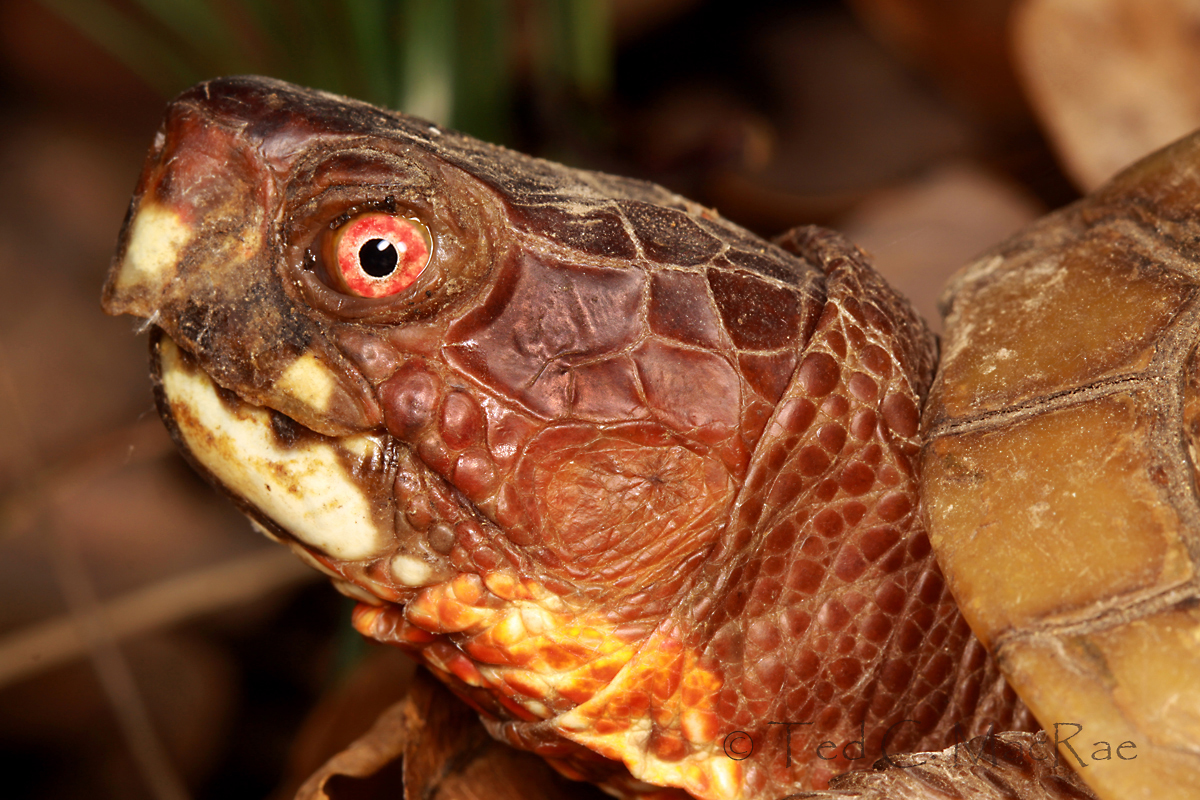
Terrapene carolina triunguis - three-toed box turtle

From Eye of the Turtle (posted December 10).  I had a hard time deciding on this category, but the striking red eye in an otherwise elegantly simple photograph won me over.  It was also one of two BitB posts featured this past year on Freshly Pressed.


Best “Super Macro”

Phidippus apacheanus - a jumping spider

From Jeepers Creepers, where’d ya get those multilayered retinae? (posted October 5).  I’m not anywhere close to Thomas Shahan (yet!), but this super close-up of the diminutive and delightfully colored Phidippus apacheanus is my best jumping spider attempt to date.  A new diffuser system and increasing comfort with using the MP-E lens in the field at higher magnification levels should allow even better photos this coming season.


Copyright © Ted C. MacRae 2011

Answer to Super Crop Challenge #2

I was hoping that Super Crop Challenge #2 would prove a little more difficult than the first one, but first responder Troy Bartlett quickly sniffed out the correct answer – the top part of the abdomen of the marmorated orb weaver, Araneus marmoreus.  As the first correct responder he earns bonus points.  Dennis also came up with the same answer after temporarily being led astray, and Colton got it right as well (once he realized the challenge was here and not over on FaceBook).  I might be justified if I deducted points for misspellings in the genus and common names (if there is any field unforgiving of spelling errors, it’s taxonomy); however, I’m watching a Christmas movie with my family and am feeling the holiday spirit.  That spirit extends to Dave as well, who earns pity points for refusing to believe that I would offer consecutive spider challenges (actually the first Super Crop Challenge was an opilionid, but the ID challenge before that was another spider, making this the third straight arachnid challenge I’ve posted – it wasn’t by design).

The crop I used for this challenge was taken from the above photo – not the best of the series, but it had the most symmetrical view of the dorsal abdominal pattern that some think looks like a face.  This is just one of many color variations exhibited by this most variable of North American spiders – see this BugGuide page for a pictorial summary of the extraordinary amount of variation found in this species.

My friend Rich and I encountered this individual – a female – in an upland oak/hickory forest while hiking the lower North Fork Section of the Ozark Trail in extreme southern Missouri.  These spiders normally hide in a retreat during the day (usually a curled leaf) and spin a new web at night – I’m not sure why she was out during the day, as it didn’t appear she was recycling the web, tattered and torn and probably still remaining from the previous evening.  When I first approached, I accidentally brushed against one of the support lines, which sent her scampering up into her retreat.  I figured “tapping” on the leaf might cause her to drop back out – Rich was skeptical, but after a few taps, the spider not only dropped out but obligingly went right back down to the center of the web and stayed in place long enough for me to get a few shots of the ventral surface.  (I couldn’t suppress a smug chuckle as Rich muttered in exasperated disbelief!)  Moving around to the other side disturbed the spider again, and she once again took refuge in her retreat.  This time, rather than fight it, I carefully uncurled the leaf that formed her retreat, working gingerly to avoid disturbing her, and took a series of photos of her attractive dorsal surface as she sat in the retreat.

Photo Details: Canon 50D w/ 100mm macro lens (ISO 100, 1/200 sec, f/16), Canon MT-24EX flash w/ Sto-Fen + GFPuffer diffusers. Typical post-processing (levels, minor cropping, unsharp mask, etc.).

Copyright © Ted C. MacRae 2010

Answer to Super Crop Challenge #1

Seemingly correct answers came quickly to yesterday’s inaugural Super Crop Challenge, which featured a curious structure atop a harvestman (class Arachnida, order Opiliones) that I encountered while hiking the lower North Fork Section of the Ozark Trail in extreme southern Missouri. “Seemingly” I say, because even though some points were earned, others remained left on the table – the organism was rightly recognized as a harvestman, and the structure in the photo does indeed contain the ocelli (or eyes).  However, nobody actually named the structure itself (see update below) – the ocularium (ocular or optical tubercle would also have been accepted).  Hey, I’m pedantic and proud!

As near as I can tell, this individual belongs to the genus Leiobunum (family Sclerosomatidae).  Species in this genus are notoriously difficult to identify; however, the super long legs, dark dorsal stripe, pointed abdomen, and very long palps with “knees” that extend dorsally to a level well above the ocularium suggest a male L. vittatum or one of its close relatives (Schulz 2010). Leiobunum vittatum is a common inhabitant of wooded habitats across the eastern U.S.

I took this shot with an MP-E 65mm macro lens at about 2.5X. The short working distance of the lens at this level of magnification makes it difficult to photograph these longer-legged species in lateral profile due to their habit of “waving” their especially elongate 2nd pair of legs in the air as pseudo-antennae – one touch of any part of the camera sends them scampering. I chased this guy back and forth across a downed tree trunk for some time before I finally got lucky when it encountered some prey (note the long structure extending down from the mouth area – I believe it is the antenna of a tiny, nymphal blattodean) and became distracted just long enough for me to close in and fire off a couple of close shots. He was actually closer to the underside of the log, so when I took this photo I was leaning far over the log with the camera almost upside-down!

Okay – Art earns points for being the first to identify it as a harvestman, while Geek snaps rare duplicate ID points for using the order’s scientific name (no complaining – scientific names will always get points on this blog).  Art, Aniruddha, and Geek also get half-points for mentioning (in order of correctness) eye, ocelli (technically more correct, but wrong plurality), and ocellus (yes, only one is visible – did I mention my pedantic tendencies?).  However, I’m going to declare arachnologist and Opiliones specialist Chris as the winner of this round for his impressive display of generic-level identification based on the meagerest of evidence!

Update 11/22, 11:00 a.m. – actually, Chris did name this structure in an email sent to my office address while the comments box was unchecked and, thus, earns a clean sweep of this challenge.

Photo Details: Canon 50D w/ MP-E 65mm 1-5X macro lens (ISO 100, 1/250 sec, f/13), Canon MT-24EX flash w/ Sto-Fen + GFPuffer diffusers. Typical post-processing (levels, minor cropping, unsharp mask).

REFERENCE:

Schulz, J. W. 2010. The Harvestmen of Maryland (accessed 20 November 2010).

Copyright © Ted C. MacRae 2010

Super Crop Challenge #1

ID quizzes and challenges seem to have become an increasingly popular subject for natural history blogs. I’ve done a few of my own, but my straight up ID challenges are starting to seem a little unimaginative compared to the DNA sequence, crypsis, mimicry, taxonomy fail, and other challenges being offered up by bug blogdom’s more creative types. To step it up a notch, I offer the first Super Crop Challenge. Small structures that we take for granted within a larger context often take on alien qualities when viewed in isolation. Can you identify this structure and the organism that possesses it?


Copyright © Ted C. MacRae 2010

Forgotten Foto Friday: Centruroides vittatus

I got this idea from Doug Taron over at Gossamer Tapestry, who credits Steve Borichevsky at Shooting my Universe for an occasional feature called Forgotten Photo Friday (hopefully my use of the alternative spelling “Foto” won’t be considered too presumptuous).  Perfect timing, as I recently ran across these photos of Centruroides vittatus (striped bark scorpion) that I took last fall after finding him secreted under a rock in a dolomite glade at White River Balds Natural Area in extreme southwest Missouri.  One other photo from the series did make it onto the blog last year – an extreme closeup of his seemingly “smiling” face (see A face only a mother could love), and while these photos are less extreme, I think they still deserve to be shared nevertheless.


One thing that strikes me about this individual is how marvelously well-matched is his coloration with that of the surrounding rocks – a perfect example of the cryptic coloration that characterizes most members of the family (Buthidae) to which this species belongs.

Photo Details: Canon 50D w/ 100mm macro lens (ISO 100, 1/250 sec, f/13-16), Canon MT-24EX flash (1/4 ratio) w/ Sto-Fen. Typical post-processing (levels, minor cropping, unsharp mask).

Copyright © Ted C. MacRae 2010