T.G.I.Flyday—fuzzy wuzzy wuz a…

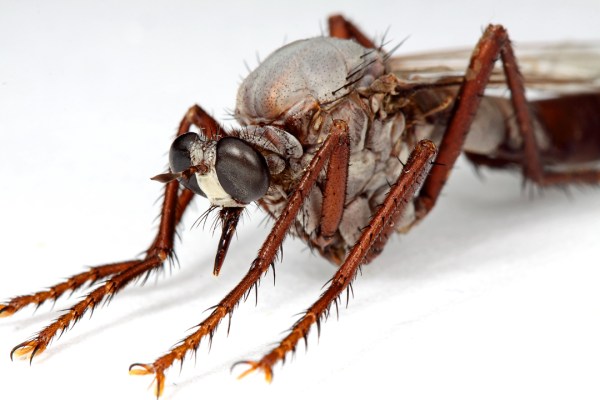
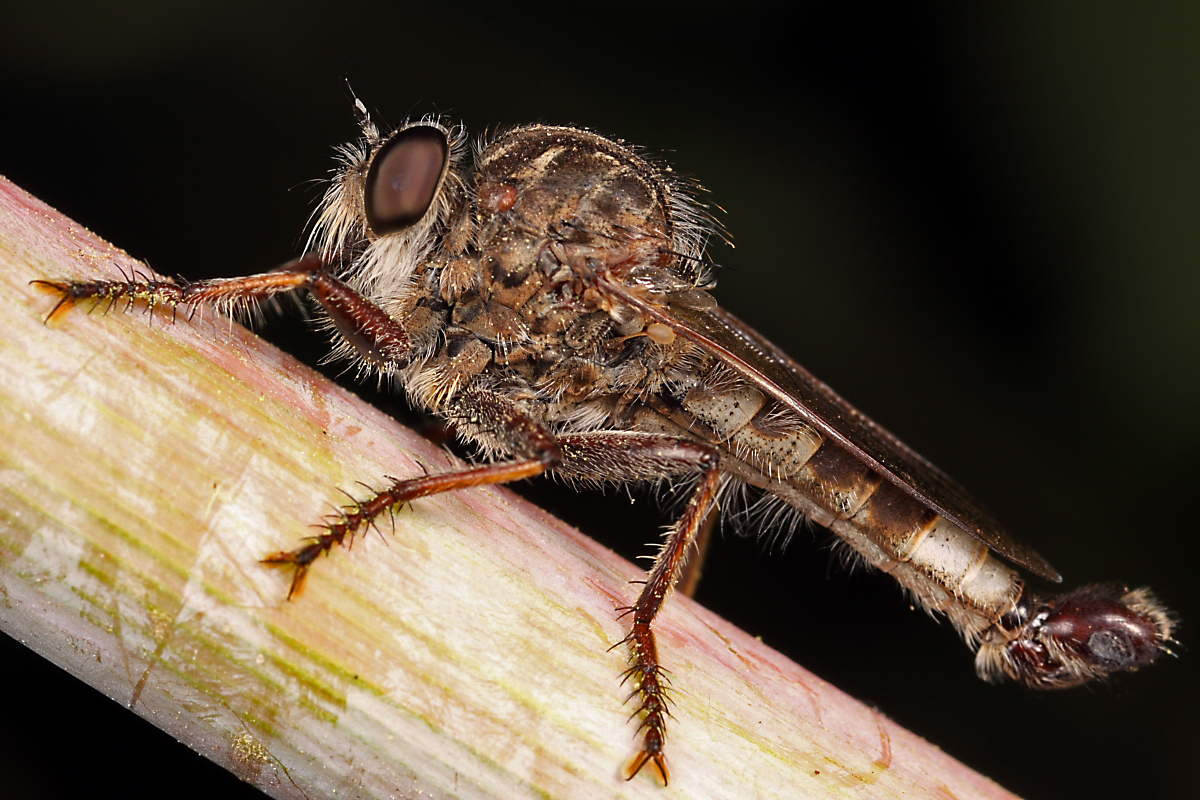
Megaphora? sp. | Lyon Co., Nevada

Megaphora? sp. | Lyon Co., Nevada

I’m back after an uncharacteristically lengthy absence, due not to loss of desire or inspiration but rather a malfunctioning computer. Repeated attempts to restore connectivity were unsuccessful, and heavy travel during the past week only exacerbated the situation. However, all is well now (for the time being—hopefully a new machine will arrive before my current one bites the dust), and as a peace offering until I can post something more substantial I offer this photo of a robber fly (family Asilidae) that I photographed near Wellington Springs in Lyon Co., Nevada during my late August Great Basin collecting trip. The fly was found very much alive but torpidly clinging to the stem of Chrysothamnus viscidiflorus (yellow rabbitbrush). My best guess is something in the genus Megaphorus (correction or confirmation by any passing fly guys would be much appreciated).

Speaking of my Great Basin collecting trip, I’m putting together an “iReport” of the trip featuring a general synopsis and photographs taken exclusively with my iPhone. Don’t snicker—when used within its capabilities an iPhone can take quite good photographs. I carry mine with me at all times despite also carrying a “real” camera and use it in situations that play to its strengths and don’t require the big camera. At any rate, look for something in the next day or so.

Copyright © Ted C. MacRae 2013

T.G.I.Flyday: Argentine robber

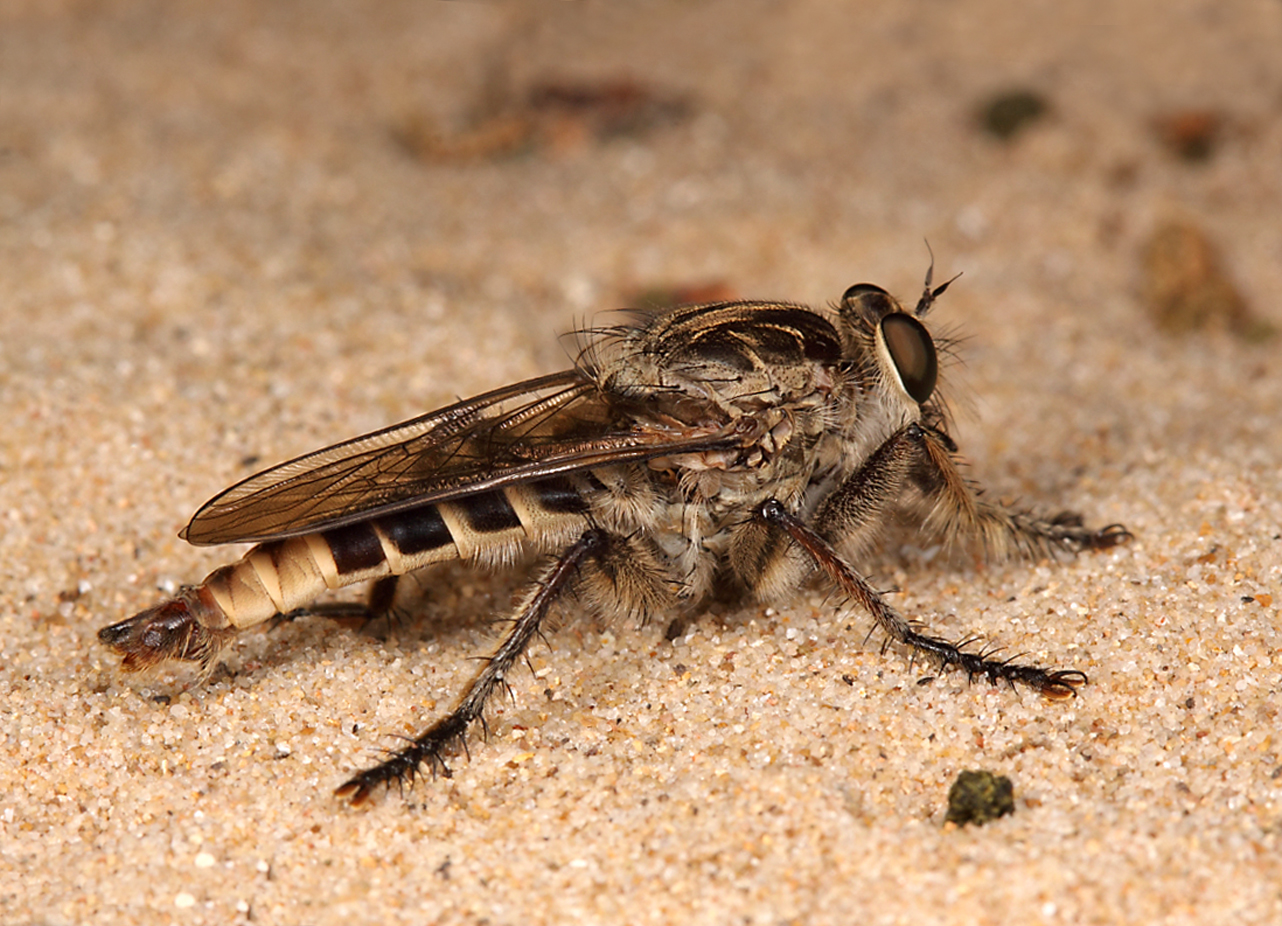
I’m back in South America for the next 2+ weeks, and though it will be another week before I actually make it into Argentina, I am celebrating my return to that lovely country with photos of Argentinian insects taken during last year’s extended visit but that I haven’t had a chance to share before now. Earlier this week I featured Camponotus sericeiventris (though I prefer the literal translation, “silky-bellied humpbacked ant“)—easily among the most handsome ants that I’ve ever seen and which I encountered in the remnant quebracho forests at Chaco National Park in northern Argentina. Today’s feature is an equally handsome robber fly (order Diptera, family Asilidae), also seen at the park and which landed on a dead log just long enough to allow one good lateral profile shot of the beast in all its hairy splendidness! (Probably it zipped off to impale an Odontocheila tiger beetle in the back of the neck!)

Triorla sp. | Chaco National Park, Argentina

Triorla sp. | Chaco National Park, Argentina

I sent this photo to a few fly guys looking for a more authoritative opinion about its identity, mentioning its resemblance to some of our North American species of Efferia. Herschel Raney agreed that it belonged to at least that group, while Eric Fisher suggested a species in the genus Triorla (an early segregate of Efferia that is now widely regarded as a valid genus). The most recent checklist of robber flies from Argentina (Artigas & Hengst 1999) lists three species in the Efferia group (all in the genus Nerax); however, both Herschel and Eric confirmed my suspicion that Argentina, and especially the north, is not well studied for Asilidae. Eric further suggested that there could be as many as several times the number listed, mainly undescribed but also described from adjacent countries and occurring in Argentina but not yet recorded from there. Also, I had presumed this individual to represent a female since it lacked the distinctly swollen genital capsule (e.g. see this post, presumably another Efferia-group species), but Herschel thought the terminal structure was odd and did not look female.

REFERENCE:

Artigas, J. N. & M. B. Hengst. 1999. Clave ilustrada para los géneros de asílidos argentinos (Diptera: Asilidae). Revista Chilena de Historia Natural 72:107—150.

Copyright © Ted C. MacRae 2013

The “Other” Marvelously Monstrous Microstylum

Microstylum galactodes | Brewster Co., Texas

A couple of years ago during the initial testing of my DIY diffuser, I pulled a selection of rather impressive insects from my collection and photographed them on a white background to see how effectively the diffuser worked with different types and sizes of insects. I posted some of those photos for the larger insects in the following weeks, including the tank-like eastern Hercules beetle, the frightful-looking stag beetle, and the downright evil-looking red-eyed devil. There were, however, a number of smaller insects that I had also photographed but whose photos never made it onto these pages as a flush of new photography began the following spring. This is one of them: the robber fly, Microstylum galactodes (order Diptera, family Asilidae). I collected this specimen nearly 20 years ago in western Texas, and until the last few years it was the largest robber fly I had ever seen. That honor now goes to the closely related M. morosum (North America’s largest robber fly), which I have seen in northwest Oklahoma and as a previously unreported occurrence in southwestern Missouri. Still, M. galactodes is an impressive beast, and these photographs of the preserved specimen do little justice to its appearance in life.

The ”beard” (mystax) of Microstylum is confined to the oral margin and composed of stout bristles.

Both species of Microstylum are distinguished by the mystax (dense moustache of bristles on the face) confined to the oral margin and composed chiefly of stout bristles, but M. galactodes may be separated from its larger cousin by the light-colored wings and even, whitish bloom (powdery covering) covering the head and thoracic dorsum (Back 1909). Despite being the relatively commoner species, M. galactodes seems to be a little more specific in habitat preference, most often found in short grass prairies and scrub lands (Beckemeyer & Carlton 2000). Also, even though both species occur broadly in the southcentral to southwestern U.S., M. galactodes seems to have a slight western shift in its distribution compared to M. morosum, extending north only into the western parts of Oklahoma and Kansas (Beckemeyer & Carlton 2000); while M. morosum occurs across these states and eastward into northwestern Arkansas (Warriner 2004) and southwestern Missouri (MacRae unpublished—gotta get that note submitted!

REFERENCES:

Back, E. A. 1909. The robberflies of America, north of Mexico, belonging to the subfamilies Leptograstrinae and Dasypogoninae. Transactions of the American Entomological Society 35:137–400.

Beckemeyer, R. J. & R. E. Carlton.  2000.  Distribution of Microstylum morosum and M. galactodes (Diptera: Asilidae): significant extensions to previously reported ranges.  Entomological News 111(2):84–96.

Warriner, M. D.  2004.  First Arkansas record of the robber fly Microstylum morosum (Diptera: Asilidae).  The Southwestern Naturalist 49(1):83–84.

Copyright © Ted C. MacRae 2012

One-Shot Wednesday—Proctacanthus fulviventris ovipositing

Proctacanthus fulviventris | Dixie Co., Florida

Today I spent the day just south of Florida’s “arm pit” to look for the state’s near-endemic tiger beetle Cicindelidia scabrosa (Scabrous Tiger Beetle). I first found this species last August on a white-sand 2-track through sand pine scrub habitat near Cedar Key Scrub State Preserve (Levy Co.). Although I was happy enough with the photographs that I got that day, the small spot of habitat that I found them in had yielded only a few specimens. My goal this time was to find the species in additional localities  to get a better idea of its precise habitat preferences and obtain a better series of specimens that more fully represents the range of variability exhibited by the species in its pubescence, color and elytral markings. By day’s end I would meet this goal, having found the species at four locations in Levy Co. and further north in Dixie Co. My first stop was actually in Dixie Co. near Lower Suwannee National Wildlife Refuge, where I found good numbers of individuals on a white-sand 2-track through pine scrub. A variety of robber flies (family Asilidae) were also seen along the 2-track, but I resisted the urge to photograph them because of the task at hand. Eventually, however, I came upon a female of this rather large species with her abdomen deeply inserted into the loose sand, surely in the act of oviposition. This was too much to pass up, so I set down the net, took off the backpack, and put the camera together. Unfortunately, in the time it took to do this, the fly had already withdrawn her abdomen and was rapidly “sweeping” the tip of the abdomen back and forth over the hole—I presume to cover and hide it. I snapped this first frame (the little bit of motion blur can be seen at the tip of the abdomen), but then I moved carelessly (not my usual habit) when scooting in for a closer shot. This spooked the fly and caused it to fly off, and I was left with this single image.

As much as I like robber flies, I can’t say that I’m well versed in their taxonomy. However, the large size (25–30 mm in length) and overall gestalt suggested to me that it belonged to the nominate subfamily, and cruising through online photographs eventually led me to Proctacanthus fulviventris. The individual seems to agree well with the description of this species provided by Hine (1911), including the bright yellow beard, black femora and red tibiae, and reddish abdominal terga. If my identification is correct, this species—like C. scabrosa—is also a Florida near-endemic whose distribution extends barely into southern Georgia. It’s dark coloration and light brown wings, combined with its large size, surely make it one of the more impressive-looking robber flies, and I’m sorry that I did not attempt to get more photographs of this species while I had the chance, as I did not see it at any of the other locations that I visited on the day.

Incidentally, by my interpretation the scientific name of this species translates to “yellow-bellied spiny-butt”!

REFERENCE:

Hine, J. S. 1911. Robberflies of the genera Promachus and Proctacanthus. Annals of the Entomological Society of America 4(2):153–172.

Copyright © Ted C. MacRae

T.G.I.Flyday – Triorla interrupta

Triorla interrupta (male) | Calico Rock, Arkansas

While I was visiting the glades near Calico Rock, Arkansas this past June, I went into town to look along the White River.  With the amount of sandstone bedrock in the area, I thought there I might find sandy loam deposits along the river of the type preferred by Cylindera cursitans (ant-like tiger beetle).  While I didn’t find any of the beetles, I did see this robber fly (managing only this single shot before it flew off), which I take to be the male of Triorla interrupta based on the pattern of abdominal coloration (the first two segments partially black, followed by two almost wholly black segments).  According to BugGuide, this is the only North American species of the genus (a second occurring from Panama to Argentina), and Herschel Raney considers it to be the most common robber fly in Arkansas.

Copyright © Ted C. MacRae 2011

T.G.I.Flyday – Andrenosoma fulvicaudum

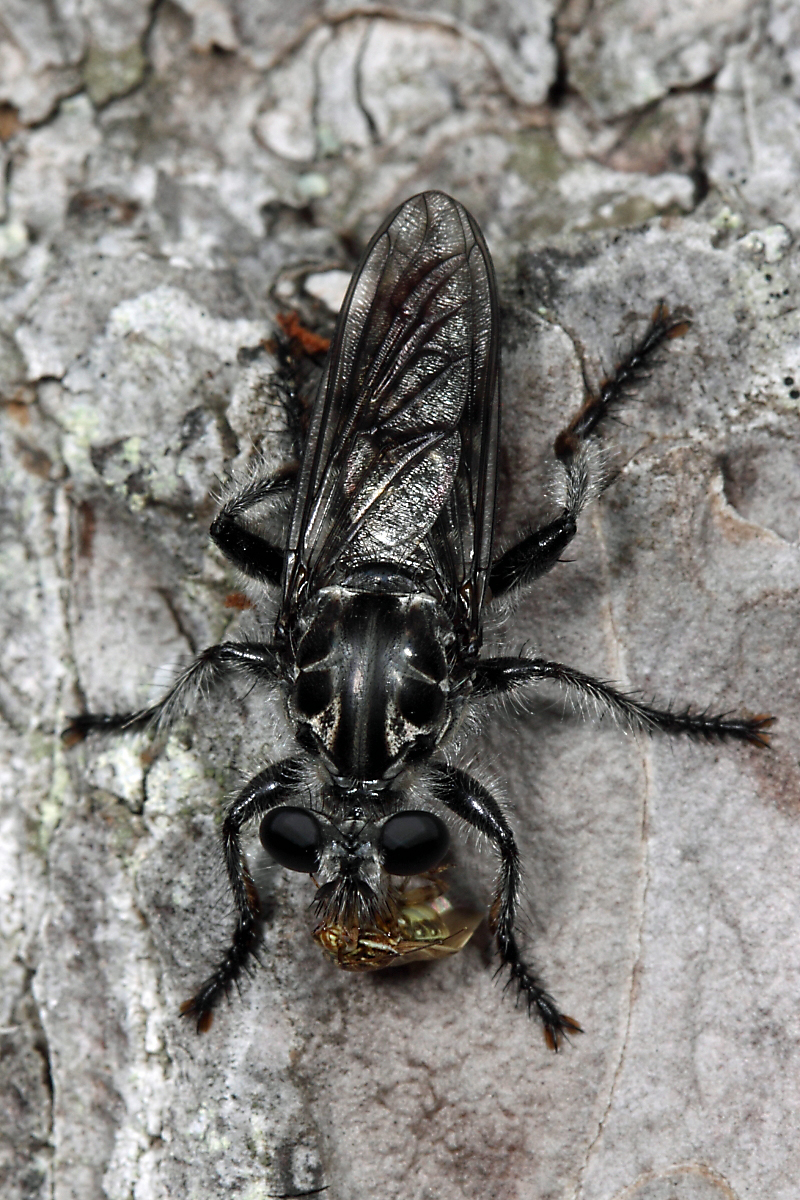
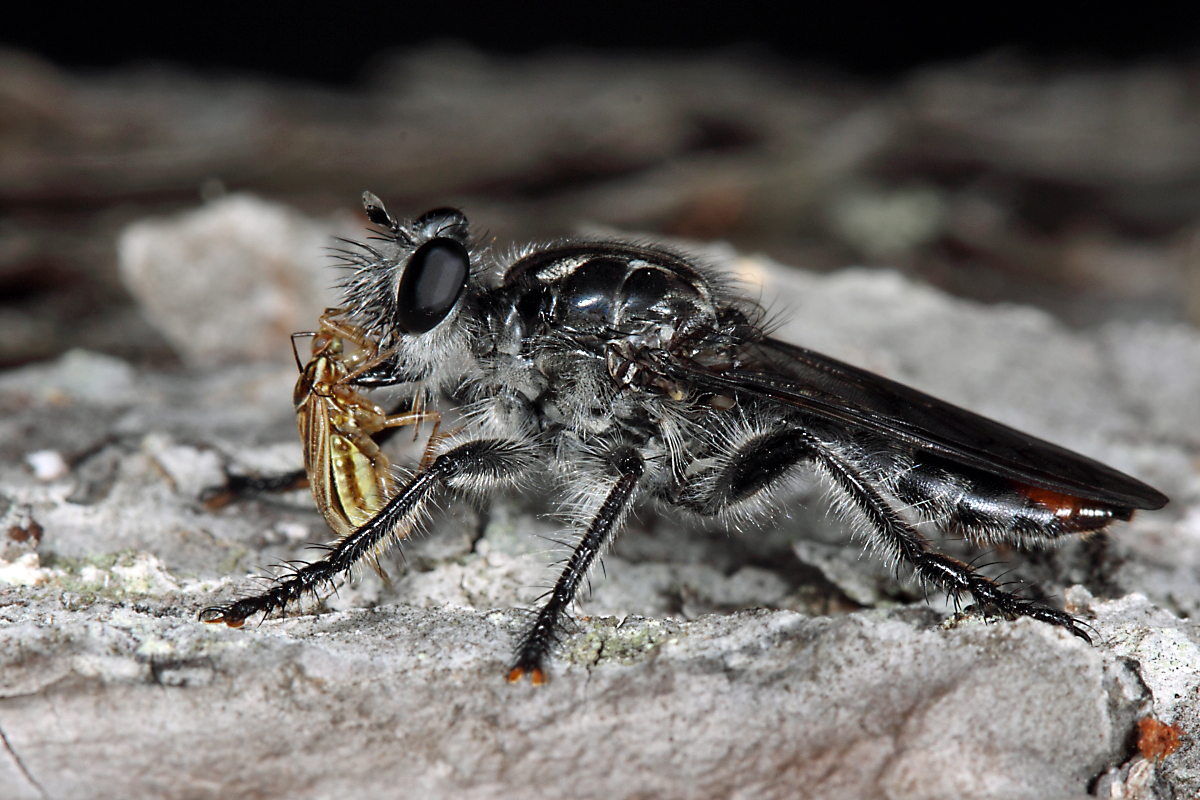
Andrenosoma fulvicaudum | Stone Co., Arkansas

First, about the name. T.G.I.Flyday is my contribution to a collusional triad between dipterist Morgan Jackson, myrmecologist Alex Wild, and myself (uhm, beetles).  Although Alex blogs primarily about ants, he has long featured a “Friday Beetle Blogging” series.  I’ve also occasionally stepped on their toes with an ant or fly post, so Morgan and I thought it would be fun to complete the Friday switcheroo with a post about ants on his blog and one about flies on mine. Get it?… Oh well, it made me chuckle when we thought it up.  Anyway, here is my first T.G.I.Flyday contribution.

Among the flies (order Diptera), it is hard to pick anything but robber flies (family Asilidae) as the most charismatic group.  Several subfamilies of robber flies have candidates that vie for the most impressive species, mostly due to their enormous size combined with striking green eyes (e.g., Microstylum morosum, Diogmites neoternatus) or vivid, aposematic / mimetic coloration (e.g., Archilestris magnificus, Eccritosia zamon, Wyliea mydas).  However, my favorite subfamily is the Laphriinae—not because of the amazing bumble bee-like appearance of the nominate genus, but rather the larval food of all species in the subfamily; wood-boring beetle larvae.  Over the years, I have put up hundreds of batches of dead wood for rearing wood-boring beetles in the families Buprestidae and Cerambycidae, and not uncommonly do I find in one of the emergence containers—especially those containing dead pine—an adult of one of these impressive flies. Oftentimes their characteristic pupal cases will be found protruding from the emergence hole, in which case I pin it underneath the fly (just in case some ambitious dipterist examines my collection after I’m gone and finds that the pupal case of xx species is not yet described).  I’ve by now accumulated a rather decent little robber fly collection (especially considering that I’m really a coleopterist), graciously identified for the most part by world robber fly expert Dr. Eric Fisher (California Department of Food and Agriculture).

Last weekend I made the second in a series of trips I’ll be taking to the White River Hills region of north-central Arkansas in an effort to confirm the occurrence there of Cylindera celeripes (swift tiger beetle).  My efforts are focused on the area around Calico Rock, a marvelous system of acidic sandstone barrens interspersed amongst shortleaf pine and oak forests.  The occasional dead pines found in such areas are highly attractive to a variety of pine-associated buprestids and cerambycids (my first loves), and whenever I see a standing dead tree I make a beeline straight for it (the tiger beetles can wait).

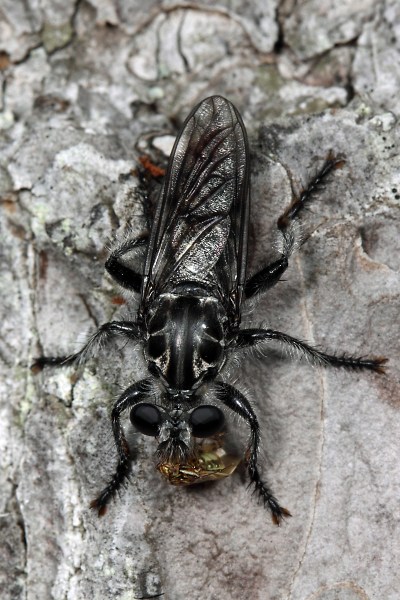
This individual was sitting on the trunk of a dead shortleaf pine with a mirid bug for prey.

On this day, sitting on the trunk of the first dead pine that I approached was not a buprestid or cerambycid, but rather this laphriine robber fly.  Based on the reddish posteriodorsal markings of the abdomen and general gestalt, I take this to be Andrenosoma fulvicaudum, a widespread though never very abundant species that occurs across most of North America.  According to Bromley (1934), the species frequents dry, sandy locations where it rests on logs, stumps, or tree trunks exposed to the bright sunlight and is commonly observed preying on small hymenopterans.  These observations are quite consistent with mine, except this one was feeding on a true bug in the family Miridae (perhaps distracting it just enough to allow me these photographs).  Cannings (1998) notes that A. fulvicaudum is attracted to recently burned forests, which will provide a fresh supply of wood-boring beetle larvae on which its larvae can prey.  This is the only species of Andrenosoma occurring in eastern North America; four additional species are restricted to Texas and a fifth occurs only in the western U.S., but the genus reaches its greatest diversity in the Neotropics.

REFERENCES:

Bromley, S. W. 1934. The Laphriine Robber Flies of North America.  Ph.D. dissertation, Ohio State University, 358 pp.

Cannings, R. A. 1998. Robber flies (Insecta: Diptera: Asilidae), In I. M. Smith and G. G. E. Scudder [Eds.], Assessment of Species Diversity in the Montane Cordillera Ecozone, Burlington: Ecological Monitoring and Assessment Network.

Copyright © Ted C. MacRae 2011

Bichos Argentinos #14 – Flies!

A few miscellaneous fly photos from La Reserva Ecológica Costanera Sur (Buenos Aires, Argentina)  taken last March.  I don’t have IDs except provisionally to family (let’s face it—flies are hard!).

I suppose something in the Tachinidae, based on the black and white striped coloration and distinct abdominal setae.


Definitely a robber fly (family Asilidae), but which one?


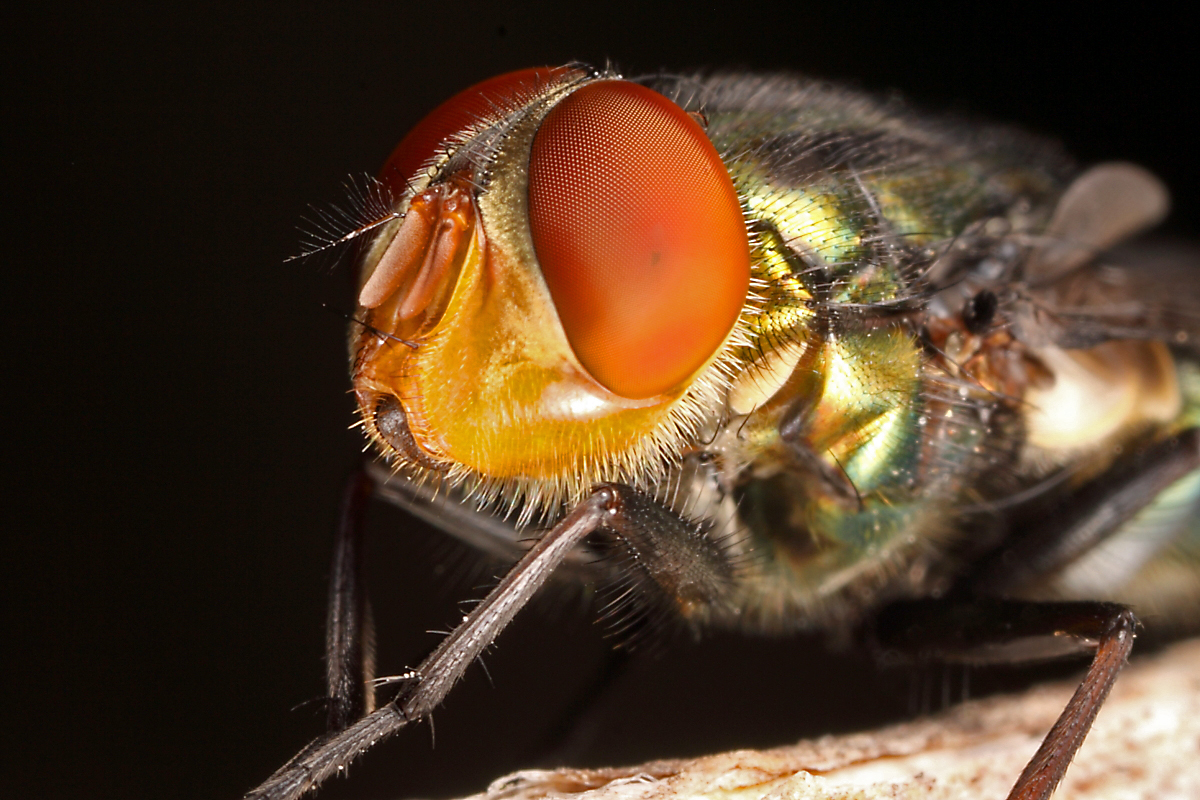
I suppose this is some kind of bottle fly (family Calliphoridae).


Nice eyes!


Copyright © Ted C. MacRae 20011

Forgotten Foto Friday: Eudioctria sp.

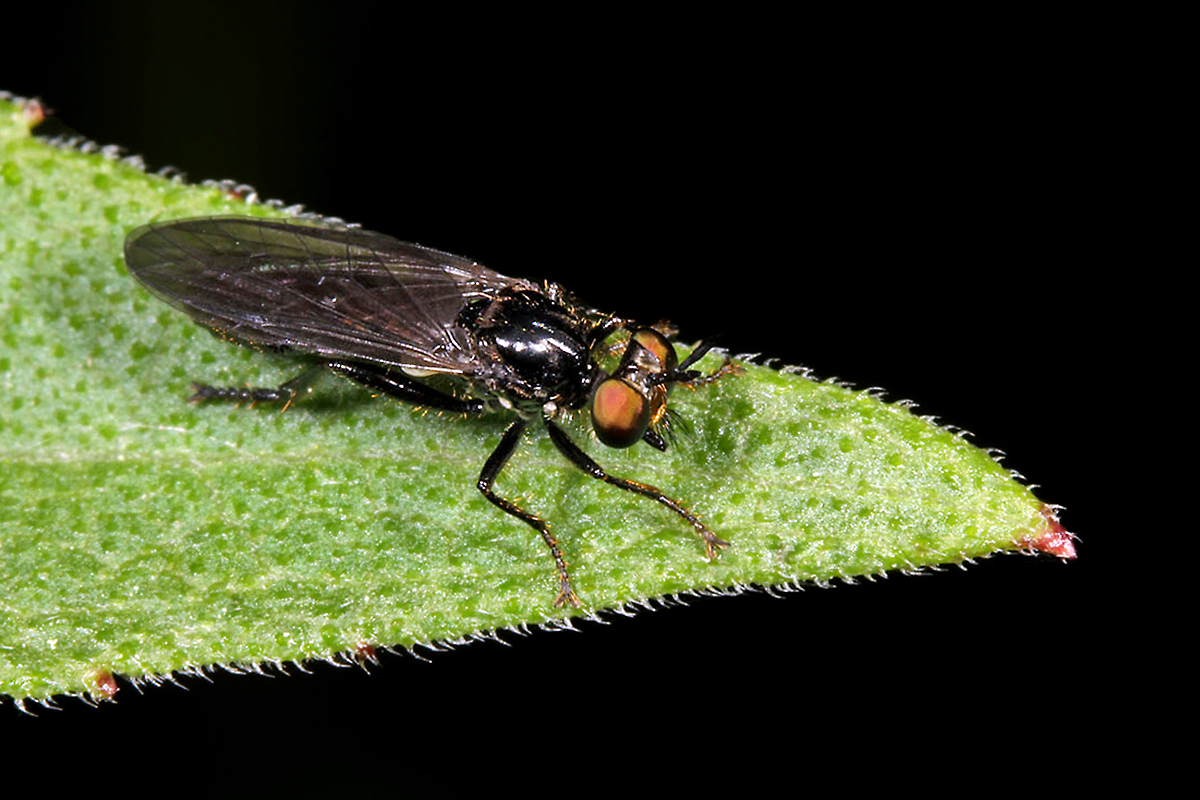
Eudioctria sp. | Shaw Nature Reserve, Gray Summit, Missouri

In keeping with my recent theme featuring insects from Shaw Nature Reserve, I present here a long-forgotten photograph that I took back in May 2009.  In fact, not only was this photo taken on the maiden voyage of my Canon dSLR setup, but it is the very first photograph of an insect that I took with the camera—image #19 (1-18 were the initial test shots and a few immediately discarded photos).  It won’t win any awards, but it’s not a bad photo, and the fact that I immediately began attempting shots with the lens dialed all the way up to 1:1 shows I had no qualms about going for broke.

As best I can tell, this is a member of the robber fly genus Eudioctria in the subfamily Stenopogoninae.  Species in this genus are among the tiniest of North American robber flies,  measuring only 6–8 mm in length (compare this with the spectacular 35–40 mm length of North America’s largest robber fly).  They superficially resemble species of the unrelated genus Cerotainia (subfamily Laphriinae) but lack the extra-long antennae. According to Norman Lavers (The Robber Flies of Crowley’s Ridge, Arkansas), Eudioctria can also be distinguished behaviorally, as it prefers flat leaves at the top of small shrubs, while Cerotainia tends to perch on twig-ends.  Eudioctria is primarily a western U.S. genus, although four of its 14 species (albius, brevis, propinqua, tibialis) occur in the eastern states (Adisoemarto and Wood 1975).  I can’t possibly determine which of those four species this individual represents, as to do so requires examination of facial gibbosities and judgements about the degree to which various body parts are pollinose(?)—perhaps I should stick with beetles!

REFERENCE:

Adisoemarto, S. and D. M. Wood.  1975.  The Nearctic species of Dioctria and six related genera (Diptera, Asilidae).  Questiones Entomologica 11:505–576.

Copyright © Ted C. MacRae 2011