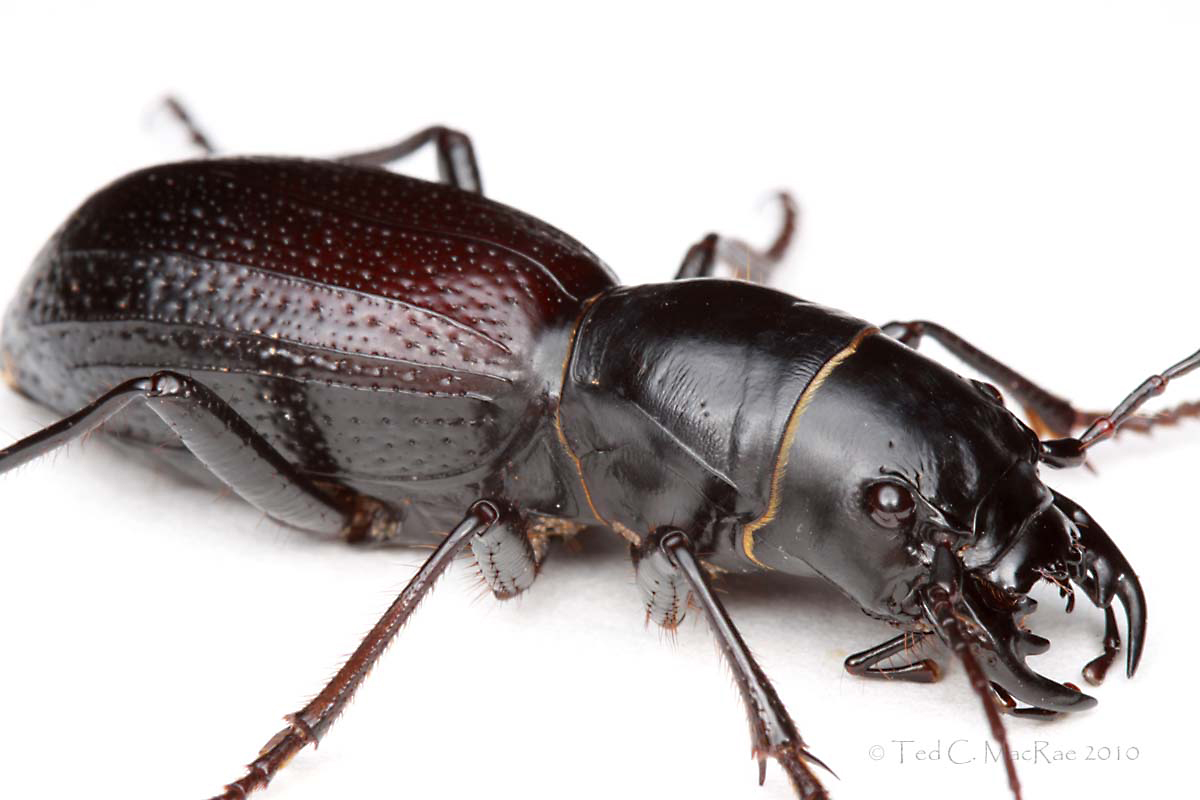
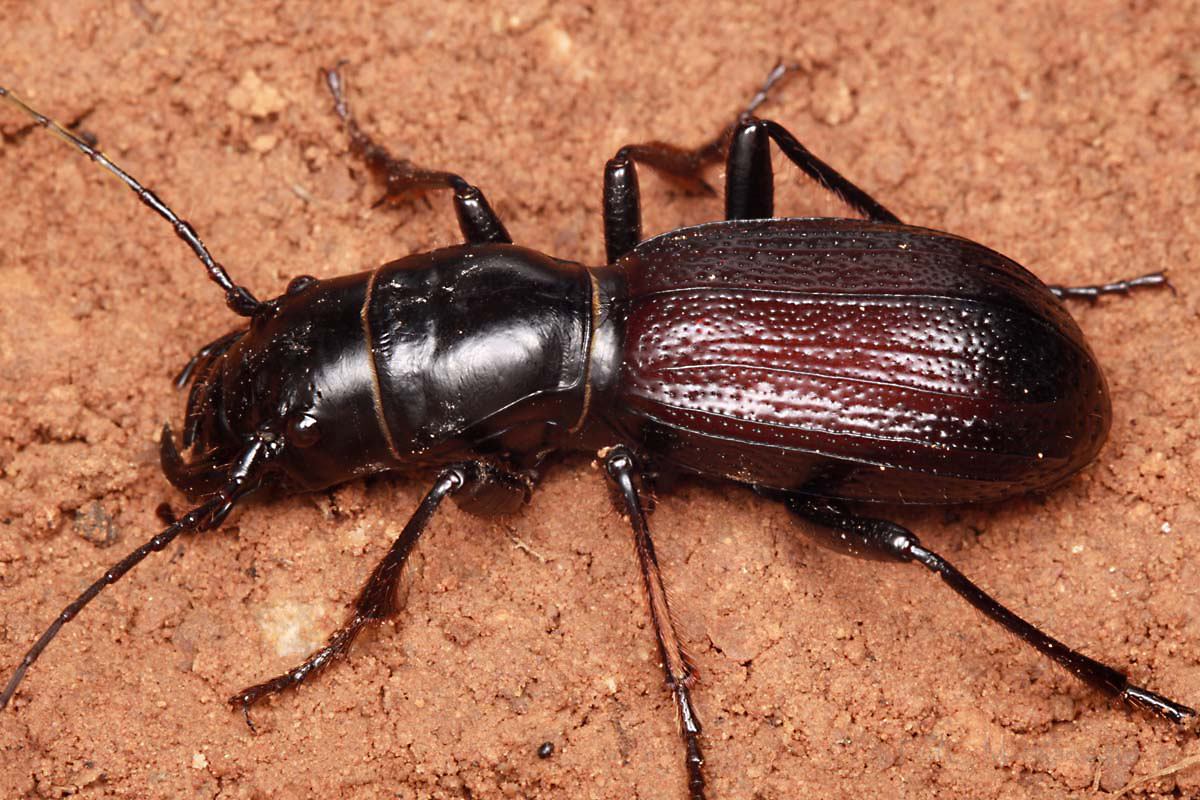
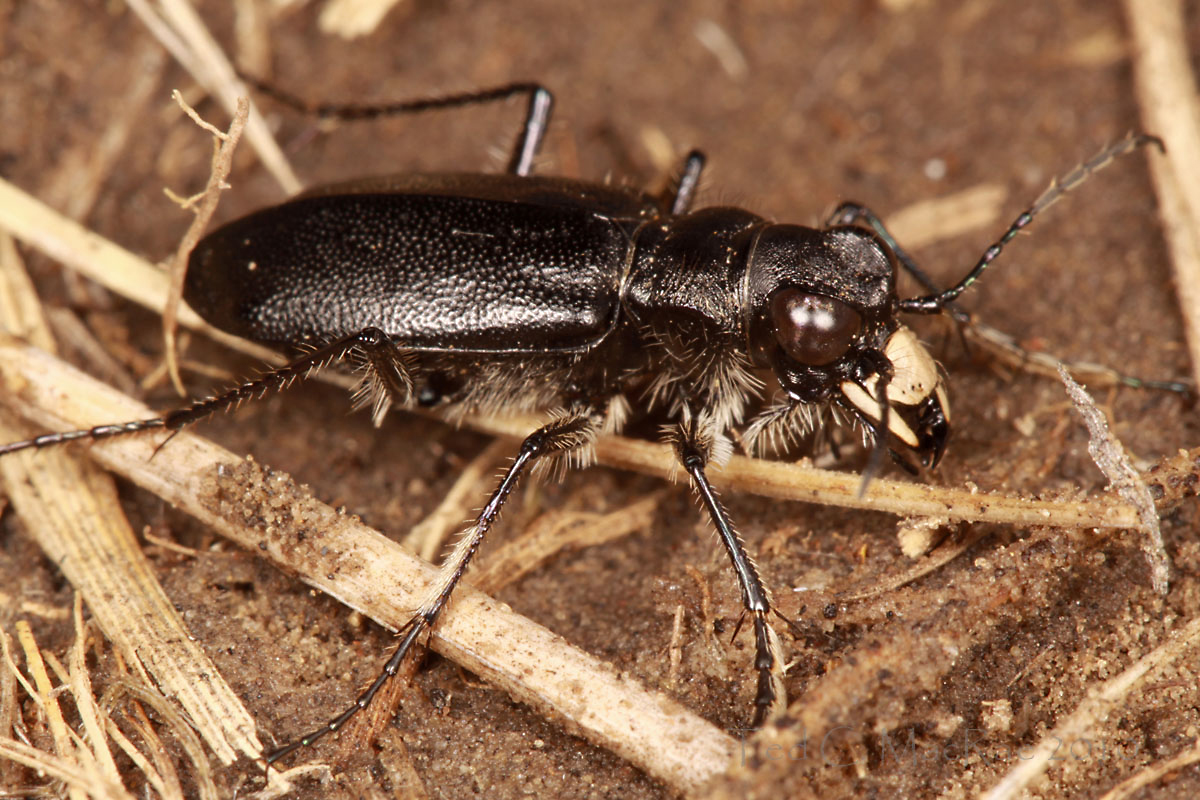
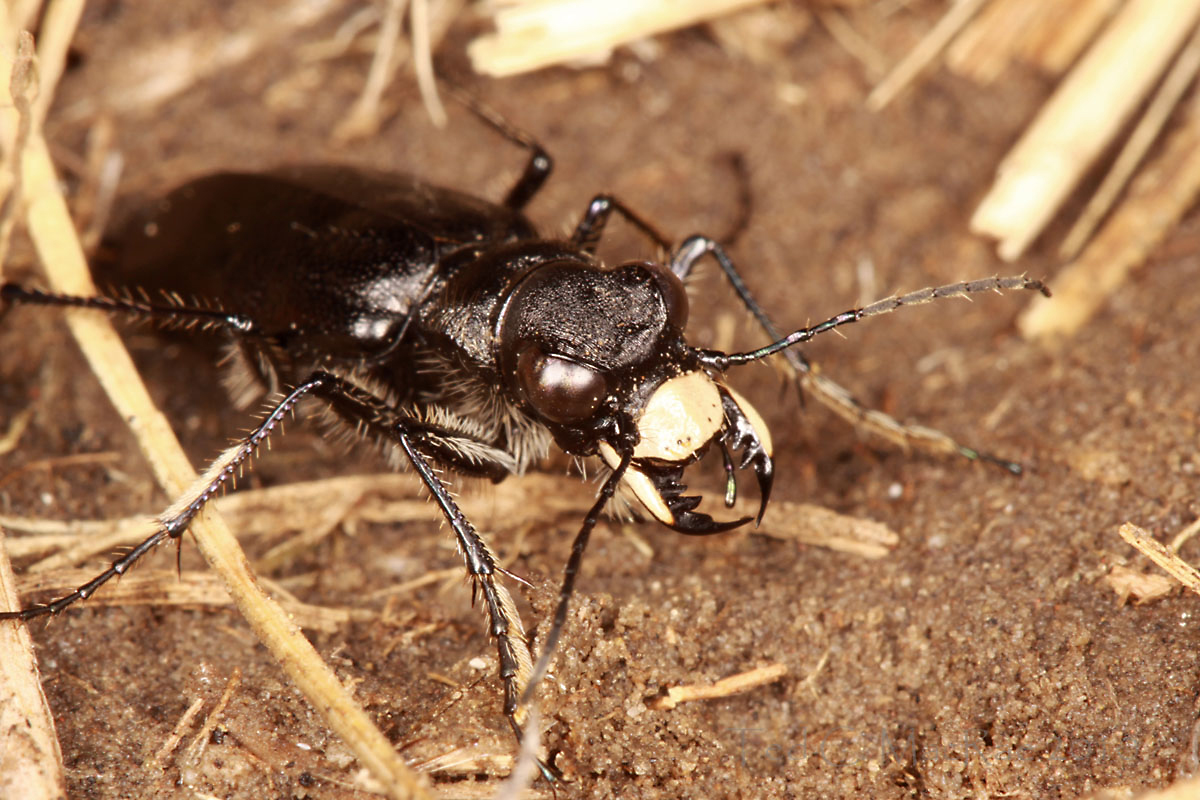
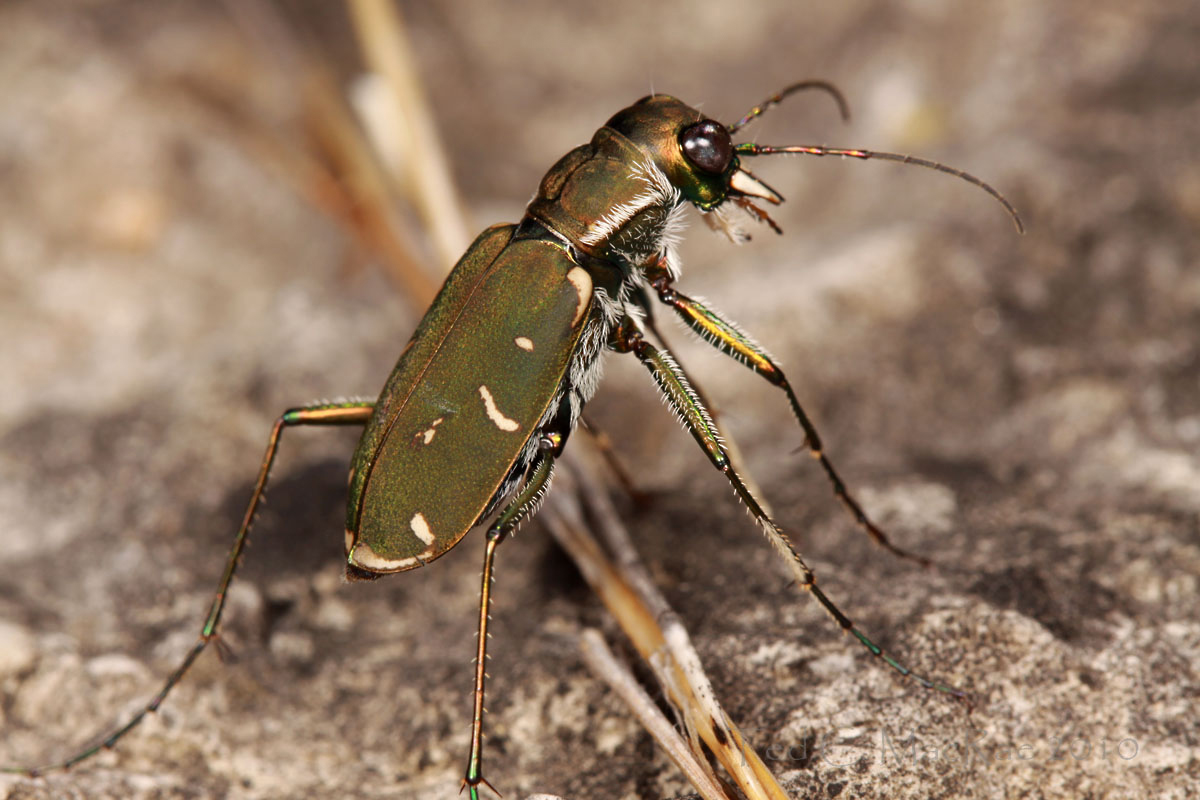
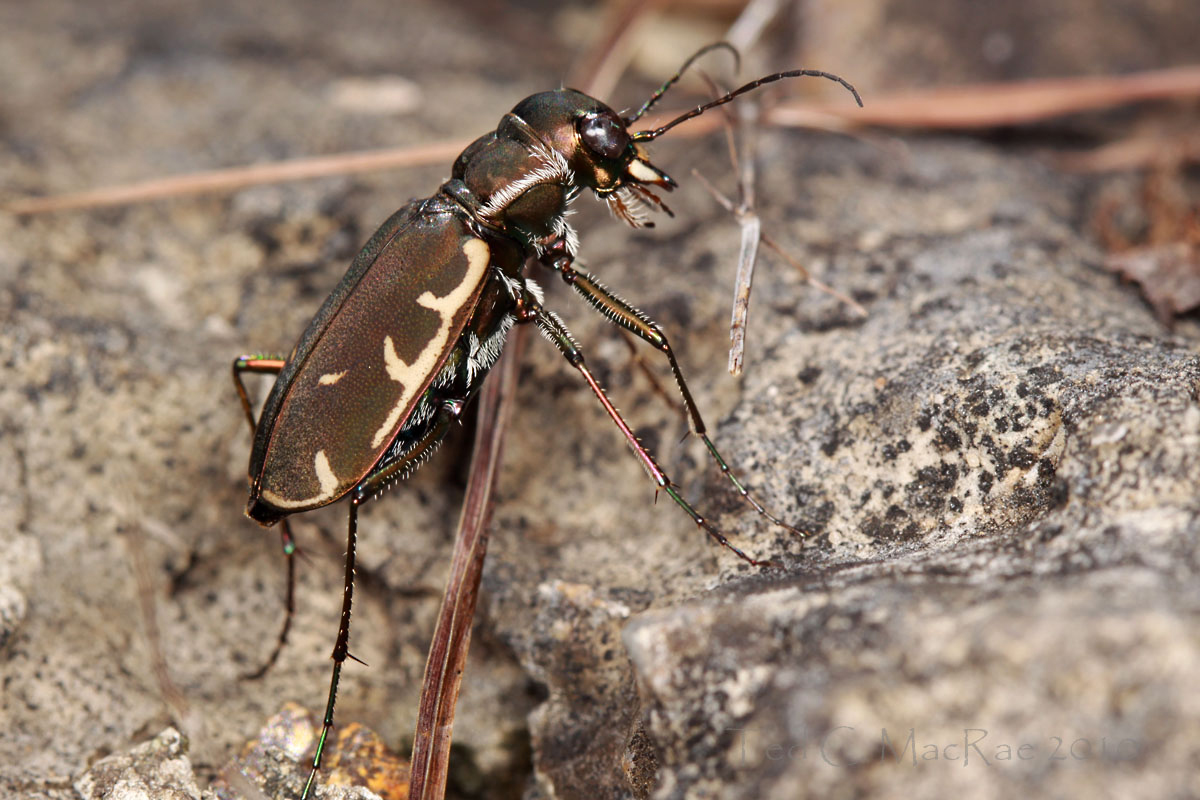
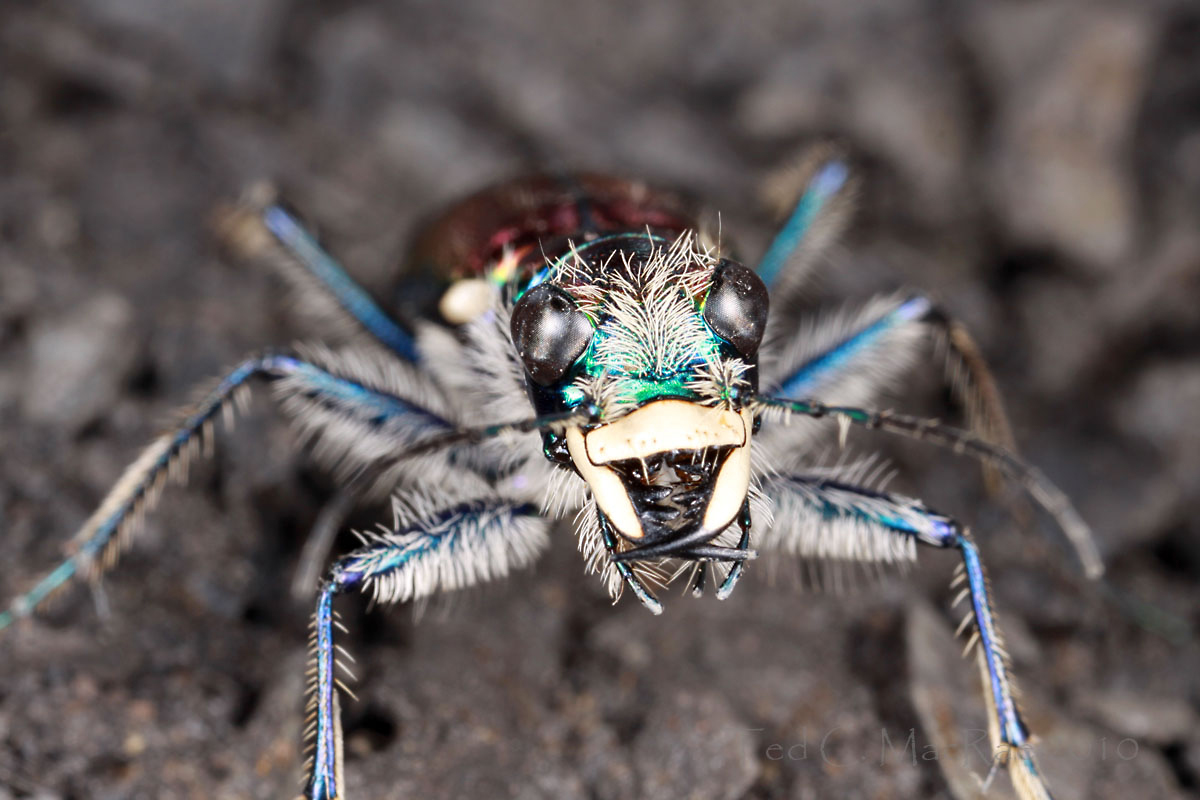
Amblycheila cylindriformis on white

It’s been four months now since I went to the Glass Mountains of northwestern Oklahoma on a hunch to look for Amblycheila cylindriformis (Great Plains giant tiger beetle).  The five adults that I brought back from that night are still alive in a terrarium of native soil, but to this point they have refused to lay eggs.  Despite feeding them regularly with fat Maduca larvae, there is obviously still something they need that I am not providing.  I’ve suspected that perhaps the terrarium that I have them in is too small, and I’ve also noted in the literature that larval burrows are often found clustered near the entrance of mammal burrows.  With this in mind, I combined the native soil from three separate terraria into one larger, deeper terrarium, packed the soil lightly, and used a spoon to create an artificial mammal burrow entrance.  Not long after placing the adults in their new home they began digging at the back of the burrow, eventually creating two separate tunnels leading in opposite directions (and fortunately against the container walls so that I can see inside the tunnels).  I was optimistic at first that finally I had given them what they wanted, but since digging the burrows they’ve just sat in them.  Perhaps they “know” that winter is coming and are just looking to hole up for now, so I suppose I’ll go ahead and place the terrarium in the 10°C incubator with the rest of my larval and adult rearing containers and wait until next spring to see what happens.

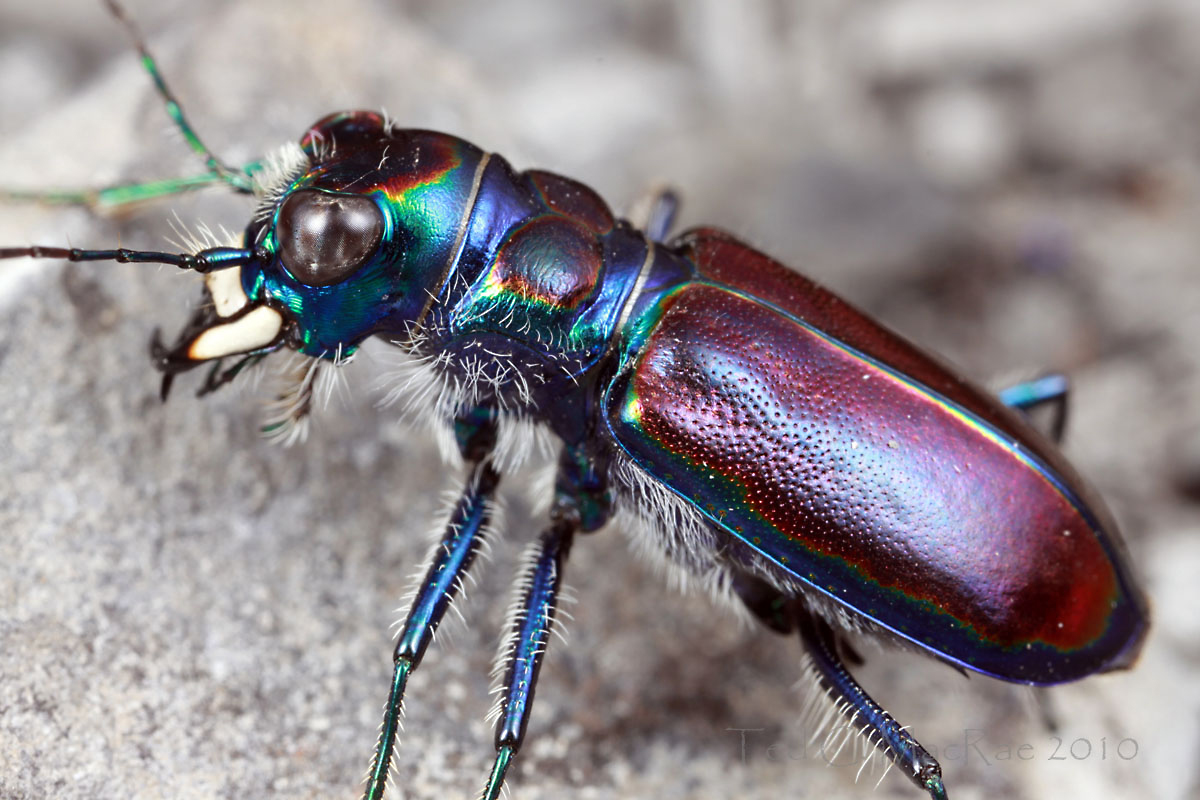
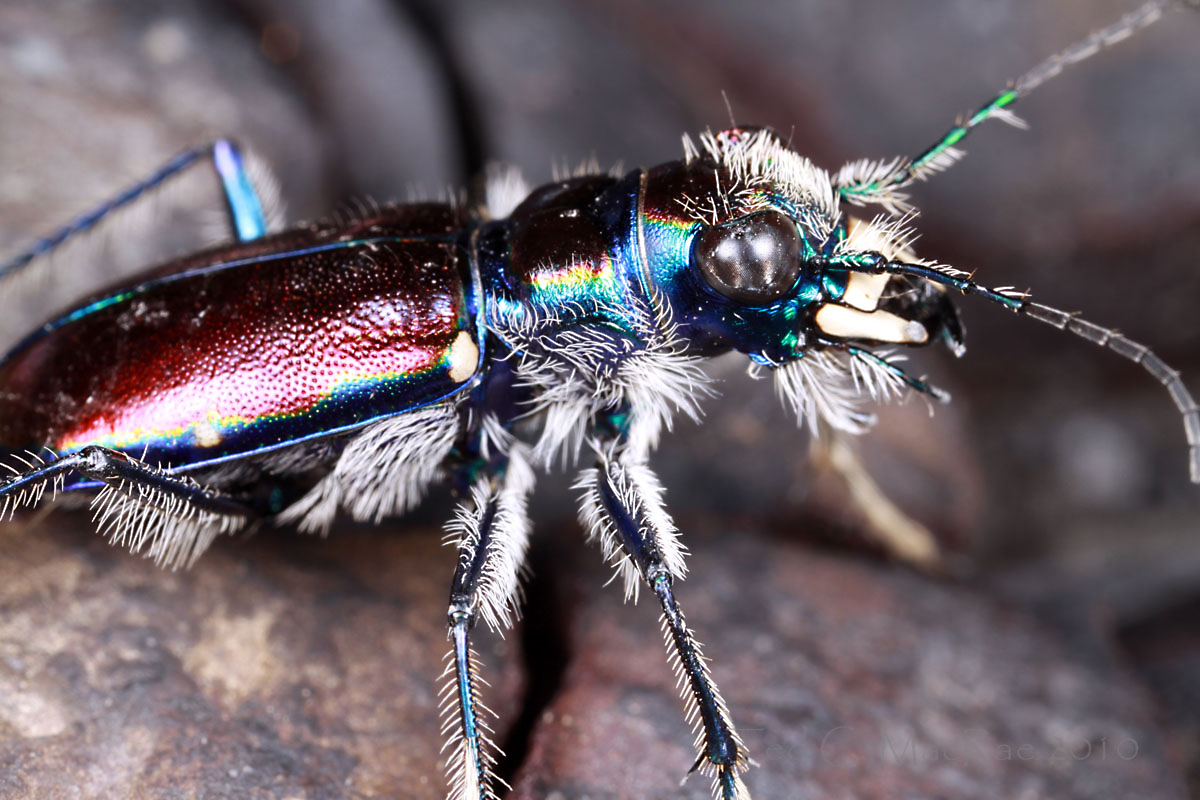
In the meantime, I thought I would share these recent photographs of one of them.  I had been wanting to take photographs of this species in a white box, which I have used with a few other species to generate some rather striking photographs (e.g., Gromphadorina portentosa, Buprestis rufipes, Scolopendron heros, Eleodes suturalis). The photographs in this post might look like they were taken in a white box, however, they were not.  I’ve been spending a lot of time lately trying to come up with a diffuser setup that is convenient for field photographs of wild insects in their native habitats.  Kurt’s do-it-yourself concave diffuser and Alex’s tracing paper diffuser work great with the Canon MT-24EX Macro Twin Lite Flash and the Canon MP-E 65mm f/2.8 1-5X Macro Lens, but as I mentioned in a previous post they do not work so well with the Canon EF 100mm f/2.8 Macro USM Lens and its longer working distance… or so I thought!  I’ve come up with a modified version of the concave diffuser that seems to be what I am looking for – it is easy to use, adds virtually no weight to the camera, is completely portable for field use, can be used with both the 65mm and 100mm macro lenses, and – best of all – costs virtually nothing.  The photographs in this post were taken with the first prototype, and now that the basic design and general dimensions seem to work I’ll try to make a more durable version. It’s simply a larger version of the concave diffuser – I found some very thick polypropylene foam that is sturdy enough to hold its shape but flexible enough to curl back and over the top of the flash heads, where the corners are held in place by Velcro. Essentially it forms a large “soft box” type diffuser in front of both flash heads. I cut the bottom inch off of a a 500-mL polypropylene beaker, then cut that in half and cut out all but a quarter inch of the bottom to form a sturdy but transluscent frame to hold the polypropylene foam against the flash head bracket on the front of the lens. Right now the foam is held in place by tape, but hot glue should do a better job, and the diffuser bracket is attached to the flash head bracket with Velcro. The whole rig comes off in a flash and lays mostly flat in the camera bag.

If this diffuser proves successful, it will eliminate the need for the different flash head extender brackets that I was considering.  I really didn’t want to go that route because even the cheapest models are rather costly, and all of them add bulk to the camera and create problems for those who need to switch lenses frequently (such as I do).  Of course, the real test is – does it achieve the desired result?  I’m quite happy with these initial photographs – the lighting is quite even due to the large “apparent” size of the light source, and the annoying double specular highlights that are the hallmark of the MT-24EX are much less apparent (though still slightly discernible).  The closest shots are at 1:1, while those of the entire beetle are between 1:1.5 and 1:2.  They are among the largest beetle species that I have photographed, so the range of magnifications used here pretty much covers the entire range that I typically use with this lens.  Wildflowers often require smaller mags and longer working distances, so it remains to be seen whether this diffuser/lens combination will be useful for them as well. 

All of the photographs in this post were taken with the 100mm macro lens (ISO100, 1/250 sec, F16) and direct MT-24EX macro twin flash using this new diffuser.  The beetle was placed on white filter paper and covered with a clear glass bowl until it settled against the side of it.  Once the beetle was quiet, I gently lifted the bowl and used micro-forceps to gently tug its legs into more appealing positions – surprisingly this did not cause it to become alarmed and try to flee (as long as I didn’t accidentally brush against one of its antennae!).  For the last photograph, I placed the beetle back in its terrarium and used the same techniques to get the beetle in a good position. 

Copyright © Ted C. MacRae 2010

Cicindela nebraskana – Prairie Long-lipped Tiger Beetle

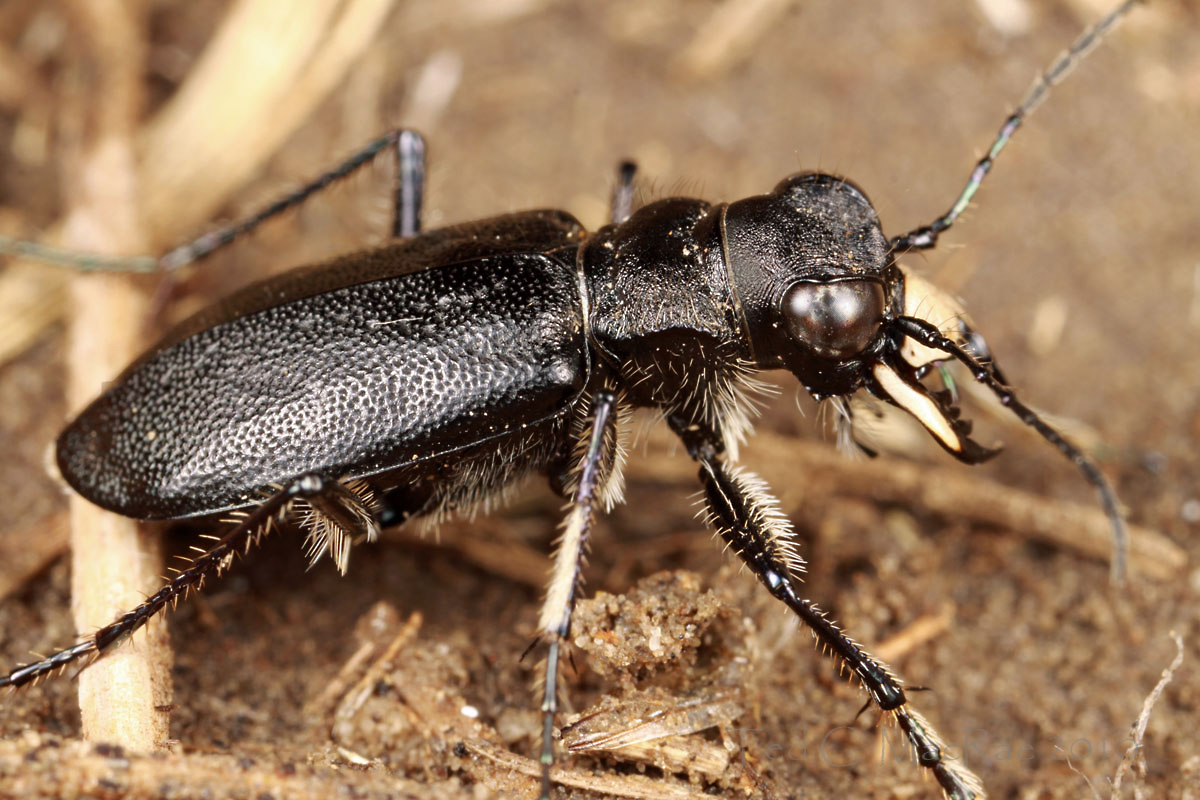
Cicindela nebraskana - the prairie long-lipped tiger beetle

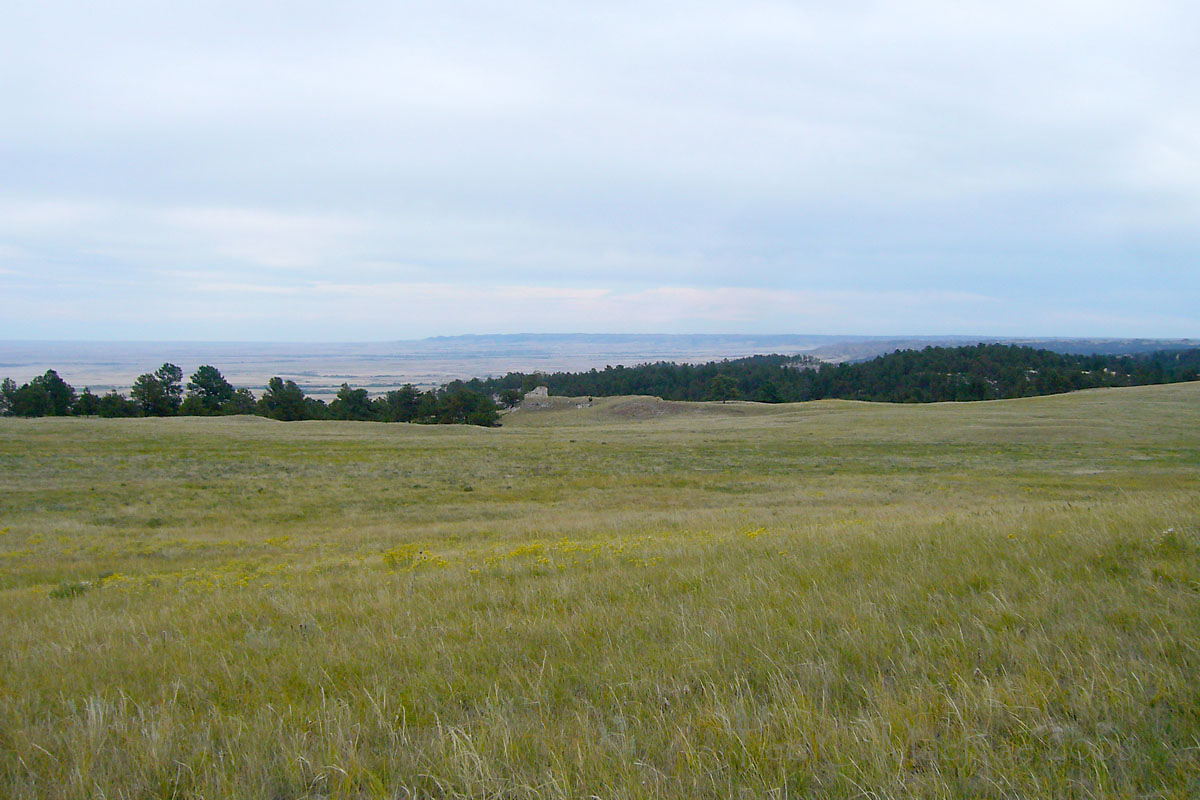
We were only halfway through Day #1 of five days in the field and had already achieved Goal #1 of the trip.  Despite that, it took a few hours before Chris and I were ready to tear ourselves away from our first stop in Fall River Co., South Dakota, where we were treated to the sight of glittering, wine-red adults of Cicindela pulchra bejeweling the charcoal-colored shale slopes.  However, the list of species that we wanted to see over the next several days was long, and eventually our pulchra-fever abated (barely) enough to head south to the Pine Ridge in Sioux Co., Nebraska to look for A-list Species #2 – Cicindela nebraskana.  Sioux Co., Nebraska is the type locality for this species (thus the name), but in reality it is a more western species whose distribution just barely sneaks into the northwestern corner of Nebraska (Pearson et al. 2006, Spomer et al. 2008).  I first saw this species at this very site two years ago, seeing only a handful of individuals and managing one harshly-sunlit, point-and-shoot image of one of them.  To my knowledge, this remains the only known field photograph of this species.

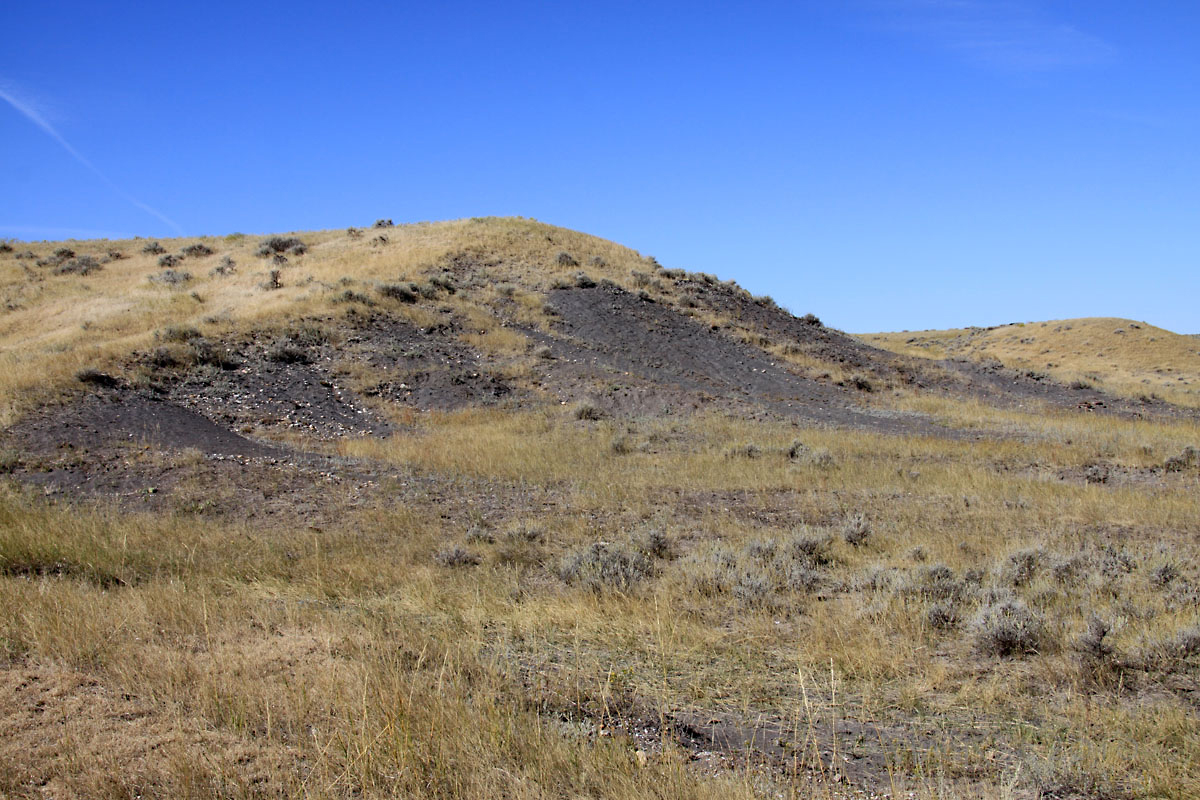
Shortgrass prairie atop the Pine Ridge, Sioux Co., Nebraska (photo taken September 2008).

This time, with a Canon 50D camera and 100mm macro lens in my backpack, I was much better equipped for vastly improved field photographs, but in contrast to the numerous individuals of C. pulchra that we saw earlier in the day, only a single C. nebraskana would turn up after intensive searching by Chris, Matt Brust, and myself in the vast shortgrass prairie sitting at the type locality atop the Pine Ridge.  I didn’t find it – Matt did – and the general rule with rare tigers is to capture the first individual rather than try to photograph it.  If no others are seen, photographing it later in a terrarium of native soil is better than trying to photograph it in the field and risk letting it escape.  Matt gave it to Chris, and at the end of the day when we realized we were not going to see another one, we prepared a terrarium of native soil, taking care to keep the surface as intact as possible so that an accurate replication of the field situation could be created when we photographed it later.

Tiger beetles "hunker down" when fatigued.

Although I prefer actual field photographs, the nice thing about photographing tiger beetles in confinement is… well, they don’t run away!  That’s not to say it is easy.  While they do settle down if left undisturbed for a while, once you start messing with them they quickly become agitated and start running in circles around the terrarium perimeter.  Much finger prodding is necessary to get them away from the edge and into a good spot for photographs, and rarely do they stay put for long.  When they finally do settle down, they tend to “hunker down” in a most unflattering pose (as above) – lacking the appearance of alertness that gives the true field photos their life.

A ferocious pose is struck after judicious prodding of the face and touching of the antennae.

I’m a persistent (syn. stubborn) sort, however, and I’ve learned that I can wear them down and poke and prod them out of their hunker.  Just a light poke at the face will often make them back up and lift their front slightly – poke again and they often open their jaws half-cocked – a light touch on the tip of one antennae and they’ll turn slightly.  With practice and patience, hunkered down beetles can be coaxed into some remarkably aggressive-looking poses.  I like the last of these photos in particular because the oblique, jaws half-cocked pose shows off two nice features of this species – the quite long labrum (upper lip) compared to most other tiger beetle species, and the bright white labrum and mandibles of the males of this species (in females they are partially or completely dark).  The long labrum and jaws give this species a very long-faced appearance that distinguishes it immediately from the black morphs of Cicindela purpurea audubonii that occur with much greater frequency in the same habitats as C. nebraskana.

Photo Details:
1: Canon 50D w/ MP-E 65mm 1-5X macro lens (ISO 100, 1/250 sec, f/13), Canon MT-24EX flash w/ Sto-Fen + GFPuffer diffusers.
2: Panasonic DMC-FX3 (ISO 100, 1/400 sec, f/5.6), natural light.
3-4: Canon 50D w/ 100mm macro lens (ISO 100, 1/250 sec, f/16), Canon MT-24EX flash w/ Sto-Fen + GFPuffer diffusers.
All photos: Typical post-processing (levels, minor cropping, unsharp mask).

REFERENCES:

Pearson, D. L., C. B. Knisley and C. J. Kazilek. 2006. A Field Guide to the Tiger Beetles of the United States and Canada. Oxford University Press, New York, 227 pp.

Spomer, S. M., M. L. Brust, D. C. Backlund and S. Weins.  2008. Tiger Beetles of South Dakota & Nebraska.University of Nebraska, Department of Entomology, Lincoln, 60 pp.

Copyright © Ted C. MacRae 2010

Flash solutions for the beautiful tiger beetle

Canon MP-E 65mm f/2.8 1-5X macro lens (f/13), Canon MT-24EX flash w/ concave diffuser.

Recently I’ve been trying some different lighting and flash diffusion techniques with the Cicindela pulchra adults I brought back from South Dakota (see previous post).  While the beetles themselves are certainly among the most spectacular tiger beetles I’ve ever seen, I’ve been less than impressed with the photographs that I’ve managed to take of them.  Two factors have been largely responsible for this: 1) the smooth, shiny integument of the beetle reflecting the flash to create strong specular highlights, and 2) the colors, though brilliant, are also dark and difficult to bring out without further exacerbating the specular highlights.  Normally, the Sto-Fen+Puffer diffuser combination that I use does a pretty good job at diffusing the flash, but it just can’t handle these beetles.  To deal with this problem, I finally got around to trying out the do-it-yourself concave diffuser that Kurt at Up Close with Nature has been using with stunning results (similar to the tracing paper diffuser used so famously by Alex Wild at Myrmecos).  Photo 1 above and 2-3 below were taken with this diffuser on my Canon MP-E 65mm f/2.8 1-5X Macro Lens, and I’m rather pleased with these initial attempts.  I do need to figure out a better way to attach the diffuser to my Canon MT-24EX Macro Twin Lite Flash.

Canon MP-E 65mm f/2.8 1-5X macro lens (f/13), Canon MT-24EX flash w/ concave diffuser.

Canon MP-E 65mm f/2.8 1-5X macro lens (f/13), Canon MT-24EX flash w/ concave diffuser.

I’d have to say the lighting with this diffuser represents a considerable improvement over the Sto-Fen+Puffer diffusers using the same lens.  Compare especially Photo 3 above and 4 below – both taken with the MP-E 65mm lens at 1:1 and f/13 – Photo 3 was taken using the concave diffuser, while Photo 4 used the Sto-Fen+Puffer diffusers.

Canon MP-E 65mm f/2.8 1-5X macro lens (f/13), Canon MT-24EX flash w/ Sto-Fen+Puffer diffusers.

The problem with the concave diffuser is that it won’t work so well on my Canon EF 100mm f/2.8 Macro USM Lens due to its longer working distance.  I actually use this lens in the field as often as the MP-E 65mm lens, especially for the tiger beetles on which I focus (heh!) – not only do they rarely require more than 1:1 magnification, but they also rarely allow the ultra-close approach needed to use the 65mm lens.  The only solution is to find some way to get the flash heads closer to the subject to increase the apparent size of the light source, but so far I haven’t figured out a satisfactory way to do this.  Some photographers use the stalwart Canon Speedlite 580EX II Flash, equipped either with a do-it-yourself snoot diffuser or mounted on a bracket extender with a small softbox.  However, I am not a photographer, but rather an entomologist with a camera – I need to carry with me a net, vials, and in some cases a beating sheet and hatchet.  Both of the previously mentioned approaches for diffusing 100mm shots add far more bulk to the camera setup than I can accept.  I’ve been looking for extender brackets that will move the MT-24EX flash heads out closer to the subject to increase apparent light size and have found a few.  The Really Right Stuff B85-B Flash Bracket equipped with two FA-EX1 Flash Extenders and an extra Flash Mount looks like it would do the job quite well, but it is still bulkier (and vastly more expensive) than I would like.  The PhotoMed R2-C Dual Point Flash Bracket is a much less bulky and more reasonably priced option; however, the lack of any vertical adjustment capabilities is an insurmountable shortcoming.  Why Canon hasn’t themselves designed a lightweight, low-cost accessory for extending the MT-24EX flash heads out away from the lens is beyond me, and I’ve actually been toying with some ideas on how to do this myself using a couple of Kaiser Adjustable Flash Shoes.

Until I do figure out a solution, at least there is always the white box for any captive-held individuals (and yes, I have considered a small, collapsible white box to bring into the field – I’m not ready to resort to that just yet!):

Canon 100mm macro lens (f/16), Canon MT-24EX flash indirect in white box.

Photo Details: Canon 50D (ISO 100, 1/250 sec). Typical post-processing (levels, minor cropping, unsharp mask).

Copyright Ted C. MacRae 2010

North America’s most beautiful tiger beetle

Cicindela pulchra pulchra (beautiful tiger beetle) - Fall River Co., South Dakota.

Five years ago this month, I got my first glimpse of North America’s most beautiful tiger – Cicindela pulchra.  This is not just my opinion – its name, given to it by Father-of-North-American-entomology Thomas Say, literally translates to “beautiful tiger beetle.”  Like Amblycheila cylindriformis, it was a species that I longed to see in the field ever since receiving a single specimen from tiger beetle guru Ron Huber.  That specimen came from the Gypsum Hills of Barber Co. in south-central Kansas – a known “hot spot” for the species.  For years I stared at that spectacular specimen as it sat in my cabinet, and in September 2004 Chris Brown and I finally made our first attempt to see it in the field for ourselves.  Unfortunately, we arrived ahead of the fall rains that seem to trigger emergence of this species, and C. pulchra would not be among the few species that we saw on that trip.  I don’t handle defeat very well, so the very next fall I resolved to try again – this time waiting until early October and also enlisting the assistance of local entomologist “Beetle Bill” Smith for access to better sites than what are available along the roadsides.  That trip was a tremendous success and was detailed in one of my Nature Notes articles (MacRae 2006), but Chris, unfortunately, was unable to join me on that second attempt.  He couldn’t join me last year, either, for my search of the species in the nearby Cimarron Gypsum Hills of northwestern Oklahoma.  Good thing, however, as a turn of the weather left me just cold and wet (although I do remain convinced that the species will eventually be found on those red clay slopes that have so far produced such prizes as Cylindera celeripes, Dromochorus pruinina, and Amblycheila cylindriformis).

Matt Brust (L) and Chris Brown (R). Matt discovered this site for Cicindela pulchra in 2009.

Fortunately, while I was getting skunked in Oklahoma, Matt Brust was discovering new populations of the species further north in the southwestern corner of South Dakota.  These discoveries were prompted by the initial discovery of the species on Pierre Shale exposures at a single site near the Black Hills (Larsen and Willis 2008).  The soft, dark gray soils of the Pierre Shales are in distinct contrast to red clay exposures with which the species has been typically associated further south, and by scouting a broader area for similar exposures Matt was able to find the species at six new sites during late summer 2009 (Brust 2010).  He found them associated not only with the Pierre Shale but also the Mowry Shale formation (and suspects they may eventually be found on Belle Fourche Shale formations as well).  When I learned of these discoveries, I decided I just had to see them for myself.  I had enjoyed my Fall 2008 trip to northwestern Nebraska and southwestern South Dakota, and the thought of seeing these beetles while spending time in the field with Matt once again seemed the perfect basis for another trip to the area.  It didn’t take much convincing for Chris to agree, thus, C. pulchra became goal #1 of the 2010 Fall Tiger Beetle Trip™.

Habitat for Cicindela pulchra in Fall River Co., South Dakota. Adults and larval burrows are found in sparsely vegetated gray shale slopes and open flats beneath.

As we drove to the site that Matt had selected for us to explore, I felt nothing but optimism.  The skies were clear and the temperature was already nearing 70°F.  Matt, however, was hedging his bets – “I hope they’re still out, I’ve never seen them this late!”  Still, I wasn’t worried.  We were two weeks earlier in the season than the 2005 Kansas trip, and the weather was simply spectacular – it just had to be a good tiger beetle day!  My optimism was justified, as within minutes of arriving at the site we saw the first individual.  I collected this one alive as a backup for photographs in the studio should that be the last one we saw, but no such contingencies were necessary – we began seeing individual after individual as we trolled across the barren gray slopes.

Adult male Cicindela pulchra taking in the morning sun.

These beetles are simply a marvel to see in the field.  Brilliant dark red with metallic green, blue, and purple borders on the head, thorax, and elytra, this relatively large tiger beetle (certainly among the largest in the genus) can be confused with no other tiger beetle in North America.  Unlike adults of most other species, which exhibit color patterns resembling the texture and hue of the soil substrate on which they occur, C. pulchra adults are obvious and non-cryptic.  It apparently mimics the large, similarly colored velvet ants of the genus Dasymutilla with which they are sympatric – even exhibiting similar behavior when alarmed such as stridulating (creating vibrations by scraping body parts across one another) and giving off defense chemicals (Pearson 1988).  Adults are powerful fliers that can fly long distances when alarmed (Spomer et al. 2008), but in the still relatively cool morning air Chris and I had relatively (emphasis on relatively!) little trouble getting close enough to attempt those coveted field photographs.  This, however, was a double-edged sword – the same cool temperatures that allowed us to get close enough for photographs also caused to the beetles to assume the most non-photogenic poses as they sprawled torpidly on the ground, sometimes hugging it closely in an attempt to conserve heat until incident radiation from the sun warmed them sufficiently to go about the day’s activities.  Once this did happen, we found getting close enough for photographs nearly impossible.  In the 2+ hours that we chased after them, we took many shots but failed to get that “perfect” shot of a brilliant beetle standing tall and alert.

Adult male Cicindela pulchra hugs the ground during the cool morning hours.

Cicindela pulchra is a “spring/fall” species – i.e., sexually immature adults emerge during fall to feed, then return to their burrows to overwinter before emerging again in spring to mate and lay eggs.   Pearson et al. (2006) state the fall period lasts from July to September; however, as I observed in Kansas in 2005 adults can remain active well into October as long as suitable weather prevails.  Larvae hatch shortly after eggs are laid in the spring, but larval burrows can be seen during the entire season since they require 2-3 to complete development.  It was actually the presence of the large larval burrows (see photo below) that alerted Matt to the occurrence of the species at this site.  Several other tiger beetle species are also found here, e.g. C. purpurea (cow path tiger beetle) and C. tranquebarica (oblique-lined tiger beetle); however, these species – and hence their larval burrows – are considerably smaller than C. pulchra.  The only other species of Cicindela in North America that matches C. pulchra in size is C. obsoleta (large grassland tiger beetle), a southwestern species that is not known to range as far north as Nebraska and South Dakota, and the slightly smaller C. formosa (big sand tiger beetle) larval burrow has a distinctive “pitfall trap” with the burrow opening situated horizontally above it (it is also restricted to dry sand rather than clay habitats).  We saw several C. pulchra larval burrows during our visit but no active larvae, and none of my attempts to “fish” them out of their relatively shallow burrows met with success.  I could have tried digging them out, but that is a time-intensive activity, and I decided instead to bring a few live adults back in a terrarium of native soil and see if I could rear the species from egg.

Despite the presence of at least two other tiger beetle species at the site, this can only be that of a 3rd-instar Cicindela pulchra due to its large size.

I had tried persistently during the last hour we were there to get a good field photograph of an active adult beetle standing tall and alert, but the following is the closest I was able to achieve.  Leaving the site without that “perfect” shot was difficult – as Matt put it, we had “pulchra fever”!  Still, there were other tiger beetles – e.g. C. nebraskana (prairie long-lipped tiger beetle) and C. decemnotata (badlands tiger beetle) – that we wanted to find in the limited time we had to explore the region, so I prepared a terrarium for the live adults I was bringing back with me and chalked up our first big success of the trip as we headed towards the shortgrass prairie sitting atop the nearby Nebraska Pine Ridge.

I chased this adult female for some time trying to get a closer photograph, but warming temperatures made this impossible.

In addition to attempting to rear the species,  bringing live adults back with me also gave me more opportunity to photograph them.  In addition to the native crumbly shale soil that I used to fill the terrarium, I placed in it one of the nicely colored, presumably volcanic, rocks that littered the slopes on which the beetles occurred.  The dark color of the rock makes a nice backdrop to really show off the extraordinary colors of this species – especially the bright white labrum and mandibles of the particularly impressive male in the following photograph.  The beetles are all now sound asleep for the winter in a 10°C incubator.  Hopefully, when I move the terrarium back into warm temperatures next spring they will re-emerge, mate, and lay eggs (hmm, photographs of a mating pair would be really nice!).

The all-white labrum and mandibles of this male Cicindela pulchra are displayed nicely in this terrarium photograph.

Photo Details:
Insects: Canon 50D w/ 100mm macro lens (ISO 100, 1/250 sec, f/16), Canon MT-24EX flash w/ Sto-Fen + GFPuffer diffusers.
Habitat: Canon 50D w/ 17-85mm wide-angle lens (ISO 100, 1/160 sec, f/11), natural light.
Matt and Chris: Canon 50D w/ 17-85mm wide-angle lens (ISO 100, 1/250 sec, f/11), natural light.
All photos w/ typical post-processing (levels, minor cropping, unsharp mask).

REFERENCES:

Brust, M. L.  2010. New distribution records for Cicindela pulchra pulchra Say in South Dakota and notes on habitat use and natural history.  Cicindela 42:1–10.

Larsen, K. J. and H. L. Willis.  2008. Range extension into South Dakota for Cicindela pulchra (Coleoptera: Carabidae).  The Coleopterists Bulletin 62(4):480.

MacRae, T. C. 2006. Beetle bits: The “beautiful tiger beetle”. Nature Notes, Journal of the Webster Groves Nature Study Society 78(4):9–12.

Pearson, D. L.  1988. Biology of tiger beetles.  Annual Review of Entomology 33:123–147.

Pearson, D. L., C. B. Knisley and C. J. Kazilek. 2006. A Field Guide to the Tiger Beetles of the United States and Canada. Oxford University Press, New York, 227 pp.

Spomer, S. M., M. L. Brust, D. C. Backlund and S. Weins.  2008. Tiger Beetles of South Dakota & Nebraska.University of Nebraska, Department of Entomology, Lincoln, 60 pp.

Copyright © Ted C. MacRae 2010

Missouri’s disjunct population of Cicindela obsoleta vulturina

Although I’ve been collecting insects since I was a kid (and seriously for nearly three decades), it has only been in more recent years that fall has become an important part of the collecting season for me. With the notable exception of Fall 1978, when the Systematic Entomology course I was enrolled in sent me on a frantic quest to become one of the few undergraduate members of the exclusive “200 family” club (I got 205!), I long viewed fall as a time to hang up the net and begin the winter-long process of mounting, labeling, and curating the hundreds – sometimes thousands – of specimens I had collected earlier in the year during spring and summer.  This has primarily been a reflection of my taxonomic interest – woodboring beetles in the families Buprestidae and Cerambycidae, which occur at their overwhelmingly greatest abundance and diversity throughout most of North America during spring and summer but are found only sparingly later in the season.  Tiger beetles (family Cicindelidae) changed all that, and when I first began serious study of the group around 10 years ago, I found the combination of gorgeous weather and multitude of “spring/fall” species that emerge briefly during fall an irresistible siren call to the field. I’ve not looked back, and the Annual Fall Tiger Beetle Collecting Trip™ is now an established and eagerly anticipated event.

Cicindela obsoleta vulturina - the prairie tiger beetle (Blackjack Knob, Taney Co., Missouri).

No species embodies all that I love about fall tiger beetle collecting more than Cicindela obsoleta vulturina, the prairie tiger beetle. I first learned of the occurrence in Missouri of this large, dark green species back in 2000, when I saw a single specimen in the Enns Entomology Museum collected in Protem, Taney Co.  I was just beginning my tiger beetle studies and would later learn what the Tiger Beetle Guild already knew – that the occurrence of this species in Missouri was restricted to cedar glade habitats in the White River Hills region in the extreme southwestern part of the state, and that the population occurring there and in adjacent northern Arkansas was disjunct by 300+ miles from the main population in Texas and Oklahoma.  I couldn’t wait to see it for myself and eventually enlisted the help of Eric Eaton, living in the area at the time, and asked him to let me know if he saw a large green tiger beetle after the late summer rains began.  That September, I got a message from Eric saying that he had seen just such a beast not far from his home, and the following weekend he and I would enjoy the chance to meet each other in person and the splendor of the season while finding this marvelous species at several locations in the area.  Thus began my love affair with this species, and for several years I returned to the area each fall to document additional localities for this and other tiger beetle species occurring in the area.
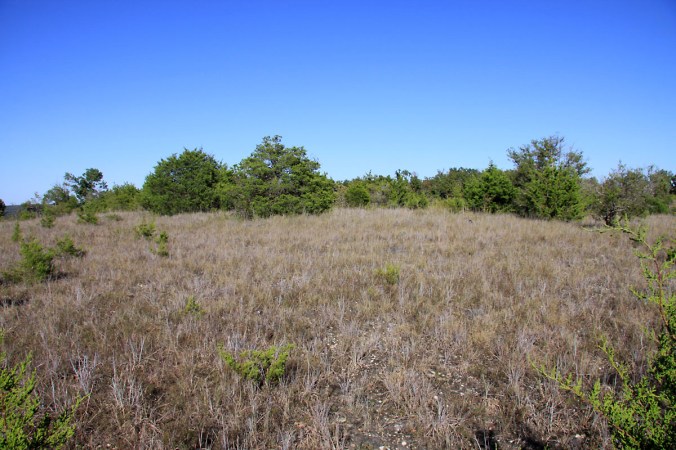
Blackjack Knob is part of an extensive xeric dolomite prairie complex (commonly referred to as cedar glades, though the term is not precisely accurate) in the White River Hills subsection of the Ozark Highlands, providing habitat for prairie tiger beetles and other typically southwestern plants and animals.

In fact, until a few weeks ago it had been several years since I had last seen this species in the field.  I did make an attempt to see it again last year but returned home from that early October trip unsuccessful, cold and wet.  Thus, when tiger beetle enthusiast Steve Spomer mentioned to me earlier this summer that he wanted to see our Missouri population, I jumped at the chance to coordinate our visits this fall and show him some of my favorite sites.  The Patron Saint of Cicindela was smiling down upon us that day, as perfect timing and sunny skies combined to bring adults out in an abundance that I’d not seen in any of my previous visits.  I would take advantage of this rare opportunity and spend the next day in the area as well, documenting a number of new localities along the northern and eastern edge of its known distribution, including a far eastern extension of its range to Caney Mountain Conservation Area in Ozark Co. where we had long suspected the beetle to occur but failed in all previous attempts to find it.

Steve Spomer and yours truly at Cane Creek Rd. site.

The prairie tiger beetle is the easternmost subspecies of the large grassland tiger beetle, which along with its other included subspecies covers a geographic range covering most of Texas, New Mexico, and eastern Arizona and extending up through western Oklahoma and Kansas into eastern Colorado.  Individuals of subspecies vulturina, occurring primarily in eastern/central Texas, are distinguished from the other subspecies (nominate in western Texas and eastern New Mexico north into Colorado, santaclarae in New Mexico and Arizona, and neojuvenilis in south Texas) by their generally black to olive-green coloration and reduced, narrow elytral markings, typically with an inverted “V” at mid-elytron.  The Missouri/Arkansas disjunct population is interesting from several standpoints:

  • Individuals mostly dark olive-green – no black individuals.
  • Elytral maculations more completely developed.
  • Adults active in late summer/early fall rather than summer.

These features, in particular coloration and maculation, have fueled speculation that this isolated population might be subspecifically distinct (Pearson et al. 2006).  A recent review of material from throughout its range found these color characters of limited use in unequivocally diagnosing individuals from the Missouri and Arkansas population as a separate subspecific taxon (Mawdsley 2009); however, a molecular systematics approach ultimately may be needed to resolve the status of this population.  Presumably, the Missouri/Arkansas disjunct population represents a hypsithermal relict, left behind when the return of cooler, moister conditions caused a retreat of the formerly more expansive grasslands to their current position.  If true, then the Missouri/Arkansas population has been isolated from the parent population for ~6,000 years.  I suspect that the late summer/early fall adult phenology is an adaptation to local precipitation patterns, relying on more predictable late summer rains to trigger adult emergence after the generally droughty months of July and August.  In this regard it differs fundamentally from the true “fall” species, which emerge briefly in the fall as sexually immature adults before overwintering and re-emerging in the spring for mating and oviposition.  These Missouri/Arkansas disjuncts do not re-emerge in spring, but instead mate and lay eggs in the fall before the onset of cold weather.  The eggs hatch as well (based on my growth chamber observations of this species), so winter also is passed as a larva – either as newly-hatched 1st instars, or as later instars that hatched during the previous year(s) – rather than as adults.

I have noted considerable variation in the coloration and maculations of individuals in this population.  The individual in the first photograph above is typical of the population – dark olive-green with thin but nearly complete maculations.  That individual comes from Blackjack Knob (Taney Co.), which is near the heart of the White River Hills region.  However, the degree to which the maculations are developed is variable, ranging from rather incomplete to even more fully developed due to the presence of a marginal connection.  Additionally, a few individuals can be found that show greater or lesser suffusion of brown on the head, pronotum, and elytra.  At another location in the county closer to the northern distributional limit (Hwy 160/Cane Creek Rd.), this brown suffusion is more common and variably expressed from minimal to nearly complete.  The photographs below show five individuals from this site expressing differing degrees of brown as well as the variable macular development seen throughout the population:
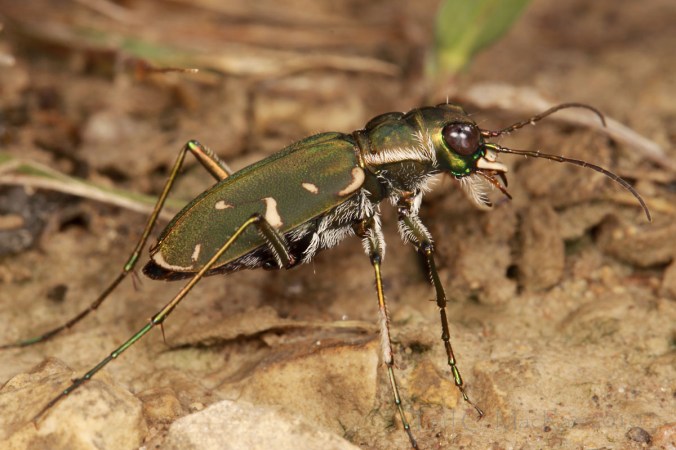
Male (Hwy 160/Cane Creek Rd.) - green w/ trace brown, marginal band incomplete, median band complete.


Female (Hwy 160/Cane Creek Rd.) - green w/ slight brown, marginal band complete, median band incomplete.


Male (Hwy 160/Cane Creek Rd.) - green w/ moderate brown, marginal band incomplete, median band incomplete.
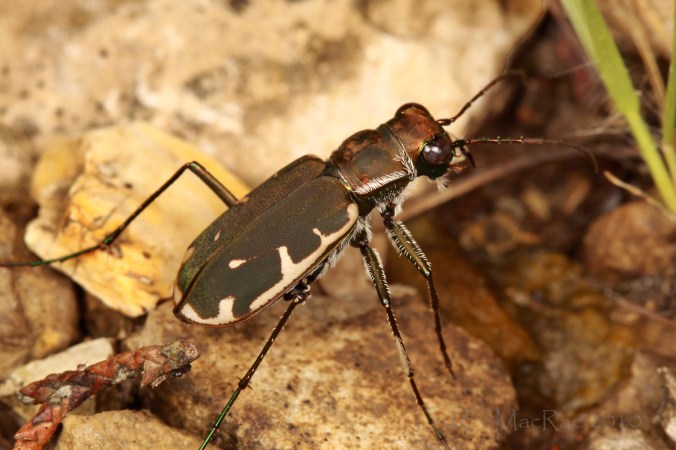

Male (Hwy 160/Cane Creek Rd.) - green w/ heavy brown, marginal band complete, median band complete.
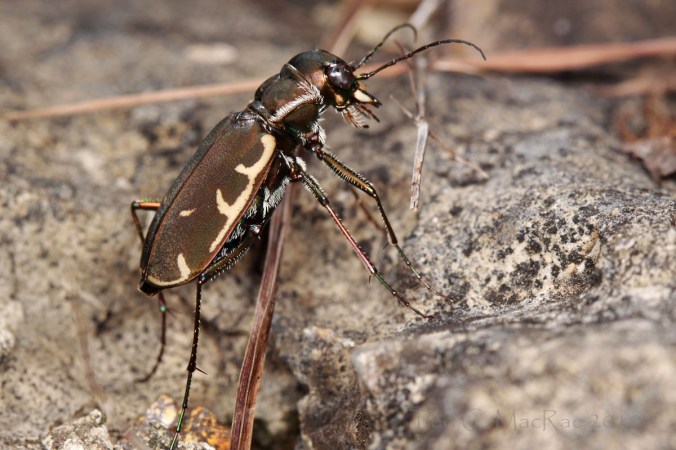

Female (Hwy 160/Cane Creek Rd.) - completely brown, marginal band complete, median band incomplete.

There is another site even further north in the county (Merriam Woods), which I found for the first time on this trip and, to my knowledge, represents the northernmost extent of the population in Missouri.  At this site, nearly all of the individuals show coppery-brown coloration with almost no hint of green.  These fully brown individuals seem to represent an appearance that is completely unlike that seen in any other part of the range of the species.  The individual in the photo below typifies the appearance of the beetles seen at this site:

Male (Merriam Woods) - brown, marginal band incomplete, median band complete.

I’m less familiar with coloration of the population further south in Arkansas, although in my limited collecting in that area I recall that most individuals I encountered exhibited the dark olive-green coloration typical of individuals at Blackjack Knob and other more southern sites in Missouri.  Thus, there seems to a clinal element to variability in coloration in the Missouri/Arkansas disjunct population.  I suspect that the unique coloration of the beetles in this population is related to the soils with which they are associated.  Light gray Jefferson City-Cotter dolomite bedrock forms the core of the White River Hills landscape and is exposed extensively in the glades that dominate its knobs and slopes.  These exposures are weather-stained black and overlain by thin, black soils that support dark, green-black lichens amongst the sparse vegetation, as seen in the following photographs taken at the newly identified northeasternmost site at Caney Mountain Conservation Area:

Thinly soiled dolomite exposures punctuate the glades in the White River Hills. Prairie tiger beetles are found in these exposures.
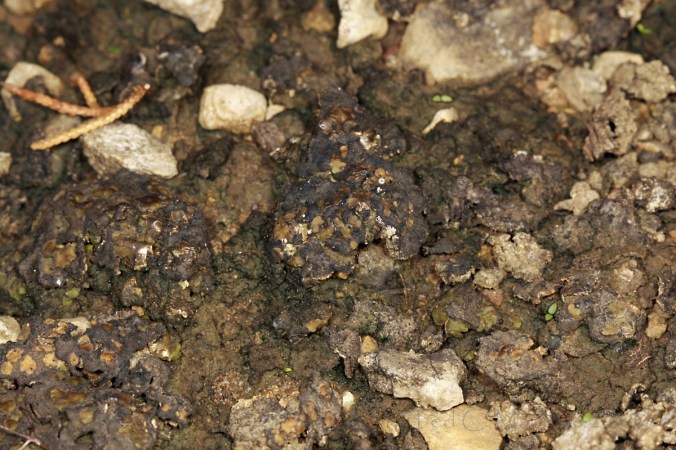

Dark green-black lichens encrust the thin black soils overlaying the dolomite exposures. Prairie tiger beetle adult coloration closely matches the coloration of the lichens and soil.

The glades and dolomite exposures where these beetles are found in the White River Hills and the dry oak woodlands that surround them have a characteristic look that is not seen once one leaves the area, and I have found many new sites for the beetle in the northern and eastern fringes of the region by stopping at locations where the roadside exposures had the right “look.”  The variation in maculation and coloration seen in this population may be an indication that the population is still adapting to local conditions since becoming isolated from main population.

Currently, I have 3rd-instar larvae that I collected from their burrows at Blackjack Knob (adults mostly green) and Merriam Woods (adults mostly brown) and hope the rear them to adulthood next year.  If I succeed in getting virgin adults from the two sites, I think it would be interesting to do some single-pair crossings and rear the progeny to see how coloration is expressed.  A long term project, for sure, as these beetles probably require at least two seasons to reach adulthood, but rearing them is fun!  A more difficult, yet far more interesting, project would be to secure virgin adults from the mostly black main population in Texas – or even the bright green, thickly-maculated santaclarae subspecies from Arizona – to see how interbreeding them with these Missouri disjuncts would affect coloration and maculation in their progeny – they could be some of the most unusual appearing large grassland tiger beetles ever seen (not to mention their tongue-twisting taxonomic moniker of Cicindela (Cicindelidia) obsoleta vulturina [Missouri disjunct] x obsoleta santaclarae!).  Timing would be a difficulty, since the Texas and Arizona populations exhibit a more normal summer adult phenology, but it would be worth a try if I could secure a source of larvae for rearing.  Anybody?

A male sports his impressive pair of choppers.

Photo Details (insects): Canon 50D w/ 100mm macro lens (ISO 100, 1/250 sec, f/13-22), Canon MT-24EX flash (1/4-1/2 ratio) w/ Sto-Fen + GFPuffer diffusers. Typical post-processing (levels, minor cropping, unsharp mask).

REFERENCES:

Mawdsley, J. R.  2009. Geographic variation in U. S. populations of the tiger beetle Cicindela obsoleta Say (Coleoptera: Cicindelidae).  Insecta Mundi 0094:1–10.

Pearson, D. L., C. B. Knisley and C. J. Kazilek. 2006. A Field Guide to the Tiger Beetles of the United States and Canada. Oxford University Press, New York, 227 pp.

Copyright © Ted C. MacRae 2010

Sweet Sixteen!

The 7th Annual Fall Tiger Beetle Trip™ is officially over – Chris and I rolled back into town a little after midnight last night. It was an amazing trip – perfect weather, unparalleled scenery, and a record-breaking 16 species of tiger beetles seen in 13 localities across four states. Not only does this beat my previous trip record of 13 species, but we did it with only five days in the field. At the time of my previous update, we had visited several locations in the South Dakota Badlands and Nebraska Pine Ridge and found ten different tiger beetle species, including Cicindela pulchra (beautiful tiger beetle) – our top priority for the trip – C. nebraskana (prairie long-lipped tiger beetle), and C. lengi (blowout tiger beetle). Our plan for the next day was to visit the Badlands of Wyoming to look for C. decemnotata (Badlands tiger beetle – appropriately) and the Yampa River Valley of northwestern Colorado to look for C. scutellaris yampae and C. formosa gibsoni, all three of which we managed to find (though with caveats – stay tuned). Our originally planned final field day was to take us back into Wyoming to look for C. longilabris (boreal long-lipped tiger beetle) in the mountains east of Laramie and the Nebraska Sand Hills to look for the delicate little C. limbata before heading back home. However, we were finally paid a visit by “the skunk” and did not see any of these species (although our sighting of C. limbata (common claybank tiger beetle) in Wyoming did officially break the old trip record). Not wanting to end the trip on a disappointing day, we delayed our departure for home yesterday and visited two more sites at the eastern edge of the Nebraska Sand Hills (sites M and N in the above map) – a clay bank site where we saw a robust population of C. denverensis (to augment the single individual we had seen earlier in the trip) and several C. splendida (splendid tiger beetle), and another sand dune/blowout system where we at last succeeded in finding C. limbata.

The day after the end of the Annual Fall Tiger Beetle Trip™ is usually a somewhat depressing day for me. Not only is the trip over, but likely so is the entire insect collecting season. I know I need the down time to process the specimens and knowledge acquired during the season, but the field work itself remains my favorite aspect of this pursuit. Nevertheless, the experiences from this trip will fuel my memories for years to come, and in the next weeks I’ll share some of the stories that unfolded. Until then, I leave you with this portrait of C. pulchra – looking rather annoyed with me for my persistent efforts to take his photograph.

Cicindela pulchra - the ''beautiful'' tiger beetle

Copyright © Ted C. MacRae 2010

2 days, 6 localities, 10 species…

Here’s an updated itinerary for the 7th Annual Fall Tiger Beetle Trip that fellow cicindelophile Chris Brown and I are in the midst of. We’ve spent the past two days visiting six localities in Nebraska and South Dakota. So far, we’ve found a total of 10 species – including every species we had hoped to see at this point in the trip. The list so far (in chronological order) is:

  • Cicindela (s. str.) tranquebarica kirbyi – ho hum, we’ll see this in several places.
  • Cicindela (s. str.) purpurea audubonii – über common Great Plains species, although the black form is always a treat to see.
  • Cicindela (s. str.) pulchra – YEAH! Seen in good numbers at one of the new South Dakota localities discovered in 2008 by Matt Brust (our personal chaperone for the day). Marvelous field photographs.
  • Cicindela (s. str.) fulgida – Only one seen, but Chris got a nice series of field photographs (I’ve seen good numbers of this species from my previous trips to this area in 2008 and in Oklahoma last year).
  • Cicindela (s. str.) nebraskana – Another “A list” species for the trip, but we’ve only seen one so far.
  • Cicindela (Cicindelidia) punctulata punctulata – also known as Cicindela ubiquita.
  • Cicindela (s. str.) scutellaris scutellaris – even though this is a common Great Plains species in any sandy area, I never tire of its dazzling red elytra and blue/green head and pronotum.
  • Cicindela (s. str.) lengi – The third species on our “A list” that we’ve seen, with some real nice field photographs from Monroe Canyon.
  • Cicindela (s. str.) formosa generosa – another common Great Plains species.
  • Cicindela (s. str.) denverensis – I didn’t expect to see this one on the trip (just a single individual at Monroe Canyon), but I’ll take it!

Tomorrow we’ll hit a Wyoming location where Cicindela (s. str.) decemnotata is known to hang out – a species I’ve not yet seen, either alive or preserved. Most sources regard this species as closely related to C. denverensis, but Matt thinks it is actually more closely related to C. fulgida due to similarity in form and shine but green instead of purple. Afterwards, in a major addition to our planned itinerary (hence the updated Google Map), we’ll go into northwestern Colorado to look for two very cool subspecies of the otherwise widespread species – C. formosa gibsoni and C. scutellaris yampae. If we’re lucky we’ll also see the delicate little sand lover, Cicindela (s. str.) limbata, but if we don’t see it there then we should see it the next day when we finish out the trip back in the Nebraska Sand Hills just east of Alliance. But before that, we’ll veer back up into Wyoming and look around in the high elevations east of Laramie in hopes of finding Cicindela (s. str.) longilabris laurentii. That one may be a stretch, but if we are successful then we have the potential to see a total of 15 species – that would be a trip high for me (literally and figuratively).

Copyright © Ted C. MacRae 2010

Reunion in the Badlands… and beyond

Two years ago I targeted Nebraska and South Dakota for that year’s Fall Tiger Beetle Trip. I had gotten my first experience with what Nebraska had to offer with a long weekend trip to the Nebraska Sand Hills during the previous fall, and with my appetite fully whetted as a result of that trip, I made a full-blown week-long trip through not only the Sand Hills, but further west to the Pine Ridge area in northwestern Nebraska and the Black Hills of South Dakota. It was a phenomenal trip that featured not only tiger beetles (13 species in all), but rare longhorned beetles, aggressive rattlesnakes, and a stunning array of autumn-flavored Great Plains landscapes.

Ted MacRae and Matt Brust stand in Cicindela nebraskana habitat (northwestern Nebraska).

Probably the species that I was happiest to encounter on that trip were Cicindela nebraskana (prairie long-lipped tiger beetle), C. lengi (blowout tiger beetle), and C. limbata (sandy tiger beetle).  I can’t claim sole credit for those finds, since I had made arrangements to meet Nebraska tiger beetle expert Matt Brust and have him show me some of his favorite sites. With Matt’s help, both in taking me to localities and directing me to others, I found nearly every species that I was hoping to see. Nearly, but not every species that is. The one species I really hoped to see but knew was a long shot was Cicindela decemnotata (Badlands tiger beetle). It’s right at the easternmost limit of its distribution in northwestern Nebraska, and only a handful of individuals have been seen in the state. Another species I did not see was Cicindela pulchra (beautiful tiger beetle). You’ve heard me talk about this species on several occasions, referring to my experience with it in south-central Kansas (written up in this little note) and my later obsession – so far unfulfilled – with finding it in nearby northwestern Oklahoma. I didn’t even try to look for this species… because nobody knew it was there! It was not until the following year that Matt found it in the Badlands of South Dakota, and since then he has located a number of populations in that area.

It is with C. decemnotata and C. pulchra in mind that I make return trip to the South Dakota Badlands for the Annual Fall Tiger Beetle Trip™. This time I am accompanied by fellow cicindelophile and field companion Chris Brown, and by the time you read this we will be on our way to meet up with Matt once again and focus our efforts on finding these two species. In this far northern area, it is already late in the season, so success is not assured. However, with Matt showing or directing us to some of the localities where he’s found these species, we’ve got the biggest bullets in our guns possible. Since I’ve already seen many of the other interesting tiger beetle species up that way (C. nebraskana, C. lengi, C. limbata, etc.) from the previous trip, we will be free to devote all of our attention to finding these two species – including driving even further west into the heart of Wyoming, where C. decemnotata occurs a little more reliably. If I come back from this trip with nothing more than some great photos of one of these species, the trip will have been a success. If I come back with photos of both of them, the trip will have been a huge success. Along the way, I’ll still keep an eye out for other tiger beetles – especially C. nebraskana, C. lengi, and C. limbata, because about the only thing I would wish for on top of success as photographing C. decemnotata and C. pulchra is nicer photographs of these other species as well to replace the dreadful point-and-shoot versions that I have from my 2008 trip.

Copyright © Ted C. MacRae 2010